

Scaling SaaS payment operations comes down to twelve factors: billing model flexibility, API-first architecture, payment method coverage, pricing transparency, payout mechanics, security and compliance (PCI DSS Level 1, SOC 2), fraud controls, operational observability, onboarding speed, reporting depth, vendor evaluation rigor, and staffing structure. Get all twelve right and payments become a growth engine. Miss even two or three and you face revenue leakage, failed authorizations, and reconciliation debt that compounds as volume grows.
Quick-reference checklist — what to evaluate before you scale:
- Billing models: Does the platform support fixed, usage-based, and hybrid billing with accurate proration and dunning?
- Architecture: Is the integration API-first and modular, with idempotency keys, webhook reliability, and swappable PSPs?
- Payment methods: Can you add local rails (UPI, PIX, iDEAL) and multi-currency without a full re-integration?
- Pricing: Is the fee model interchange-plus or network-offset with no hidden minimums or long-term contracts?
- Payouts: What are settlement cadence options (T+1, T+2, daily) and reserve policies?
- Compliance: Does the vendor hold PCI DSS Level 1 certification and SOC 2 attestation with third-party audit reports?
- Fraud controls: Are ML-based scoring, programmatic rule sets, and chargeback tooling included?
- Observability: Are authorization rate, dunning success rate, and MTTD/MTTR tracked in real time?
- Onboarding: What are KYC/underwriting timelines and support SLAs (target: 99.99% uptime)?
- Reporting: Does the platform export normalized settlement files and connect to ERP/GL systems?
- Vendor criteria: Can the vendor demonstrate idempotency semantics, failover architecture, and a clean audit trail?
- Staffing: Is there a defined payments ownership model with clear escalation paths?
Paysec covers all twelve of these dimensions for SaaS platforms, with network-offset pricing that has delivered a 42% reduction in processing costs for clients and transparent, contract-free terms.
Table of Contents
- What billing models and subscription mechanics should you evaluate?
- Does your payment architecture support modular, API-first scaling?
- Which payment methods and currencies should you plan for?
- How do pricing models and commercial terms affect your total cost?
- What payout mechanics and settlement timing should you require?
- How do security, compliance, and fraud controls scale with volume?
- What operational metrics and SLAs should you monitor?
- What should you expect from onboarding, underwriting, and support?
- What reporting and finance operations capabilities should you require?
- How do you build a vendor evaluation scorecard for payment scalability?
- What does "good" look like? Benchmarks and measurable outcomes
- Key Takeaways
- Payments are a living layer, not a set-and-forget system
- Paysec helps SaaS platforms scale payments without the cost overhead
- Useful sources and further reading
- FAQ
What billing models and subscription mechanics should you evaluate?
Payment friction causes a notable portion of SaaS churn, and most of that friction originates in billing infrastructure, not the product itself. The billing layer is where revenue either compounds or leaks, so evaluating it carefully is the first real test of a payment platform's scalability.

Fixed, usage-based, and hybrid models
Fixed recurring billing (seat-based or flat subscription) is the simplest to operate but the hardest to grow with as pricing strategies evolve. Usage-based billing meters consumption in real time and requires a rating engine that can handle high-frequency events without lag. Hybrid models, which combine a base subscription with usage overages, are increasingly common in SaaS and demand both capabilities simultaneously.
When evaluating platforms, confirm support for:
- Flexible plan modeling: seat-based, tier-based, metered, and hybrid configurations in one system
- Proration accuracy: correct billing when customers upgrade or downgrade mid-cycle
- Trial and freemium handling: grace periods, conversion logic, and automatic plan transitions
- Upgrade/downgrade workflows: immediate, end-of-period, and prorated options
Dunning and failed payment recovery
Smart retry logic and machine-learning-powered dunning sequences materially outperform simple retry schedules. A platform that retries at fixed intervals will recover far less revenue than one that analyzes historical card behavior and times retries for peak authorization probability.
Pro Tip: Set up customizable dunning campaigns with multiple retry attempts spread over a couple of weeks, and pair each retry with a customer-facing email sequence. Platforms that let you configure retry timing per card type and failure reason recover significantly more revenue than those with a single fixed schedule.
The dunning stack you need:
- Automated retry logic with configurable timing per decline reason
- Card updater services that refresh expired or replaced card numbers automatically
- Pre-dunning outreach before payment methods expire
- Grace periods that maintain service access while resolution is in progress
- Escalation to manual outreach for high-value accounts
Tokenization and billing performance
Network tokens (issued by card networks directly) consistently outperform vault tokens on authorization rates because they stay current when cards are reissued. For recurring billing at scale, network tokenization is the right default. Also confirm the platform handles idempotent invoice generation: at end-of-cycle mass billing events, duplicate invoice creation is a real risk without proper idempotency controls.
Does your payment architecture support modular, API-first scaling?
Modular, API-first payment architecture lets platforms swap providers and add local methods without major engineering effort. That single design choice separates teams that can respond to a PSP outage in hours from those that face weeks of emergency re-integration.

Why decoupling payment logic matters
When payment logic is embedded directly in the core application, every change, whether adding a new payment method, switching acquirers, or adjusting routing rules, requires engineering involvement and a deployment cycle. Decoupling payment workflows into a dedicated layer lets product and finance teams configure payment behavior safely, without touching core application code.
A payment orchestration layer adds a neutral routing and management plane above individual PSPs. The benefits compound quickly:
- Single integration point that routes to multiple processors
- Intelligent routing based on authorization rates, cost, and geography
- Unified reporting across all payment rails
- Faster addition of new methods and acquirers
Pro Tip: Before committing to any payment platform, test the sandbox environment against real decline scenarios, including soft declines, hard declines, and network timeouts. A sandbox that only simulates successful payments will leave your engineering team unprepared for production edge cases.
Integration primitives to demand from vendors
| Primitive | Why It Matters | What to Ask |
|---|---|---|
| Idempotency keys | Prevents duplicate charges on retries | "How are idempotency keys scoped and stored?" |
| Webhook signatures | Verifies event authenticity | "Do you support HMAC signature verification?" |
| Transactional outbox | Guarantees event delivery | "How do you handle webhook delivery failures?" |
| Sandbox fidelity | Enables realistic testing | "Can your sandbox simulate all decline codes?" |
| SDK maintenance cadence | Reduces integration debt | "How often are client libraries updated?" |
Idempotency at scale requires producer-side keys, consumer-side deduplication, transactionally-linked idempotency stores, and an effectively-once processing strategy. Platforms that treat this as optional will create reconciliation problems that grow proportionally with transaction volume.
Failover and routing architecture
Multi-acquirer routing with automatic failover is table-stakes for any SaaS platform processing significant annual recurring revenue. Geographic routing, which directs transactions to local acquirers in the customer's region, typically lifts authorization rates noticeably versus cross-border acquiring. Circuit-breaker patterns that detect PSP degradation and reroute traffic before failures cascade are equally important.
Which payment methods and currencies should you plan for?
Payment method coverage directly affects authorization rates and customer conversion in every market you enter. The right coverage depends on where your customers are, not where your company is headquartered.
High-impact local methods by region
Adding local payment methods is not a feature request; it is a revenue decision. In markets where local rails dominate, offering only card payments means losing customers at checkout.
- India: UPI handles the majority of digital transactions; card-only checkout will underperform significantly
- Brazil: PIX is the dominant real-time payment rail and customer expectation
- Netherlands: iDEAL is the standard bank-transfer method for online purchases
- Europe broadly: SEPA Direct Debit for subscription billing reduces card dependency
- US: ACH bank transfers for B2B SaaS reduce interchange costs on large invoices
Multi-currency considerations
Presenting prices in local currency and settling in a different currency are two separate capabilities. Confirm both. FX markups on settlement can add meaningful cost at scale, and some processors apply markups that are not visible in the headline rate. Ask vendors to show you the full FX cost on a sample transaction, including spread and conversion timing.
- Map your top 10 revenue countries and confirm local currency presentation for each
- Identify which currencies you need to settle in versus convert
- Ask vendors for their FX markup rate and conversion timing policy
- Evaluate whether local acquiring is available in your top three markets
Local acquiring typically lifts authorization rates noticeably in the acquiring country. For a SaaS platform with significant international revenue, that lift translates directly to lower involuntary churn.
Wallets and alternative rails
Digital wallets (Apple Pay, Google Pay) reduce checkout friction on mobile and improve conversion for self-serve SaaS. Bank-to-bank rails reduce interchange costs for high-value B2B transactions. Add wallets when mobile checkout is a significant acquisition channel; add bank rails when average transaction values make interchange costs material.
The operational cost of adding methods includes integration time, settlement reconciliation for each new rail, and dispute handling procedures that differ by method. Factor all three into the timeline when planning international expansion.
How do pricing models and commercial terms affect your total cost?
Pricing transparency is one of the clearest signals of a payment vendor's long-term reliability. Opaque fee structures that look competitive at low volume often become expensive at scale, and contract terms that seem standard can create significant working capital drag.
Interchange-plus vs. flat-rate pricing
Interchange-plus pricing passes the actual interchange cost through to the merchant and adds a fixed markup. Flat-rate pricing bundles everything into a single percentage, which is simple but almost always more expensive for higher-volume merchants. At $1M ARR, the difference between the two models is often negligible. At $10M ARR and above, interchange-plus consistently produces lower total cost of acceptance (TCA).
TCA calculation must include:
- Interchange fees (vary by card type, transaction type, and network)
- Gateway fees (per-transaction and monthly)
- Monthly platform or account fees
- FX conversion costs on international transactions
- Chargeback and dispute fees
- PCI compliance fees (if charged separately)
Pro Tip: Ask every vendor for a sample fee statement on a $100,000 transaction batch that mirrors your actual card mix (consumer debit, consumer credit, corporate card, international card). The difference between headline rate and actual TCA on a realistic batch is often 20–40 basis points, which compounds significantly at scale.
Network-offset pricing
Network-offset pricing is a transparent alternative to both flat-rate and standard interchange-plus models. It offsets processing costs by passing a portion of the savings from network incentives back to the merchant. Paysec's network-offset model eliminates hidden fees, charges no monthly minimums, and requires no long-term contracts, making it particularly well-suited for growth-stage SaaS platforms that need cost predictability without volume commitments.
Paysec clients have achieved 30–60% savings on processing costs through network-offset pricing. The 42% processing-cost reduction documented in Paysec's SaaS marketplace case study reflects what transparent, volume-optimized pricing looks like in practice.
Commercial terms that matter at scale
- Settlement timing: T+1 vs. T+2 vs. weekly affects cash flow planning directly
- Reserve policy: rolling reserves or upfront reserves tie up working capital; negotiate the percentage and release schedule
- Chargeback economics: per-dispute fees, threshold penalties, and representment support costs
- Early termination clauses: long-term contracts with termination fees reduce your ability to switch vendors as requirements evolve
- SLA credits: confirm that uptime SLA breaches trigger contractual credits, not just apologies
What payout mechanics and settlement timing should you require?
Settlement timing and payout structure affect cash flow in ways that are easy to underestimate during vendor evaluation and very difficult to fix after go-live.
Payout cadence options and cash-flow impact
| Settlement Cadence | Typical Delay | Reconciliation Artifact | Best For |
|---|---|---|---|
| Daily (T+1) | 1 business day | Daily settlement file per currency | High-volume platforms needing fast liquidity |
| Standard (T+2) | 2 business days | Daily settlement file | Most growth-stage SaaS |
| Weekly | 5–7 business days | Weekly consolidated file | Lower-volume or early-stage platforms |
| Custom/Enterprise | Negotiated | Custom format available | Multi-entity or marketplace platforms |
Reserve models and working capital
Reserves exist to protect the processor against chargeback liability. Rolling reserves (typically 5–10% of volume held for 90–180 days) are the most common model. Upfront reserves require a lump sum at onboarding. For SaaS platforms with low chargeback rates and predictable revenue, negotiate rolling reserves down or request a reserve release schedule tied to processing history.
- Ask for the reserve percentage and holding period in writing before signing
- Request a reserve release schedule based on 90-day processing history milestones
- Confirm whether reserves earn interest or sit idle
- For marketplace or multi-entity platforms, clarify whether reserves apply per sub-merchant or at the platform level
Reconciliation expectations
Automated reconciliation requires normalized settlement files with consistent transaction IDs that map across authorization, capture, and settlement events. Manual reconciliation at scale is a finance team bottleneck. Confirm the vendor provides:
- Normalized settlement files in CSV or API format
- Consistent transaction reference IDs across all events
- Fee breakdowns itemized by category (interchange, gateway, FX, dispute)
- Exception reports for unmatched or failed settlements
Issuing isolated payment instruments per use case, such as virtual cards per vendor or campaign, reduces reconciliation complexity by embedding context directly into each transaction record.
How do security, compliance, and fraud controls scale with volume?
Security and compliance requirements do not stay constant as volume grows. PCI DSS scope, fraud exposure, and chargeback rates all increase with transaction volume, and the controls that were adequate at $1M ARR are often insufficient at $10M ARR.
PCI DSS scope reduction
The fastest way to reduce PCI DSS engineering burden is to minimize the scope of cardholder data that touches your systems. Hosted fields (where the payment form is served by the processor's domain) and tokenization both achieve this. Hosted fields qualify for SAQ A, the lowest-scope self-assessment questionnaire. Storing raw card numbers in your own systems requires SAQ D compliance, which is significantly more complex and expensive to maintain.
Ask vendors for their scope reduction documentation and confirm that their hosted fields implementation does not require your servers to handle raw card data at any point in the transaction flow.
Pro Tip: Request the vendor's most recent PCI DSS Level 1 Report on Compliance (RoC) and SOC 2 Type II report. A vendor that cannot produce both on request is a compliance risk at enterprise scale.
SOC 2 and audit-readiness signals
SOC 2 Type II attestation covers security, availability, processing integrity, confidentiality, and privacy controls over a minimum 6-month audit period. Type II is meaningfully stronger than Type I (which only covers a point-in-time assessment). For enterprise SaaS, SOC 2 Type II from the payment vendor is often a procurement requirement.
Fraud controls and chargeback management
A layered fraud approach combines ML-based transaction scoring, programmatic rule sets (velocity limits, BIN-country mismatch rules, device fingerprinting), and manual review workflows for high-risk transactions. Four scaling concerns consistently dominate SaaS payment operations: webhook reliability, failed payment recovery, multi-currency handling, and fraud prevention. Fraud controls that work at $1M ARR often need reconfiguration at $10M ARR as attack patterns evolve.
Chargeback management at scale requires:
- Automated evidence collection and submission within dispute windows
- Vendor-provided dispute tooling that reduces manual labor per case
- Threshold monitoring to stay below network chargeback ratios (Visa and Mastercard both apply penalties above 1%)
- Root-cause analysis to identify and fix the transaction patterns generating disputes
What operational metrics and SLAs should you monitor?
Operational observability is what separates payment teams that catch problems before they affect revenue from those that discover issues in the monthly reconciliation.
Core metrics to track
- Authorization rate: percentage of attempted transactions that result in a successful authorization; target above 95% for domestic card transactions
- Failed payment recovery rate: percentage of initially failed payments recovered through retry and dunning
- Dunning success rate (DSR): percentage of failed subscription payments recovered within the dunning window
- Mean time to detect (MTTD): how quickly the team identifies a payment processing anomaly
- Mean time to resolve (MTTR): time from detection to resolution of a payment incident
- Reconciliation drift: unmatched transactions between authorization records and settlement files
- Dispute rate: chargebacks as a percentage of transaction volume
Webhook reliability and failed payment recovery are two of the four dominant scaling concerns for SaaS payment operations. Both require active monitoring, not just reactive investigation.
SLA expectations and contractual commitments
Target high uptime (99.99%) for any payment platform processing significant annual recurring revenue. That level of uptime translates to minimal downtime per year. Confirm that the SLA covers the full payment flow, including authorization, capture, and webhook delivery, not just API availability. Ask specifically what remediation the vendor commits to when SLA thresholds are breached, and whether those commitments are contractual or best-effort.
Pro Tip: Instrument idempotency and webhook deduplication from the first day of integration. Teams that add these controls retroactively after volume grows face weeks of reconciliation cleanup. Build the deduplication logic into your event consumer before you process your first live transaction.
Alerting and incident playbooks
- Routing failure: alert when authorization rate drops more than 3 percentage points below 7-day baseline; triage by PSP, card type, and geography
- Webhook flood: alert when webhook delivery queue depth exceeds normal baseline; check for duplicate event generation at the source
- Reconciliation gap: alert when unmatched transactions exceed 0.1% of daily volume; investigate settlement file mapping first
- Settlement anomaly: alert when settlement amount deviates more than 2% from expected based on captured transactions
What should you expect from onboarding, underwriting, and support?
Onboarding speed directly affects time-to-first-transaction, and support quality determines how quickly issues get resolved once you are live. Both deserve structured evaluation before you sign a contract.
Onboarding steps and KYC timelines
Ask every vendor to walk you through their onboarding process step by step. Key questions:
- What documents are required for KYC and underwriting?
- What is the typical approval timeline for a SaaS business at your ARR level?
- Is underwriting automated, manual, or hybrid?
- How are exceptions handled (e.g., high-risk verticals, international entities)?
Paysec's onboarding process is designed for speed and clarity, with no long-term contracts and no monthly minimums, so SaaS platforms can get to first transaction without unnecessary friction.
Support model and SLA tiers
- SMB support: ticket-based with defined response SLAs (target: under 4 hours for P1 issues)
- Enterprise support: dedicated account management, named technical contacts, and escalation paths with contractual response commitments
- Self-service resources: documentation quality, sandbox access, and developer portal completeness
Enterprise customers often require the ability to bring their own PSP or negotiated acquirers. Platforms that do not support BYOPSP mandates may face challenges meeting enterprise-tier requirements. Confirm this capability early in vendor evaluation.
Pro Tip: During vendor evaluation, submit a test support ticket and measure the actual response time. Vendor-stated SLAs and real-world response times sometimes differ. A 30-minute test tells you more than a contract clause.
Implementation milestones: 30/90/180 days
- Day 30: KYC approved, sandbox integration complete, first test transaction processed
- Day 90: Production go-live, core billing flows operational, reporting connected to finance systems
- Day 180: Advanced features live (dunning campaigns, local payment methods, multi-currency), reconciliation automated
What reporting and finance operations capabilities should you require?
Finance teams need payment data that closes books faster, not data that creates more manual work. The reporting layer is where payment infrastructure either integrates cleanly with finance operations or creates a permanent reconciliation burden.
Reporting primitives to require
- Normalized transaction model with consistent IDs across authorization, capture, refund, and chargeback events
- Settlement files in structured formats (CSV, JSON) with itemized fee breakdowns
- Chargeback and dispute reports with timeline data and evidence submission status
- Export-ready ledgers compatible with standard accounting platforms
- Role-based access controls so finance teams can pull reports without engineering involvement
Integration needs and reconciliation automation
| Integration Type | Use Case | Trade-off |
|---|---|---|
| ERP/GL connector | Automated journal entry creation | Requires mapping configuration upfront |
| Accounting platform API | Direct sync to QuickBooks, NetSuite, Xero | Dependent on connector maintenance |
| Webhook-driven events | Real-time transaction posting | Requires consumer-side deduplication |
| Scheduled file pulls | Batch reconciliation | Simpler but introduces lag |
| BI tool export | Analytics and dashboards | Best for trend analysis, not close |
Reconciliation automation requires matching rules that normalize transaction IDs across rails, map multi-currency settlements to functional currency, and flag exceptions for manual review. Detailed transaction reporting is a core requirement for finance teams at any ARR level above $1M.
Finance integration checklist
- Confirm normalized settlement file format and delivery schedule
- Verify fee breakdown granularity (interchange, gateway, FX, dispute itemized separately)
- Test ERP/GL connector or confirm API availability for custom integration
- Confirm immutable transaction history and audit trail for compliance
- Validate role-based access controls before granting finance team access
How do you build a vendor evaluation scorecard for payment scalability?
A structured vendor scorecard prevents evaluation bias and ensures every shortlisted platform is assessed on the same criteria. The categories below reflect the engineering buying framework that experienced payment teams use when scoring processors for long-term maintainability.
Vendor scorecard categories
- Reliability and failover (20%): uptime history, multi-acquirer routing, circuit-breaker patterns, incident disclosure
- Idempotency and ledger correctness (20%): idempotency key semantics, deduplication guarantees, ledger audit trail
- Reconciliation (15%): settlement file format, normalized IDs, exception handling, automated matching
- Developer experience (15%): sandbox fidelity, SDK quality, documentation completeness, decline simulation
- Fees and commercial terms (15%): TCA transparency, no hidden minimums, contract flexibility
- Rails and geography (10%): local acquiring footprint, supported payment methods, multi-currency
- Compliance fit (5%): PCI DSS Level 1, SOC 2 Type II, audit report availability
- Operational support (5%): SLA tiers, dedicated contacts, escalation paths
Sample RFP questions by stakeholder
Technical:
- How do you implement idempotency keys, and what happens on a duplicate request?
- Can your sandbox simulate soft declines, hard declines, and network timeouts?
- What is your webhook delivery guarantee and retry policy?
- How do you handle PSP failover during a partial outage?
Finance:
- What does a sample settlement file look like for a multi-currency transaction batch?
- How are interchange fees itemized in your reporting?
- What is your dispute fee structure and representment support model?
Legal:
- What are your SLA credits for uptime breaches?
- What are the early termination terms?
- Can you provide your most recent SOC 2 Type II report and PCI DSS RoC?
Red flags that should trigger deeper diligence
- Opaque fee schedules that require a sales call to get a full rate card
- Sandbox environments that cannot simulate decline scenarios
- No BYOPSP support for enterprise clients
- SLA commitments that are best-effort rather than contractual
- Inability to produce SOC 2 Type II or PCI DSS Level 1 documentation on request
Pro Tip: Run a 4–8 week proof-of-concept with real transaction volume before committing to a full migration. Measure authorization rate, webhook delivery reliability, and reconciliation accuracy during the pilot. Success criteria should be defined in writing before the pilot starts.
A payment orchestration platform provides single integration, intelligent routing, unified reporting, and faster addition of new rails, which makes it a strong default architecture choice for growth-stage SaaS companies evaluating vendors.
What does "good" look like? Benchmarks and measurable outcomes
Benchmarks give you a reference point for evaluating vendor claims and measuring your own payment operations against industry standards.
Target metrics by growth stage
| Metric | Growth Stage ($1M–$10M ARR) | Scale Stage ($10M+ ARR) |
|---|---|---|
| Authorization rate (domestic) | 92% | 95% |
| Failed payment recovery rate | 20% | — |
| Dunning success rate | 25% | 40–60% |
| Uptime SLA target | 99.99% | 99.99% |
| Reconciliation SLA | Same-day | Real-time or same-day |
| Onboarding time (SMB) | Under 5 business days | Under 3 business days |
| P1 support response | Under 4 hours | Under 1 hour |
Concrete savings evidence
Paysec's network-offset pricing model has produced documented savings of 30–60% on processing costs for clients across SaaS, eCommerce, and healthcare verticals. The 42% processing-cost reduction achieved by a SaaS marketplace client reflects what transparent, volume-optimized pricing delivers in practice. That outcome is not an outlier; it reflects the structural advantage of eliminating hidden fees and aligning processor incentives with merchant outcomes.
Operational staffing targets
- $1M–$5M ARR: one payments-focused engineer plus finance ownership of reconciliation
- $5M–$20M ARR: dedicated payments engineer, finance analyst with payment data access, and a defined escalation path to a payment operations lead
- $20M+ ARR: payments operations team (2–4 people), dedicated vendor relationship management, and a monthly payment health review cadence
Pro Tip: Assign a named payments owner before you hit $5M ARR. Teams that treat payments as shared infrastructure with no clear owner consistently discover reconciliation gaps and fee leakage months after they started.
Key Takeaways
Scaling SaaS payment operations requires evaluating twelve interconnected factors, from billing model flexibility and API-first architecture to pricing transparency and operational observability, with PCI DSS Level 1 and SOC 2 compliance as non-negotiable baseline requirements.
| Point | Details |
|---|---|
| Billing model flexibility | Confirm support for fixed, usage-based, and hybrid billing with accurate proration and ML-powered dunning. |
| Architecture and idempotency | Require API-first design, idempotency keys, webhook signature verification, and multi-acquirer failover from day one. |
| Pricing transparency | Evaluate total cost of acceptance including interchange, FX, and dispute fees; network-offset pricing can deliver documented reductions of 30–60% (including a 42% reduction for a SaaS marketplace client). |
| Compliance baseline | PCI DSS Level 1 and SOC 2 Type II attestation are minimum requirements; request audit reports, not just certifications. |
| Paysec for SaaS scaling | Paysec's network-offset pricing, real-time reporting, and contract-free terms have delivered documented savings across SaaS platforms, including a 42% reduction for a marketplace client. |
30/90/180-day action plan
30 days — discovery and baseline:
- Audit your current authorization rate, dunning recovery rate, and total cost of acceptance
- Map your top 10 revenue countries and identify gaps in local payment method coverage
- Pull a sample settlement file and test whether it reconciles cleanly against your authorization records
90 days — pilot and validate:
- Run a 4–8 week proof-of-concept with a shortlisted vendor using real transaction volume
- Measure authorization rate, webhook reliability, and reconciliation accuracy against defined success criteria
- Confirm PCI DSS Level 1 and SOC 2 Type II documentation from the vendor
180 days — scale and optimize:
- Complete migration to the new platform with dunning campaigns, local payment methods, and multi-currency live
- Connect settlement data to ERP/GL for automated reconciliation
- Establish a monthly payment health review covering authorization rate, dispute rate, and reconciliation drift
Immediate checks to run on your current stack:
- Is your dunning sequence using ML-powered retry timing or a fixed schedule?
- Are you paying hidden fees (PCI fees, batch fees, monthly minimums) that do not appear in your headline rate?
- Does your settlement file include itemized fee breakdowns, or does it show only net settlement amounts?
Payments are a living layer, not a set-and-forget system
The most common mistake SaaS leaders make with payments is treating the initial vendor selection as a permanent decision. Payment infrastructure requires continuous optimization: authorization rates drift as card networks update routing rules, fraud patterns evolve, and new payment methods become customer expectations in markets you enter.
The right operating model assigns a named payments owner, runs monthly health checks on core metrics (authorization rate, dunning success rate, dispute rate, reconciliation drift), and reviews vendor performance against SLA commitments quarterly. Modularity is the strategic hedge that makes this sustainable. A modular, API-first stack lets teams add local methods, swap PSPs, and update routing without system-wide rework. That capability is worth more than any single feature a vendor offers today, because it preserves your ability to respond to what the market requires tomorrow.
Set a review cadence. Build a payments ownership model. Treat the monthly health check as a revenue meeting, not an IT task. The SaaS companies that grow fastest are the ones that recognize payment optimization as a continuous competitive advantage, not a one-time infrastructure project.
Paysec helps SaaS platforms scale payments without the cost overhead
SaaS platforms that have worked through this checklist consistently find the same gap: their current processor charges more than the headline rate suggests, and the contract terms make switching harder than it should be. Paysec is built to close that gap directly.
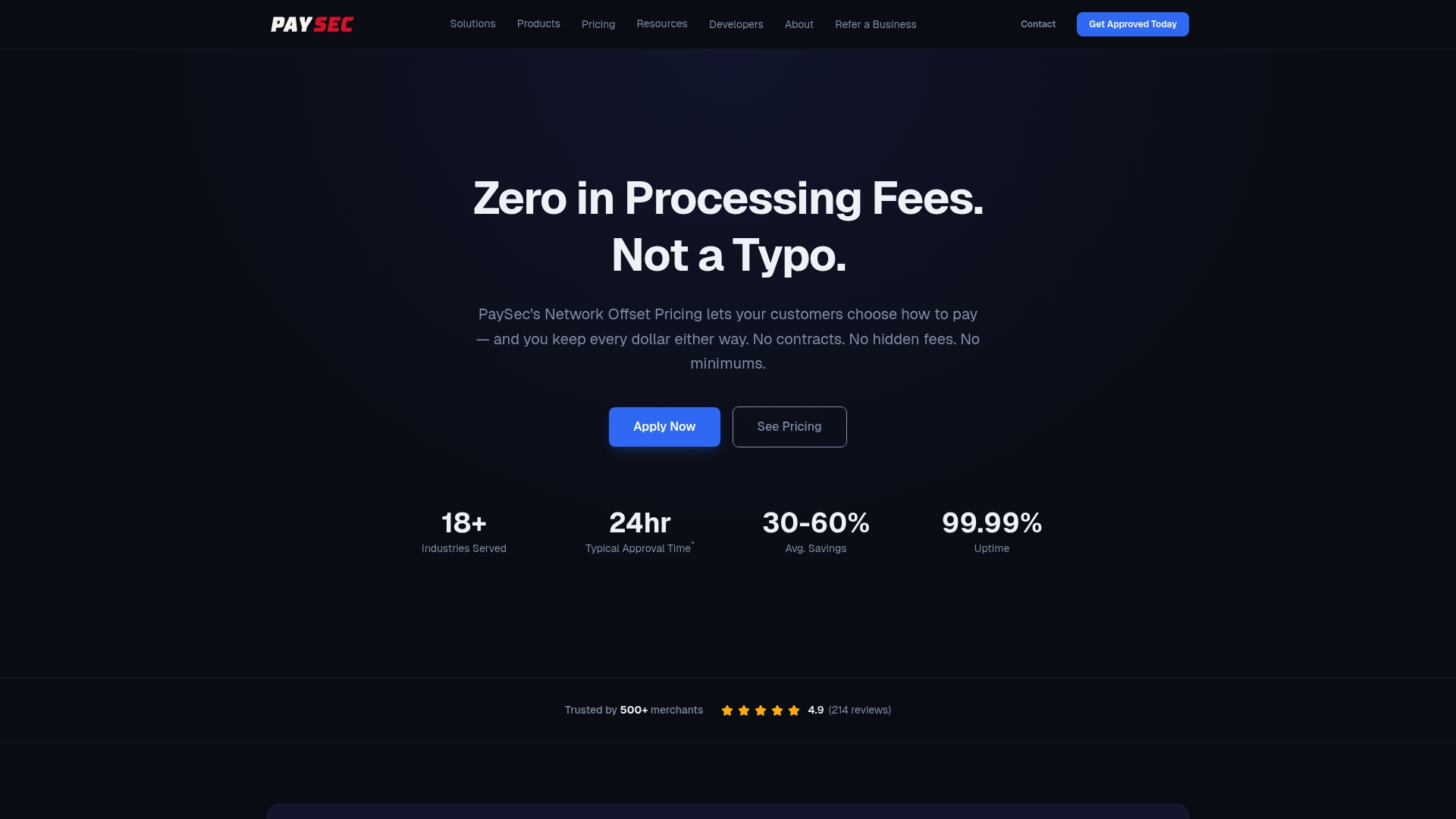
Paysec's network-offset pricing eliminates hidden fees, charges no monthly minimums, and requires no long-term contracts, so your cost structure stays transparent as volume grows. PCI DSS Level 1 certification and SOC 2 compliance are built in, not add-ons. Real-time reporting connects directly to finance workflows, and the platform supports multi-rail orchestration for SaaS platforms that need local payment methods, multi-currency settlement, and enterprise-grade failover. Documented client outcomes include reductions in processing costs ranging from 30% up to 42% after switching to Paysec's network-offset model.
See exactly how network-offset pricing works for your transaction volume at Paysec's pricing page, or explore the full network-offset pricing solution to get a cost comparison against your current processor.
Useful sources and further reading
The resources below support deeper research on the technical, commercial, and operational dimensions covered in this article.
Paysec resources:
- SaaS payment processing overview — Paysec's capabilities for SaaS platforms, including billing, reporting, and compliance
- 42% processing-cost reduction case study — documented outcome from a SaaS marketplace client
- How to reduce SaaS payment processing costs — practical cost-reduction strategies for SaaS platforms
- SaaS payment reporting best practices — finance team guide to reconciliation and GL integration
- Payment scalability on platforms: 2026 guide — platform operator guidance on scaling milestones
- Why SaaS platforms pay excess processing fees — analysis of common fee leaks and architectural causes
External technical and commercial resources: 7. Engineering buying framework for payment processors — Formance's scorecard covering idempotency, ledger correctness, and reconciliation 8. Scalable infrastructure: why payments can't be an afterthought — Gr4vy's case for modular, API-first payment architecture 9. Payment platform evaluation checklist for platform operators — Shuttle's guide covering BYOPSP, multi-acquirer routing, and enterprise requirements 10. Multi-cloud billing visibility — EverythingCloud analysis on billing complexity and cost governance relevant to multi-vendor payment infrastructure
Pro Tip: Download Paysec's RFP template and cost-comparison worksheet from the SaaS payment processing page before your next vendor evaluation. Having a pre-built scorecard cuts evaluation time significantly and keeps stakeholder discussions focused on the criteria that matter.
FAQ
What is scalability in SaaS payments?
Scalability in SaaS payments means the ability to handle growing transaction volume, new billing models, additional payment methods, and new markets without re-architecting the core payment stack. A modular, API-first architecture is the standard approach.
What are the biggest challenges in scaling SaaS billing systems?
The four most common challenges are webhook reliability, failed payment recovery, multi-currency handling, and fraud prevention. Billing complexity also increases significantly when platforms add usage-based or hybrid pricing models alongside fixed subscriptions.
What is the Rule of 40 for SaaS?
The Rule of 40 states that a healthy SaaS company's revenue growth rate plus profit margin should equal or exceed a significant benchmark. Payment cost optimization directly improves the margin component; a substantial reduction in processing costs, as documented in Paysec's SaaS marketplace case study, contributes measurably to that calculation.
How does a SaaS platform cope with payment scalability at enterprise scale?
Enterprise-scale SaaS platforms use payment orchestration layers with multi-acquirer routing, local acquiring in key markets, ML-powered dunning, and automated reconciliation. Supporting BYOPSP mandates and maintaining PCI DSS Level 1 and SOC 2 Type II compliance are also required for enterprise procurement approval.
How do you measure payment scalability in a SaaS platform?
Track authorization rate (target: 95%+ for domestic transactions), failed payment recovery rate, dunning success rate, reconciliation drift, and uptime against a 99.99% SLA target. These metrics together give a complete picture of payment health at any ARR level.