

TL;DR:
- Effective SaaS payment processing involves subscription lifecycle management, automated tax compliance, PCI scope minimization, and account updater services. These features protect revenue, reduce operational costs, and support flexible pricing across global markets. Selecting a scalable platform that prioritizes billing logic over simple gateways is essential for long-term growth.
Payment processing for SaaS businesses is defined as the full stack of billing logic, subscription management, tax automation, and security tools that govern how recurring revenue is collected and retained. A payment gateway alone does not constitute a complete SaaS payment solution. The payment processing features SaaS businesses need go far beyond card transactions: they include subscription lifecycle management, automated tax compliance, PCI scope optimization, account updater services, and flexible pricing model support. Platforms like Stripe, Chargebee, and Fungies have built their reputations on solving exactly these problems. Getting this stack right reduces costs, protects compliance, and keeps customers from churning over billing failures.
1. What subscription lifecycle management features do SaaS businesses need?
SaaS billing systems manage the full subscription lifecycle, including proration, dunning, usage billing, and tax automation, while payment processors only handle card transactions. This distinction matters enormously for SaaS finance teams. If you rely on a bare payment gateway without billing logic layered on top, you are manually managing every upgrade, downgrade, and failed payment retry. That is a revenue leak waiting to happen.
Subscription lifecycle management covers four core capabilities:
- Proration: When a customer upgrades mid-cycle, the billing system calculates the exact credit or charge owed for the remaining days. Without this, customers either overpay or you under-collect.
- Dunning management: Automated retry logic sends payment failure notifications and retries charges on a schedule. Ignoring automated dunning can increase churn by up to 40%. That figure represents real, preventable revenue loss.
- Free trial handling: The system must convert trials to paid plans automatically, with configurable grace periods and pre-expiry notifications.
- Usage-based billing: Metered billing tracks API calls, seats, or data consumed and invoices accordingly at the end of each period.
Stripe Billing handles this through hosted UI components, webhook-based state synchronization, and customer portals. Chargebee and Recurly offer similar capabilities with more out-of-the-box dunning workflows. The Stripe integration pattern for subscriptions uses Stripe Checkout for purchase flow, Customer Portal for self-service management, and webhook handlers to keep your internal database consistent with Stripe's event data. Webhook handling is the most operationally complex piece. A missed webhook can leave a customer's account in the wrong state, triggering billing errors or unintended service interruptions.
Pro Tip: Set up a dead-letter queue for failed webhook deliveries. Replaying missed events is far cheaper than debugging billing discrepancies after the fact.

2. How automated tax compliance improves SaaS payment processing
Automated tax compliance is non-negotiable for SaaS companies selling across borders, given constant regulation changes across 160-plus countries. VAT in the EU, GST in Australia and Canada, and US sales tax across 50 states with varying software taxability rules create a compliance matrix that no spreadsheet can manage reliably. A billing system that handles calculation, collection, and remittance by customer location removes that burden from your finance team.
The risks of manual tax handling are concrete. Miscalculated VAT on a single EU invoice can trigger audits. Failing to register for economic nexus in a US state after crossing revenue thresholds exposes you to back taxes and penalties. These are not hypothetical scenarios. They are the reason Merchant of Record services have grown in popularity among SaaS companies.
Here is how the two main approaches compare:
| Approach | Tax responsibility | Fraud liability | Best for |
|---|---|---|---|
| In-house tax automation (e.g., Stripe Tax, Avalara) | Merchant | Merchant | Established SaaS with legal resources |
| Merchant of Record (e.g., Fungies, Paddle) | MoR provider | MoR provider | Early-stage or global-first SaaS |
Merchant of Record providers handle tax collection, fraud prevention, reporting, and refunds, unlike processors or gateways that leave those responsibilities entirely with you. The trade-off is less control over the checkout experience and a higher per-transaction cost. For SaaS companies entering new international markets quickly, that trade-off is often worth it. For companies with established legal and finance teams, self-managed tax automation tools integrated directly into the billing platform are the more cost-effective path.
3. What payment security and PCI compliance features are essential for SaaS?
Hosted payment gateways qualify for SAQ A with 22 validation requirements, while integrated gateways require SAQ D-Merchant with 328-plus requirements. That gap in compliance burden translates directly into cost and engineering time. SAQ D-Merchant requires annual on-site assessments by a Qualified Security Assessor for many businesses, while SAQ A can be completed with a self-assessment questionnaire. The difference in annual compliance cost can run into tens of thousands of dollars.
For most SaaS businesses, a hosted payment page or embedded iframe solution is the right starting point. The card data never touches your servers, which keeps your PCI scope minimal. Integrated gateway solutions, where you build a fully custom checkout that transmits card data through your own infrastructure, expand your scope to SAQ D and introduce significant security engineering requirements.
| Gateway type | PCI SAQ level | Validation requirements | Typical annual cost |
|---|---|---|---|
| Hosted (iframe/redirect) | SAQ A | 22 requirements | Low |
| Integrated (custom form) | SAQ D-Merchant | 328+ requirements | High |
Beyond PCI scope, look for these security features in any SaaS payment stack:
- Tokenization: Card numbers are replaced with tokens stored in a vault. Your system never holds raw card data.
- 3D Secure 2.0: Adds authentication for high-risk transactions while reducing friction for low-risk ones through risk-based decisioning.
- Fraud scoring: Real-time machine learning models flag suspicious transactions before authorization.
Pro Tip: If you are evaluating a new payment integration, ask the provider directly which SAQ level your implementation will require. Some "embedded" solutions still qualify for SAQ A. Others do not, and the difference is not always obvious from marketing materials.
For a deeper look at reducing your compliance burden, the PCI compliance guide from Paysec walks through exactly how hosted solutions change your annual obligations.
4. Why account updater service is a must-have for SaaS payment collection
Real-time and batch account updater capabilities improve authorization rates by refreshing vaulted card tokens before expiration or charge attempts. For subscription businesses, this is one of the highest-return features you can add to your payment stack. Cards expire. Banks reissue cards after fraud events. Customers get new cards when they change banks. Every one of those events is a potential failed charge if your vault holds stale card data.
Account updater services work by querying card network databases, primarily Visa Account Updater and Mastercard Automatic Billing Updater, to retrieve updated card numbers and expiration dates before you attempt a charge. There are two modes:
- Batch updates: You submit a file of stored card tokens periodically. The network returns updated card data for any cards that have changed. This is best run weekly or monthly for your full subscriber base.
- Real-time updates: Triggered at the point of a charge attempt or when a card is flagged as expiring soon. This catches changes that occurred after your last batch run.
Effective account updater strategies combine batch and real-time updates, targeting cards expiring within 30 days, cards declined recently, and high-value subscriptions to maximize retention. Prioritizing high-value subscriptions makes sense because the revenue impact of a single failed charge on a $500-per-month plan is far greater than on a $10-per-month plan. Segment your subscriber base by plan value and run real-time updates for your top tier before every billing cycle.
The downstream effect on authorization rates is measurable. Fewer declines mean fewer dunning emails, fewer customer service contacts, and lower involuntary churn. For a SaaS business with thousands of subscribers, even a one-percentage-point improvement in authorization rates compounds into significant annual revenue.
5. Which flexible pricing model features should SaaS payment processors support?
Modern SaaS pricing complexity requires billing systems that support monthly, annual, per-seat, and usage-based pricing with proration and upgrade or downgrade flows. The days of a single flat monthly fee are largely over for competitive SaaS products. Customers expect to pay for what they use, scale up when they grow, and scale down when they do not. Your billing system must handle all of that without manual intervention.
The pricing models your payment stack must support include:
- Monthly and annual subscriptions: Annual plans with upfront payment improve cash flow and reduce churn. Your billing system must handle the prorated refund if a customer cancels mid-year.
- Per-seat pricing: Common in B2B SaaS. Adding or removing seats mid-cycle requires real-time proration calculations.
- Usage-based billing: Charges are calculated from metered events, such as API calls, storage consumed, or messages sent. The billing system must aggregate usage data and generate accurate invoices at period end.
- Tiered pricing: Customers move between price tiers based on volume. The billing system must apply the correct rate for each tier automatically.
- Hybrid models: A base subscription fee plus usage overage charges. This is increasingly common in AI and infrastructure SaaS products.
Chargebee and Recurly handle all of these models with configurable plan structures and built-in proration engines. Stripe Billing supports them through its subscription and metered billing APIs, though the implementation requires more custom development. The key evaluation criterion is not just whether a platform supports a pricing model, but how much engineering effort is required to implement it and how easily your team can modify it as your pricing strategy evolves.
For SaaS companies exploring how these payment integrations connect to broader financial operations, the SaaS payment stack overview from Paysec covers how billing, processing, and reporting layers interact.
6. Detailed transaction reporting and financial transparency
Detailed transaction reporting is the feature most SaaS finance teams underestimate until they are reconciling month-end accounts and cannot match payment processor data to their billing system records. Every payment event, including successful charges, refunds, disputes, and failed retries, must be captured with enough metadata to reconstruct the customer's billing history at any point.
What good transaction reporting looks like in practice:
- Cohort-level revenue tracking: Revenue broken down by acquisition cohort, plan type, and geography. This feeds directly into MRR and ARR calculations.
- Dispute and chargeback logs: Every dispute with its reason code, resolution status, and financial impact. High dispute rates can trigger processor reviews or account terminations.
- Failed payment analytics: Decline reason codes segmented by card type, issuing bank, and geography. This data tells you whether failures are caused by expired cards, insufficient funds, or issuer-side fraud blocks, each of which requires a different remediation strategy.
- Tax remittance reports: Jurisdiction-level tax collected and remitted, formatted for filing requirements. This is non-negotiable if you are managing tax compliance in-house.
Paysec's approach to transaction reporting gives SaaS clients granular visibility into every payment event, which directly supports the financial transparency that auditors and investors expect. A SaaS marketplace that implemented this level of reporting alongside Paysec's processing infrastructure cut processing costs by 42% while gaining the reconciliation accuracy their finance team had been missing.
7. Multi-currency and global payment support
Multi-currency support is defined as the ability to present prices, collect payments, and settle funds in the customer's local currency without requiring the merchant to hold accounts in every currency. For SaaS businesses selling internationally, this feature directly affects conversion rates and customer trust. A customer in Germany who sees a price in US dollars and then gets charged a foreign transaction fee by their bank is a customer who may not renew.
The mechanics of multi-currency support involve three distinct layers. First, dynamic currency presentation shows the customer a localized price at checkout, calculated from your base price using real-time exchange rates. Second, local currency processing routes the transaction through a local acquiring bank where possible, which improves authorization rates because the issuing bank sees a domestic transaction. Third, settlement currency management determines whether you receive funds in local currencies or converted to your home currency, which affects your exposure to exchange rate fluctuation.
Beyond currency, global payment support means accepting the payment methods that customers in each market actually use. Credit cards dominate in the US, but SEPA Direct Debit is standard for B2B SaaS in Europe, and local bank transfer methods are preferred in markets across Southeast Asia. A SaaS payment stack that only accepts Visa and Mastercard is leaving revenue on the table in every market outside North America.
Key takeaways
The most effective SaaS payment stack combines subscription lifecycle automation, jurisdiction-aware tax compliance, PCI scope minimization, and account updater services to protect revenue and reduce operational cost.
| Point | Details |
|---|---|
| Subscription lifecycle management | Automate proration, dunning, and usage billing to prevent involuntary churn and billing errors. |
| Automated tax compliance | Use MoR services or integrated tax tools to handle VAT, GST, and US sales tax across all markets. |
| PCI scope optimization | Hosted payment gateways reduce compliance requirements from 328-plus to 22 validation points. |
| Account updater services | Refresh card tokens before expiration to protect authorization rates and subscription retention. |
| Flexible pricing model support | Your billing system must handle per-seat, usage-based, tiered, and hybrid pricing without custom engineering for each change. |
What we have learned from watching SaaS businesses choose their payment stack
The most common mistake we see SaaS founders and finance leaders make is treating payment processing as a commodity decision. They choose a processor based on headline transaction rates and discover six months later that they need a separate billing system, a tax compliance tool, and a card vault, each with its own integration, contract, and support relationship.
The businesses that get this right start with the billing layer, not the gateway. They ask: what pricing models do we need to support in the next 18 months? What markets are we entering? What is our current churn rate from failed payments? Those answers determine which features are non-negotiable on day one. A company selling a single flat-rate plan to US customers has very different requirements from one selling usage-based plans to enterprise customers in the EU.
We have also seen the cost of migrating payment stacks mid-growth. Moving thousands of stored card tokens from one vault to another requires network-level token migration agreements, engineering time, and a period of parallel running that introduces reconciliation complexity. Starting with a platform that can scale with your pricing and geographic ambitions is far cheaper than rebuilding later.
The other thing worth saying plainly: monitoring payment success rates is not a one-time setup task. Authorization rates shift as your customer base changes, as card networks update their fraud models, and as you enter new markets. SaaS finance teams that review decline reason code data monthly catch problems that would otherwise compound quietly into meaningful revenue loss.
— PaySec Marketing Team
How Paysec addresses SaaS payment processing needs
SaaS businesses that want to reduce processing costs without sacrificing compliance or reporting capability should look at what Paysec's Network Offset Pricing delivers in practice.
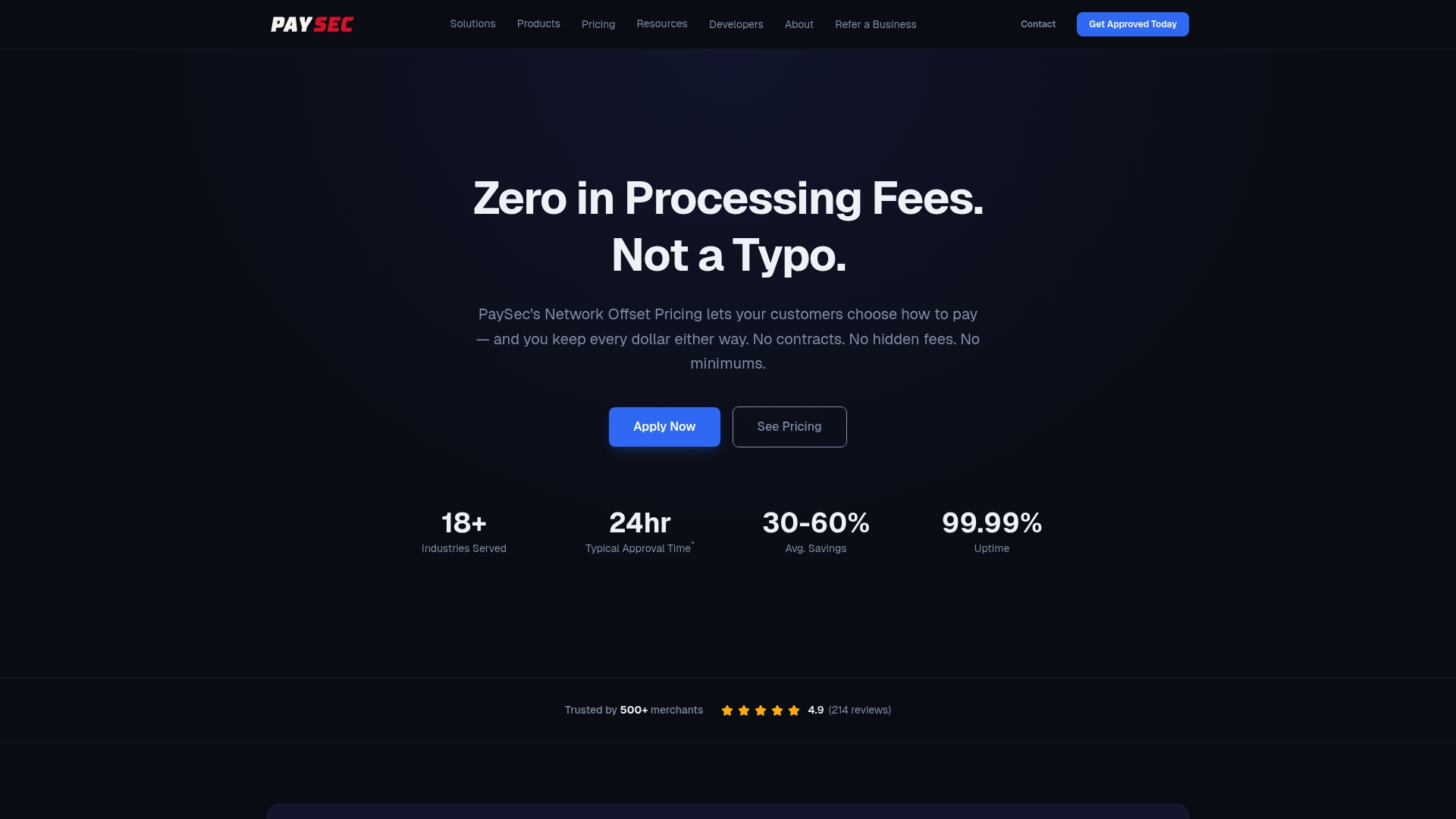
Paysec's wholesale interchange pricing eliminates the markup layer that most processors add to every transaction, and clients across SaaS and other industries have documented savings of 30 to 60 percent on processing costs. The dedicated merchant services model means your account is managed by a team that understands SaaS billing cycles, not routed through a generic support queue. Detailed transaction reporting gives your finance team the reconciliation data they need without additional tooling. There are no minimums and no long-term contracts, which matters when your billing volume is growing and your pricing strategy is still evolving. Learn more at paysec.ai.
FAQ
What payment features separate SaaS billing from standard processing?
SaaS billing requires subscription lifecycle management, automated tax compliance, and account updater services on top of standard card processing. A payment gateway alone handles only the transaction layer.
How does hosted vs. integrated gateway affect PCI compliance costs?
Hosted gateways qualify for SAQ A with 22 validation requirements, while integrated gateways require SAQ D-Merchant with 328-plus requirements. The compliance cost difference can reach tens of thousands of dollars annually.
What is dunning management and why does it matter for SaaS?
Dunning management is automated retry logic and customer notification for failed payments. Skipping it can increase churn by up to 40%, according to billing system research from Fungies.
How does an account updater service reduce SaaS churn?
Account updater services query Visa and Mastercard databases to refresh expired or reissued card tokens before a charge attempt fails. Targeting cards expiring within 30 days and recently declined cards produces the highest retention impact.
Do SaaS businesses need a Merchant of Record?
A Merchant of Record is the right choice for SaaS companies entering multiple international markets quickly, since MoR providers handle VAT, GST, fraud liability, and refunds. Companies with established legal teams often prefer self-managed tax automation tools for greater control and lower per-transaction cost.