

TL;DR:
- Payment scalability ensures payment platforms can handle increasing transaction volumes without sacrificing speed or accuracy.
- Operational success depends on modular, asynchronous, and horizontally scalable architecture, not just technical capacity.
Payment scalability is the capability of a payment platform to maintain accurate, efficient transaction processing as volume grows, without degrading speed, reliability, or financial accuracy. For business owners and finance executives, understanding how payment scalability works on platforms is not a technical curiosity. It is a direct driver of revenue protection, cost control, and competitive positioning. The Bank for International Settlements has studied this challenge extensively, and the findings are clear: modern modular architectures can process 10,000 transactions per second in testing conditions. That benchmark sets the standard every serious payment platform must aim for. Paysec is built around exactly these principles, serving merchants across 18+ industries with infrastructure designed to grow as your business grows.
What are the technical foundations that enable payment scalability on platforms?
Payment scalability on platforms rests on a set of architectural decisions made long before a single transaction is processed. Get these decisions right, and your system handles Black Friday volumes without breaking a sweat. Get them wrong, and a traffic spike becomes a revenue crisis.
Modular and microservices architecture
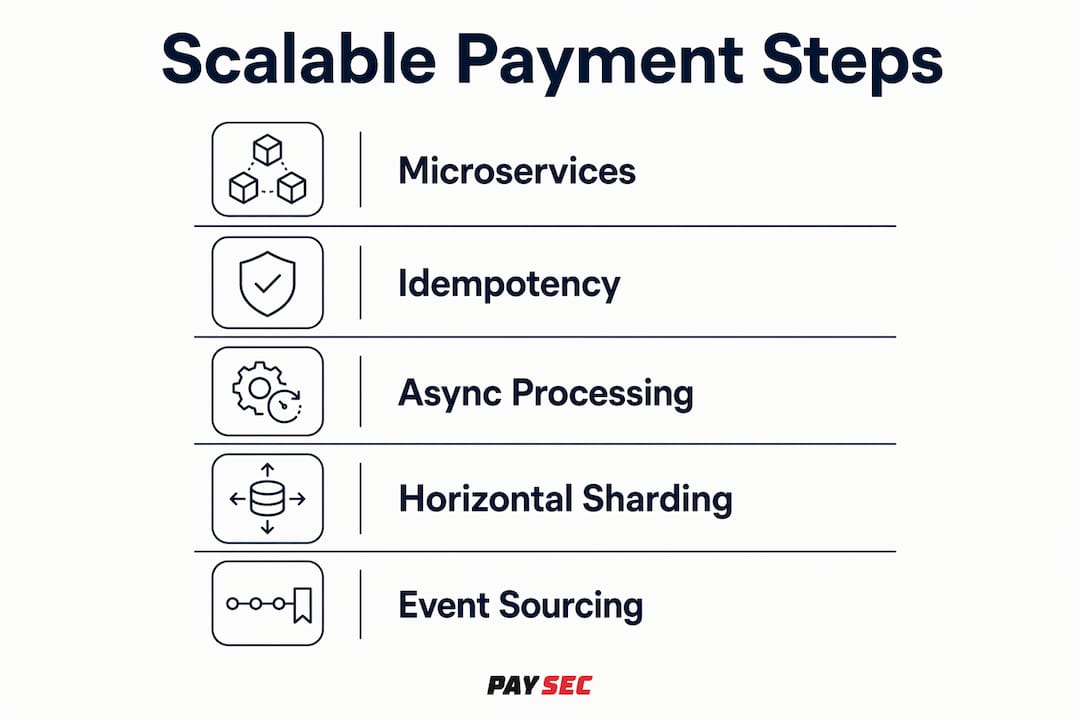
A microservices architecture breaks a payment system into independent components: authorization, fraud detection, ledger, settlement, and reporting each run as separate services. This means you can scale the fraud detection engine independently from the ledger without touching the rest of the system. The Bank for International Settlements confirmed that modular settlement engines achieve this kind of proportional scaling, adding computing resources at a fraction of the rate that transaction volume grows.

Idempotency and exactly-once processing
Every payment system faces retries. A customer's browser times out. A network packet drops. Without a safety mechanism, the same charge fires twice. Idempotency keys combined with event tracking solve this by assigning each transaction a unique identifier. If the same request arrives twice, the system recognizes it and returns the original result without processing a duplicate charge. This is not optional engineering. It is the baseline for any platform handling real money at scale.
Asynchronous processing
The core payment authorization path must stay fast and synchronous. Everything else, including reconciliation, notifications, and ledger updates, should run asynchronously to prevent bottlenecks under load. Think of it like a restaurant kitchen: the chef plates the dish immediately, but the dishwasher runs on a separate schedule. Mixing those two workflows creates chaos.
Horizontal database sharding
A single database becomes a bottleneck the moment transaction volume spikes. Horizontal sharding by merchant or tenant ID distributes data across multiple database nodes, allowing throughput to grow linearly as you add nodes. Monolithic databases cannot do this. They hit a ceiling, and that ceiling becomes your business ceiling.
Event sourcing and CQRS
Command Query Responsibility Segregation (CQRS) separates the system's write path from its read path. Event sourcing and CQRS allow transactional writes and reporting queries to scale independently. As a bonus, event sourcing produces an immutable log of every state change, which is invaluable for audits and dispute resolution.
| Architectural technique | Primary scalability benefit | Key trade-off |
|---|---|---|
| Microservices | Independent component scaling | Higher orchestration complexity |
| Idempotency keys | Exactly-once processing under retries | Requires persistent key storage |
| Asynchronous processing | Prevents authorization bottlenecks | Eventual consistency in reporting |
| Horizontal sharding | Linear database throughput growth | Complex cross-shard queries |
| CQRS and event sourcing | Independent read/write scaling | Steeper initial design investment |
Pro Tip: Map your transaction flow before choosing an architecture. Identify which steps are truly synchronous requirements and which can safely run in the background. Most teams over-synchronize and pay for it at scale.
How do leading platforms achieve high throughput and low latency?
Raw throughput numbers only tell part of the story. The more revealing metric is what happens inside each transaction within that throughput window.
Leading payment processing platforms complete card validation, fraud checks across 300+ signals, routing, authorization, and ledger entry in under 800 milliseconds per transaction. That is the entire payment lifecycle, including fraud scoring, completed in less than one second. For a finance executive, that number matters because latency directly affects cart abandonment rates and customer experience at checkout.
Microbatch settlement
High-throughput platforms decouple execution speed from final settlement using microbatch processing. Authorization happens in real time. Settlement batches run on a separate cycle, typically every few seconds or minutes. This design means the authorization engine never waits for settlement to complete, which keeps transaction times low even during peak volume periods.
Fraud detection as an inline service
Fraud detection at scale is not a checkpoint that slows transactions down. It runs as a parallel inline service that scores each transaction against behavioral signals, device fingerprints, and velocity rules simultaneously with authorization. The 300+ signal fraud check completing within that 800-millisecond window is the direct result of this parallel architecture.
Nanopayments and new economic models
Circle's Nanopayments technology demonstrates what the frontier of payment scalability looks like. Nanopayments process transactions as small as $0.000001 with sub-500-millisecond authorization and background batch settlement. This is not a niche curiosity. It opens entirely new business models: pay-per-API-call pricing, AI agent commerce, and IoT device payments that were economically impossible with traditional per-transaction fee structures.
Financial accuracy under load
Maintaining financial accuracy is often the hardest challenge in scaling payments, more so than pure volume processing. Double-entry bookkeeping must remain consistent even when thousands of writes hit the ledger simultaneously. Platforms that skip this discipline create reconciliation nightmares that surface weeks later as unexplained discrepancies.
Pro Tip: Test your system's financial accuracy under synthetic load before you hit real peak volume. Run a load test that intentionally introduces retries and partial failures. If your ledger balances perfectly after that test, your architecture is production-ready.
What operational complexities and trade-offs come with payment scalability?
Scaling a payment platform is not purely a technical win. Every architectural gain introduces a corresponding operational challenge. Finance executives who understand these trade-offs make better vendor and infrastructure decisions.
The most significant complexities include:
- Increased attack surface. Microservices increase operational complexity and require advanced orchestration, security, and governance frameworks. Each service-to-service communication channel is a potential vulnerability. A monolithic system has one perimeter. A microservices system has dozens.
- Post-quantum cryptography readiness. The Bank for International Settlements explicitly flags post-quantum cryptography as a requirement for future-proof payment infrastructure. Platforms that rely solely on current encryption standards face a long-term security risk as quantum computing matures.
- Incident response complexity. When a monolithic system fails, the failure is usually obvious. When a microservices system degrades, the root cause can hide across five different services. Distributed tracing tools like OpenTelemetry are not optional at this scale. They are the only way to find the problem before it becomes a customer-facing outage.
- Synchronous coupling failures. The most common architectural mistake in payment systems is extending synchronous coupling beyond the core authorization step. When reconciliation or notification services block the authorization path, a slow downstream service can collapse the entire transaction pipeline.
- Governance and auditability. Scalable systems process millions of events. Without a structured event log and clear data ownership per service, regulatory audits become extremely expensive. Event sourcing addresses this directly by maintaining an immutable record of every state change.
- Fraud prevention at volume. Fraud detection models trained on low-volume data perform poorly at scale. The signal patterns change. Platforms must retrain models continuously and monitor for drift in real time.
The best mitigation for these complexities is strong observability from day one. Real-time payment data security practices and anomaly detection dashboards give operations teams the visibility to catch problems before they compound. Building observability in after the fact is significantly more expensive than designing it in from the start.
How can business owners apply payment scalability principles for operational benefit?
Understanding the architecture is useful. Translating it into operational decisions is where the real value lives for business owners and finance teams.
The following steps reflect how organizations successfully move from a fragile, monolithic payment setup to a genuinely scalable one:
- Audit your current transaction flow. Map every step from payment initiation to settlement. Identify which steps are synchronous and which could safely run asynchronously. Most businesses discover that 60–70% of their payment pipeline is unnecessarily synchronous.
- Separate your payment execution from your ledger and reporting systems. Decoupling the write path from the read path prevents reporting queries from competing with live transactions for database resources. This single change often produces a measurable improvement in authorization speed.
- Implement multi-processor routing. Multi-processor routing lets your platform send each transaction to the processor offering the best combination of cost, approval rate, and geographic coverage. This reduces processing costs and improves resilience if one processor experiences downtime.
- Add idempotency to every payment endpoint. If your current system does not use idempotency keys, add them before scaling. Duplicate charges at high volume are not just a customer service problem. They are a regulatory and reconciliation problem.
- Build real-time fraud prevention as a parallel service. Inline fraud scoring that runs alongside authorization, rather than before it, keeps transaction times low without sacrificing security. Paysec integrates this approach natively, giving merchants comprehensive fraud protection without adding latency to the checkout experience.
- Invest in real-time reporting dashboards. Finance teams need transaction visibility at the same speed that transactions occur. Batch reporting that arrives the next morning is not sufficient when you are managing high-volume operations. Real-time dashboards surface anomalies, chargebacks, and approval rate drops while there is still time to act.
- Plan for sub-cent payment models. If your business operates in SaaS, AI services, or IoT, the economics of nanopayments are worth evaluating now. Paysec's SaaS payment processing infrastructure supports the kind of modular billing structures that make these models viable without custom engineering.
The businesses that benefit most from payment scalability are not always the largest. A mid-size SaaS company that routes payments intelligently and separates its ledger from its authorization engine can outperform a much larger competitor running on a monolithic stack. The advantage is structural, not just financial.
Pro Tip: When evaluating payment platforms, ask specifically how they handle retries and idempotency. A vendor that cannot explain their exactly-once processing mechanism is a vendor whose system will create duplicate charges at scale.
Key Takeaways
Payment scalability on platforms requires modular architecture, asynchronous processing, idempotency, and horizontal database scaling to sustain high transaction volumes without losing financial accuracy or speed.
| Point | Details |
|---|---|
| Modular architecture is the foundation | Microservices allow independent scaling of fraud, authorization, and ledger components. |
| Idempotency prevents duplicate charges | Idempotency keys combined with event tracking guarantee exactly-once processing under retries. |
| Asynchronous design protects throughput | Keep authorization synchronous; run reconciliation and notifications asynchronously to avoid bottlenecks. |
| Financial accuracy is the hardest challenge | Decoupling write and read paths maintains ledger consistency even under peak transaction loads. |
| Multi-processor routing cuts costs | Routing transactions across multiple processors reduces fees and improves resilience simultaneously. |
The scalability lesson most platforms learn too late
From where we sit at Paysec, the most consistent pattern we see across businesses that struggle with payment scalability is not a technology problem. It is a sequencing problem. Teams invest in volume capacity before they solve for financial accuracy. They can process 5,000 transactions per second, but their ledger reconciles incorrectly 0.1% of the time. At 5,000 TPS, that 0.1% is hundreds of errors per minute.
The counter-intuitive truth is that financial accuracy should be the first scalability problem you solve, not the last. Build your idempotency layer, your CQRS separation, and your immutable event log before you worry about raw throughput. Volume capacity is an infrastructure investment. Financial accuracy is an architectural commitment.
We are also watching the nanopayment space closely. The ability to process transactions at $0.000001 is not just a technical novelty. It represents a fundamental shift in how AI agents, IoT devices, and API-driven services will transact with each other. Businesses that build payment infrastructure capable of handling these micro-transactions today will have a structural advantage when agentic commerce becomes mainstream.
The platforms that win in the next five years will be the ones that treat payment infrastructure as a core business capability, not a commodity vendor relationship. Modular, event-driven designs are not just better engineering. They are better business strategy. The operational cost savings from intelligent routing, real-time fraud prevention, and separated ledger systems compound over time in ways that flat-rate processing fees never will.
— Paysec Marketing Team
Paysec's approach to scalable payment infrastructure
Paysec is built for the transaction volumes and cost pressures that business owners and finance executives face in 2026. Its modular architecture supports multi-processor routing, real-time analytics, and inline fraud prevention without requiring custom engineering from your team.
Paysec's Network Offset Pricing eliminates the hidden fees that make high-volume processing expensive, with documented savings of 30–60% for merchants across SaaS, eCommerce, healthcare, and retail. There are no minimums and no long-term contracts. Paysec also offers real-time reporting dashboards that give finance teams transaction visibility at the speed the business actually operates. If you are ready to build payment infrastructure that scales with your revenue, Paysec is the place to start.
FAQ
What is payment scalability on a platform?
Payment scalability is a platform's ability to process increasing transaction volumes without losing speed, accuracy, or reliability. It depends on modular architecture, asynchronous processing, and horizontal database scaling.
How do payment platforms handle thousands of transactions per second?
Modern modular settlement engines achieve up to 10,000 transactions per second by scaling computing resources independently across services like fraud detection, authorization, and ledger. This architecture avoids the bottlenecks that monolithic systems create under load.
What is idempotency and why does it matter for payment scalability?
Idempotency ensures that a payment request processed multiple times, due to retries or network failures, produces exactly one charge. Platforms use idempotency keys combined with event state tracking to guarantee this without degrading system performance.
How does multi-processor routing reduce payment costs?
Multi-processor routing sends each transaction to the processor offering the best approval rate, cost, and geographic coverage at that moment. This reduces per-transaction fees and protects revenue if one processor experiences downtime.
What is the biggest challenge in scaling payment systems?
Maintaining financial accuracy is consistently the hardest challenge, more so than raw volume capacity. Decoupling the transaction write path from the read path and using event sourcing are the most effective methods for preserving ledger consistency at scale.