

SaaS payment processing costs run deeper than the percentage you see on a transaction receipt. The primary cost drivers fall into four categories: direct transaction fees (typically 2.9%–3.5% plus fixed per-transaction amounts for card payments), compliance and infrastructure overhead, subscription billing layer fees, and indirect operational costs from chargebacks, failed payments, and reconciliation work. Together, SaaS companies often spend 5%–9% of total revenue on payments infrastructure once all those layers are counted, as revealed by recent industry analyses. Most finance teams only track the headline rate.
The processor type you choose determines which of these cost drivers you own and which you outsource. Traditional payment service providers (PSPs) give you control and lower raw fees but hand you the compliance burden. Merchant of Record (MoR) solutions absorb tax and legal liability across jurisdictions at a higher fee. Regional specialists optimize for local payment methods. Subscription billing layers sit on top of any base processor, adding a small percentage per transaction for dunning, proration, and usage metering. Understanding where each dollar goes is the first step toward controlling it.
Key cost drivers at a glance:
- Transaction fees: Flat-rate, interchange-plus, tiered, or subscription pricing models, each with different transparency and scalability profiles
- Compliance costs: PCI DSS audits, tooling, and ongoing maintenance
- Engineering and infrastructure: Developer time to build and maintain payment logic
- Involuntary churn: Failed payments can equal 1%–3% of monthly recurring revenue (MRR) without recovery systems
- Operational overhead: Finance team hours for reconciliation, dispute management, and fraud review
Table of Contents
- 1. What types of SaaS payment processing solutions exist?
- 2. Key cost drivers that raise your SaaS payment processing fees
- 3. How to choose the right payment processor for your SaaS business
- 4. How Paysec cuts SaaS payment processing costs with Network Offset Pricing
- 5. Subscription billing complexities every SaaS team should plan for
- 6. Common challenges in SaaS payment processing
- 7. How authorization and settlement timing affect your cash flow
- 8. How chargebacks and fraud prevention shape your processing costs
- Paysec makes SaaS payment cost control straightforward
- Key Takeaways
- FAQ
1. What types of SaaS payment processing solutions exist?
SaaS businesses can choose from several distinct processor categories. Each carries a different cost structure, compliance profile, and operational footprint.
Traditional payment service providers (PSPs)
PSPs like direct card-acquiring platforms process payments and pass the interchange cost to you, typically under flat-rate, tiered, or interchange-plus pricing. They offer the lowest raw transaction fees but require your team to manage PCI DSS compliance, tax collection, and billing logic. This model suits SaaS companies with engineering resources and a domestic-first customer base.

Merchant of Record (MoR) solutions
An MoR provider legally becomes the seller of record for your transactions. They handle VAT, GST, US sales tax, and chargeback liability across dozens of jurisdictions. The trade-off is higher transaction fees of 3.9%–10%, but founders often recover 10–20 hours per month in compliance and tax work. For early-stage SaaS businesses selling internationally, that time savings frequently justifies the premium.
Regional payment specialists
Regional processors optimize for local payment rails: SEPA Direct Debit in Europe, ACH in the US, PIX in Brazil, or UPI in India. If a meaningful share of your subscriber base pays through non-card methods, a regional specialist can reduce decline rates and lower per-transaction costs compared to a global PSP routing those same transactions through card networks.
Subscription and billing management layers
Platforms like Stripe Billing sit on top of a base PSP and add subscription-specific features at 0.5%–0.8% per transaction. These include proration, dunning, usage-based metering, trial management, and revenue recognition. For SaaS businesses with complex billing logic, the cost of building those features in-house typically exceeds the layer fee.
Payment facilitator (PayFac) models
Building your own PayFac infrastructure gives maximum control and the lowest per-transaction economics at scale. The catch: justifying that investment requires more than $50M in annual processing volume. Below that threshold, fixed engineering and compliance costs outpace the savings from owning the rails.
Pro Tip: Before choosing a processor type, map your billing complexity first. A SaaS product with annual plans and no usage-based components needs far less billing infrastructure than one with seat-based pricing, mid-cycle upgrades, and metered overages. Match the solution to your actual billing model, not the most feature-rich option available.
2. Key cost drivers that raise your SaaS payment processing fees
Direct transaction fees by pricing model
Pricing models fall into four main structures:
- Flat-rate: A single blended percentage on every transaction. Simple to forecast, but you pay the same rate on a debit card as on a premium rewards card, which costs more at volume.
- Interchange-plus: The actual interchange cost plus a fixed processor markup. More transparent and typically cheaper above $5,000/month in processing volume.
- Tiered: Transactions sorted into "qualified," "mid-qualified," and "non-qualified" buckets. Opaque by design; most business cards land in the expensive non-qualified tier.
- Subscription pricing: A flat monthly fee plus a small per-transaction rate. Predictable for high-volume SaaS businesses but can be costly at lower volumes.
Engineering and infrastructure costs
Payment infrastructure is not a one-time build. Webhook handling, retry logic, tokenization, API version upgrades, and compliance tooling all require ongoing engineering attention. One analysis found that many SaaS businesses allocate the equivalent of 3–4 full-time employees to payment engineering, finance, and tax work on a $2M revenue base. That headcount cost rarely appears in a payment processing budget.

PCI DSS compliance
PCI DSS compliance costs vary by scope level, but even a SAQ-A merchant (the lightest scope) carries annual assessment fees, penetration testing, and security tooling costs. SaaS companies storing or transmitting card data directly face SAQ-D requirements, which involve quarterly vulnerability scans and significantly higher audit costs.
Involuntary churn from failed payments
Smart retry systems and automated card update services recover 60%–75% of failed charges, making dunning one of the highest-ROI investments in a SaaS payment stack. Visa Account Updater and Mastercard Automatic Billing Updater push fresh card credentials before a charge even fails, cutting decline rates at the source.
Chargebacks and fraud costs
Each chargeback carries a dispute fee (commonly $15 per incident) plus the lost transaction value and the staff time to respond. Fraud prevention tools add their own per-transaction or monthly fees. SaaS businesses with high-ticket annual plans are particularly exposed because a single chargeback on a $1,200 annual subscription represents a meaningful revenue event.
Operational overhead
Reconciliation, dispute management, and tax reporting consume finance team hours that scale with transaction volume. These costs are real but rarely appear in a payment processing cost breakdown. Detailed transaction reporting tools reduce this overhead by surfacing discrepancies automatically rather than requiring manual ledger review.
3. How to choose the right payment processor for your SaaS business
The right processor depends on four variables: your current MRR, billing complexity, geographic footprint, and internal engineering capacity.
Evaluation criteria
- Pricing transparency: Can you see the interchange component separately from the processor markup? Opaque tiered pricing consistently costs more at scale.
- Subscription billing capability: Does the processor natively support proration, dunning, usage metering, and mid-cycle plan changes, or will you build those yourself?
- Compliance ownership: Who handles PCI DSS scope, sales tax collection, and chargeback liability? The answer changes your operational cost significantly.
- Global coverage: If more than 10% of your subscribers pay in non-USD currencies or through local payment methods, a processor's international rails matter as much as its domestic rates.
Build vs. buy trade-offs
The DIY payment stack gives you the lowest raw transaction fees and full control over the customer experience. It also means your engineering team owns every failure mode: expired tokens, webhook retries, API deprecations, and compliance updates. For SaaS companies under $50M in annual processing volume, total cost of ownership almost always favors an outsourced provider over building PayFac infrastructure.
MoR solutions make the most sense when international tax complexity is high and founder time is the binding constraint. The fee premium is real, but so is the time saved on VAT filings, GST registrations, and jurisdiction-specific compliance.
MRR breakpoints worth knowing
At $50,000 MRR, a 2% involuntary churn rate means $1,000 lost monthly. A dunning system recovering 60% of those charges returns $600/month, often exceeding the cost of the billing layer that provides it. At $100,000 MRR, negotiating interchange-plus pricing directly with your processor typically saves 0.3%–0.5% versus standard rates.
Pro Tip: Run a full payment cost audit quarterly, not just at contract renewal. Pull your actual interchange mix, chargeback rate, failed payment volume, and engineering hours spent on payment maintenance. The headline transaction rate is rarely where the real cost lives.
4. How Paysec cuts SaaS payment processing costs with Network Offset Pricing
Paysec's Network Offset Pricing model takes a structurally different approach to the cost problem. Instead of layering fees on top of interchange, it offsets processing costs by giving businesses the flexibility to pass payment method costs to customers who choose premium card types, while keeping the full transaction value for lower-cost payment methods. There are no hidden fees, no monthly minimums, and no long-term contracts.
The practical benefits for SaaS finance teams:
- Transparent cost breakdown: Every transaction report shows the exact interchange, network, and processor components, so finance teams can track true payment costs and identify where fees concentrate.
- Compliance clarity: Paysec handles compliance reporting, reducing the internal audit burden for SaaS businesses operating across multiple states.
- No minimums or lock-in: SaaS businesses at any MRR level can access the same pricing structure without committing to volume thresholds.
- Detailed transaction reporting: Real-time dashboards surface cost drivers, failed payment trends, and processor performance in one place.
The 42% cost reduction case study for a SaaS marketplace demonstrates what happens when pricing transparency replaces opaque tiered billing. Finance teams gain the data to make processor decisions based on actual cost, not estimates.
5. Subscription billing complexities every SaaS team should plan for
Subscription billing is not a single feature. It is a set of interdependent processes, and each one carries its own cost and failure mode.
Proration handles mid-cycle plan changes. When a subscriber upgrades from a $49 plan to a $99 plan on day 15 of a 30-day cycle, the billing system must calculate the credit for unused days and charge only the difference. Done manually, this creates reconciliation errors. Done automatically, it requires billing logic that most base PSPs do not include.
Dunning is the process of retrying failed payments and notifying subscribers before canceling their accounts. The timing and sequencing of retries matters. Retrying a declined card immediately after failure rarely succeeds. Smart retry systems analyze decline codes and schedule retries at statistically optimal times, recovering a meaningfully higher share of failed charges.
Usage-based billing adds another layer. SaaS products charging per API call, per seat, or per GB of storage must meter consumption accurately, aggregate it at billing intervals, and apply the correct rate tiers. Errors in metering translate directly to revenue leakage or customer disputes.
Trial management requires the system to convert trial subscribers to paid status at the right moment, handle failed conversion charges gracefully, and trigger the correct dunning sequence without canceling accounts prematurely.
Each of these features adds engineering complexity if built in-house, or a billing layer fee if outsourced. Understanding which features your billing model actually requires helps you evaluate whether a subscription billing platform earns its cost.
6. Common challenges in SaaS payment processing
SaaS payment operations surface a consistent set of problems regardless of company size.
Card network rule changes happen multiple times per year. Visa and Mastercard update interchange categories, dispute rules, and authentication requirements on their own schedules. SaaS teams using direct integrations must track these changes and update their implementations accordingly, or face higher decline rates and compliance exposure.
Cross-border payment friction increases as SaaS products grow internationally. A US-based SaaS company billing a subscriber in Germany faces currency conversion fees, potential VAT obligations, and a higher likelihood of card declines due to issuer fraud rules for international transactions. ACH works domestically; it does not work for a subscriber paying in euros.
Revenue recognition complexity compounds with billing model variety. A SaaS business offering monthly plans, annual prepay, and usage-based tiers must recognize revenue differently for each, and payment processor data rarely maps cleanly to accounting system requirements without a reconciliation layer.
Chargeback management is operationally intensive. Responding to a dispute requires pulling transaction records, delivery evidence, and communication logs within tight network deadlines. SaaS businesses with high-volume, low-ticket subscriptions face a different chargeback profile than those with enterprise annual contracts, but both require a defined response process.
Tracking why SaaS platforms pay excess fees often reveals that these operational gaps, not the headline transaction rate, account for the largest share of avoidable cost.
7. How authorization and settlement timing affect your cash flow
Payment authorization and settlement are two separate events, and the gap between them has real cash flow consequences for SaaS businesses.
Authorization happens at the moment a card is charged. The issuing bank approves or declines the transaction, and the funds are reserved. But the money does not move yet.
Settlement is when funds actually transfer from the issuing bank through the card networks to your processor and then to your bank account. Standard settlement windows run T+1 to T+2 for most card transactions, meaning one to two business days after the authorization date. Some processors hold funds longer for new accounts or high-risk transaction profiles.
For SaaS businesses running monthly billing cycles, a two-day settlement delay on a large billing run can create a meaningful gap between recognized revenue and available cash. Annual plan renewals amplify this: a $500,000 billing run settling over two days requires adequate working capital to cover operating expenses in the interim.
ACH payments settle more slowly than card transactions, typically T+3 to T+5, but carry lower per-transaction fees. SaaS businesses offering ACH as a payment option for annual or high-value plans often find the fee savings worth the extended settlement window, provided cash flow planning accounts for the delay.
Failed authorizations also carry a timing cost. When a card declines, the retry cycle adds days before either recovering the payment or confirming the loss. During that window, the subscriber's access status, the dunning sequence, and the revenue recognition treatment all remain in an uncertain state that requires system logic to handle correctly.
8. How chargebacks and fraud prevention shape your processing costs
Chargebacks are not just a fee line item. They affect your processor relationship, your reserve requirements, and your ability to accept certain payment methods.
Card networks set chargeback thresholds at 1% of monthly transactions for Visa and similar levels for Mastercard. Exceeding those thresholds triggers monitoring programs that carry additional monthly fees and, if unresolved, can result in processor termination. SaaS businesses with free trial models are particularly exposed because trial-to-paid conversions generate a higher share of "did not recognize" disputes from cardholders who forgot they subscribed.
Fraud prevention tools add cost but reduce exposure. Address Verification Service (AVS) and Card Verification Value (CVV) checks are standard and typically included in processor fees. 3D Secure 2.0 authentication shifts chargeback liability from the merchant to the issuing bank for authenticated transactions, which is a meaningful protection for high-ticket SaaS plans. The trade-off is a slightly higher friction checkout flow that can reduce conversion rates on some card types.
Chargeback representment, the process of disputing a chargeback with evidence, recovers a portion of lost revenue but requires documented evidence and timely submission. SaaS businesses that maintain clear transaction records, subscriber communication logs, and service delivery evidence win a higher share of disputes. This is one area where detailed transaction reporting pays for itself directly: the data needed to win a dispute is the same data a well-structured reporting system captures automatically.
Paysec makes SaaS payment cost control straightforward
SaaS finance teams spend significant time managing payment costs that should be predictable. Paysec's Network Offset Pricing removes the opacity that makes payment processing budgeting difficult. No hidden fees, no volume minimums, and no long-term contracts mean you access transparent pricing from day one, whether you are processing $10,000 or $10M per month.
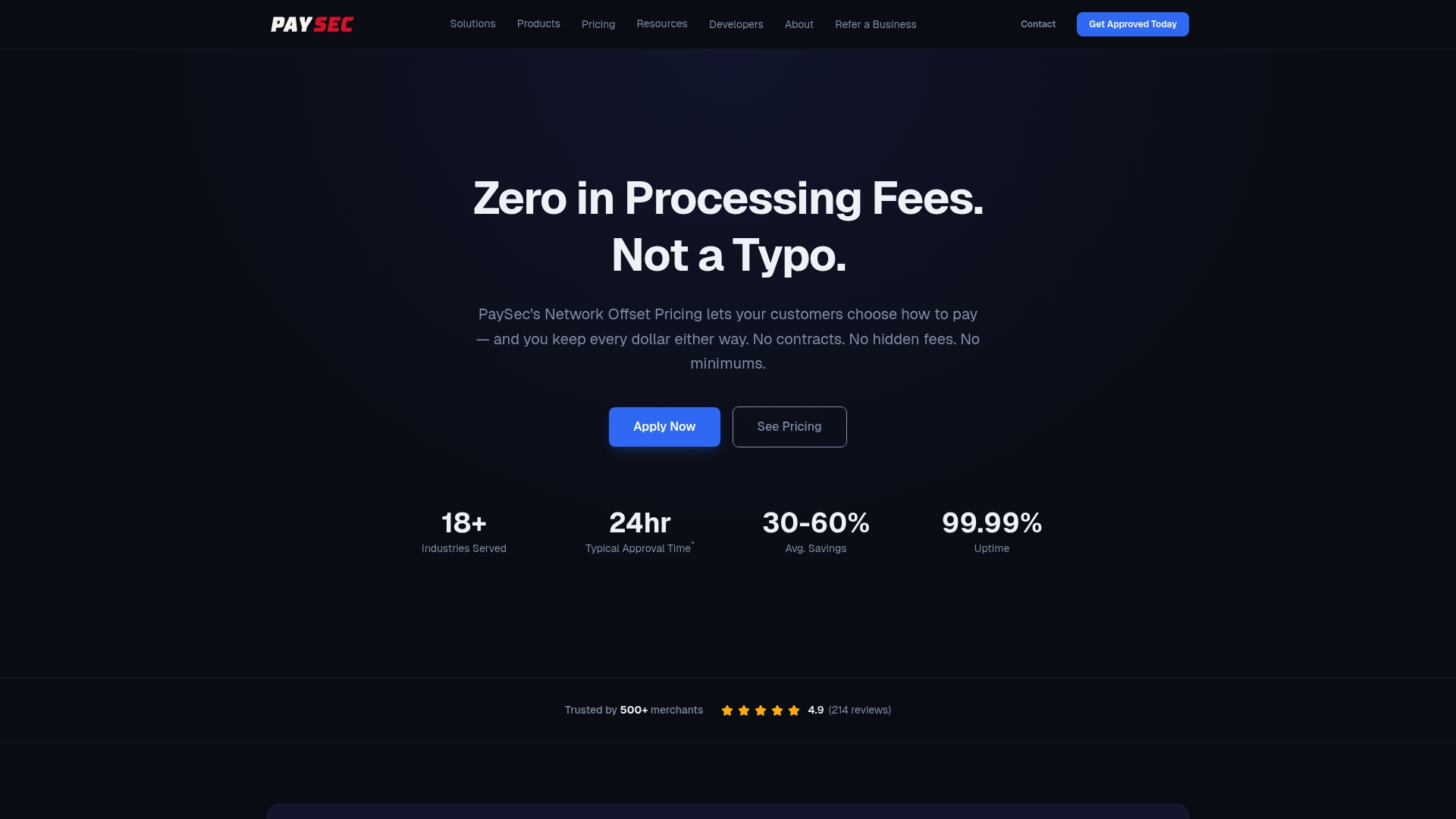
Clients across SaaS, eCommerce, healthcare, and 15+ other industries have reduced processing costs by 30%–60% after switching to Paysec. The 42% cost reduction achieved by one SaaS marketplace came directly from replacing opaque tiered pricing with full interchange transparency and Network Offset Pricing. Real-time reporting dashboards give finance teams the visibility to track every cost driver, identify fee concentrations, and make processor decisions based on actual data.
For SaaS businesses looking to reduce payment processing fees without sacrificing billing capability or compliance coverage, Paysec is a direct path to lower costs and cleaner financial reporting. Visit paysec.ai/pricing to see the wholesale interchange rates and calculate your potential savings.
Key Takeaways
SaaS payment processing costs consistently exceed the headline transaction rate once compliance, engineering, failed payments, and operational overhead are included in the total.
| Point | Details |
|---|---|
| Total cost exceeds headline rate | SaaS companies often spend 5%–9% of revenue on payments when all infrastructure costs are counted. |
| Failed payments are a major cost driver | Involuntary churn from failed payments can equal 1%–3% of MRR monthly without smart retry systems. |
| Processor type determines cost ownership | MoR solutions charge higher percentage rates but absorb tax and compliance liability; PSPs cost less but require internal resources. |
| Billing layer fees add up | Subscription billing layers add a small slice per transaction but offset in-house development and revenue leakage costs. |
| Paysec delivers measurable savings | Paysec's Network Offset Pricing has delivered significant cost reductions, including a documented case study with large savings for a SaaS marketplace. |
FAQ
What are the main pricing models for SaaS payment processing?
The four primary models are flat-rate, interchange-plus, tiered, and subscription pricing. Interchange-plus offers the most transparency and tends to be the most cost-effective above $5,000 per month in processing volume.
How much do failed payments actually cost a SaaS business?
Failed payments typically cause involuntary churn equal to 1%–3% of MRR per month. Smart retry systems and automated card update services recover 60%–75% of those failed charges, making dunning one of the highest-return investments in a SaaS payment stack.
What is the best payment processing approach for SaaS businesses?
The best approach depends on MRR, billing complexity, and geographic footprint. Early-stage SaaS businesses often benefit from MoR solutions for their compliance coverage, while scaling businesses with engineering resources typically move to interchange-plus PSPs with a dedicated billing layer for lower total cost.
How does Paysec reduce SaaS payment processing costs?
Paysec's Network Offset Pricing eliminates hidden fees and replaces opaque tiered billing with full interchange transparency. Clients report 30%–60% reductions in processing costs, with no monthly minimums or long-term contracts required.
When should a SaaS company build its own payment infrastructure?
Building PayFac infrastructure only makes financial sense above $50M in annual processing volume. Below that threshold, fixed engineering and compliance costs outpace the savings from owning the payment rails directly.