

TL;DR:
- Proper SaaS marketplace payment gateway setup relies on embedded facilitation to avoid lengthy licensing processes and regulatory risks. It involves choosing the right architecture, automating vendor onboarding, configuring payment flows, and testing thoroughly before launch. Optimizing transaction authorization and payout strategies can significantly reduce fees and improve payment efficiency.
SaaS marketplace payment gateway setup is the process of integrating and configuring payment systems that handle multi-vendor transactions, commission splits, and regulatory compliance within a single platform. Get this wrong and you face Money Transmitter Licensing exposure across 40+ US states, failed vendor payouts, and processing fees that quietly drain your margins. Get it right and you collect revenue efficiently, onboard vendors in days, and scale past $50M GMV without rebuilding your payment stack from scratch. This guide walks you through every stage, from prerequisites to fee optimization, so you can build a payment infrastructure that works from day one.
What are the prerequisites for a SaaS marketplace payment gateway setup?
The single most important decision you make before writing one line of integration code is whether to pursue your own Money Transmitter License or use embedded payment facilitation. MTL applications require 6–12 months per state across 40+ US states. That timeline alone kills most early-stage marketplace launches before they start.
Embedded payment facilitation solves this by letting your marketplace inherit the provider's existing MTL coverage. You avoid the licensing burden entirely while still collecting commissions, splitting payments, and managing vendor payouts. This is the standard approach for any marketplace under $50M GMV.
Beyond licensing, your setup checklist covers five core areas:
| Requirement | What it means for your marketplace |
|---|---|
| Money Transmitter Licensing (MTL) | Use embedded facilitation to inherit provider coverage and skip state-by-state applications |
| PCI-DSS compliance | Your payment provider handles card data security; you must not store raw card numbers |
| KYC/KYB for vendors | Verify vendor identity and business legitimacy before enabling payouts |
| Escrow and fund holding | Understand how funds are held between buyer payment and vendor payout |
| Payout schedule configuration | Set T+2 or T+7 payout windows based on your risk profile and vendor agreements |
KYC and KYB requirements deserve special attention. Every vendor on your platform is a sub-merchant. Regulators treat unverified sub-merchants as a compliance liability. Pre-built KYC/KYB onboarding flows can save up to three months of development time per integration. That is not a small number when you are racing to launch.
Pro Tip: Before selecting a payment provider, confirm in writing that their embedded facilitation covers your target states. Coverage maps vary by provider, and gaps create unexpected MTL exposure.
How to execute the step-by-step payment gateway integration for SaaS marketplaces
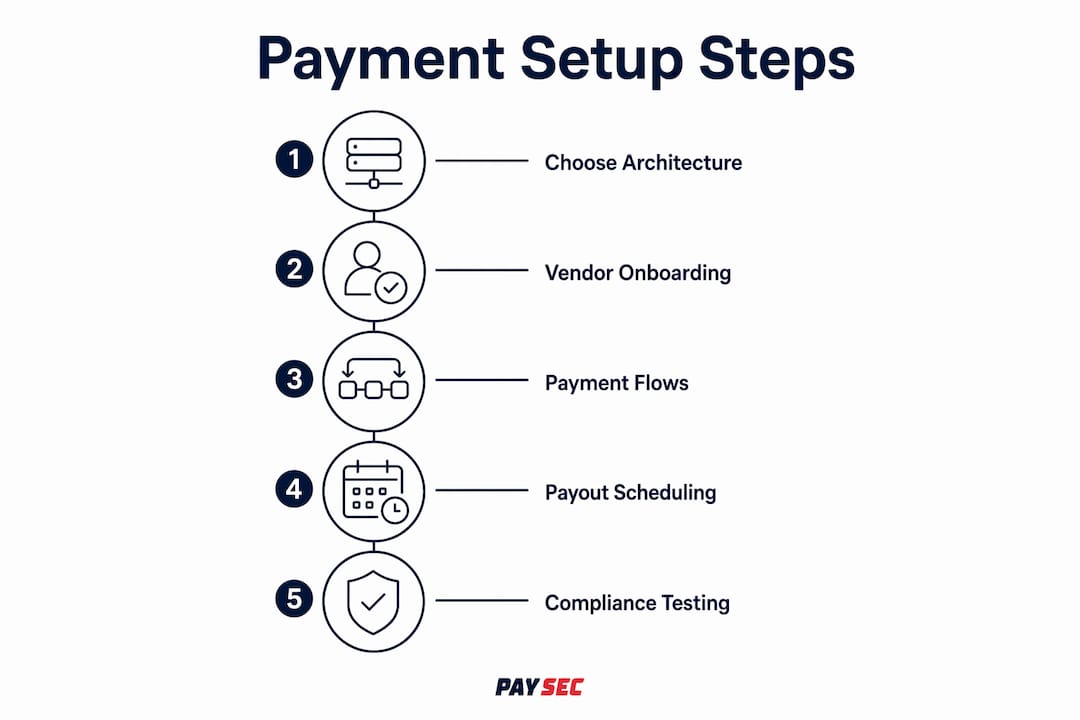
Step 1: Choose your payment architecture
The first decision is whether to use a single integrated provider or a multi-PSP architecture. Marketplaces under $50M GMV are best served by a single integrated provider. The setup is faster, the developer experience is cleaner, and the compliance overhead is lower. Multi-acquirer routing adds meaningful complexity and takes 3–6 weeks to integrate versus 1–2 weeks for a single provider. Save that complexity for when your transaction volume justifies it.

Step 2: Configure vendor onboarding with automated KYC/AML
Your vendor onboarding flow is the front door to your marketplace's payment system. A well-built flow collects business details, tax identification, bank account information, and identity documents. It then runs automated KYC and AML checks before activating the vendor's payout capability. Platforms that offer pre-built onboarding UX reduce your engineering effort significantly. You get document collection, status management, and verification workflows without building them from scratch.
Step 3: Set up payment flows with commission splits
Multi-vendor marketplaces require payment flows that automatically deduct your platform commission before routing the remainder to the vendor. This is called a split payment or charge-and-transfer model. You configure a fixed percentage or flat fee per transaction, and the payment provider handles the math and routing at settlement. Test this configuration thoroughly with edge cases: partial refunds, disputed transactions, and multi-item carts with vendors from different payout tiers.
Step 4: Configure payout schedules and currency management
Payout windows vary by provider and risk profile, with T+2 as the standard for established platforms and T+7 common for newer marketplaces. Set your payout schedule to match your cash flow needs and vendor expectations. Currency management is equally critical. If your vendors operate in multiple currencies, configure currency conversion at the point of settlement rather than at the point of sale. Conversion at the wrong stage creates losses that compound at scale.
Pro Tip: Run a full end-to-end test with a live vendor account before launch. Simulate a purchase, a refund, and a dispute. Most integration errors surface during refund and dispute flows, not during standard purchases.
The table below summarizes each setup stage by complexity and time requirement:
| Setup stage | Complexity | Estimated time |
|---|---|---|
| Provider selection and contract | Low | 1–2 weeks |
| Vendor onboarding flow (pre-built) | Low to medium | 1–3 weeks |
| Commission split configuration | Medium | 1–2 weeks |
| Payout schedule and currency setup | Medium | 1 week |
| Multi-acquirer routing (if applicable) | High | 3–6 weeks |
Step 5: Test compliance and reporting before go-live
Run your compliance checklist one final time before accepting live transactions. Confirm PCI-DSS scope is handled by your provider, not your servers. Verify that your KYC approval rate is above 85% in testing. Set up transaction reporting dashboards so you can monitor authorization rates, failed payments, and payout statuses from day one. Paysec's real-time reporting tools give marketplace operators the transaction-level visibility needed to catch issues before they become revenue problems.
What strategies optimize transaction fees and processing efficiency in SaaS marketplaces?
Fee optimization in SaaS marketplace transaction processing is not about negotiating a lower headline rate. It is about building a payment architecture that maximizes authorization rates and minimizes unnecessary cost at every stage of the transaction lifecycle.
Start with authorization rate optimization. A 1% lift in authorization rate on $20M GMV recovers $200,000 per year. That figure offsets the entire cost of a multi-acquirer setup. Authorization rate improvements come from better card data handling, retry logic for soft declines, and routing transactions to the acquirer most likely to approve them based on card type and geography.
The following areas deliver the highest return when you are building your fee optimization strategy:
- Interchange optimization: Route transactions to qualify for the lowest interchange tier. Corporate cards and rewards cards carry higher interchange. Identify them at checkout and adjust your pricing model accordingly.
- Decline recovery: Implement smart retry logic for soft declines. A transaction declined for "insufficient funds" at 9:00 AM may succeed at 9:05 AM. Automated retries recover a meaningful share of failed revenue.
- Surcharging and cost-sharing models: Paysec's Network Offset Pricing lets you pass processing costs to the payer as a transparent surcharge, retaining your full revenue on every transaction. Clients using this model report savings of 30–60% on processing costs.
- Payout batching: Batch vendor payouts rather than processing them individually. Per-transaction payout fees add up quickly on high-volume marketplaces.
- Chargeback management: Dispute resolution costs time and money. Implement pre-chargeback alerts and clear refund policies to reduce dispute rates below the 1% threshold that triggers processor scrutiny.
Multi-acquirer routing architectures become worth the integration effort once your GMV crosses $20M. Below that threshold, the complexity outweighs the savings. Above it, the authorization rate gains and fee negotiation leverage justify the 3–6 week integration investment.
Pro Tip: Ask your payment provider for a monthly interchange analysis report. Most providers offer this at no cost, and it shows exactly which transaction types are costing you the most. That data drives every fee negotiation you will ever have.
What common challenges arise during SaaS marketplace payment gateway setups?
The most expensive mistakes in payment gateway integration for SaaS platforms happen before the first transaction, not after. Regulatory missteps and architectural shortcuts create problems that are far harder to fix once you have live vendors and active transactions.
"Building a custom payment routing engine without significant regulatory readiness exposes marketplaces to compliance burdens that can halt operations entirely. Each Money Transmitter License requires a 6–12 month state application process across 40+ US states. The cost of getting this wrong is not just financial. It is existential for an early-stage marketplace."
The most common pitfalls and how to avoid them:
- Unhandled MTL exposure: Marketplaces that collect and hold funds without proper licensing face regulatory action. Use embedded payment facilitation from the start to inherit your provider's MTL coverage.
- Unsupported multi-destination payment intents: Not all payment providers support splitting a single transaction to multiple vendors in one API call. Confirm this capability before committing to a provider. Rebuilding your payment flow after launch is costly.
- Vendor currency mismatches: If your platform operates in multiple countries, currency conversion must be handled at the settlement layer, not the display layer. Mismatches between the currency a vendor expects and the currency the platform settles in create reconciliation errors and vendor disputes.
- Inadequate dispute management: Marketplaces carry chargeback liability for their vendors. Build a dispute management workflow before launch. Define who is responsible for responding to disputes, what evidence is required, and what the resolution timeline looks like.
- Skipping reconciliation testing: Reconciliation errors are invisible until month-end. Test your reconciliation process with at least 30 days of simulated transaction data before going live.
The payment stack for a marketplace is more complex than a standard ecommerce checkout. Every layer, from vendor onboarding to payout scheduling, introduces a new failure point. Build your testing plan to cover all of them.
Key Takeaways
Successful SaaS marketplace payment gateway setup requires embedded facilitation for compliance, a staged architecture approach tied to GMV thresholds, and active fee optimization from the first transaction.
| Point | Details |
|---|---|
| Use embedded facilitation | Inherit your provider's MTL coverage to avoid 6–12 month state licensing processes. |
| Match architecture to GMV | Single integrated providers work best under $50M GMV; add multi-acquirer routing as you scale. |
| Automate vendor KYC/KYB | Pre-built onboarding flows save up to three months of engineering time per integration. |
| Optimize authorization rates | A 1% authorization rate improvement on $20M GMV recovers $200,000 per year. |
| Test reconciliation before launch | Simulate 30 days of transactions, refunds, and disputes before accepting live payments. |
What the payment infrastructure evolution actually looks like
The conventional advice on SaaS marketplace payment setup treats compliance as a checkbox and fee optimization as a phase-two problem. That framing costs marketplaces real money.
At Paysec, we have worked with marketplace operators across 18+ industries, and the pattern is consistent. Founders who treat payment infrastructure as a core product decision from day one build faster and spend less. Founders who treat it as a back-office integration problem rebuild their payment stack at the worst possible time, usually right when they are trying to close a funding round or expand to new markets.
The embedded facilitation model changed the calculus entirely. Before it existed, a marketplace had two options: spend 12–18 months and significant legal fees obtaining MTLs, or partner with a payment facilitator and accept limited control. Embedded facilitation gives you the compliance coverage of the second option with far more control over your fee structure, onboarding UX, and payout logic.
The scaling threshold at $50M GMV is real, but it is not a cliff. Think of it as a signal. When your authorization rate optimization potential exceeds the integration cost of multi-acquirer routing, you add it. Not before. The marketplaces that add complexity too early spend engineering cycles on infrastructure instead of product. The ones that wait too long leave authorization rate gains on the table.
My honest recommendation: start with a single embedded provider, build your KYC and payout workflows properly the first time, and instrument your authorization rates from day one. When the data tells you to add routing complexity, you will know. And you will have the transaction history to negotiate better rates when you do.
— Paysec Marketing Team
How Paysec simplifies your marketplace payment gateway setup
Paysec's SaaS payment processing platform is built for marketplace operators who want compliance coverage, transparent pricing, and real fee savings without long-term contracts or hidden minimums.
Paysec's Network Offset Pricing model passes processing costs to the payer as a transparent surcharge, so your platform retains full revenue on every transaction. Clients across SaaS, ecommerce, and healthcare report 30–60% reductions in processing costs, including a documented 42% reduction in processing costs for one SaaS marketplace. Paysec handles merchant onboarding, multi-channel payment support, and detailed transaction reporting across 18+ industries. Explore Paysec's pricing model to see exactly what your marketplace would save.
FAQ
What is a SaaS marketplace payment gateway setup?
A SaaS marketplace payment gateway setup is the process of integrating payment systems that handle multi-vendor transactions, commission splits, vendor payouts, and compliance within a single platform. It includes KYC/KYB onboarding, payout scheduling, and regulatory coverage through embedded payment facilitation.
How long does payment gateway integration for SaaS marketplaces take?
A single integrated provider setup takes 1–2 weeks for core integration, with vendor onboarding flows adding 1–3 weeks. Multi-acquirer routing architectures require 3–6 weeks to integrate and are recommended only for marketplaces scaling beyond $50M GMV.
What is the best way to avoid Money Transmitter Licensing requirements?
Using an embedded payment facilitation provider is the most effective approach. Embedded facilitation lets your marketplace inherit the provider's existing MTL coverage, bypassing the 6–12 month state application process required in 40+ US states.
How do SaaS marketplaces reduce payment processing fees?
The most effective methods include authorization rate optimization, smart decline retry logic, payout batching, and cost-sharing models like Network Offset Pricing. A 1% improvement in authorization rate on $20M GMV recovers $200,000 per year in otherwise lost revenue.
What is the difference between T+2 and T+7 payout schedules?
T+2 means vendors receive their funds two business days after a transaction settles, while T+7 means a seven-day delay. T+2 is standard for established platforms; T+7 is common for newer marketplaces where the payment provider holds funds longer to manage chargeback risk.