

TL;DR:
- A no-minimum SaaS payment processor charges only per transaction without fixed monthly or setup fees. Platforms like Fungies.io, Vandly, and Nexway act as Merchant of Record, handling tax compliance and legal liability across multiple countries. This model offers predictable costs, simplifies international expansion, and is increasingly preferred by SaaS companies for operational and financial efficiency.
A SaaS payment processor without minimums is defined as a payment solution that charges only per transaction, with no monthly minimum fees, no setup costs, and no long-term contracts required. Platforms like Fungies.io, Vandly, and Nexway have made this model the standard for SaaS businesses that want predictable, variable-only costs. The shift matters because monthly minimums can range from hundreds to thousands of dollars, a fixed burden that punishes early-stage companies with low transaction volumes. For SaaS businesses focused on growth, eliminating that fixed cost floor changes the entire unit economics of payment processing.
What is a SaaS payment processor without minimums?
A no-minimum payment processor charges your business only when a transaction occurs. There are no monthly fees to cover, no annual contracts to sign, and no penalties for low-volume months. This structure is the opposite of traditional merchant accounts, which typically require you to hit a monthly processing floor or pay the difference regardless of actual sales.
The industry term for the most common no-minimum model in SaaS is Merchant of Record, often abbreviated as MoR. A Merchant of Record is the legal entity that takes financial and tax responsibility for a sale on behalf of the software vendor. Fungies.io, Vandly, and Nexway all operate as MoR platforms. They appear as the seller on the customer's receipt, handle tax collection and remittance, and absorb regulatory liability so you do not have to.
Traditional payment processors like standalone gateways require you to assemble your own stack. You need a payment gateway, a merchant account, and a separate tax compliance solution. Managing registrations and compliance across multiple providers can cost hundreds of dollars monthly before a single transaction clears. MoR platforms collapse all of that into one per-transaction fee, which is why they can offer payment processing with no minimums.
Pro Tip: If your SaaS product sells in more than two countries, the tax compliance savings from an MoR platform will almost always outweigh the slightly higher per-transaction rate compared to a standalone gateway.
Merchant of Record vs. traditional payment processor: what's the real difference?
The distinction between an MoR and a traditional payment processor is not just technical. It determines who owns the compliance risk, who files the VAT or sales tax returns, and who absorbs chargebacks at the legal level.
| Feature | Merchant of Record | Traditional Processor |
|---|---|---|
| Monthly minimum fees | None | Common, often $25–$500+ |
| Tax compliance | Included in transaction fee | Your responsibility |
| Legal liability for sales | Absorbed by MoR | Remains with your business |
| Global tax registration | Handled by provider | You register in each jurisdiction |
| Pricing structure | Per-transaction percentage | Per-transaction + monthly fees |
| Setup cost | Typically none | Often includes setup fees |
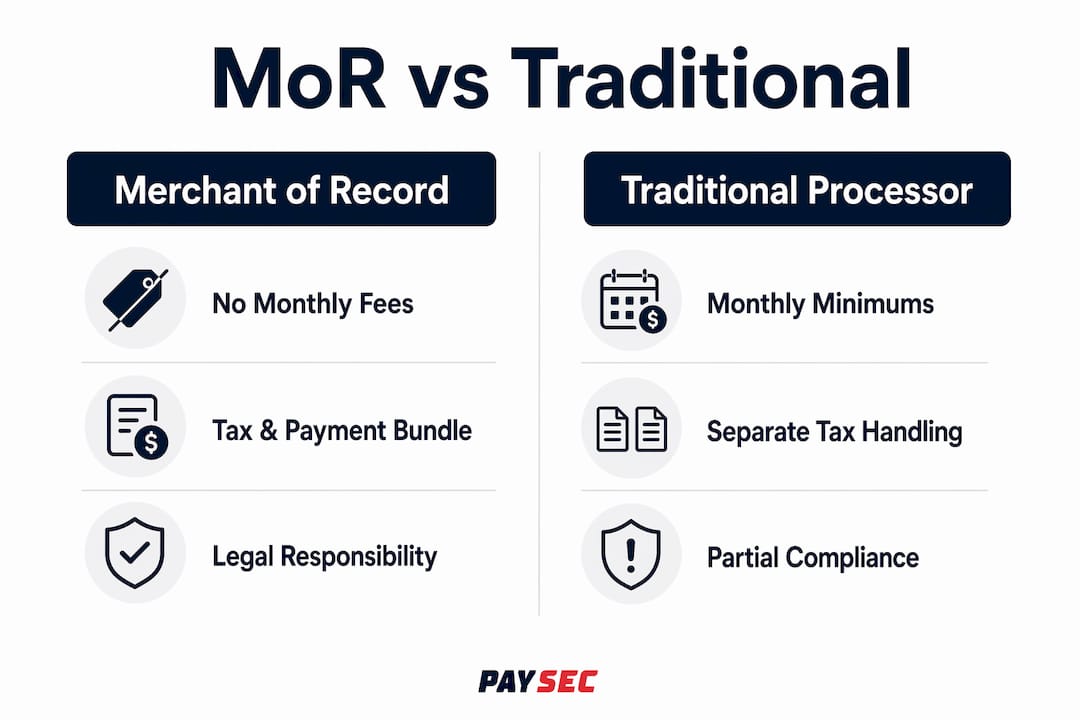
MoR providers like Nexway take full legal and financial responsibility for payments, tax, and compliance across more than 140 countries. That coverage removes the need for your business to register for VAT or GST in each market you enter. For a SaaS company expanding globally, that is a significant operational cost removed from the equation.
The bundling of tax and payment into a single per-transaction fee is exactly why MoR platforms can eliminate monthly minimums. Fixed costs like tax registration and reporting get absorbed into the provider's per-transaction economics rather than passed to you as a flat monthly charge. This shift is especially valuable for SaaS startups and scaling companies with uneven monthly revenue.
Pro Tip: Ask any payment provider to itemize every recurring fee before signing. Monthly minimums are sometimes labeled as "account maintenance fees" or "statement fees" in contracts.
Top no-minimum SaaS payment processors compared
The three most referenced no-minimum platforms for SaaS businesses in 2026 are Fungies.io, Vandly, and Nexway. Each serves a different stage and scale of SaaS business.
Fungies.io
Fungies.io operates as a full MoR platform built specifically for SaaS and digital product companies. It charges no monthly fees or minimums, bundling tax compliance and payment processing into a per-transaction rate. Typical MoR pricing across the category runs 3–7% per transaction plus fixed per-transaction fees. Fungies.io targets bootstrapped and early-stage SaaS companies that cannot absorb fixed monthly costs. It provides developer-friendly APIs, no-code checkout options, and global tax automation, making it accessible whether or not you have a dedicated engineering team.
Vandly
Vandly is an EU-based MoR platform that lets SaaS sellers go to market without registering a company or obtaining VAT IDs in target markets. Vandly charges a transparent 2% fee with the first sale free and handles compliance automatically. That pricing is among the lowest in the MoR category. Vandly suits early-stage SaaS founders who want to test a product in European markets without legal entity setup costs. Its no-code integration and automatic compliance handling make it a strong fit for solo founders and small teams.
Nexway
Nexway serves mid-size to enterprise SaaS businesses that need global reach with full compliance coverage. Nexway covers 140+ countries, includes fraud protection, and offers billing options that support complex subscription models. It absorbs tax registration and filing obligations entirely, removing that overhead from your finance team. Nexway is the right choice when your SaaS business is scaling internationally and needs a provider that can handle regulatory complexity at volume.
- Fungies.io: Best for bootstrapped SaaS startups needing zero fixed costs and developer-friendly tools
- Vandly: Best for early-stage founders entering European markets with minimal setup
- Nexway: Best for scaling SaaS businesses with global customer bases and complex billing needs
- Paysec: Best for SaaS businesses seeking processing cost savings of 30–60% through Network Offset Pricing with no minimums and no long-term contracts
No-minimum processors also commonly include developer-friendly APIs, global tax automation, customizable checkout flows, and multi-currency support. These features matter because your payment layer needs to handle diverse customer bases without requiring separate tools for each function.
Pro Tip: Request a sandbox environment from any processor before committing. Testing your actual checkout flow, subscription billing logic, and refund handling in a test environment reveals integration gaps that pricing pages never mention.

How to choose the right no-minimum SaaS payment processor
Choosing a flexible payment processing solution requires more than comparing per-transaction rates. The right processor depends on your business stage, geographic markets, technical resources, and compliance obligations.
1. Map your compliance exposure first. List every country where you have paying customers. If you sell in the EU, UK, Australia, or Canada, you face VAT, GST, or digital services tax obligations. An MoR platform absorbs those obligations. A standalone gateway does not. Choosing between MoR and a traditional processor is a critical decision for SaaS businesses operating in multiple jurisdictions.
2. Calculate your true monthly cost under each model. Take your average monthly transaction volume and apply the per-transaction rate. Then add any monthly minimums, statement fees, or compliance tool subscriptions the traditional processor requires. The total cost comparison often surprises finance teams who assumed the lower per-transaction rate was the better deal.
3. Evaluate integration requirements. Check whether the processor offers a native integration with your SaaS billing platform, whether that is Stripe Billing, Chargebee, or a custom subscription engine. A processor with a clean API and good documentation reduces engineering time. Fungies.io and Vandly both offer no-code options alongside developer documentation for teams that need flexibility.
4. Confirm what "no minimums" actually means in the contract. Some providers advertise no monthly minimums but include annual volume commitments or inactivity fees. Read the contract terms, not just the pricing page. Ask specifically: "Is there any fee I pay if I process zero transactions in a given month?"
5. Assess payout timing and currency options. Global SaaS businesses need payouts in multiple currencies without excessive conversion fees. Confirm the processor's payout schedule, supported currencies, and foreign exchange rates before signing. Nexway's global coverage across 140+ countries includes multi-currency payout options that matter for international revenue.
6. Check reporting and analytics depth. SaaS payment reporting is not optional for finance teams managing recurring revenue. Your processor should provide transaction-level detail, failed payment tracking, chargeback reporting, and tax remittance records. Weak reporting creates reconciliation problems that cost finance teams hours every month.
How to implement a no-minimum SaaS payment processor effectively
Getting a no-minimum processor live is straightforward when you follow a structured setup process. The common mistakes happen in configuration, not in the initial signup.
Step 1: Complete your account and compliance documentation. MoR platforms require business verification documents, banking details for payouts, and product category information. Gather these before starting the application. Vandly and Fungies.io both have fast onboarding processes designed for SaaS businesses.
Step 2: Configure your product catalog and pricing. Set up your subscription tiers, one-time purchase options, and trial periods inside the processor's dashboard. Map each product to the correct tax category. MoR platforms handle tax calculation automatically, but they need accurate product classifications to apply the right rates.
Step 3: Integrate with your SaaS billing system. Connect the processor to your existing billing infrastructure using the provider's API or native integration. Test every billing scenario: new subscriptions, upgrades, downgrades, cancellations, and refunds. Do not skip the refund and chargeback flow testing. These edge cases cause the most operational problems post-launch.
Step 4: Set up monitoring and alerts. Configure alerts for failed payments, unusual chargeback rates, and payout delays. SaaS businesses that pay excess processing fees often do so because they lack visibility into their transaction data. Real-time monitoring prevents small fee anomalies from becoming large monthly losses.
Step 5: Establish a monthly reconciliation process. Download transaction reports monthly and reconcile them against your accounting system. Verify that tax remittances match what the MoR platform reports. Even when the provider handles compliance, your finance team needs to confirm accuracy for internal records and investor reporting.
Best practices for ongoing management include the following:
- Review your per-transaction rate annually and benchmark it against current market rates
- Monitor your chargeback ratio monthly. A ratio above 1% triggers additional scrutiny from processors
- Keep your product catalog and tax classifications updated when you add new features or pricing tiers
- Confirm payout schedules align with your cash flow needs, especially during high-growth months
- Document your processor's dispute resolution process before you need it
Key Takeaways
A SaaS payment processor without minimums eliminates fixed monthly fees by charging only per transaction, with MoR platforms like Fungies.io, Vandly, and Nexway delivering the most complete no-minimum model by bundling tax compliance into each transaction fee.
| Point | Details |
|---|---|
| MoR eliminates fixed costs | Merchant of Record platforms bundle tax and payment into one per-transaction fee, removing monthly minimums entirely. |
| Compliance is the hidden cost | Traditional processors shift tax registration and filing costs to you; MoR platforms absorb them. |
| Pricing varies by stage | Vandly suits early-stage founders at 2% per transaction; Nexway serves enterprise-scale global SaaS. |
| Contract terms matter | Always verify that "no minimums" means no inactivity fees, no annual volume commitments, and no hidden charges. |
| Reporting drives savings | Transaction-level reporting and monthly reconciliation prevent fee creep and protect cash flow. |
Why zero-minimum pricing is the right default for SaaS businesses
The Paysec Marketing Team has worked with SaaS businesses across multiple growth stages, and the pattern is consistent. Companies that lock into monthly minimum contracts early almost always regret it. The minimum feels manageable at signup, but it becomes a fixed cost that survives slow months, product pivots, and seasonal dips in transaction volume.
The MoR model changed the conversation. When bundling taxes and payment into a single per-transaction fee removes administrative overhead, the total cost of payment processing becomes genuinely predictable. You pay more when you earn more, and you pay nothing when you earn nothing. That alignment between cost and revenue is exactly what early-stage SaaS businesses need to survive the unpredictable early years.
The compliance angle is underappreciated. Most SaaS founders focus on the per-transaction rate and ignore the cost of staying compliant in five or ten countries simultaneously. VAT registration in the EU, GST in Australia, and digital services taxes in the UK each require separate filings, separate registrations, and ongoing maintenance. An MoR platform absorbs all of that. The slightly higher per-transaction rate is almost always cheaper than the legal and accounting fees required to manage compliance independently.
The trend for 2026 is clear. More SaaS businesses are choosing MoR platforms not just for the no-minimum pricing but for the operational simplicity. The MoR model is increasingly favored by startups and mid-size businesses because it lets teams focus on product and growth instead of payment infrastructure. Evaluate your no-minimum options before you scale internationally. Switching processors after you have built billing integrations across multiple markets is expensive and time-consuming.
— PaySec Marketing Team
How Paysec supports SaaS businesses with no-minimum payment processing
Paysec brings a different approach to the no-minimum model through its Network Offset Pricing, which gives SaaS businesses access to wholesale interchange rates without monthly minimums or long-term contracts.
SaaS businesses using Paysec report processing cost reductions of 30–60%, with one SaaS marketplace cutting costs by 42% after switching. Paysec serves businesses across 18+ industries with full transaction-level reporting, pricing transparency, and compliance support built in. Explore Paysec's pricing model to see how Network Offset Pricing compares to what you pay today. For SaaS-specific payment solutions, the Paysec SaaS page covers the full feature set tailored to subscription billing and recurring revenue.
FAQ
What is a SaaS payment processor without minimums?
A SaaS payment processor without minimums charges only per transaction, with no monthly fees, no setup costs, and no penalties for low-volume months. Merchant of Record platforms like Fungies.io, Vandly, and Nexway are the most common examples of this model.
Why do MoR platforms offer no monthly minimums?
MoR platforms bundle tax compliance and payment processing into a single per-transaction fee, which shifts fixed costs into variable costs. This bundling eliminates the need to charge monthly minimums because the provider's revenue scales directly with transaction volume.
What is the typical per-transaction rate for no-minimum SaaS processors?
Typical MoR pricing runs 3–7% per transaction plus fixed per-transaction fees, though Vandly charges as low as 2% with the first sale free. Rates vary based on transaction volume, geography, and the complexity of compliance coverage included.
How does a Merchant of Record handle tax compliance for SaaS businesses?
An MoR platform registers for VAT, GST, and other digital services taxes in each jurisdiction on your behalf, collects the correct tax at checkout, and remits it to the relevant tax authority. Nexway's global coverage spans 140+ countries, removing the need for your business to manage separate tax registrations.
Can a no-minimum payment processor scale with a growing SaaS business?
No-minimum processors scale directly with transaction volume because costs are entirely variable. No minimum fee processors allow SaaS companies to grow transaction volume without inflated fixed costs, improving cash flow predictability at every stage of growth.