

The fastest way to cut ecommerce fees is to start with payment processing. It is the one cost that grows with every sale, and the pricing model behind it decides how much of each sale you keep. Move to transparent pass-through pricing such as interchange-plus or Network Offset Pricing. Then tighten checkout, fulfillment and promotions. PaySec's Network Offset Pricing passes through wholesale interchange rates with no minimums and no long-term contracts, and merchants typically save 30-60% compared to major processors.
This guide is for ecommerce store owners, restaurant operators with online ordering, healthcare practices, CBD retailers and SaaS marketplace owners. Each of them pays card fees on every online sale. Below you will find where the money goes, what to change first, and how to prove the savings.
TL;DR
- Start with processing fees. Every online sale carries a card fee, so the pricing model matters more than any single line item.
- Choose pass-through pricing. Interchange-plus shows the true cost plus a fixed markup, and Network Offset Pricing is built to remove the flat-rate markup.
- Fix the checkout. Failed payments, abandoned carts and fraud losses all cost money you have already spent to acquire.
- Review shipping and promotions second. Benchmarks and discount research show where margin leaks outside payments.
- Measure for 90 days. Compare effective rate, conversion and net margin per order, not just the headline rate.
Table of Contents
- Where ecommerce fees add up
- Strategy 1: Read your statement and find your effective rate
- Strategy 2: Move from tiered or flat-rate pricing to pass-through pricing
- Strategy 3: Optimize by transaction type
- Strategy 4: Protect the sales you already paid to acquire
- Strategy 5: Offer flexible payment options without giving up margin
- Strategy 6: Trim shipping and fulfillment
- Strategy 7: Protect margin in pricing and promotions
- How to measure results
- What this means for your industry
- Switch your ecommerce processing to PaySec
- Our perspective
- FAQ
- Sources
Where ecommerce fees add up
Before you cut anything, list what you pay per order. Most online stores carry the same five groups of costs:
- Payment processing: interchange, card network assessments, processor markup, gateway and statement fees.
- Platform and app fees: subscriptions, transaction fees and add-ons.
- Fulfillment and shipping: pick and pack, packaging, postage, returns.
- Acquisition: advertising and promotional discounts.
- Risk: chargebacks, fraud and failed payments.
Payment processing is the place to begin because it is invisible on most dashboards. You see revenue, then a deposit that is smaller than expected. The difference is spread across many small lines.
The scale of card costs in the US is large. The Federal Reserve reports that interchange fees on debit and general-use prepaid transactions totaled $34.12 billion in 2023, and network fees to all parties were $12.95 billion. In the same report, acquirers and merchants paid 64.9% of those network fees. Those figures cover debit and prepaid cards regulated under the Federal Reserve's rules, and credit cards add more on top. The point for a merchant: card costs are made of interchange, network fees and processor markup, and only the markup is set by your provider. How your provider prices the other layers decides whether you can see them.
Our guide to the types of ecommerce payment processing fees breaks each layer down line by line.
Strategy 1: Read your statement and find your effective rate
Your effective rate is the total fees paid divided by the total card volume processed in the same month. It is the only number that tells you what card acceptance really costs.
Here is the routine:
- Pull the last three monthly statements.
- Add every fee: per-transaction fees, percentage fees, gateway fees, monthly fees, PCI fees, chargeback fees.
- Divide the total by gross card volume.
- Split online (card-not-present) sales from in-person sales if you sell both. Online sales usually cost more to process, as our comparison of ecommerce vs. in-person processing fees explains.
- Look for grouped line items such as "qualified," "mid-qualified" and "non-qualified." These are signs of tiered pricing, where your processor decides which bucket each transaction lands in.
Where this goes wrong: a quoted rate such as "2.9% plus a fixed fee" is not your effective rate. Extra fees add to it, and a flat-rate model builds a markup into every transaction, whatever the card costs the processor.
You do not have to run this alone. PaySec shows detailed transaction reporting, so you can see what each sale costs. The Merchant Checklist for interchange-plus pricing walks through the calculation and the markup you should expect to see.
Strategy 2: Move from tiered or flat-rate pricing to pass-through pricing
There are three common ways a processor can price card fees.
| Model | How it works | What you see |
|---|---|---|
| Tiered | Transactions are grouped into buckets, each with its own rate | Few details on the real cost per card |
| Flat rate | One percentage and fixed fee for every transaction | A simple number with the markup built in |
| Interchange-plus | Wholesale cost passed through, plus a stated markup | The real cost and the markup separately |
| Network Offset Pricing | Wholesale interchange passed through with transparent reporting | The real cost per transaction and what is offset |
The Washington State Attorney General's Office has explained that switching from tiered pricing to interchange-plus can save merchants as much as 25 percent each month. Its explanation is simple: with interchange-plus, the provider passes through what it is charged and adds a flat-fee markup, rather than sorting transactions into tiers. That is the same logic behind transparent pricing at any scale.
PaySec goes one step further with Network Offset Pricing. It passes through true wholesale interchange rates and removes the flat-rate markup. Merchants can offer customers flexible payment options while keeping their full revenue. PaySec's positioning is that merchants typically save 30-60% compared to major processors. It adds no hidden fees, no minimums and no long-term contracts. Our page on how Network Offset Pricing works gives the details, and our article on lowering credit card processing fees with Network Offset Pricing shows the mechanics.
For a side-by-side view, read flat-rate vs. interchange-plus vs. Network Offset Pricing.
A worked example
Take an online store processing $1,000,000 a year in card sales. This is an illustration, not a quote.
- At an all-in effective rate of 3.0%, annual card costs are $30,000.
- If savings in the 30-60% range PaySec describes applied to those costs, the annual cost would fall to between $12,000 and $21,000.
- That is $9,000 to $18,000 that stays in the business, with no change to prices, products or traffic.
If that store earns a 10% net margin, it makes $100,000 on that volume. Savings of $9,000 to $18,000 would raise profit by 9% to 18% without selling one more item. This is why processing is the first cost to fix.
Strategy 3: Optimize by transaction type
Once the pricing model is transparent, you can reduce cost per transaction type.
Debit vs. credit. Debit and credit cards carry different wholesale costs. Our article on five data-backed ways to lower debit vs. credit fees covers how to read the split on your statement.
B2B and commercial cards. If you sell to businesses, PaySec's Enhanced Data Optimization is designed to supply the extra transaction data that commercial cards need, aimed at B2B savings. Wholesale marketplaces and SaaS platforms with business buyers should ask for it first.
ACH and bank transfers. For high-ticket or recurring invoices, moving payments from cards to bank transfers can reduce cost per payment. PaySec supports ACH & bank transfers alongside cards.
Recurring billing. For subscription and SaaS models, one processor for cards, ACH and recurring billing keeps reporting in one place. PaySec offers recurring billing as part of its merchant services.
Card network fees. Network assessments and similar fees are set by the card networks, so the lever is visibility. Our 90-day playbook to cut card network fees lays out the steps.
Strategy 4: Protect the sales you already paid to acquire
A fee strategy is also a conversion strategy. Every abandoned cart carries ad spend, platform cost and your time, and earns nothing.
Focus on three areas:
- Payment failures. Declines caused by weak gateway setup or missing data mean lost orders. A gateway that supports your checkout flow without extra steps keeps more orders.
- Checkout friction. Fewer form fields, saved payment methods and mobile-ready payment pages make a sale easier to finish. PaySec's mobile payments and eCommerce gateway are built for this.
- Fraud losses. Chargebacks cost the sale, the product and a fee. PaySec includes fraud prevention with its eCommerce services, and runs to PCI DSS Level 1 and SOC 2 compliance standards.
Our guide to reducing cart abandonment payment fees shows how the payment layer affects conversion.
Strategy 5: Offer flexible payment options without giving up margin
Shoppers like choices at checkout, including installments. The cost depends on who pays for them. With some models the merchant absorbs a fee on each financed order, so it pays to plan the fee into your pricing and your average order value. A clear summary of BNPL fees for merchants shows what these programs typically charge and how to plan for them.
Network Offset Pricing takes a different route to the same goal. It lets a business offer customers flexible payment options while retaining full revenue, so the choice at checkout does not come out of your margin.
Strategy 6: Trim shipping and fulfillment
Outside payments, fulfillment is the next largest controllable cost. The practical step is to benchmark what you pay.

The WinsBS 2025 vertical fulfillment benchmark report puts the typical median for first-unit pick-and-pack fees at $2.60 to $2.95, with the middle half of providers between $2.40 and $3.25. If your first-unit fee sits well above that band, it is worth a conversation with your fulfillment partner.
A short checklist:
- Compare your pick-and-pack fee with the benchmark range.
- Right-size packaging so you do not pay for air.
- Set a free-shipping threshold slightly above your current average order value, so more orders cross it.
- Review returns by reason code and fix the product pages behind the most common ones.
Strategy 7: Protect margin in pricing and promotions
Discounts are a fee you pay yourself. Two published findings are useful here.
NielsenIQ's 2025 pricing and promotion guide states that overpromotion erodes base volume and trains shoppers to move from deal to deal. It recommends judging promotions against set KPIs to find the right offer, price and calendar cadence.
Simon-Kucher reports that 65% of top-performing consumer firms treated price increases as a top priority in 2023, and that surgical, selective increases can improve margins without large volume losses.
What to do with that:
- Set a KPI for each promotion before it starts, such as margin per order after discount and payment costs.
- Keep a promotion calendar so offers do not run back to back.
- Raise prices on the items with the strongest demand rather than across the catalog.
- Calculate margin after payment costs. When processing costs fall, the same price leaves more margin, and you can run fewer discounts.
How to measure results
Savings that are not measured are easy to lose. Use a 90-day window and track the same numbers each month.
| Metric | How to calculate | Why it matters |
|---|---|---|
| Effective processing rate | Total fees / card volume | The truest cost of accepting cards |
| Cost per order | Payment fees / number of orders | Shows the effect of order size |
| Checkout conversion | Completed orders / checkout starts | Confirms savings did not hurt sales |
| Payment decline rate | Declined payments / attempts | Flags lost orders |
| Chargeback rate | Chargebacks / orders | Tracks fraud losses |
| Net margin per order | Revenue minus product, shipping, payment and promo costs | The number that counts |
Two rules keep the exercise honest. First, compare the same period, such as the same months a year apart, so seasonality does not distort the result. Second, change one thing at a time where you can. If you change pricing model, shipping threshold and promotions in the same week, you will not know which one worked.
PaySec's real-time reporting is designed to make the first four rows quick to read, since each transaction is visible with its costs.
What this means for your industry
Ecommerce stores. Start with the effective rate and your pricing model. Online sales carry the highest processing costs, so this is where transparent pricing pays back first. See how to eliminate hidden merchant fees.
Restaurant chains. Online ordering and in-person sales run through the same processor, so one pricing model across locations makes costs comparable. Reporting by location shows which sites cost more to run. PaySec offers free terminal placement at $0 per month, with in-store processing alongside online ordering.
Healthcare practices. Patients pay through portals, by phone and at the desk. PaySec supports PCI DSS Level 1 and SOC 2 compliance, which suits practices that need compliant payments, along with recurring billing for payment plans.
CBD and high-risk retailers. Fair pricing and fast approvals matter most here. PaySec supports high-risk verticals, including CBD, with fast approvals, no contracts and dedicated merchant accounts.
SaaS and marketplace owners. Recurring billing, ACH and Enhanced Data Optimization for B2B buyers are the main levers, and custom enterprise pricing is available for high volume.
Switch your ecommerce processing to PaySec
If payment processing is your largest controllable cost, PaySec is built for it. Our eCommerce payment processing offering includes an online payment gateway with fraud prevention, and our merchant services cover in-store, mobile, ACH and recurring billing. Pricing options are Network Offset, Flat Rate and Custom Enterprise, with no minimums and no long-term contracts. See the pricing options or start at paysec.ai.
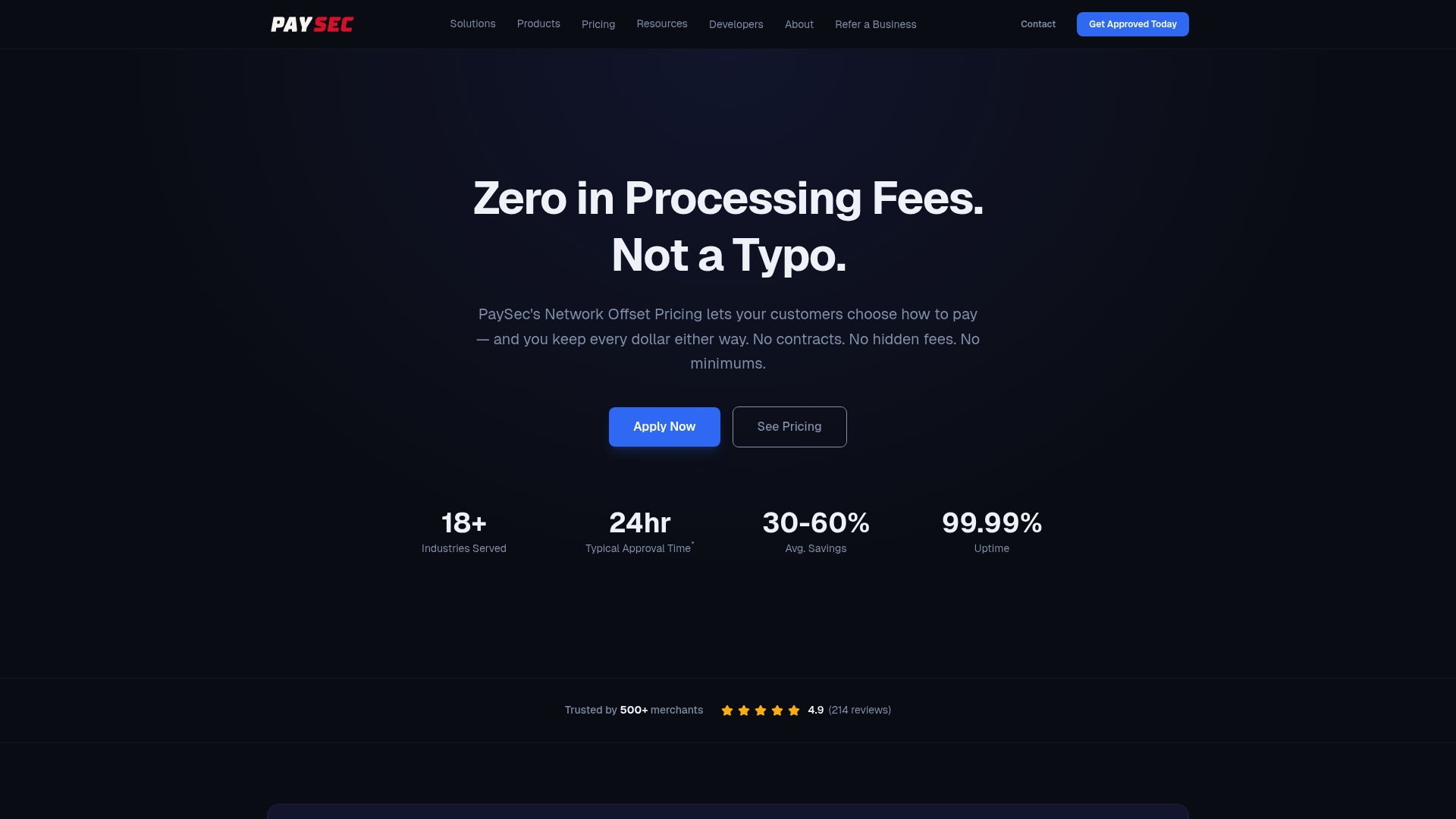
Merchants across 18+ industries use PaySec, including SaaS, restaurants, eCommerce, healthcare and CBD retail. One reported result is a 42% reduction in processing costs.
Our perspective
Most merchants we talk to know their sales numbers to the dollar and their processing costs to the nearest guess. That gap is where money is lost.
We built Network Offset Pricing so the cost of accepting cards is passed through at true wholesale interchange rates, with no flat-rate markup. We think the right model is the one a merchant can read: every transaction, every fee, every month.
That is why we pair pricing with detailed transaction reporting, no minimums and no long-term contracts. A merchant should keep the revenue they earn, and be able to see exactly where it goes.
Our approach is designed to deliver savings of 30-60% compared with major processors. For a store, a restaurant group or a practice, that means more margin without changing prices or losing customers.
PaySec Marketing Team
FAQ
What is the quickest way to reduce ecommerce fees?
Review your processing pricing first. Calculate your effective rate from three months of statements, then move to a transparent model such as interchange-plus or Network Offset Pricing. Because card fees apply to every order, this change affects every sale.
How much can switching pricing models save?
The Washington State Attorney General's Office has said interchange-plus can save merchants as much as 25 percent each month over tiered pricing. PaySec states that merchants typically save 30-60% compared with major processors. Your result depends on your card mix, volume and current pricing.
Will lower fees affect payment security or checkout experience?
No. PaySec operates to PCI DSS Level 1 and SOC 2 compliance standards and includes fraud prevention with its eCommerce gateway. Pricing and security are separate layers, so you can lower cost and keep a smooth checkout.
Do I need a long contract or minimum volume?
Not with PaySec. There are no monthly minimums and no long-term contracts. High-volume businesses can ask about custom enterprise pricing.
Sources
- Federal Reserve: 2023 Interchange Fee Revenue, Covered Issuer Costs, and Covered Issuer and Merchant Fraud Losses
- Washington State Attorney General: Cut credit card processing fees with interchange plus
- WinsBS: 2025 Vertical Fulfillment Benchmark Report
- NielsenIQ: The Ultimate Guide to Pricing and Promotion, June 2025
- Simon-Kucher: Growth during volatility, 3 strategies for US consumer businesses