

TL;DR:
- Ecommerce payment processing fees include fixed and variable costs, with interchange fees being non-negotiable. Merchants should focus on negotiating processor markups and gateway fees, especially for high-volume transactions, to reduce overall costs. Utilizing ACH payments for high-value or recurring transactions offers significant savings by replacing costly card processing fees.
Ecommerce payment processing fees are the distinct charges merchants pay every time a customer completes an online transaction, covering interchange fees, processor markups, payment gateway charges, assessment fees, chargeback costs, and ACH flat fees. Understanding each fee type is not optional for financial decision-makers. The difference between a 1.8% effective rate and a 3.2% effective rate can represent tens of thousands of dollars annually for a mid-volume ecommerce business. Brands like Stripe, PayPal, and Plaid each bundle these costs differently, which makes comparing apples to apples nearly impossible without knowing what you are actually looking for.
1. Types of ecommerce payment processing fees: the full breakdown

Before negotiating or switching providers, you need to know exactly which charges appear on your statement and why. The types of ecommerce payment processing fees fall into two broad categories: fixed costs set by card networks and variable costs set by your processor. Fixed costs are largely outside your control. Variable costs are where your leverage lives.
Here is how the full fee structure maps out:
- Interchange fees: Paid to the card-issuing bank, set by Visa, Mastercard, or American Express
- Assessment fees: Paid directly to the card network for transaction processing services
- Processor markup: The margin your payment processor adds on top of interchange and assessments
- Payment gateway fees: Charged for the technology that authorizes and routes transactions
- Chargeback fees: Triggered when a customer disputes a transaction
- Monthly and setup fees: Fixed recurring or one-time charges for account maintenance and onboarding
- ACH fees: Flat per-transfer fees for bank-to-bank payments, separate from card rails
Each of these operates independently. A low advertised rate from a processor can still produce a high effective rate once gateway fees, monthly minimums, and chargeback costs are added in.
2. What interchange fees are and why they are non-negotiable
Interchange fees are the largest single component of credit card processing fees, paid by the merchant's acquiring bank to the customer's issuing bank on every card transaction. Visa, Mastercard, and American Express set these rates unilaterally, and they vary based on card type, transaction method, and merchant category code.
A rewards credit card carries a higher interchange rate than a basic debit card. A card-not-present transaction (standard in ecommerce) carries a higher rate than a card-present swipe. For most ecommerce merchants, interchange rates land between 1.5% and 2.5% per transaction, though premium rewards cards from American Express can push that figure higher.
Interchange fees are fixed by networks and cannot be negotiated by merchants or processors. This is the most misunderstood fact in payment processing. No matter how large your volume or how strong your relationship with your processor, the interchange rate on a Visa Signature card is the same for every merchant in your category.
- Visa and Mastercard publish their interchange schedules publicly and update them periodically
- American Express historically set higher rates, though its OptBlue program has narrowed the gap for smaller merchants
- Merchant category codes (MCCs) directly affect your interchange rate, and an incorrect MCC can cost you more than necessary
Pro Tip: Since interchange is non-negotiable, redirect all fee negotiation energy toward your processor markup and gateway fees. Those are the layers where real savings exist. Read more about how interchange works before your next contract renewal.
3. How processor markups and payment gateway fees affect overall costs
Processor markup is the fee your payment processor charges on top of interchange and assessment fees. This is where pricing models diverge significantly and where processor fees can be negotiated based on your transaction volume and fraud profile.
The markup structure depends on which pricing model your processor uses:
- Flat-rate pricing: One blended rate covers interchange, assessments, and markup. Stripe charges 2.9% plus $0.30 per transaction. Simple, but often expensive for high-volume merchants.
- Interchange-plus pricing: Interchange is passed through at cost, and the processor adds a fixed markup (e.g., 0.3% plus $0.10). More transparent and typically cheaper at scale.
- Tiered pricing: Transactions are bucketed into qualified, mid-qualified, and non-qualified tiers. This model obscures true costs and almost always favors the processor.
- Subscription pricing: A flat monthly fee replaces percentage-based markups. Stax uses this model, which benefits merchants with high average transaction values.
Payment gateway fees are a separate charge for the software layer that encrypts, routes, and authorizes each transaction. Providers like Authorize.Net charge a monthly gateway fee plus a per-transaction fee. Stripe and PayPal bundle gateway costs into their flat rate, which makes comparison harder but not impossible.
Gateway fees typically include:
- Monthly gateway access fees ($10 to $30 per month is common)
- Per-transaction authorization fees ($0.05 to $0.15 per transaction)
- Tokenization or data storage fees for recurring billing
- API call fees for high-frequency integrations
Pro Tip: Merchants processing over $50,000 per month have real negotiating power on markup and gateway fees. Bring three months of statements to any negotiation. Processors respond to data, not requests. Compare your pricing model options before signing any new agreement.
4. Additional fees to watch: assessment, chargeback, monthly, and setup charges
Beyond interchange and markup, several supplementary fees inflate your effective processing rate in ways that rarely appear in sales conversations. Assessment fees are charged by card networks per transaction and cover the network's infrastructure and services. Visa's assessment fee is approximately 0.14% per transaction. Mastercard's is similar. These are small individually but add up at volume.
Chargeback fees are triggered by payment disputes and carry costs beyond the fee itself. Most processors charge between $15 and $100 per chargeback incident, and a high chargeback ratio (above 1% of transactions) can result in account termination or placement in a high-risk category with permanently elevated rates.
Monthly maintenance and setup fees vary widely by provider. Some processors charge no monthly fee. Others charge statement fees, PCI compliance fees, or batch fees that appear as line items most merchants never question.
Here is a summary of the supplementary fees merchants commonly encounter:
| Fee type | Typical cost range | Negotiable? |
|---|---|---|
| Assessment fee | 0.13% to 0.15% per transaction | No |
| Chargeback fee | $15 to $100 per dispute | Sometimes |
| Monthly statement fee | $5 to $15 per month | Yes |
| PCI compliance fee | $5 to $30 per month | Yes |
| Setup or onboarding fee | $0 to $500 one-time | Yes |
| Batch processing fee | $0.10 to $0.30 per batch | Sometimes |
PCI compliance fees deserve special attention. They appear on statements as monthly charges and can escalate into significant penalties if your compliance documentation is outdated or missing. Merchants who complete their annual PCI Self-Assessment Questionnaire on time typically pay the lower monthly rate. Those who do not can face non-compliance surcharges that dwarf the original fee.
Review your processing statement line by line every quarter. Most merchants who do this for the first time find at least one fee they cannot explain. A resource like the guide on hidden processing fees gives you a checklist to work through systematically.
5. How ACH fees differ and when to use ACH for savings
ACH (Automated Clearing House) payments operate on an entirely different fee structure than card transactions. ACH flat fees commonly range from $0.20 to $1.50 per transfer, regardless of the transaction amount. That structure makes ACH dramatically cheaper for high-value or recurring payments compared to percentage-based card fees.
Consider the math: a $5,000 B2B invoice paid by credit card at 2.9% costs the merchant $145 in processing fees. The same payment via ACH costs under $1.50. That gap compounds fast for businesses with recurring billing, subscription models, or large average order values.
Here is how ACH and card fees compare directly:
| Payment method | Fee structure | Cost on $1,000 transaction | Best use case |
|---|---|---|---|
| Credit card (flat-rate) | 2.9% + $0.30 | $29.30 | Low-value, one-time purchases |
| Credit card (interchange-plus) | ~1.8% + $0.10 | $18.10 | Mid-volume retail |
| ACH transfer | $0.20 to $1.50 flat | $0.20 to $1.50 | Recurring billing, B2B, subscriptions |
| Debit card | ~0.8% + $0.15 | $8.15 | In-person or low-value ecommerce |
Plaid and Ramp both support ACH payment initiation and verification, making it practical to offer ACH as a checkout option without significant technical overhead. The main caution with ACH is return fees. A returned ACH transaction (due to insufficient funds or incorrect account details) typically costs $2 to $5 per return and can trigger additional review from your processor.
Pro Tip: Audit your payment mix quarterly. If more than 30% of your revenue comes from recurring billing or B2B transactions, you are almost certainly leaving money on the table by defaulting to card processing. Understanding how to read your processing statement is the first step toward identifying where ACH can replace card fees.
ACH is a practical cost-saving alternative to card processing for large and recurring payments. This is not a niche strategy. It is standard practice among financially sophisticated ecommerce operators.
6. Comparing pricing models: flat-rate, tiered, interchange-plus, and subscription
Credit card processing fees vary significantly by pricing model, and the model your processor uses determines how much visibility you have into your actual costs. Choosing the wrong model for your transaction profile is one of the most common and most expensive mistakes ecommerce merchants make.
Flat-rate pricing bundles interchange, assessments, and markup into one percentage. Stripe at 2.9% plus $0.30 and PayPal at similar rates are the most recognizable examples. This model is predictable and easy to budget, but it overcharges merchants whose card mix skews toward lower-interchange debit cards. You pay the same rate whether a customer uses a basic Visa debit card or a premium Amex rewards card.
Tiered pricing sorts transactions into qualified, mid-qualified, and non-qualified buckets. Processors define these buckets themselves, which means they can classify more transactions into higher-cost tiers at their discretion. This model is the least transparent and is generally unfavorable for merchants who understand their numbers.
Interchange-plus pricing passes interchange through at actual cost and adds a fixed processor margin. A rate of interchange plus 0.3% plus $0.10 is typical for mid-market merchants. This model rewards merchants with a favorable card mix and gives full visibility into what the network charges versus what the processor charges.
Subscription pricing, used by providers like Stax, replaces percentage markups with a flat monthly fee. Merchants pay interchange at cost plus a monthly subscription. This model works best for businesses with high average transaction values, where eliminating the percentage markup produces savings that exceed the monthly fee.
- Flat-rate: best for low-volume merchants under $10,000 per month who value simplicity
- Tiered: avoid unless you have no alternative and understand the tier definitions in writing
- Interchange-plus: best for merchants above $25,000 per month who want cost transparency
- Subscription: best for high-ticket merchants where the monthly fee is offset by markup savings within the first few transactions
The comparison between pricing models also needs to account for a fourth option that most merchants have never heard of: Network Offset Pricing, which Paysec uses to pass wholesale interchange rates directly to merchants while offsetting fees through compliant customer pricing structures.
Key takeaways
Ecommerce payment processing costs are controllable once you separate the non-negotiable network fees from the processor and gateway layers where real negotiation leverage exists.
| Point | Details |
|---|---|
| Interchange is fixed | Card networks set interchange rates; redirect all negotiation to processor markup and gateway fees. |
| ACH cuts costs dramatically | ACH flat fees of $0.20 to $1.50 replace percentage-based card fees for recurring and high-value payments. |
| Pricing model selection matters | Interchange-plus or subscription models outperform flat-rate pricing for merchants above $25,000 per month. |
| Hidden fees compound fast | PCI compliance, chargeback, and statement fees add 0.3% to 0.8% to effective rates when left unchecked. |
| Negotiation is real | Processor markups and gateway fees are negotiable based on volume and fraud profile, per Forbes 2026. |
What most merchants get wrong about processing fees
After working with merchants across ecommerce, SaaS, healthcare, and retail, the Paysec team has seen one pattern repeat without exception: merchants focus on the headline rate and ignore everything underneath it.
A merchant sees "2.9% plus $0.30" and thinks they understand their costs. They do not. That rate does not tell them whether they are on flat-rate or interchange-plus. It does not reveal the $25 monthly PCI fee, the $0.15 batch fee, or the $35 chargeback fee sitting three lines down on their statement. The effective rate, meaning total fees divided by total volume, is almost always higher than the advertised rate. Often by 30% to 50%.
The second mistake is treating all fees as fixed. Many merchants mistakenly believe all processing rates are fixed. Processor markups, gateway fees, monthly minimums, and even chargeback fees have room to move, especially for merchants with clean fraud records and consistent volume. The merchants who negotiate are the ones who know which line items are negotiable before they pick up the phone.
The third mistake is ignoring ACH entirely. For any business with recurring revenue or B2B transactions above $500, defaulting to card processing is a choice to pay 20 to 50 times more per transaction than necessary. That is not an exaggeration. It is arithmetic.
The Paysec team recommends pulling your last three months of processing statements, calculating your true effective rate, and mapping every fee to one of the seven categories covered in this article. That exercise alone typically surfaces $500 to $5,000 in annual savings for merchants doing $500,000 or more in volume. The fees are already there. You just need to see them clearly.
— PaySec Marketing Team
See how Paysec eliminates the fees that hurt most
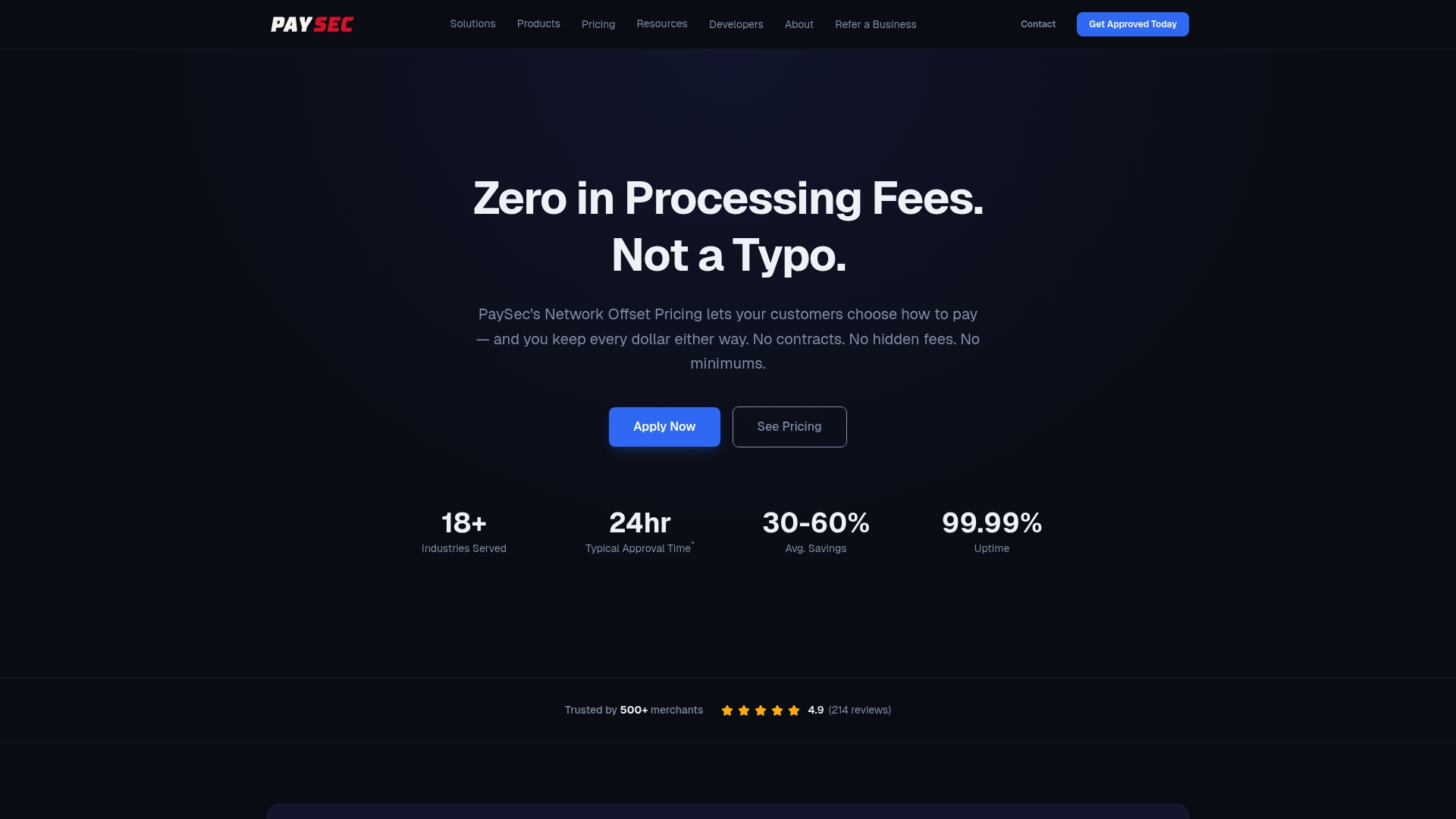
Most processors profit from the fees you do not notice. Paysec is built on the opposite model. Through Network Offset Pricing, Paysec passes wholesale interchange rates directly to merchants and offsets processing costs through compliant customer pricing structures, producing verified savings of 30% to 60% for clients across ecommerce, SaaS, healthcare, and CBD retail. There are no hidden fees, no monthly minimums, and no long-term contracts. Merchants across 18+ industries have used Paysec to cut effective processing rates without changing how customers pay. If your current processor cannot explain every line on your statement, explore what Paysec offers and see what your fees should actually look like.
FAQ
What are the main types of ecommerce payment processing fees?
The main types include interchange fees, processor markups, payment gateway fees, assessment fees, chargeback fees, monthly maintenance fees, and ACH flat fees. Each fee type has a different source, cost structure, and level of negotiability.
Are interchange fees negotiable?
Interchange fees are set by card networks like Visa and Mastercard and are not negotiable by merchants or processors. Negotiation opportunities exist at the processor markup and gateway fee levels instead.
How much can ACH payments reduce processing costs?
ACH fees typically range from $0.20 to $1.50 per transfer regardless of transaction size, compared to 1.8% to 2.9% for card transactions. On a $2,000 payment, that difference can exceed $40 per transaction.
What is the difference between flat-rate and interchange-plus pricing?
Flat-rate pricing bundles all fees into one percentage, while interchange-plus separates the network's interchange cost from the processor's fixed markup. Interchange-plus is more transparent and typically cheaper for merchants processing above $25,000 per month.
What hidden fees should merchants watch for on processing statements?
PCI compliance fees, batch processing fees, monthly statement fees, and chargeback fees are the most commonly overlooked charges. Reviewing your processing statement quarterly helps catch fees that inflate your effective rate without explanation.