

Card network fees are the sum of interchange paid to issuers, assessments paid to networks like Visa and Mastercard, and any markup added by your processor, and they typically make up the majority of your card-processing cost. Visa, Mastercard, and the Federal Reserve all publish data on these fees, and merchants who understand each component can find real savings without switching card brands. Options like PaySec exist specifically to make that cost structure visible and negotiable.
TL;DR:
- Interchange fees, which are the largest component, depend on card type, merchant category, and data submitted, varying significantly across transactions.
- Assessment or network fees are generally fixed and non-negotiable, covering system operations like fraud monitoring and branding.
- Processor markups are the only component merchants can influence directly by negotiating or auditing statements for non-qualified transactions.
- Using Level 2 and Level 3 data, routing debit transactions correctly, and switching to interchange-plus pricing can significantly reduce processing costs.
- Cross-border and premium rewards cards add extra assessment fees, meaning international volume and high-rewards cards typically increase overall processing rates.
Table of Contents
- What card network fees include: interchange, assessments, and processor costs
- How interchange and network fees are calculated
- Regulation II and routing rules every merchant should know
- What changes a transaction's fee: category, card type, and data
- A prioritized playbook for lowering effective processing costs
- How PaySec's Network Offset Pricing applies here
- Who absorbs card network fees, and who benefits
- Regional and brand differences in card network fees
- Recent trends shaping card network fees
- Why card network fees fund cardholder rewards
- Sequencing fee-reduction work: an editorial view
- Put the playbook to work with PaySec
- FAQ
- Sources
What card network fees include: interchange, assessments, and processor costs
Every card transaction carries three distinct charges, and separating them is the first step toward controlling your processing bill.
Interchange is the fee paid to the cardholder's issuing bank. It is set by the card network (Visa, Mastercard) but collected on the bank's behalf, and it typically accounts for the largest share of total processing costs. Interchange rates depend on the merchant category, the card product used, and how the transaction data is submitted, a point confirmed in the Kansas City Fed's interchange fee update.

Network or assessment fees go to the card brand itself, not the issuing bank. These cover the cost of running the payment rails: fraud monitoring, network connectivity, and brand licensing. They apply to every transaction and are generally non-negotiable, regardless of processor.
Processor or acquirer markup is the one line item you can actually influence. This is what your payment processor adds on top of interchange and assessments to cover its own margin.
On a monthly statement, these three components combine into what is usually called the merchant discount rate. Common assessment-style charges include:
- Brand usage fees charged per transaction by the network
- Network connectivity or access fees tied to processing volume
- Fixed per-transaction fees layered on top of a percentage rate
Most merchants never separate these line items, which means they cannot tell whether a high bill comes from interchange, from assessments, or from processor markup. A statement audit answers that question directly, and it is the cheapest fee-reduction step available.
How interchange and network fees are calculated
Interchange is almost never a flat percentage. Most rates combine a percentage of the transaction value with a fixed cent amount, and the exact combination depends on the card's "qualification bucket," a category determined by card type, merchant category code, and the data submitted with the transaction.
Two quick examples show how the pieces stack, a process detailed in the Payment Gateway Integration Guide for Ecommerce.
- A $40 in-person debit transaction. Using a capped-issuer debit rate based on Regulation II formula components, interchange typically totals a few cents plus a small percentage of the transaction value. Adding typical assessment fees and processor markup, the total cost for a small debit transaction can be just above a dollar or around one percent of the sale.
- A $400 card-not-present credit transaction. A standard retail interchange rate near 1.8% plus $0.10 produces about $7.30 in interchange. Add assessment fees and a processor markup, and the total cost for a larger credit card transaction often ranges around a couple percent of the sale.
These are illustrative calculations using representative rate inputs, not published rates for a specific card product, and actual figures vary by issuer, network, and merchant category.
To find the real numbers for your business, go to the source rather than a secondhand summary:
- Visa and Mastercard publish their own interchange and assessment rate schedules for registered merchants and acquirers.
- The Federal Reserve's Regulation II average interchange fee data shows average fees per transaction and as a percentage of transaction value by network.
- The Kansas City Fed publishes periodic updates on interchange fees assessed to merchants, broken out by card type and category.
Regulation II and routing rules every merchant should know
The Durbin Amendment, implemented through the Federal Reserve's Regulation II, caps debit interchange for large issuers (generally those with $10 billion or more in assets) at $0.21 plus 0.05% of the transaction value, with an optional $0.01 fraud-prevention adjustment for issuers that meet certain standards, according to the Federal Reserve's Regulation II data. Smaller issuers are exempt from the cap, so a debit card from a community bank or credit union can carry a meaningfully different rate than one from a large national bank.
Regulation II also gives merchants a routing right: debit transactions must be able to run over at least two unaffiliated networks, and merchants get to choose which one processes the transaction.
- Debit cards must support at least two unaffiliated networks under Regulation II.
- Merchants, not issuers, choose which available network routes each debit transaction.
- Routing choice can shift a transaction to a lower-cost network without changing the card itself.
- The FTC's guidance on post-Durbin routing rules recommends merchants work with their acquirer to confirm which networks are available and review invoices for routing-related savings.
Check the Federal Reserve's Regulation II pages periodically, since the average fee tables are updated.
What changes a transaction's fee: category, card type, and data
Interchange is not one number. It shifts based on several factors a finance team can actually audit.
Merchant category code (MCC) assigns your business a risk and cost profile. Categories flagged as higher-risk or higher-fraud, such as certain travel, subscription, or specialty retail segments, often carry higher interchange than grocery or utility categories.
Card product matters as much as card brand. A basic consumer debit card, a standard rewards credit card, and premium travel rewards card can carry meaningfully different interchange rates for the identical purchase amount, because richer rewards programs are funded partly through higher interchange.
Data level separates casual transactions from optimized ones. Level 2 data (tax amount, customer code) and Level 3 data (line-item detail, product codes, shipping information) can qualify business and government transactions for lower interchange buckets than a basic swipe or online checkout provides, per the Kansas City Fed's reporting on fee drivers.
Channel and geography add another layer:
- Card-present transactions (chip or tap) generally qualify for lower rates than card-not-present transactions.
- Card-not-present (CNP) transactions, common in eCommerce, carry higher fraud risk and higher interchange.
- Cross-border transactions typically add an international or currency conversion assessment on top of standard interchange.
Pro Tip: Pull one month of statements and tag each transaction by MCC and channel before touching anything else, since that single audit usually reveals where the real cost is hiding.
A prioritized playbook for lowering effective processing costs
Fee reduction works best in sequence: cheap fixes first, structural changes second.
- Audit your statement. Separate interchange, assessments, and markup line by line, and flag any transaction coded as "non-qualified," since those often carry penalty rates tied to missing data fields.
- Review debit routing with your acquirer. Confirm which networks are enabled and whether a lower-cost option is available for your debit mix.
- Capture Level 2 and Level 3 data for business and government customers, since enhanced data frequently qualifies those transactions for lower interchange buckets.
- Move to interchange-plus pricing if you are still on a flat-rate or tiered plan, since interchange-plus separates true network cost from processor markup and makes the markup visible enough to negotiate.
- Shift repeat B2B invoicing to ACH where it fits your customer relationships, since bank transfers avoid card network fees entirely for recurring payments.
Pro Tip: Negotiate the markup, not the interchange. Interchange and assessments are set by the networks and issuers and are not up for discussion; your processor's margin is.
How PaySec's Network Offset Pricing applies here
The services map directly to the playbook above: transparent reporting, Level 3 support for B2B transactions, and no long-term contracts. Review the case studies and pricing pages for concrete examples.
Who absorbs card network fees, and who benefits
Card network fees distribute cost and benefit unevenly across the payment chain. Merchants pay the discount rate on every transaction, and for thin-margin businesses, that rate can determine whether a sale is profitable at all. Issuing banks receive the interchange portion, which funds everything from fraud protection to the rewards programs that make their cards attractive to cardholders.
Acquirers and processors sit in the middle, collecting their markup for handling settlement, risk, and customer support. Card networks collect assessment fees for maintaining the rails that make the whole system work, independent of which bank issued the card or which processor routed the transaction.
Consumers rarely see these fees directly, but they feel the effect. Rewards programs are funded in large part by interchange revenue, so cardholders using premium rewards cards are, in effect, financed by merchant processing costs. Some merchants pass a portion of card costs back to customers through surcharges or minimum purchase amounts, within the limits their card brand agreements and state rules allow.
The tension is structural: issuers and networks want interchange high enough to fund rewards and infrastructure, while merchants want it low enough to protect margin. Regulation II addressed part of that tension for debit cards, but credit interchange remains largely a negotiation between networks and issuers, with merchants on the receiving end of the rate, not a party to setting it.
Regional and brand differences in card network fees
Card network fees are not uniform across geography or brand, and that variation matters for any business processing cross-border or multi-brand volume.
Cross-border transactions typically carry an added assessment, sometimes called an international service fee, on top of standard interchange, since the issuing bank and the merchant's acquirer sit in different markets. Currency conversion, when it applies, adds a separate charge layered on top of that.
Between card brands, Visa and Mastercard each publish their own interchange and assessment schedules, and while the two networks often land in similar ranges for comparable card products, the specific percentage and fixed-cent components differ by category and card type. Discover and other networks set their own schedules as well, which is why the Federal Reserve's average interchange data by network breaks results out network by network rather than reporting one blended figure.
For merchants operating internationally or accepting multiple card brands, this means a single "average" processing rate rarely reflects reality. A business with meaningful cross-border volume should expect its effective rate to run higher than a purely domestic business with the same transaction mix, simply because of the added international assessment layer.
Recent trends shaping card network fees
Interchange and assessment schedules are not static. Visa and Mastercard typically update their rate tables multiple times a year, adjusting rates by category, card product, and channel as fraud patterns, data capabilities, and competitive pressure shift.
The Federal Reserve and the Kansas City Fed track these changes on the regulatory side. The Kansas City Fed's periodic updates on fees assessed to merchants give finance teams a benchmark to check their own rates against, since the averages are recalculated as networks adjust their schedules.
One steady trend is the growing gap between card-present and card-not-present qualification, as fraud risk in digital channels pushes networks to price CNP transactions higher relative to in-person chip and tap payments. Another is the continued expansion of enhanced data programs, with networks adding incentives for merchants who submit Level 2 and Level 3 data on B2B and government transactions.
Debit routing has also drawn renewed attention since the Regulation II framework gives merchants routing choice, and acquirers continue to add lower-cost network options to that routing menu. Tracking these shifts against official sources rather than secondhand summaries is the only reliable way to know whether your rates have actually moved or whether your processor's markup has simply crept upward.
Why card network fees fund cardholder rewards
Rewards points, cashback, and travel perks are not free to the networks or issuers that offer them, and interchange is the primary funding source.
This is why premium rewards cards, the ones offering the richest cashback or travel benefits, typically carry higher interchange rates than basic debit or no-rewards credit cards. Issuers price the card product to cover the cost of the rewards program, and that cost is passed through the interchange system to the merchant accepting the card.
For merchants, this creates an uncomfortable dynamic: the more attractive a customer's rewards card, the more that transaction likely costs to accept. Regulation II's debit cap exists partly because debit cards generally do not carry equivalent rewards funding needs, which is part of why debit interchange is capped for large issuers while credit interchange is not.
Understanding this link explains why a flat-rate processing plan can quietly cost more over time: as customers increasingly pay with premium rewards cards, a flat rate absorbs rising interchange costs that interchange-plus pricing would show you directly.
Sequencing fee-reduction work: an editorial view
The conventional advice tells merchants to negotiate their rate. That misses where the real savings live. Negotiating a processor's markup matters, but it is a smaller lever than fixing a statement full of non-qualified transactions or routing debit to the wrong network by default.
A sensible sequence: in the first 90 days, audit statements and fix routing, since both require no new technology. Over the following 12 months, build out Level 2 and Level 3 data capture for B2B and government customers, and use that cleaner data as leverage when renegotiating processor markup or evaluating interchange-plus pricing. Benchmark every step against the Federal Reserve and Kansas City Fed averages rather than trusting a processor's claim that your rate is already competitive.
— PaySec Marketing Team
Put the playbook to work with PaySec
PaySec's Network Offset Pricing applies the same principles covered above directly to your statement: transparent interchange pass-through, no hidden markup, and detailed transaction reporting that shows exactly where each fee comes from.
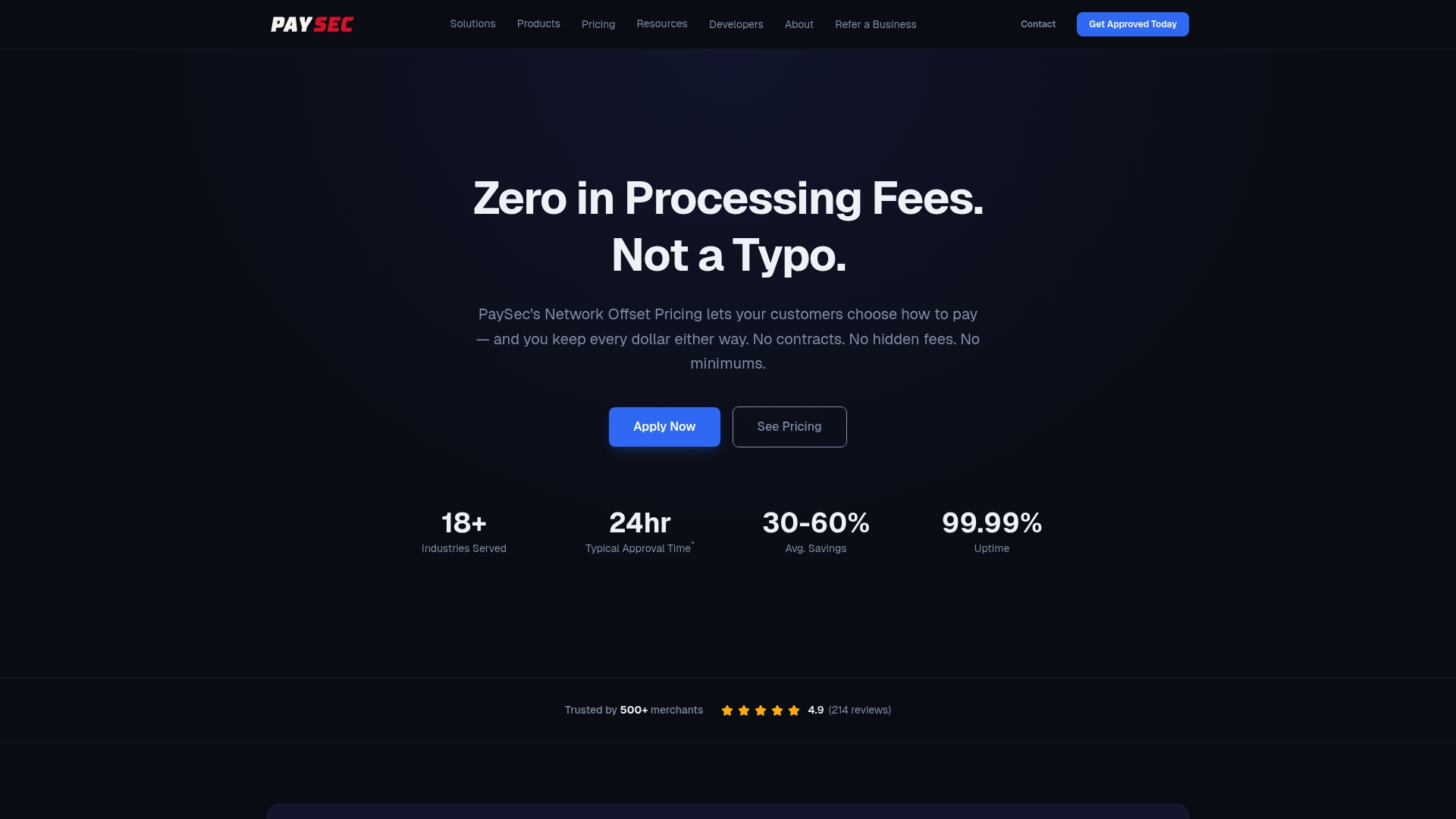
For various sectors, that means Level 3 data support for B2B customers, no long-term contracts, and fast approval even for harder-to-place verticals. Review the Network Offset, Flat Rate, and Custom Enterprise plans to see how the pricing applies to your transaction mix, or check the merchant services overview for the full list of supported channels. For a closer look at the mechanics, the Network Offset Pricing explainer walks through how the savings are calculated, and the case studies page shows a Level 3 optimization example in a B2B context.
FAQ
Is it illegal to charge a 3% credit card fee?
Merchants should check their state's current surcharge law and their card brand's published surcharge rules before adding any fee.
Can merchants charge a 2% surcharge on credit card payments?
Confirm both your state's surcharge law and your processor's surcharge program before implementing one.
Is it legal to charge 4% on a debit card?
Surcharging debit card transactions is restricted or prohibited in many states even where credit card surcharging is allowed, since debit draws directly from a cardholder's bank account.
Why are businesses charging extra for card payments?
Businesses add card surcharges to offset interchange, assessment, and processor markup costs that are typically the largest line item in processing a card transaction. As card network fees and rewards-funded interchange rates have risen, more merchants have turned to surcharging or cash discounts to recover that cost rather than absorb it into product pricing.
How is the merchant discount rate different from interchange?
The merchant discount rate is the total cost a merchant pays per transaction, and it includes interchange plus network assessment fees plus the processor's own markup. Interchange alone is just the portion that goes to the card-issuing bank.
Sources
- Credit and Debit Card Interchange Fees Assessed to Merchants in the United States (Kansas City Fed, Aug 2025)
- Regulation II — Average Debit Card Interchange Fee by Payment Card Network (Board of Governors of the Federal Reserve System)
- New Rules on Electronic Payments Lower Costs for Retailers | Federal Trade Commission