

Audit your monthly statement to find your true effective rate, then attack the two levers you actually control: processor markup and transaction qualification. Negotiate markup or switch to transparent interchange-plus or network offset pricing, move large invoices to ACH, and fix operational habits like batching and card-present acceptance. These three moves recover most of what businesses overpay, often within a single billing cycle.
TL;DR:
- Reviewing six months of statements reveals recurring fees like PCI, statement, or batch charges that can often be eliminated to lower the effective rate.
- Moving from flat-rate to interchange-plus pricing can save roughly $90 a month on $10,000 in monthly volume, with larger savings at higher volumes.
- Fixing operational habits such as daily batching and processing card-present transactions can shift more sales into lower, qualified interchange tiers.
- Passing Level 2 or Level 3 transaction data for B2B sales can reduce interchange costs by up to one percentage point.
- Routing large invoices via ACH transfers instead of credit cards consistently cuts costs, especially for high-value transactions.
Table of Contents
- What Makes Up Your Credit Card Processing Fees
- How Do You Audit a Monthly Statement for Junk Fees?
- How Do You Negotiate Processor Markup?
- Operational Fixes That Change How Transactions Qualify
- Cutting B2B Costs With Level 2 and Level 3 Data
- Routing Large Invoices Through ACH Instead of Cards
- Cash Discounts and Surcharges: What's Actually Compliant
- Calculate Your Effective Rate and Set a Savings Target
- How PaySec's Network Offset Pricing Delivers Measurable Savings
- Common Blind Spots Merchants Miss on Fees
- Get a Free Statement Audit and Savings Estimate
- Sources
- FAQ
What Makes Up Your Credit Card Processing Fees
Every swipe generates three separate charges, and only one of them is negotiable. Interchange goes to the cardholder's bank and is set by Visa, Mastercard, and the other networks based on card type and how the transaction is processed. Assessments go to the card networks themselves as a flat percentage. Processor markup is what your payment company adds on top, and it's the only piece you can actually negotiate or shop around.
Pricing models determine how that markup gets applied:
- Flat-rate pricing bundles everything into one number (like 2.9% + $0.30) but hides how much goes to markup versus interchange.
- Tiered pricing sorts transactions into "qualified," "mid-qualified," and "non-qualified" buckets, often pushing more volume into expensive tiers than it should.
- Interchange-plus pricing passes through the real interchange cost and shows markup as a separate, visible line.
- Network offset pricing, PaySec's model, restructures how markup applies so merchants keep more revenue per transaction.
Rates for typical processing arrangements run between 1.5% and 3.5%, but that headline number tells you little on its own. Your effective rate, total fees divided by total card volume, is what actually determines whether you're overpaying.
How Do You Audit a Monthly Statement for Junk Fees?
Most merchants have never read their statement line by line. That's usually where the easy money hides.
- Pull six months of statements and list every line item separately, not just the total.
- Flag recurring flat fees: PCI compliance fees, statement fees, batch fees, gateway fees, and 1099-K reporting charges.
- Check for PCI noncompliance fees. These are entirely avoidable once you complete your Self-Assessment Questionnaire through the PCI Security Standards Council, and removing them is often the first easy win.
- Calculate your effective rate: total fees ÷ total card volume. If you processed a certain amount and paid total fees accordingly, calculating total fees divided by total card volume gives you your effective rate.
- Compare against benchmarks. Retail should land around 1.8% to 2.2%, ecommerce around 2.2% to 2.8%.
Auditing statements this way and stripping out junk fees typically lowers a merchant's effective rate by 0.1% to 0.5%, which on $50,000 in monthly volume is $25 to $250 back in your pocket every single month.
How Do You Negotiate Processor Markup?
Processors expect pushback, but only merchants who show up prepared get real concessions. Walk into the conversation with data, not just a complaint about your bill.
- Bring 6 to 12 months of processing volume, your average ticket size, and your chargeback rate.
- Ask specifically for markup reduction, not a vague "better rate." Name the basis points you want cut.
- Request removal of monthly fees like PCI, statement, or batch charges as part of the deal.
- Get two or three competing quotes before you call. Processors move faster when they know you have alternatives in hand.
Switching from flat-rate to interchange-plus pricing alone has produced estimated savings of roughly $90 a month at $10,000 in monthly volume, and that gap widens as volume grows.
Pro Tip: Call your processor a week after your statement cycle closes, not mid-month. Account reps have more authority to approve rate adjustments right after billing than during it.
Operational Fixes That Change How Transactions Qualify
Interchange rates aren't fixed once and forgotten. How you process a transaction determines which tier it lands in, and small habits push transactions into cheaper or more expensive categories.
- Batch settle daily. Transactions left open past 24 to 48 hours often downgrade to a higher, non-qualified rate.
- Process card-present whenever possible. A swiped or tapped card qualifies for lower interchange than a keyed-in number.
- Use AVS and CVV verification on every card-not-present transaction. Skipping these both raises fraud risk and pushes rates up.
- Keep checkout flows consistent. Irregular data entry (missing zip codes, inconsistent order totals) is a common downgrade trigger.
Daily batching combined with consistent transaction data is one of the lowest-effort, highest-return fixes available, and it's repeatedly cited by industry guidance as a first step before anything more complex.
Cutting B2B Costs With Level 2 and Level 3 Data
If you sell to other businesses, you're likely leaving money on the table by not passing enhanced transaction data. Commercial and purchasing cards qualify for lower interchange when processors receive more detail about the sale.
- Level 2 data adds tax amount, customer code, and merchant zip code to the transaction.
- Level 3 data goes further, including line-item detail, product codes, quantities, and unit costs.
- Distributors, wholesalers, and B2B service providers see the biggest impact since they process high volumes of commercial cards.
- Implementation usually requires a gateway or processor update, and in some cases a POS or ERP integration to pass the extra fields automatically.
Sending Level 3 data is genuinely worth the setup effort for B2B-heavy merchants, since enhanced data can reduce interchange by up to a full percentage point once it applies to qualifying transactions.
Routing Large Invoices Through ACH Instead of Cards
Every invoice over a few thousand dollars that runs through a card network is paying a percentage fee on money that didn't need to move that way. ACH transfers charge a flat fee, usually under a dollar, regardless of the invoice size.
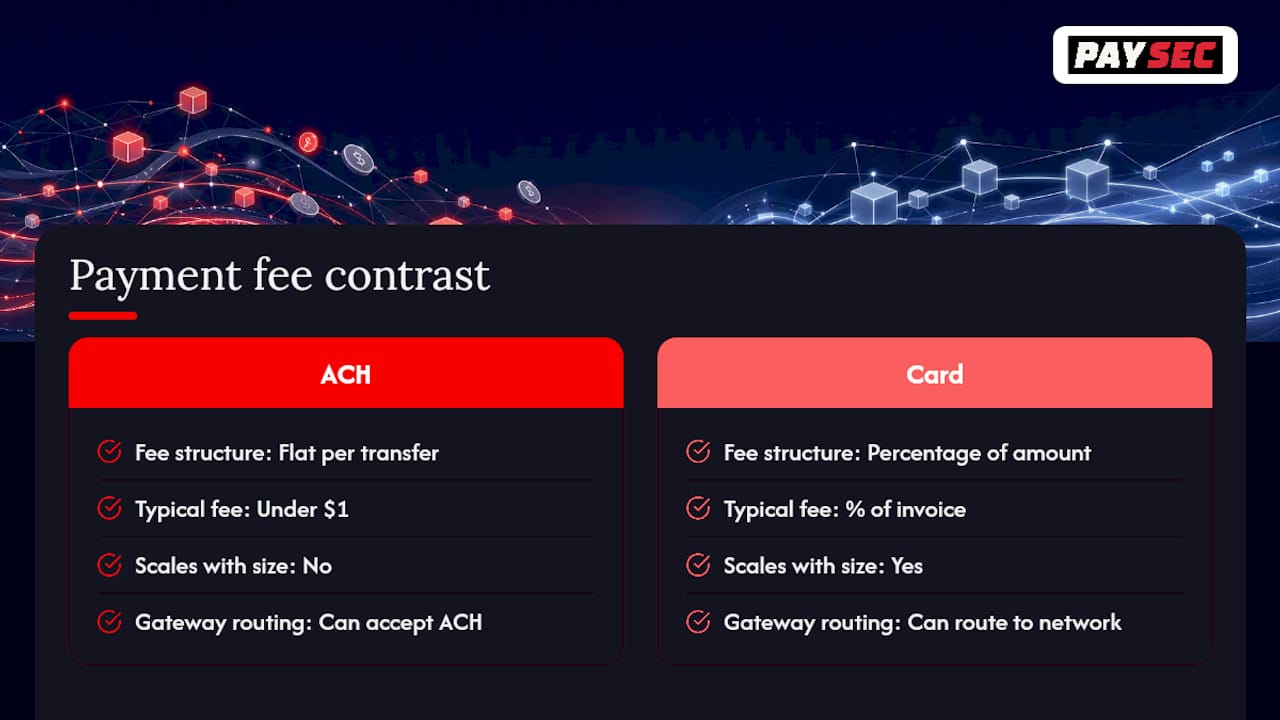
Encourage ACH adoption by offering a small discount or setting it as the default option in your invoicing terms for high-ticket clients. On the technical side, gateway routing controls let you direct debit transactions to the lowest-cost network automatically, which matters most for recurring billing and B2B accounts payable relationships.

Cash Discounts and Surcharges: What's Actually Compliant
Shifting some processing cost to customers is legal in most states, but the rules differ depending on which model you use. A cash discount program raises your posted price and gives a discount for cash or debit payments. A surcharge adds a fee specifically to credit card transactions.
- Card network rules cap surcharges (commonly around 3%) and require advance notice to the card brands.
- Several states restrict or ban surcharging outright, so check your state's specific rules before implementing one, since state law can override what card networks otherwise allow.
- Signage is mandatory at the point of sale and on receipts wherever surcharging is used, and state-specific guidance is worth reviewing before rollout, especially in states with stricter disclosure rules.
- Test messaging carefully. Poorly explained surcharges hurt conversion more than the fee itself costs you.
Calculate Your Effective Rate and Set a Savings Target
Your effective rate is the single number that tells you whether everything above is working.
- Add up every fee on your statement, not just the percentage rate, including flat monthly charges.
- Divide that total by your gross card volume for the month.
- Compare the result against your industry benchmark and track it monthly, not annually.
At $50,000 in volume, the same half-point drop saves $250 monthly, or $3,000 annually. Merchants running more than 0.5 percentage points above their industry benchmark of 1.8% to 2.2% for retail or 2.2% to 2.8% for ecommerce almost always have recoverable savings sitting in their statement.
How PaySec's Network Offset Pricing Delivers Measurable Savings
Network Offset Pricing restructures how markup is applied so merchants keep more of every transaction instead of absorbing compounding fees on top of interchange.
- No hidden fees, no minimums, and no long-term contracts, so switching doesn't lock you into terms you can't get out of.
- PCI DSS Level 1 and SOC 2 compliance are built in, removing the noncompliance risk covered earlier.
- Real-time transaction reporting gives you visibility into your effective rate every day, not just at month end.
- Trusted across 18+ industries, including complex, high-risk verticals that many processors turn away.
Pro Tip: Before switching processors, request a side-by-side comparison of your current statement against a network offset pricing quote. The gap is usually visible within a single line-item breakdown.
Common Blind Spots Merchants Miss on Fees
The biggest mistake we see is merchants negotiating rate before they've audited their statement, which means they're bargaining without knowing their actual baseline. The correct sequence is audit first, fix operational habits second, negotiate markup third, then reconsider your pricing model if negotiation hits a ceiling. Skipping straight to "get a better rate" leaves the junk fees and downgrade patterns untouched. Start with the statement in front of you today.
— PaySec Marketing Team
Get a Free Statement Audit and Savings Estimate
Paysec gives merchants a transparent alternative to flat-rate and tiered pricing that hides markup inside a bundled number. Request a free statement audit and Paysec will show you exactly where your effective rate stands today and how much Network Offset Pricing could recover, with no long-term contracts and no hidden fees to worry about later.
Whether you're processing in person or need to accept payments on the go, Paysec's mobile payment processing supports card-present transactions that qualify for lower interchange from day one. Pair that with real-time reporting and you can track your effective rate monthly instead of guessing at it once a year. Request your free audit today and see the actual numbers before you decide anything.
Sources
- Credit Card Processing Fees: A 2026 Guide for Businesses - NerdWallet
- Credit card processing fees: How to reduce costs | Commerce Bank
- How to Reduce Your Credit Card Processing Fees | CO - US Chamber of Commerce
- PCI Security Standards Council
FAQ
What company has the lowest credit card processing fees?
No single processor has the lowest rate for every business, since your actual cost depends on your industry, ticket size, and how transactions qualify. Merchants focused on transparent markup, like those using interchange-plus or Paysec's Network Offset Pricing, tend to see the lowest effective rates rather than the lowest advertised rate.
Is it illegal to charge a 3% credit card fee?
It depends on your state and how the fee is structured. Card network rules generally cap surcharges around 3%, but several states restrict or ban surcharging outright, so check your specific state's law before adding one.
How do you negotiate credit card processing fees?
Bring 6 to 12 months of processing volume, your average ticket size, and competing quotes, then ask specifically for a reduction in processor markup rather than a vague better deal.
Can merchants charge a 2% surcharge on credit card payments?
Rules vary enough by state that it's worth a quick compliance check before rolling one out.