

Most businesses are overpaying for payment processing without realizing it. Hidden merchant fees, the charges buried in processor statements under names like "regulatory product fee" or "network access fee," inflate your effective rate quietly every month. The good news: most of these fees are either negotiable or entirely avoidable.
Common hidden fees to watch for include:
- PCI non-compliance fees: typically charged monthly ($20–$40) when you haven't filed the annual Self-Assessment Questionnaire (SAQ)
- Statement fees: A flat monthly charge with no real service attached
- Monthly minimum fees: Triggered when your volume dips below a contract threshold
- Batch and settlement fees: typically charged per batch, often on top of transaction fees
- Authorization fees: Per-transaction charges that add up fast at high volume
- Early termination fees: Penalties for leaving a contract before its end date
- Non-qualified surcharges: Penalties when transactions fail to meet card network data requirements
- Chargeback fees: charged per dispute, plus the refunded transaction amount
Switching to interchange-plus pricing separates what you owe the card networks from what your processor marks up, making the negotiable layer visible. That single change, combined with a thorough statement audit, is where most merchants recover the most money.
Table of Contents
- What are the most common hidden merchant fees?
- How to identify hidden fees on your processing statement
- Practical steps to reduce or eliminate hidden transaction fees
- How Paysec's pricing model eliminates hidden fees
- Paysec cuts your processing costs without the complexity
- FAQ
- Key Takeaways
What are the most common hidden merchant fees?
Every fee on your processing statement falls into one of three buckets: pass-through costs set by card networks (interchange and assessments), processor markup, and junk fees. Pass-through fees are fixed by Visa, Mastercard, and the issuing banks. You cannot negotiate them. Everything else is fair game.
PCI compliance fees are among the most common junk fees. Processors charge a monthly fee when merchants haven't completed the annual PCI SAQ. Filing the SAQ takes roughly 30 minutes and ends the fee permanently.
Statement fees and monthly minimums are pure processor margin:
- Statement fees are flat monthly charges for generating a PDF you could access online for free
- Monthly minimum fees kick in during slow months when your processing volume falls below a contract floor
- Both are commonly negotiable at contract renewal or when you present a competing quote
Early termination fees range from a few hundred dollars to several thousand, depending on the contract. Some processors calculate them as a percentage of remaining monthly fees. Always read the cancellation clause before signing.
Non-qualified surcharges occur when a transaction fails to meet card network data requirements, triggering a penalty on top of the standard interchange rate. Incomplete transaction data is the most common cause, and it's fully preventable with proper setup.

Chargeback fees compound the pain. You lose the transaction amount and pay a dispute fee, which can range from $20–$100 per dispute. Chip and contactless readers reduce fraud-related chargebacks significantly.
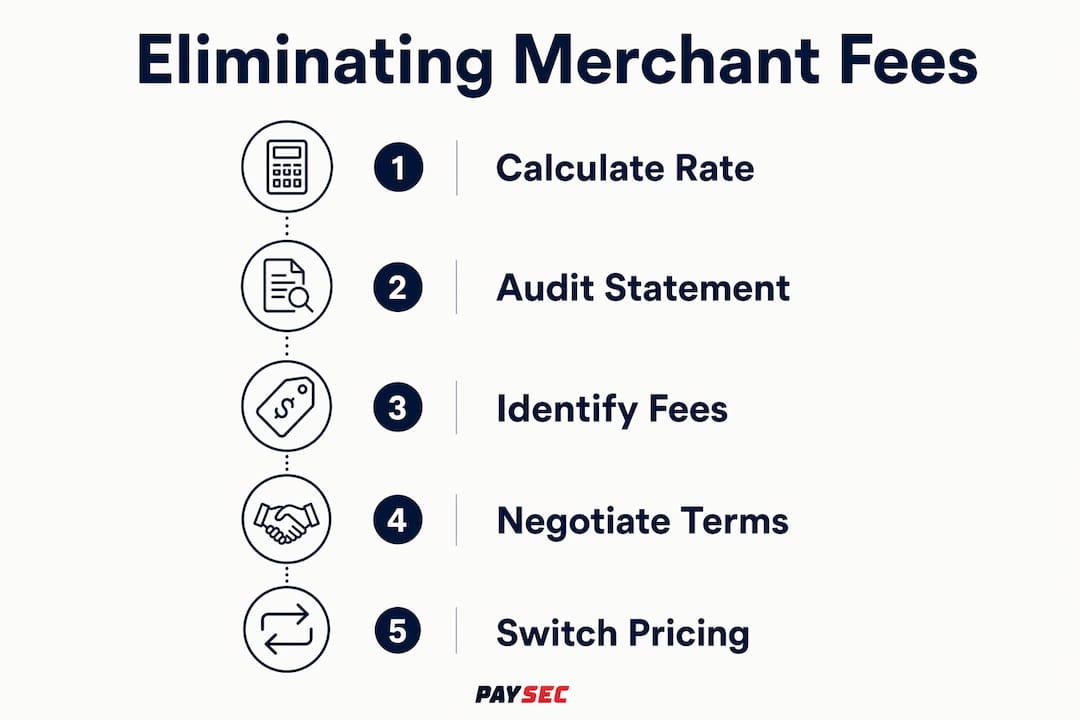
"Regulatory" or "network access" fees are the most deceptive category. Processors disguise markup as a flat percentage, often 0.10%–0.20%, labeled to look like a government or network pass-through. It isn't. On $250,000 in monthly volume, a 0.15% "regulatory product fee" costs $375 per month, or $4,500 per year, for nothing.
How to identify hidden fees on your processing statement
Reading a merchant statement isn't complicated once you know what to look for. Work through these steps every month.
-
Pull a full itemized statement. Request three months of complete statements from your processor, not the summary view. You need every line item, including fees listed separately from transaction costs.
-
Calculate your effective rate. Divide your total monthly processing fees by your total monthly card volume. This single number tells you what you're actually paying, regardless of what your contract says your rate is.
-
Separate interchange from markup. Interchange and card network assessments are fixed costs. Everything above those amounts is your processor's margin. If you're on tiered or flat-rate pricing, you can't see this split clearly, which is exactly why those models cost more.
-
Flag interchange downgrades. Downgrades happen when a transaction fails to qualify for the lowest available interchange tier because required data wasn't submitted correctly. Interchange downgrades are not negotiable after the fact, but they are preventable going forward.
-
Identify the four junk fees. On most statements, these appear as: PCI non-compliance fee, monthly minimum shortfall, batch and IRS reporting fees, and "regulatory" or "network access" fees. None of these are interchange. All of them are processor profit.
-
Compare line items to your contract. Every fee on your statement should map to a specific line in your merchant agreement. If a fee appears on your statement but not in your contract, challenge it in writing immediately.
-
Check your IRS 1099-K reporting fee. Some processors charge $5–$7 per month for IRS 1099-K reporting, a filing they are legally required to produce anyway. This is markup theater, and it's negotiable.
-
Run a quarterly review. Card networks update interchange rates in April and October. Processors sometimes slip in fee increases at the same time. A quarterly review of your effective rate, downgrade frequency, and authorization rate catches rate creep before it compounds.
Pro Tip: Don't call your processor with complaints. Call with three numbers: your 90-day effective rate, your markup-only rate with interchange stripped out, and the dollar total of every junk fee you've identified. That's negotiating leverage.
Practical steps to reduce or eliminate hidden transaction fees
Knowing where the fees are is half the work. Acting on that knowledge is where the savings land.
-
Switch to interchange-plus pricing. This is the single highest-impact change most merchants can make. Interchange-plus pricing breaks your rate into interchange, assessments, and a fixed processor markup, so you can see and negotiate each layer. Tiered pricing hides the markup inside bundled rates.
-
Negotiate specific fee waivers. Come to the conversation with documentation. Request that your processor waive PCI non-compliance fees (because you've completed the SAQ), drop the monthly minimum, remove batch fees, and eliminate any "network access" or "regulatory" fees that aren't genuine pass-throughs.
-
Submit enhanced transaction data. For B2B transactions, submitting Visa CEDP Product 3 or Mastercard Level 3 data qualifies transactions for reduced interchange rates. Savings typically range from 0.50% to 1.00% per transaction. On $1 million in annual B2B volume, that's $5,000–$10,000 back per year.
-
Use address verification and batch daily. AVS and CVV checks reduce fraud risk and keep transactions qualifying at the best interchange tier. Settling transactions within 24 hours prevents downgrades that card associations apply to late batches.
-
Consider fee-shifting programs. Surcharging and cash discount programs, when compliant with state law, shift processing costs to customers who pay by card. This can reduce your net processing expense to near zero. Debit card surcharges are prohibited under federal rules, so confirm your setup with your processor before launching.
-
Keep chargebacks low. Use chip and contactless readers, respond to disputes quickly, and maintain clear return policies. High chargeback ratios trigger rate increases that compound over time.
-
Collect competing quotes. A written quote from another processor is the most effective negotiating tool you have. Your current processor will often match or beat it rather than lose the account.
Pro Tip: Write a one-page negotiation request before you call. State the specific rate you want (e.g., interchange-plus at IC + 0.25% + $0.10), list each fee you want waived, and name the alternative: moving the account. Processors respond to specifics, not general complaints.
How Paysec's pricing model eliminates hidden fees
Most merchants spend months auditing statements and negotiating with processors to recover fees that shouldn't exist in the first place. Paysec's approach removes that cycle entirely.
Paysec's Network Offset Pricing works differently from traditional models. Instead of layering markup and junk fees on top of interchange, it gives merchants access to wholesale interchange rates and offsets processing costs through a flexible customer payment structure. There are no hidden fees, no monthly minimums, and no long-term contracts.
Merchants across many industries report a significant reduction in processing costs compared to their previous processors. Paysec's detailed transaction reporting gives finance managers full visibility into every charge, so there's nothing buried in a statement to find.

The model also handles PCI compliance and surcharging program setup as part of the service, so merchants don't need to manage those requirements separately.
Paysec cuts your processing costs without the complexity
If your current processor is charging PCI fees, monthly minimums, or "regulatory" fees you can't explain, Paysec is the direct alternative. With Network Offset Pricing, you get wholesale interchange rates, zero hidden fees, and no long-term contract to sign. Merchants who switch typically see much lower processing costs, with full transaction-level reporting included from day one. No minimums. No junk fees. No surprises on your statement. Check your potential savings at Paysec's pricing page and see exactly what you'd pay.
FAQ
How do I reduce merchant fees quickly?
Start by calculating your effective rate, then audit your statement for PCI non-compliance fees, monthly minimums, and "network access" fees. Routine audits combined with a switch to interchange-plus pricing typically produce the fastest, largest savings.
Is it illegal to charge hidden fees?
Undisclosed fees can violate FTC regulations and state consumer protection laws, particularly when they aren't clearly stated in the merchant agreement. Always request a full fee schedule in writing before signing with any processor.
Do merchants have to pay all the fees on their statement?
No. Pass-through fees like interchange and card network assessments are fixed, but processor markup fees, PCI fees, monthly minimums, and batch fees are negotiable or removable. Paysec eliminates these junk fees entirely through its Network Offset Pricing model.
How do I avoid the 3% transaction fee?
Switch to interchange-plus pricing so you can see and negotiate the markup layer separately from interchange. Submitting enhanced transaction data and using fee-shifting programs like cash discounts can also reduce your net cost per transaction significantly.
Key Takeaways
Eliminating hidden merchant fees requires auditing your statement, separating fixed interchange costs from negotiable processor markup, and switching to a transparent pricing model.
| Point | Details |
|---|---|
| PCI fees are avoidable | Filing the annual SAQ ends monthly PCI non-compliance fees immediately. |
| Junk fees are negotiable | Monthly minimums, batch fees, and "network access" fees are processor markup, not fixed costs. |
| Enhanced data saves money | Submitting Visa CEDP Product 3 or Mastercard Level 3 data saves 0.50% to 1.00% per B2B transaction. |
| Quarterly reviews prevent creep | Card networks update interchange rates in April and October; reviewing your effective rate each quarter catches increases early. |
| Paysec removes hidden fees | Paysec's Network Offset Pricing delivers substantial savings with no hidden fees, no minimums, and no long-term contracts. |