

TL;DR:
- No-minimum pricing in SaaS billing charges fees based on usage without fixed monthly minimums, reducing costs for early-stage companies. Effective management of transaction routing and cost forecasting is essential to avoid hidden expenses and ensure margins scale with revenue. Paysec offers a transparent no-minimum model that significantly cuts processing costs through detailed reporting and fee offsetting strategies.
No-minimum pricing in SaaS payments is a billing model where providers charge fees based solely on usage or transaction volume, with no fixed monthly minimums required. This structure directly aligns payment costs with revenue scale, making it one of the most financially efficient models for SaaS companies at any growth stage. The role of no-minimum pricing in SaaS payments has grown significantly as business leaders seek to cut overhead, improve cash flow, and give customers more flexible billing options. Platforms like Stripe Billing demonstrate the model with a 0.5% fee on recurring volume, while Paysec applies its Network Offset Pricing to eliminate minimums entirely. Understanding how this model works, where it saves money, and where it requires careful management is the difference between a payment strategy that scales and one that quietly erodes your margins.
How no-minimum pricing lowers costs and improves cash flow

No-minimum pricing removes the single largest fixed cost in most SaaS billing stacks: the mandatory monthly platform fee. Traditional billing platforms charge $299 to $599 or more per month regardless of your revenue, which means a company at $500k ARR pays the same base fee as one at $5M ARR.
The cost gap is concrete. Choosing a no-minimum platform charging 0.5% of recurring volume saves a $500k ARR SaaS company $1,000 to $2,500 annually compared to platforms with $299+ monthly fixed fees. That figure represents real operating budget, not an accounting abstraction.
At $500k ARR, Stripe Billing's 0.5% fee costs roughly $208 per month. A legacy provider at $599 per month costs nearly three times as much for the same billing function. The gap narrows as ARR grows, but for early-stage SaaS companies under $2M ARR, no-minimum models consistently deliver lower total costs.
Cash flow benefits compound the direct savings. When you pay only for what you process, your payment costs drop automatically during slow months and rise only when revenue rises. That symmetry protects working capital during product pivots, seasonal dips, or customer churn events.
| ARR Level | No-minimum platform (0.5%) | Fixed-fee platform ($599/mo) | Annual difference |
|---|---|---|---|
| $500k | ~$2,500/yr | ~$7,188/yr | ~$4,688 saved |
| $1M | ~$5,000/yr | ~$7,188/yr | ~$2,188 saved |
| $2M | ~$10,000/yr | ~$7,188/yr | Fixed fee cheaper |
| $5M | ~$25,000/yr | ~$7,188/yr | Fixed fee much cheaper |
The table shows a clear inflection point near $1.5M ARR. Below that threshold, no-minimum pricing wins on cost. Above it, the math shifts toward fixed-fee or tiered models.
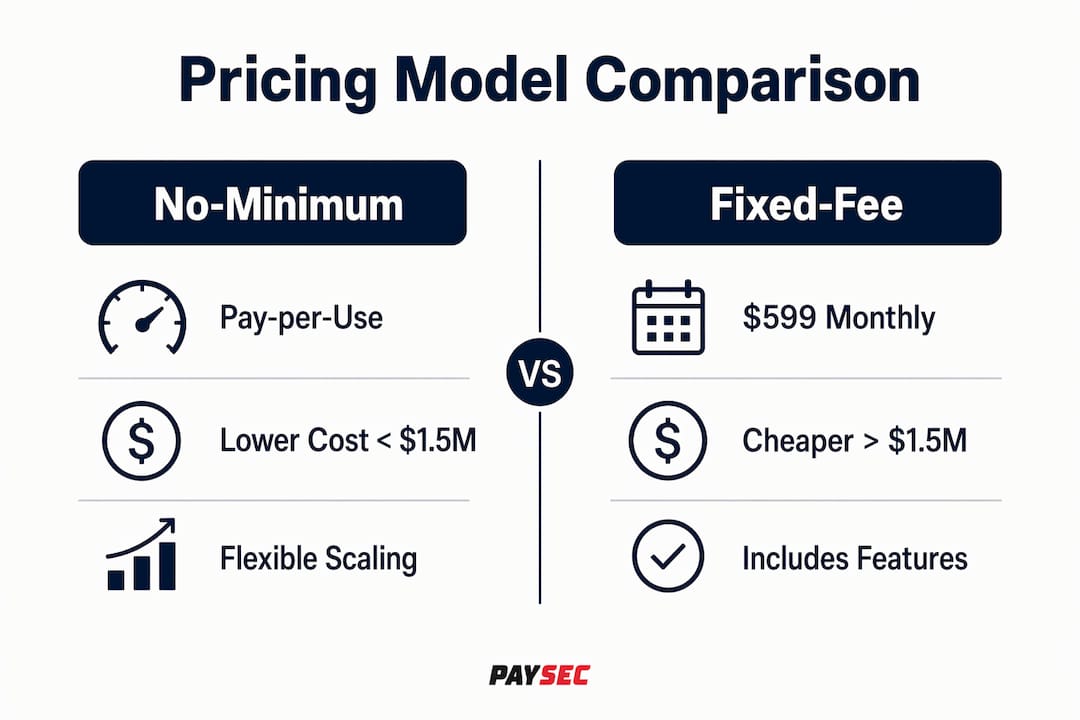
Pro Tip: Forecast your ARR trajectory for the next 12 months before committing to a billing platform. If you expect to cross $1.5M ARR within the year, evaluate whether a hybrid or tiered model will serve you better at scale.
Balancing customer flexibility and operational margins
No-minimum pricing gives customers the freedom to start small, scale gradually, and avoid committing to billing tiers they cannot yet justify. That flexibility directly improves conversion rates and reduces friction during the sales process. Removing a minimum invoice requirement means a prospect can sign up for a $15/month plan without triggering a platform fee that wipes out your margin on that account.
The challenge is that small transactions carry the same fixed per-transaction fee as large ones. A $0.30 fixed fee on a $5 invoice represents 6% of the transaction value before any percentage fee is applied. That math erodes margins fast on low-ticket items.
The most effective countermeasure is minimum invoice routing rules. These rules redirect small transactions to lower-cost channels without rejecting the customer or the sale. Common routing strategies include:
- Annual billing: Bundle monthly micro-payments into a single annual invoice, reducing transaction count and fixed fees by up to 12x.
- ACH transfers: Route low-value recurring payments to ACH, which carries lower per-transaction costs than card networks.
- Prepaid credit: Offer customers the option to load account credit in larger increments, reducing the frequency of small charges.
- Bundled invoicing: Aggregate multiple small charges into a single monthly invoice rather than processing each one separately.
Each of these strategies preserves the customer experience while protecting your unit economics. The customer still gets flexible, low-commitment billing. You stop paying $0.30 per $5 transaction.
Routing small transactions to annual billing or ACH offsets fixed cost impacts without losing sales. That is the operational discipline that separates SaaS companies that benefit from no-minimum pricing from those that simply absorb the cost.
Pro Tip: Set a transaction routing threshold at $20 or your calculated break-even invoice amount. Any charge below that threshold routes automatically to ACH or annual billing. Review the threshold quarterly as your pricing evolves.
When does no-minimum pricing increase effective transaction costs?
No-minimum pricing is not universally cheaper. The model introduces specific cost risks that SaaS leaders need to account for before committing to it as a long-term payment strategy.
The first risk is percentage-based fee creep at scale. A 0.5% billing fee sounds modest, but it compounds with card network fees, international surcharges, and currency conversion charges. SaaS companies processing international transactions using standard payment gateways encounter effective rates between 4.35% and 5.3%. That range includes Stripe's 0.5–0.8% billing fees, $0.01–$0.50 transaction fees, and approximately 1% surcharges for international cards and foreign exchange. At $5M ARR with significant international volume, those percentages translate to hundreds of thousands of dollars annually.
The second risk is hidden feature costs. Some platforms advertise low base fees but charge separately for dunning, revenue recognition, and tax compliance. Add-on pricing for dunning and revenue recognition can push effective monthly fees well beyond $749 per month, erasing the apparent savings of a no-minimum structure. Always calculate total cost of ownership, not just the headline rate.
| Scenario | No-minimum model | Fixed-fee or tiered model | Better choice |
|---|---|---|---|
| $500k ARR, domestic only | ~$208/mo | $599/mo | No-minimum |
| $1M ARR, 30% international | ~$600/mo + FX fees | $599/mo flat | Roughly equal |
| $3M ARR, compliance needed | ~$1,500/mo + add-ons | $599/mo all-inclusive | Fixed-fee |
| $5M ARR, global volume | ~$2,500/mo + FX | Enterprise tier | Enterprise tier |
The third risk is compliance cost displacement. Merchant of Record platforms charge higher percentage fees near 5%, but they absorb VAT/GST compliance and save SaaS founders 180–240 hours annually in tax management. A no-minimum platform that shifts compliance responsibility back to you may cost less in fees but more in operational time.
As ARR grows, tiered or enterprise pricing can become more cost-effective. Leaders should forecast costs at 12-month and 24-month ARR projections and plan platform transitions before the inflection point arrives, not after.
How to choose and implement a no-minimum pricing payment platform
Selecting the right no-minimum pricing platform requires evaluating five criteria: fee structure, feature completeness, compliance coverage, integration depth, and support quality.
Fee structure is the starting point. Confirm whether the platform charges a percentage of volume, a flat monthly fee, or a hybrid. Verify that "no minimum" means no minimum monthly charge, not just no minimum transaction size. Read the fine print on international card fees, currency conversion, and chargeback costs.
Feature completeness determines your total cost. A platform with a low headline rate but no dunning management, revenue recognition, or tax tools will require you to purchase those capabilities separately. That hidden cost structure can push effective monthly fees far beyond what a more complete platform charges.
Compliance coverage matters more as you expand internationally. If your SaaS product sells to customers in the European Union, the United Kingdom, or Australia, VAT and GST obligations apply. Platforms that handle tax calculation and remittance automatically reduce your compliance burden significantly.
The practical implementation process follows four steps:
- Audit your current transaction mix. Identify the percentage of transactions below your break-even invoice amount. This tells you how aggressively you need to configure routing rules.
- Configure invoice routing rules. Set thresholds for ACH routing, annual billing prompts, and bundled invoicing. Test each rule in a staging environment before pushing to production.
- Connect revenue recognition tools. Platforms that support ASC 606 compliance natively reduce the manual work of deferred revenue accounting. If your platform does not include this, integrate a dedicated revenue recognition tool.
- Monitor effective rates monthly. Your headline fee rate and your effective rate after all surcharges, add-ons, and chargebacks are different numbers. Track both and compare them against your ARR growth trajectory.
Paysec's Network Offset Pricing applies this model directly to SaaS billing. It eliminates monthly minimums, removes hidden fees, and provides detailed transaction reporting that makes effective rate monitoring straightforward. Paysec clients across SaaS and 18+ other industries have reported processing cost reductions of 30–60%, with one SaaS marketplace achieving a 42% reduction in processing costs. That result reflects what happens when no-minimum pricing is paired with disciplined routing rules and full fee transparency.
SaaS companies that want to understand the full range of payment processing features needed for efficient billing in 2026 should evaluate platforms against all five criteria before committing. The cost of switching platforms mid-growth is high. Getting the selection right early pays dividends for years.
Pro Tip: Request a full fee schedule from any platform you evaluate, including international card surcharges, chargeback fees, and add-on module costs. Build a 12-month cost model at your current ARR and your projected ARR before signing any contract.
For SaaS leaders thinking about sustainable growth strategies, payment cost optimization is one of the highest-leverage levers available. Reducing processing fees by even 1% of ARR compounds directly into operating margin.
Key Takeaways
No-minimum pricing delivers the greatest cost advantage for SaaS companies under $2M ARR, but requires invoice routing discipline and total-cost analysis to protect margins at every stage.
| Point | Details |
|---|---|
| Cost advantage is stage-dependent | No-minimum models beat fixed-fee platforms below ~$1.5M ARR; above that, tiered pricing often wins. |
| Routing rules protect margins | Directing small transactions to ACH or annual billing prevents fixed per-transaction fees from eroding unit economics. |
| Hidden fees change the math | Add-ons for dunning, revenue recognition, and compliance can push effective monthly costs well above headline rates. |
| International volume raises effective rates | SaaS companies with global customers face effective rates of 4.35–5.3% on standard gateways, making fee structure selection critical. |
| Paysec eliminates minimums with full transparency | Paysec's Network Offset Pricing removes monthly minimums and hidden fees, with documented savings of 30–60% for SaaS clients. |
What I've learned about no-minimum pricing after working with SaaS payment stacks
The most common mistake I see SaaS leaders make is treating "no minimum" as a complete payment strategy rather than a starting condition. No-minimum pricing removes one cost constraint. It does not automatically produce a low-cost payment operation. The leaders who extract the most value from it are the ones who pair it with routing discipline, monthly effective-rate tracking, and a clear ARR trigger for platform reassessment.
The second thing I've observed is that founders systematically underestimate compliance costs. A platform that saves $400 per month in billing fees but shifts 200 hours of VAT/GST management back to your finance team is not actually cheaper. Time has a cost. When you factor in the hours your team spends on tax reconciliation, the economics of a Merchant of Record model sometimes look better than a pure no-minimum structure, even at modest ARR levels.
The third observation is about timing. The SaaS companies that get into trouble with payment costs are the ones that selected a platform at $200k ARR and never revisited the decision at $1M or $2M. No-minimum pricing is genuinely excellent for early-stage companies. It is not always the right answer at scale. Build a calendar reminder to reassess your payment platform every time you cross a meaningful ARR milestone.
The broader point is that flexible SaaS pricing models, including no-minimum structures, are tools. They work when applied with precision and reviewed regularly. The payment stack is not a set-it-and-forget-it decision. Treat it like any other cost center: measure it, model it, and adjust it as your business changes.
— Paysec Marketing Team
How Paysec supports SaaS growth with no-minimum payment pricing
Paysec's Network Offset Pricing is built for SaaS companies that want to eliminate fixed monthly minimums without sacrificing fee transparency or compliance support.
There are no monthly minimum fees, no long-term contracts, and no hidden charges buried in the fine print. Paysec provides detailed transaction reporting that makes effective rate monitoring straightforward, so you always know exactly what you are paying and why. Clients across SaaS and 18+ industries have reduced processing costs by 30–60% using this model. One SaaS marketplace cut its processing costs by 42%. If you are ready to align your payment costs with your actual revenue, explore Network Offset Pricing or review Paysec's full pricing structure to see how the numbers work for your business.
FAQ
What is no-minimum pricing in SaaS payments?
No-minimum pricing is a billing model where payment platforms charge fees based on usage or transaction volume only, with no fixed monthly minimum fee required. This structure aligns payment costs directly with revenue, making it cost-efficient for early-stage and scaling SaaS companies.
When does no-minimum pricing stop being the cheapest option?
No-minimum pricing typically becomes more expensive than fixed-fee models around $1.5M ARR, where a 0.5% volume fee exceeds a $599 monthly flat rate. SaaS leaders should model costs at projected ARR levels before committing to any platform.
How do invoice routing rules protect margins under no-minimum pricing?
Invoice routing rules direct small transactions to lower-cost channels like ACH or annual billing, preventing fixed per-transaction fees from disproportionately consuming revenue on low-value invoices. Setting a routing threshold at your break-even invoice amount is the standard approach.
Does no-minimum pricing cover international transaction costs?
No-minimum pricing reduces base platform fees but does not eliminate international card surcharges or foreign exchange fees. SaaS companies with significant international volume face effective rates of 4.35–5.3% on standard gateways, so total cost of ownership must include all surcharges.
How does Paysec's Network Offset Pricing differ from standard no-minimum models?
Paysec's Network Offset Pricing eliminates monthly minimums and hidden fees while providing detailed transaction reporting and compliance support across 18+ industries. Clients have documented processing cost reductions of 30–60%, with no long-term contracts required.