

TL;DR:
- CBD payment compliance involves meeting federal and industry standards to manage high-risk transactions. Merchants must provide extensive documentation, enforce clear policies, and proactively monitor chargebacks to maintain active accounts. While the 2018 Farm Bill legalized hemp-derived CBD, processing access remains selective and dependent on strict compliance.
CBD payment compliance is the process of meeting the regulatory and underwriting standards required to accept and manage financial transactions in the CBD industry. Understanding how CBD payment compliance works means knowing the rules set by federal agencies like FinCEN and the FDA, the card network policies of Visa and Mastercard, and the documentation requirements that acquiring banks demand before approving a merchant account. The 2018 Farm Bill federally legalized hemp-derived CBD with a THC threshold of 0.3% or below, but that legal status does not guarantee payment processing access. CBD merchants still operate in a high-risk category, and every processor, bank, and card network applies its own layer of scrutiny on top of federal law.
What are the main regulatory and underwriting requirements for CBD payment processing?
CBD merchants must clear a documentation threshold that most conventional retailers never face. Processors require business licenses, Certificates of Analysis (COAs) confirming THC content at or below 0.3%, supply chain documentation, and insurance certificates before approving an account. These documents prove that the products being sold qualify as hemp under federal law and that the business operates transparently.
KYC and AML obligations
Enhanced Know Your Customer (KYC) procedures apply to every CBD merchant account. Banks and processors verify the identity of business owners, review corporate structure, and assess the source of funds before onboarding. AML compliance adds another layer: merchants must support transaction monitoring systems, file Suspicious Activity Reports (SARs) when required, and submit Currency Transaction Reports (CTRs) for qualifying cash transactions. These are not optional steps. Processors that work in the CBD space treat them as baseline requirements, not advanced features.

State-specific regulations create additional complexity. A merchant selling CBD products legally in Colorado faces different underwriting conditions than one operating in Idaho, where hemp-derived CBD remains restricted. Processors factor state law into their risk models, which means your approval terms can vary significantly depending on where your business is registered and where you ship products.
Merchant Category Codes and their impact
Merchant Category Codes (MCCs) determine how card networks classify your business. CBD merchants are typically assigned high-risk MCCs, which triggers elevated scrutiny and higher fees from the start. The MCC assigned to your account affects your processing rates, reserve requirements, and the monitoring frequency your processor applies. Choosing the wrong MCC, or allowing a processor to misclassify your business, creates compliance exposure that can result in account termination with little warning.
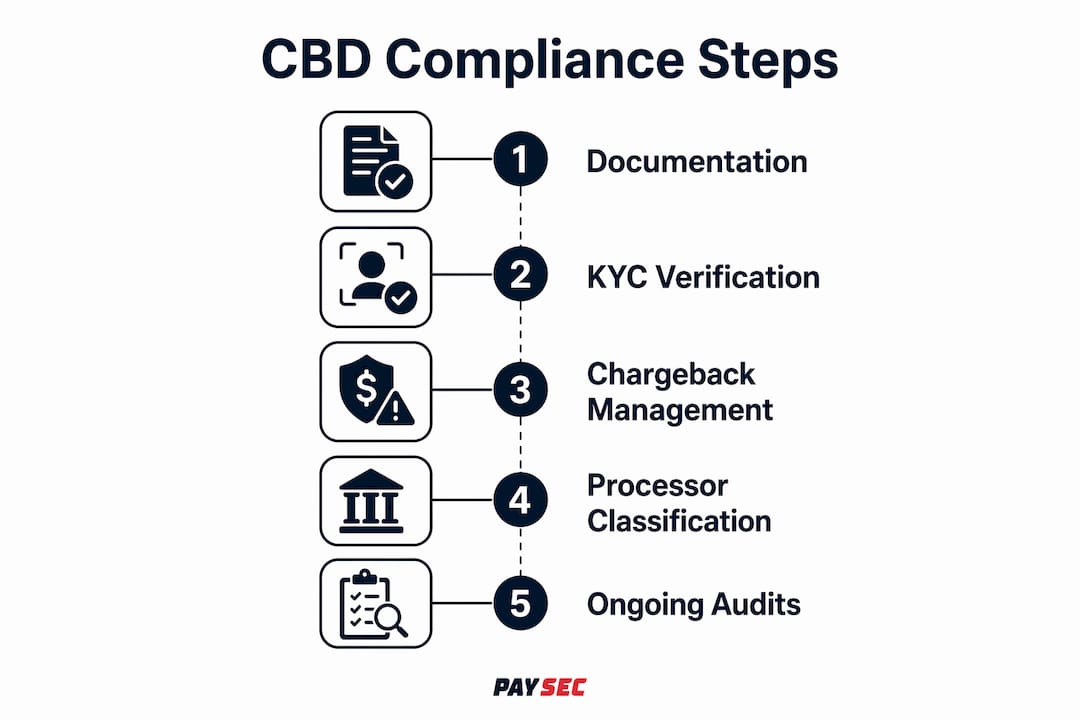
Here is a summary of the core documentation and compliance requirements:
| Requirement | Purpose |
|---|---|
| Business license | Confirms legal operation in the merchant's state |
| Certificate of Analysis (COA) | Verifies THC content at or below 0.3% |
| Supply chain documentation | Establishes product sourcing and manufacturing transparency |
| Insurance certificate | Demonstrates financial responsibility to the processor |
| KYC identity verification | Confirms beneficial ownership and business structure |
| SAR and CTR filing readiness | Satisfies AML obligations under the Bank Secrecy Act |
How do CBD merchants manage chargebacks and transaction risk?
Chargeback management is the single most critical factor for CBD merchants who want to keep their payment accounts long-term. Processors monitor chargeback ratios closely, and accounts that exceed threshold levels face termination. In a product category where effectiveness claims are subjective and customer expectations vary, disputes arise more often than in conventional retail.
The most common causes of chargebacks in CBD transactions include:
- Customers disputing charges because a product did not meet their health expectations
- Unclear or hard-to-find refund and return policies at the time of purchase
- Delivery delays that prompt customers to file disputes before the product arrives
- Confusing billing descriptors that customers do not recognize on their bank statements
- Subscription or auto-ship charges that customers forgot they authorized
Each of these causes has a direct operational fix. Clear delivery timelines on product pages and in order confirmation emails reduce dispute filings before they start. A refund policy that is visible at checkout, not buried in a footer, gives customers an alternative to a chargeback. Responsive customer support with a real email address or phone number resolves complaints before they escalate to the card network.
Merchants who maintain visible policies and rapid dispute management keep chargeback ratios below termination thresholds. Proactive communication with customers after purchase, including shipping updates and easy return instructions, is the most effective way to prevent disputes in the CBD category.
Pro Tip: Set up a dedicated customer support email address that appears on every order confirmation, shipping notification, and product page. Customers who can reach you directly rarely escalate to a chargeback.
Billing descriptors deserve special attention. The name that appears on a customer's bank statement must match what they expect to see. A descriptor that reads as an unfamiliar company name triggers "friendly fraud," where a customer disputes a legitimate charge simply because they do not recognize it. Use your business name or a clear product-line name, and keep it consistent across every transaction.
Monitoring refund trends gives you early warning before a chargeback problem becomes a termination risk. Track your refund rate weekly. A rising refund rate often precedes a rise in chargebacks by two to four weeks, giving you time to identify the product or process causing the issue and correct it before your processor flags the account. You can find detailed guidance on chargeback prevention strategies that apply directly to high-risk merchant categories like CBD.
How do payment processors and banks classify and handle CBD merchants?
Acquiring banks and processors treat CBD businesses as high-risk accounts by default. That classification is not a judgment on the legitimacy of the business. It reflects the regulatory uncertainty, the elevated chargeback rates in the category, and the card network rules that restrict certain hemp and cannabis transactions.
Processing fees for CBD merchants typically range between 3% and 6%, compared to 1.5%–2.5% for conventional retail. That gap represents a real cost that compounds quickly at scale. Accounts also face rolling reserves, where the processor holds a percentage of revenue for a set period as a buffer against chargebacks and refunds. Understanding these terms before signing a processing agreement prevents surprises that affect cash flow.
The table below shows how hemp-friendly processors and general processors differ in their approach to CBD accounts:
| Category | Hemp-friendly processors | General processors |
|---|---|---|
| CBD account approval | Standard underwriting with hemp documentation | Often prohibited outright |
| Processing fees | 3.5%–5.5% for specialized services | Not applicable; accounts declined |
| Reserve requirements | Rolling reserves common | N/A |
| Monitoring intensity | High, with regular compliance reviews | N/A |
| Payment methods supported | Credit cards, ACH, cashless ATM | Credit cards only for non-CBD categories |
Federal law prohibits Visa and Mastercard transactions involving marijuana. Hemp-derived CBD is a separate legal category, but processors still apply conservative policies because the line between hemp and marijuana is defined by a lab test, not by appearance. A single batch of product that tests above 0.3% THC can expose a processor to card network violations, which is why underwriting for CBD accounts is more thorough than for most other retail categories.
Post-2026 federal reclassifications have increased the compliance burden on financial institutions working with hemp businesses. Banks must now verify product compliance more rigorously and track high-risk customers under updated Bank Secrecy Act and AML guidance. That increased burden on the banking side translates directly into more documentation requests and longer review cycles for CBD merchants seeking new accounts or account renewals.
Specialized hemp payment processors charge higher fees but provide services built around CBD compliance requirements. ACH transfers and cashless ATM systems have emerged as practical alternatives where card network restrictions create barriers. CBD merchants who understand the full range of payment processing alternatives are better positioned to maintain payment continuity even when card processing terms change.
What operational best practices support ongoing CBD payment compliance?
Compliance is not a one-time approval. It is a daily operational discipline that determines whether your payment account stays active or gets terminated. The merchants who maintain stable accounts over time are the ones who treat compliance as a business process, not a paperwork exercise.
The following practices form the foundation of a compliant CBD payment operation:
- Keep your product catalog current and accurate. Every product listed in your storefront must match the COAs on file with your processor. A product reformulation or a new SKU requires updated documentation before it goes live.
- Maintain consistent billing descriptors. The name on a customer's bank statement must match your business name or a clearly recognizable product line. Change descriptors only when necessary, and notify your processor in advance.
- Monitor transaction patterns weekly. Track declines, refunds, and disputes in real time. A sudden spike in any of these metrics signals a problem that needs investigation before your processor flags the account.
- Avoid traffic or offer spikes that look suspicious. A sudden surge in transaction volume from an unusual geographic area or a flash sale that drives abnormal order patterns can trigger automated risk reviews. Notify your processor before running large promotions.
- Keep policy pages visible and current. Refund, return, shipping, and subscription cancellation policies must be easy to find and written in plain language. Processors review these pages during compliance audits.
- Communicate proactively with your processor. If you receive a compliance inquiry or a request for documentation, respond within 24 hours with complete information. Delayed responses are interpreted as non-cooperation.
Pro Tip: Run a quarterly self-audit of your storefront, billing descriptors, and COA documentation. Treat it like a processor review. Fix anything a compliance officer would flag before they find it first.
Accurate storefront information matters more than most CBD merchants realize. Processors review merchant websites as part of ongoing compliance monitoring. A product page that makes unverified health claims, lists a product without a COA reference, or shows a price inconsistent with what is being charged creates an immediate compliance concern. The CBD merchant account approval process evaluates your storefront as a primary signal of business transparency.
Transaction pattern monitoring also connects directly to your risk profile with your processor. Merchants who track their own data and can explain anomalies proactively are treated as lower risk than those who wait for a processor inquiry. Real-time reporting tools that show declines, refunds, and dispute trends by product, region, and time period give you the visibility to act before a problem becomes a compliance event. Using structured data tools to organize and monitor product transaction data can help CBD merchants maintain cleaner records for compliance reviews.
Key Takeaways
CBD payment compliance requires continuous operational discipline across documentation, chargeback management, and processor communication to maintain account stability.
| Point | Details |
|---|---|
| Documentation is non-negotiable | COAs, business licenses, and supply chain records must stay current and match your active product catalog. |
| Chargebacks drive account terminations | Keep chargeback ratios low through clear policies, consistent billing descriptors, and fast dispute resolution. |
| High-risk MCC codes raise fees | CBD merchants pay 3%–6% in processing fees; understanding this upfront prevents cash flow surprises. |
| Federal law shapes processor policies | Hemp-derived CBD is legal under the 2018 Farm Bill, but card networks and banks apply their own restrictions. |
| Operational monitoring prevents surprises | Weekly tracking of declines, refunds, and disputes gives you time to fix problems before processors flag them. |
What we have learned from working with CBD merchants on payment compliance
The merchants who struggle most with CBD payment compliance are not the ones who break rules. They are the ones who treat compliance as a setup task rather than an ongoing system. They get approved, file their COAs, and then stop paying attention until a processor sends a termination notice.
The blind spot we see most often is product classification mismatch. A merchant reformulates a product, changes a supplier, or adds a new SKU without updating the documentation on file with their processor. From the processor's perspective, that is an undisclosed change to the business. It creates the same risk signal as a deliberate misrepresentation, even when the merchant had no intent to mislead.
Customer policy consistency is the second most common gap. A merchant might have a solid refund policy on their website but a customer support team that handles returns differently in practice. When a customer disputes a charge and the processor reviews the case, inconsistency between stated policy and actual practice is a red flag. It suggests the merchant cannot be relied upon to manage disputes fairly, which raises the risk profile of the entire account.
The processors that work best for CBD merchants are the ones that offer transparency on fees, reserve terms, and monitoring criteria from day one. Opaque agreements with vague hold policies create operational uncertainty that compounds over time. When you know exactly what triggers a reserve increase or a compliance review, you can manage your business to stay within those parameters.
Regular self-audits are the most underused tool in CBD payment compliance. A quarterly review of your storefront, billing descriptors, COA files, and chargeback data takes a few hours and prevents the kind of account termination that takes months to recover from. Treat your payment account like a banking relationship that requires maintenance, because that is exactly what it is.
— Paysec Marketing Team
How Paysec supports compliant CBD payment processing
CBD merchants who want to reduce processing costs without sacrificing compliance have a direct path through Paysec's Network Offset Pricing, which shifts interchange fees away from the merchant and delivers savings of 30%–60% compared to standard high-risk processing rates.
Paysec's real-time reporting and analytics dashboard gives CBD merchants the transaction visibility they need to monitor declines, refunds, and dispute trends before they become compliance problems. For merchants selling in-store and online, Paysec's payment terminals and mobile payment solutions support compliant transactions across every sales channel. There are no hidden fees, no minimums, and no long-term contracts, so CBD merchants can focus on building their business instead of managing payment friction. Paysec serves merchants across 18+ industries, including CBD retail, with the same transparent pricing and detailed reporting that high-risk categories demand.
FAQ
What documents do CBD merchants need for payment processing?
CBD merchants must provide a business license, Certificates of Analysis confirming THC content at or below 0.3%, supply chain documentation, and insurance certificates. Processors also require KYC identity verification for all beneficial owners.
Why are CBD merchants classified as high-risk?
CBD merchants receive high-risk classifications because of regulatory uncertainty, elevated chargeback rates, and card network restrictions on cannabis-related transactions. This classification results in processing fees of 3%–6% and rolling reserve requirements.
How do I keep my chargeback ratio low as a CBD merchant?
Use clear billing descriptors, publish visible refund and return policies, send shipping updates proactively, and respond to disputes within 24 hours. Merchants who communicate actively with customers before disputes escalate maintain ratios below termination thresholds.
Does the 2018 Farm Bill guarantee CBD payment processing access?
The 2018 Farm Bill legalized hemp-derived CBD at the federal level, but it does not obligate card networks or banks to process CBD transactions. Visa, Mastercard, and individual acquiring banks each apply their own policies on top of federal law.
What is the difference between hemp and marijuana banking regulations?
Hemp-derived CBD with THC at or below 0.3% is federally legal and can be processed under specific MCC codes by hemp-friendly processors. Marijuana remains federally prohibited, and Visa and Mastercard explicitly ban transactions involving marijuana sales regardless of state law.