
TL;DR:
- A CBD merchant account enables hemp-derived CBD businesses to process credit and debit card payments legally, despite mainstream banks rejecting them.
- Approval requires submitting specific documents, maintaining website compliance, choosing a high-risk provider, and active monitoring after approval to stay within Visa's thresholds.
A CBD merchant account is a specialized payment processing account that allows hemp-derived CBD businesses to accept credit and debit card transactions legally and reliably. Standard merchant accounts from mainstream banks reject CBD businesses outright because card networks classify them as high-risk. This CBD merchant account approval guide covers everything you need: the exact documents underwriters require, how pricing works in 2026, the step-by-step application process, and how to keep your account in good standing after approval. Providers like Paysec and CARDZ3N specialize in this space and understand the compliance demands that general processors refuse to handle.
What documents and prerequisites do you need for CBD merchant account approval?

Getting your CBD merchant account approved starts with your business structure. Underwriters require a formal corporate entity such as an LLC or C-Corp, a dedicated business bank account, and a verifiable U.S. business address. Personal accounts like Venmo or informal DBAs do not pass underwriting review. This is the first filter that eliminates unprepared applicants.
Certificates of Analysis (COAs)
Your product documentation carries as much weight as your business registration. Underwriters require Certificates of Analysis from ISO 17025-accredited, DEA-registered labs confirming that your products are hemp-derived and contain less than 0.3% THC. A COA from an unaccredited lab will not satisfy compliance review. Every SKU you sell needs its own current COA on file.
FDA-compliant labeling and product descriptions
Your product labels and website copy must follow FDA guidelines strictly. That means no medical claims, no disease treatment language, and no therapeutic promises. Phrases like "treats anxiety" or "cures inflammation" are automatic red flags during underwriting. Stick to factual ingredient descriptions and general wellness language that does not cross into drug claim territory.
Website audit checklist
Your website is reviewed as carefully as your documents. Compliant website policies including refund, shipping, and privacy pages are required. Your site must run on HTTPS with a valid SSL certificate, display visible contact information, and include age-gate pop-ups for states where age restrictions apply. Missing any one of these elements can delay or kill your approval.
Here is the core document checklist underwriters expect:
| Requirement | Details |
|---|---|
| Corporate entity proof | LLC or C-Corp formation documents, EIN letter from the IRS |
| Dedicated business bank account | Three months of statements showing business activity |
| COAs from accredited labs | ISO 17025-accredited, DEA-registered lab results per product SKU |
| Government-issued ID | Owner or officer photo ID matching business registration |
| Manufacturer agreements | Supplier contracts confirming hemp-derived sourcing |
| Website compliance | SSL, refund policy, privacy policy, no medical claims, age gate |
| Previous processing statements | Six months of statements if you have prior processing history |
Pro Tip: Run your website through a compliance checklist before submitting your application. Fix every policy gap and remove any medical claim language first. Underwriters flag these issues immediately, and resubmitting after a rejection adds weeks to your timeline.
How do you choose the right CBD merchant account provider?
The provider you choose determines your pricing, your reserve requirements, and how much support you get when problems arise. CBD merchant account pricing in 2026 typically runs from 3.95% to 5.95% plus $0.25 per transaction. That range is wide because your specific rate depends on your average ticket size, your product mix, and your chargeback history. A business with clean processing history and low chargebacks lands closer to 3.95%. A new business with no history starts higher.
Understanding reserves and contract terms
Reserves are a standard feature of high-risk merchant accounts. Most providers hold 5%–10% of your monthly volume on a rolling 180-day schedule. That money sits in a reserve account as a buffer against chargebacks and disputes. Negotiate the reserve percentage and the release schedule before you sign. Some providers also charge annual fees, PCI compliance fees, and early termination fees. Get every fee in writing before committing.
Pricing model comparison
| Fee Type | Typical Range | What to Negotiate |
|---|---|---|
| Discount rate | 3.95%–5.95% per transaction | Lower rate with clean processing history |
| Per-transaction fee | $0.25 per transaction | Flat fee reduction for high volume |
| Rolling reserve | 5%–10% of monthly volume | Release schedule and percentage cap |
| Annual fee | $99–$295 per year | Waiver or reduction for multi-year commitment |
| PCI compliance fee | $99–$199 per year | Bundle with annual fee or waive entirely |
| Early termination fee | $295–$595 | Month-to-month contract instead |
Chargeback history is the single biggest factor affecting your rate. A business with a chargeback ratio above 1% will pay the highest rates and face stricter reserve requirements. Keeping your ratio below 0.5% gives you real negotiating power when renewal time comes.
Specialized providers like Paysec focus on cannabis-adjacent merchants and offer transparent pricing with no hidden fees, no minimums, and no long-term contracts. That flexibility matters when your business is scaling and your processing volume changes month to month. Paysec's Network Offset Pricing model lets you pass processing costs to customers who choose to pay by card, which protects your margins entirely.
Pro Tip: Ask every provider for a sample merchant agreement before you apply. Read the reserve clause, the chargeback threshold, and the termination terms carefully. A provider unwilling to share their agreement upfront is a provider worth avoiding.
What is the step-by-step process for submitting your CBD merchant account application?
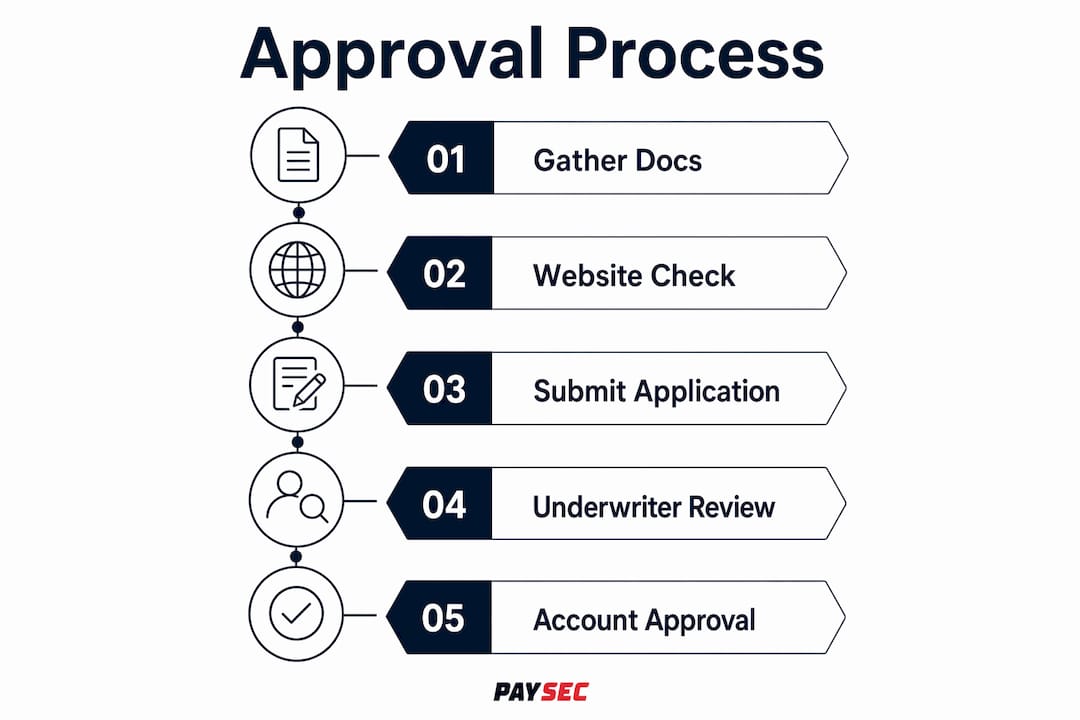
The application process follows a predictable sequence when you prepare correctly. Conditional approvals can arrive within 48 hours when your documents and website pass the initial pre-check. Full underwriting decisions typically take 3–10 business days. Speed depends entirely on how complete and clean your submission is.
Here is the sequence that maximizes your approval odds:
- Organize your documents first. Gather your EIN letter, corporate formation documents, government ID, business bank statements, COAs, manufacturer agreements, and any prior processing statements before you touch the application.
- Audit your website. Fix every compliance gap: add missing policies, remove medical claims, install your SSL certificate, and activate your age gate. Do this before submission, not after.
- Select your provider. Compare at least two or three specialized high-risk providers. Review their fee structures, reserve policies, and contract terms side by side.
- Submit a complete application. Incomplete applications go to the back of the queue. Attach every required document in the formats the provider specifies. PDF is standard.
- Respond to document requests within 24 hours. Underwriters issue conditional approvals with follow-up requests. Slow responses extend your timeline significantly.
- Review the merchant agreement before signing. Confirm that every fee, reserve term, and chargeback threshold matches what was discussed verbally.
- Test your payment gateway. Once approved, run test transactions before going live. Confirm that your gateway integrates correctly with your shopping cart or point-of-sale system.
What underwriters look for during review
Underwriters assess four things: legal compliance, financial stability, website integrity, and product legitimacy. They check that your COAs are current and from accredited labs. They verify that your bank statements show consistent, legitimate revenue. They review your website for policy compliance and prohibited claims. They also look at your personal credit history as a secondary signal of financial responsibility.
If you receive a conditional approval with a document request, treat it as a positive signal. It means the underwriter sees a path to approval and needs clarification. Respond with exactly what was requested, nothing more and nothing less.
Pro Tip: If you have prior processing statements from a previous CBD merchant account, include them even if that account was closed. Clean processing history from a prior account is one of the strongest signals you can give an underwriter. A CBD retailer approval case study from Paysec shows how prior history helped a business get approved after three previous declines.
How do you maintain a healthy CBD merchant account after approval?
Approval is the beginning, not the finish line. Keeping your account in good standing requires active monitoring of your fraud and chargeback ratios every single month. Visa's VAMP program calculates your compliance risk using TC40 and TC15 metrics divided by your total monthly settled card-not-present transactions. TC40 reports fraud. TC15 reports disputes. Both count against you.
Visa's 2026 VAMP thresholds
Visa's 2026 VAMP standards set a hard line for CBD merchants. The Excessive threshold in the U.S., Canada, EU, and APAC is a combined fraud and dispute ratio of 1.5% or higher per month. Breaching that threshold triggers fines of $8 per TC40 and TC15 event above the limit. Those fines accumulate fast on any meaningful transaction volume. Staying below 1.5% is not optional. It is the price of keeping your account open.
Card-not-present transactions are the only transactions that count in the VAMP denominator. That means your e-commerce channel carries the most compliance weight. Strong online fraud prevention directly protects your VAMP ratio.
Merchants must reduce chargebacks and preempt fraud-related disputes equally to avoid exceeding Visa's 2026 VAMP thresholds. Treating them as separate problems is the most common mistake CBD merchants make.
Dos and don'ts for account health
Do:
- Monitor your chargeback ratio weekly, not monthly
- Respond to every dispute within the provider's required window
- Keep your COAs current and replace expired lab results immediately
- Notify your provider before launching new product lines or entering new sales channels
- Use chargeback prevention strategies like clear billing descriptors and proactive customer communication
Don't:
- Ignore authorization decline spikes. Unusual transaction patterns are early compliance signals that require investigation.
- Process transactions through a personal account or secondary processor without disclosing it
- Make medical claims in new marketing materials after approval
- Let your website policies go stale or your SSL certificate expire
- Wait for your provider to contact you about risk issues. Reach out first.
Continuous monitoring of transaction patterns is the most effective defense against sudden account freezes. Spikes in unusual transactions trigger compliance reviews. Catching them early and communicating proactively with your provider keeps small issues from becoming account-ending problems.
Pro Tip: Set a weekly calendar reminder to pull your chargeback and fraud reports. Most providers give you access to a merchant portal with this data. Reviewing it weekly gives you enough lead time to act before ratios breach Visa's thresholds.
Key Takeaways
Getting a CBD merchant account approved in 2026 requires complete compliance documentation, a clean website, a specialized high-risk provider, and active post-approval monitoring to stay within Visa's VAMP thresholds.
| Point | Details |
|---|---|
| Documentation is the foundation | Gather COAs, corporate entity proof, EIN, and bank statements before applying. |
| Website compliance is non-negotiable | Fix all policy pages, remove medical claims, and add an age gate before submission. |
| Pricing ranges from 3.95% to 5.95% | Negotiate reserves, PCI fees, and termination terms before signing any agreement. |
| Underwriting takes 3–10 business days | Complete submissions with fast document responses get conditional approvals in 48 hours. |
| VAMP thresholds require active monitoring | Keep combined fraud and dispute ratios below 1.5% monthly to avoid Visa fines. |
What working with CBD merchants has taught us about approval
The Paysec Marketing Team perspective
The biggest mistake CBD business owners make is treating merchant account approval as a one-time event. They prepare intensely for the application, get approved, and then go quiet on compliance. Six months later, they are dealing with a frozen account and a chargeback ratio that crept past Visa's threshold while they were focused on sales.
The businesses that stay approved long-term share one habit: they treat compliance as an ongoing operational function, not a paperwork exercise. They update their COAs before they expire. They review their chargeback data weekly. They call their provider when something looks off rather than waiting to be called. That proactive posture is what separates merchants who build durable payment infrastructure from those who cycle through approvals and account closures.
The 2026 VAMP updates have raised the stakes considerably. The $8 per-event fine structure means that a merchant processing meaningful volume can accumulate thousands of dollars in penalties in a single month if their fraud and dispute ratios drift above 1.5%. That is not a theoretical risk. We have seen it happen to merchants who had clean records for years but failed to adapt their fraud prevention practices as their e-commerce volume grew.
Our honest advice: choose a provider with real experience in high-risk industries, not one that accepts CBD merchants as an afterthought. Ask them directly how they support merchants who receive VAMP notices. Ask what their dispute response process looks like. A provider who can answer those questions specifically is a provider who will actually help you when things get difficult. Approval is achievable with preparation. Staying approved requires the same discipline applied consistently.
— Paysec Marketing Team
Paysec's CBD payment solutions for compliant merchants
CBD merchants who want transparent pricing and genuine compliance support have a direct path forward with Paysec.
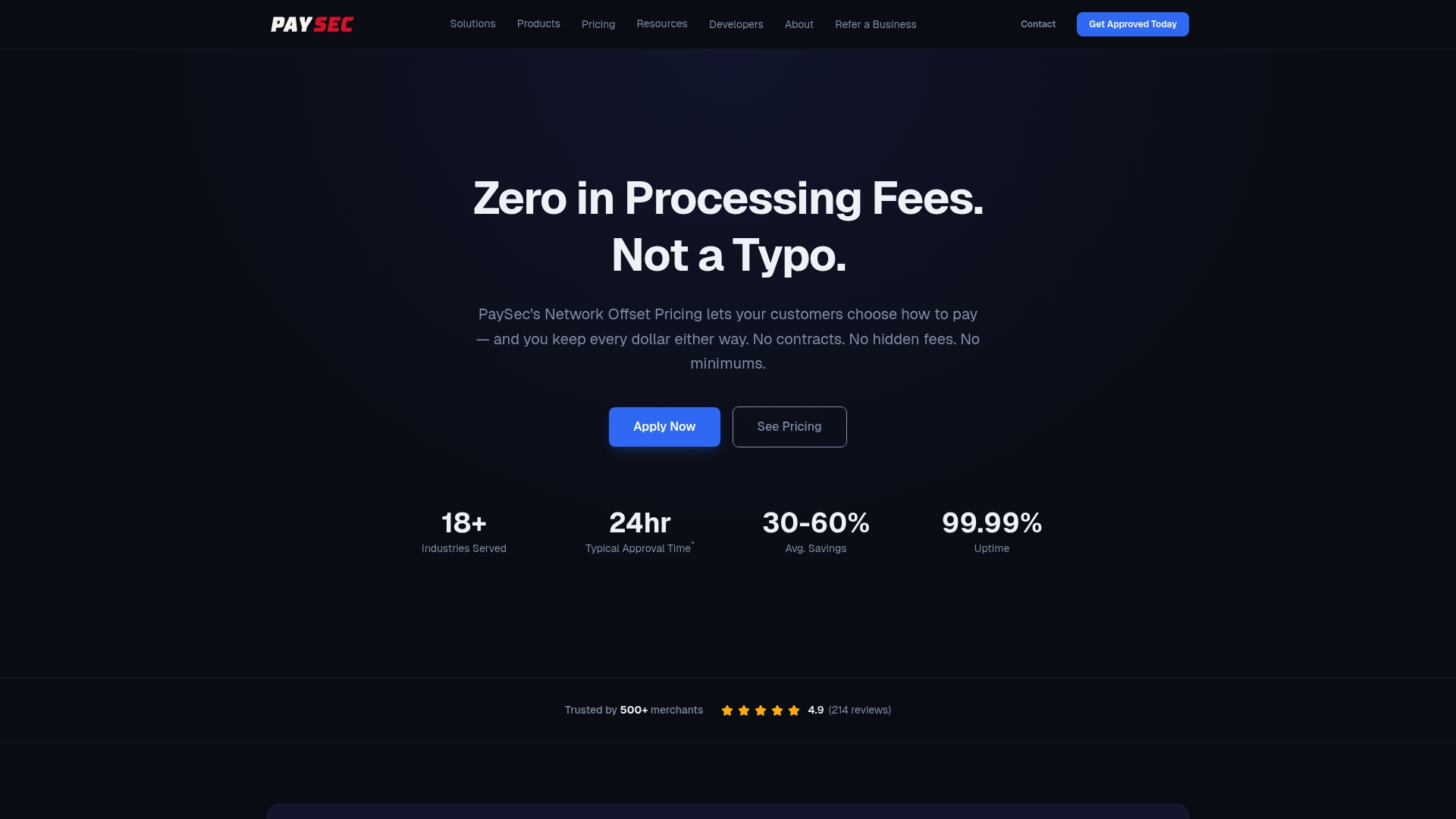
Paysec specializes in CBD and hemp payment processing and works with merchants across 18-plus industries to reduce processing costs by 30%–60%. Its Network Offset Pricing model eliminates hidden fees, requires no minimums, and carries no long-term contracts. That means you keep more revenue from every transaction without being locked into terms that no longer fit your business. Paysec's pricing structure is fully transparent and built for merchants who want to understand exactly what they pay and why. CBD business owners can review pricing options and apply directly without complex onboarding requirements.
FAQ
What is a CBD merchant account?
A CBD merchant account is a specialized payment processing account that allows hemp-derived CBD businesses to accept credit and debit card payments. Standard merchant accounts reject CBD businesses because card networks classify them as high-risk.
How long does CBD merchant account approval take?
Conditional approvals can arrive within 48 hours when documents and website pass the initial pre-check. Full underwriting decisions typically take 3–10 business days depending on application completeness.
What are the typical fees for a CBD merchant account?
CBD merchant account pricing in 2026 runs from 3.95% to 5.95% plus $0.25 per transaction, with rolling reserves of 5%–10% held on a 180-day schedule. Annual, PCI, and early termination fees should be negotiated before signing.
What is Visa's VAMP and why does it matter for CBD merchants?
Visa's VAMP program monitors combined fraud and dispute ratios monthly using TC40 and TC15 metrics. CBD merchants must keep their ratio below 1.5% or face fines of $8 per event above the threshold.
What documents do I need to apply for a CBD merchant account?
You need corporate entity proof, an EIN letter, a dedicated business bank account, government-issued ID, ISO 17025-accredited COAs for each product, manufacturer agreements, and a compliant website with all required policies in place.