

TL;DR:
- CBD payment processing remains difficult due to regulatory ambiguity, high chargeback risks, and limited options for merchants. Most CBD businesses face rejection or account termination because of chargeback ratios, compliance issues, and reliance on a single processor. Success depends on choosing specialized processors, maintaining thorough documentation, managing chargebacks proactively, and having multiple payment channels for continuity.
CBD payment processor approval challenges are defined by a combination of regulatory ambiguity, high chargeback risk, and specialized underwriting demands that most standard processors refuse to accommodate. As of early 2026, 67% of hemp businesses face significant payment processing difficulties. That figure tells you this is not an edge case. It is the baseline reality for CBD merchants operating today.
The core problem is structural. CBD sits in a legal gray zone created by the 2018 Farm Bill, which legalized hemp at the federal level, and the FDA, which still restricts CBD in food and dietary supplements. Banks and processors read that conflict as liability. The result: 43% of compliant businesses still get terminated, and 78% pay above-standard fees. Understanding each specific hurdle is the first step toward clearing them.
1. How high chargeback ratios block CBD payment processor approvals
Chargeback ratio is the single most scrutinized metric in the CBD merchant account approval process. Processors require CBD merchants to stay below 1% chargeback ratio. Exceeding that threshold triggers account reviews, fund holds, and often immediate termination.

The financial cost compounds quickly. Each chargeback carries a non-refundable fee between $35 and $50, regardless of the dispute outcome. That means a merchant with 20 chargebacks in a month pays up to $1,000 in fees before any revenue impact is counted.
The trend is moving in the wrong direction. Ecommerce chargebacks surged 222% between Q1 2023 and Q1 2024. CBD merchants, who sell primarily online, absorb a disproportionate share of that increase.
Practices that keep chargeback ratios low:
- Use clear product descriptions and dosage information on every product page
- Send order confirmation and shipping notification emails automatically
- Display a visible, easy-to-find refund policy before checkout
- Offer live chat or a direct phone line to resolve disputes before they escalate
- Use a recognizable billing descriptor so customers identify the charge immediately
Pro Tip: Set up automated alerts when your chargeback ratio approaches 0.7%. Waiting until you hit 1% leaves no room to correct course before a processor review begins.
Processors also review chargeback history during initial underwriting. A merchant with a documented history of dispute resolution and low ratios from a prior account gets approved faster. That history is a real asset. Build it deliberately.
2. Regulatory complexity and how it affects the approval process for CBD payments
The 2018 Farm Bill legalized hemp and hemp-derived CBD at the federal level. The FDA's position complicates that legality immediately. The FDA restricts CBD in food and dietary supplements, creating a regulatory gray zone that banks treat as direct liability exposure.
No single federal agency provides a unified compliance standard for CBD payment processing. Merchants must satisfy requirements from multiple bodies simultaneously, including the FDA, FinCEN for anti-money-laundering obligations, and state-level banking regulators that vary significantly by jurisdiction. That overlap creates the conditions for sudden account termination even when a merchant believes they are fully compliant.
Regulatory agencies CBD merchants must address:
- FDA: Product labeling, health claims, and ingredient restrictions
- FinCEN: Anti-money-laundering (AML) program requirements and suspicious activity reporting
- State banking regulators: Vary by state; some states impose additional licensing requirements on CBD sellers
- USDA: Hemp cultivation and testing standards that affect product sourcing documentation
Non-compliance with any one of these bodies gives a processor grounds to terminate an account without notice. Processors do not wait for a legal ruling. They act on perceived risk.
Accurate product representation during underwriting is not optional. Misrepresenting product categories, THC content, or sales volume during the application process is the most common reason for sudden account terminations. Processors verify claims against third-party lab reports and website content.
Pro Tip: Before submitting any processor application, audit your website for unsubstantiated health claims. The FDA considers phrases like "treats anxiety" or "reduces inflammation" as drug claims. Remove them entirely. Processors flag these during underwriting reviews.
Ongoing compliance monitoring matters as much as the initial application. Regulations shift, and a processor can re-evaluate your account at any time. Merchants who maintain current Certificates of Analysis (COAs), updated lab reports, and documented AML procedures give processors fewer reasons to act.
3. Limited processing options and underwriting challenges for CBD businesses
CBD merchants are classified as high-risk by processors and acquiring banks. That classification is not a judgment on the business quality. It reflects the statistical risk profile of the category, including chargeback rates, regulatory exposure, and reputational risk for the acquiring bank.
The practical consequence is a much smaller pool of available processors. Most mainstream payment platforms decline CBD applications outright. The processors that do accept CBD accounts impose conditions that reflect their elevated risk exposure.
Underwriting factors processors evaluate for CBD merchant accounts:
- Product categories (full-spectrum vs. isolate, topicals vs. ingestibles)
- Monthly transaction volume and average ticket size
- Business age and processing history
- Chargeback history and dispute resolution documentation
- COAs and THC compliance documentation
- Website content for FDA-compliant health claims
- Business registration, licenses, and state-specific permits
Volume caps are standard. A processor may approve a merchant for $25,000 per month in processing volume and require a formal review before raising that limit. Growing businesses hit this ceiling faster than they expect.
Rolling reserves add another layer of financial pressure. Processors hold a percentage of each transaction in reserve as a buffer against future chargebacks. Those reserves are typically held for 90 to 180 days. Reserves can lock five to six figures for months, directly restricting operating capital.
| Underwriting factor | Impact on approval |
|---|---|
| Incomplete documentation | Delays approval by weeks or causes outright rejection |
| High chargeback history | Triggers higher reserve requirements or denial |
| Single banking relationship | Creates termination risk if that bank changes policy |
| Accurate product representation | Speeds underwriting and reduces post-approval scrutiny |
| Multiple acquiring bank relationships | Improves continuity when industry policies shift |
Processors with multiple acquiring banks provide better continuity when industry policies shift. A processor tied to a single acquiring bank can lose that relationship and terminate all its CBD accounts simultaneously. That is not a theoretical risk. It has happened repeatedly across the industry.
Pro Tip: When evaluating processors, ask directly how many acquiring bank relationships they maintain for CBD accounts. A processor with two or more active banking partners for hemp merchants offers meaningfully better stability than one operating on a single relationship.
4. Technical integration and operational hurdles in CBD payment processing
The approval timeline for a CBD merchant account runs from 3 to 7 business days under normal conditions. That window assumes complete documentation submitted correctly on the first attempt. Missing a single required document restarts portions of the review and can push the timeline out by weeks.
The documentation checklist for CBD processor applications is longer than most merchants expect. Processors require business registration documents, government-issued ID for all principals, voided business checks, three to six months of processing statements, COAs for all products, and a fully functional website with compliant content. Submitting an incomplete package is the most common cause of unnecessary delays.
Account freezes during reviews are common and can block funds entirely. A processor that initiates a compliance review mid-operation can freeze the merchant's account while the review proceeds. That freeze can last days or weeks. Merchants without cash reserves or a backup processor face an immediate operational crisis.
Operational readiness checklist before submitting a CBD processor application:
- Confirm all product COAs are current (within 12 months) and from an ISO-accredited lab
- Verify your website contains no FDA-prohibited health claims
- Prepare three to six months of bank statements and prior processing statements
- Document your refund and dispute resolution policy in writing
- Set up a dedicated business bank account separate from personal accounts
- Test your eCommerce platform's integration with the processor's payment gateway before go-live
- Identify a backup payment solution before you need one
Transaction monitoring tools and compliance software reduce the risk of mid-operation account freezes. These tools flag unusual transaction patterns before a processor's risk team does. Catching a spike in chargebacks or a suspicious transaction cluster internally gives you time to respond proactively rather than reactively.
Integration complexity with eCommerce platforms adds another layer. Not every payment gateway connects cleanly with every CBD-focused eCommerce setup. Merchants using platforms like WooCommerce or Shopify need to confirm that their processor's gateway supports their specific configuration before signing any agreement.
5. Strategies for overcoming CBD payment processor approval challenges
The most effective strategy for securing CBD merchant account approval is partnering with a processor that specializes in high-risk categories, not one that merely tolerates them. Processors specializing in high-risk CBD compliance offer long-term stability that fee-minimizing processors cannot match. The difference shows up when regulations shift or a chargeback spike triggers a review.
Transparent fee structures matter more than low headline rates. A processor offering a low processing rate but charging opaque fees for compliance reviews, reserve adjustments, or gateway access often costs more than a processor with a higher stated rate and no hidden charges. Get the full fee schedule in writing before signing.
Pre-application checklist for CBD merchants:
- Research the processor's specific experience with hemp and CBD merchant accounts
- Confirm the processor maintains multiple acquiring bank relationships
- Request a full written fee schedule including reserve terms, chargeback fees, and gateway costs
- Verify the processor offers dedicated compliance support, not just a general customer service line
- Confirm the processor's volume caps align with your current and projected monthly processing needs
- Prepare a complete documentation package before initiating the application
- Identify a secondary processor as a backup before your primary account goes live
Multiple payment rails are not a luxury for CBD businesses. They are a business continuity requirement. Working with processors who maintain multiple payment rails as backup improves resilience when a primary processor changes policy or terminates accounts. A CBD retailer operating on a single payment channel has no fallback when that channel closes.
Proactive chargeback management reduces the risk of account reviews. Respond to every dispute within 24 hours. Maintain detailed transaction records. Train customer service staff to resolve complaints before customers contact their bank. These practices keep your ratio below the 1% threshold that triggers processor scrutiny.
Pro Tip: Industry compliance certifications, such as U.S. Hemp Authority certification, signal to processors that your business meets recognized quality and compliance standards. Including certification documentation in your application strengthens your underwriting profile and can reduce reserve requirements.
You can also review CBD retail payment processor options to compare what specialized processors actually offer versus what general-purpose platforms provide. The gap is significant.
6. What the approval timeline actually looks like for CBD merchants
The approval process for a CBD merchant account follows a defined sequence, but the timeline varies based on documentation quality and processor workload. Understanding each stage prevents merchants from misreading delays as rejections.
Stage one is the application submission. The merchant submits all required documents, including business registration, COAs, processing history, and website review confirmation. A complete submission moves to underwriting within one to two business days.
Stage two is underwriting review. The processor's risk team evaluates every document against their internal criteria. This stage takes the bulk of the 3 to 7 business day window. Underwriters verify COA accuracy, check website content for prohibited claims, and assess chargeback history. They may request additional documents during this stage.
Stage three is approval or conditional approval. Some processors issue conditional approvals that require additional documentation or impose initial volume caps. Conditional approval is not a rejection. It is a starting point for building a processing relationship.
Stage four is integration and go-live. The merchant integrates the processor's payment gateway with their eCommerce platform or point-of-sale system. This stage introduces technical complexity that delays many merchants who have not tested their integration in advance.
The merchants who move through this process fastest are the ones who treat the application as a formal business submission, not a quick online form. Preparation before submission is the variable that controls the timeline most directly.
7. Why 34% of CBD businesses still operate cash-only
34% of CBD businesses operate cash-only because they cannot secure viable payment processing solutions. That is not a choice. It is the outcome of repeated rejections and account terminations that exhaust the merchant's options and patience.
Cash-only operations face real competitive disadvantages. Customers expect card payment options. Online sales are impossible without a payment processor. Cash handling increases operational costs and security risks. The businesses stuck in this position are not failing because of their products. They are failing because the payment infrastructure available to them is inadequate.
The path out of cash-only operations runs through the same steps every CBD merchant needs: specialized processor selection, complete documentation, compliant website content, and proactive chargeback management. Merchants who treat payment processing as a compliance function rather than a commodity purchase find processors willing to work with them.
The CBD merchant account approval guide for 2026 outlines the specific documentation and positioning strategies that move applications from rejection to approval. The difference between a declined application and an approved one is rarely the business itself. It is almost always the preparation behind the application.
Key takeaways
CBD payment processor approval challenges are best addressed by combining specialized processor selection, meticulous documentation, proactive chargeback management, and multiple payment rails to maintain business continuity.
| Point | Details |
|---|---|
| Chargeback ratio threshold | Stay below 1% at all times; exceeding it triggers reviews, penalties, and termination. |
| Regulatory documentation | Submit current COAs, compliant website content, and AML procedures with every application. |
| Processor selection criteria | Choose processors with multiple acquiring bank relationships and dedicated CBD compliance support. |
| Rolling reserve planning | Expect reserves held 90–180 days post-termination; maintain cash reserves to cover this gap. |
| Multiple payment rails | Operate at least one backup processor to protect business continuity when policies shift. |
What the industry gets wrong about CBD payment processing in 2026
The conventional advice for CBD merchants is to find the lowest-fee processor willing to approve them. That advice is wrong, and we have seen it cost businesses far more than it saves.
At Paysec, we work with merchants across 18+ industries, including CBD retail. The pattern we see repeatedly is this: a merchant chooses a processor based on rate, gets approved, and then faces an account freeze or termination six months later because that processor lacked the compliance infrastructure to manage a CBD account through a regulatory review. The merchant loses access to funds, loses sales during the downtime, and starts the approval process over from scratch.
The real cost of a cheap processor is not the fee difference. It is the operational disruption when that processor cannot support you through a compliance event.
The merchants who build stable, long-term payment processing relationships do three things consistently. They choose processors with genuine CBD expertise, not just processors that accept CBD applications. They maintain documentation as a living practice, not a one-time submission. And they treat chargeback management as a daily operational priority, not a quarterly review.
The rolling reserve issue deserves more attention than it typically gets. Funds locked for 90 to 180 days after a termination can represent months of operating capital. Merchants who do not plan for this scenario face genuine financial crises when it happens. The solution is simple: maintain a cash reserve equivalent to at least three months of your rolling reserve balance before you need it.
The CBD payment processing environment in 2026 is more navigable than it was three years ago. More processors have built genuine compliance programs for hemp merchants. But the fundamentals have not changed. Compliance first, documentation always, and processor relationships built on expertise rather than price.
— Paysec Marketing Team
Paysec's approach to CBD payment processing approval
CBD merchants dealing with high fees, account instability, or repeated rejections have a direct path forward with Paysec. Paysec works with CBD retailers across the country, bringing transparent pricing through Network Offset Pricing that eliminates hidden fees and delivers processing cost reductions of 30–60%.
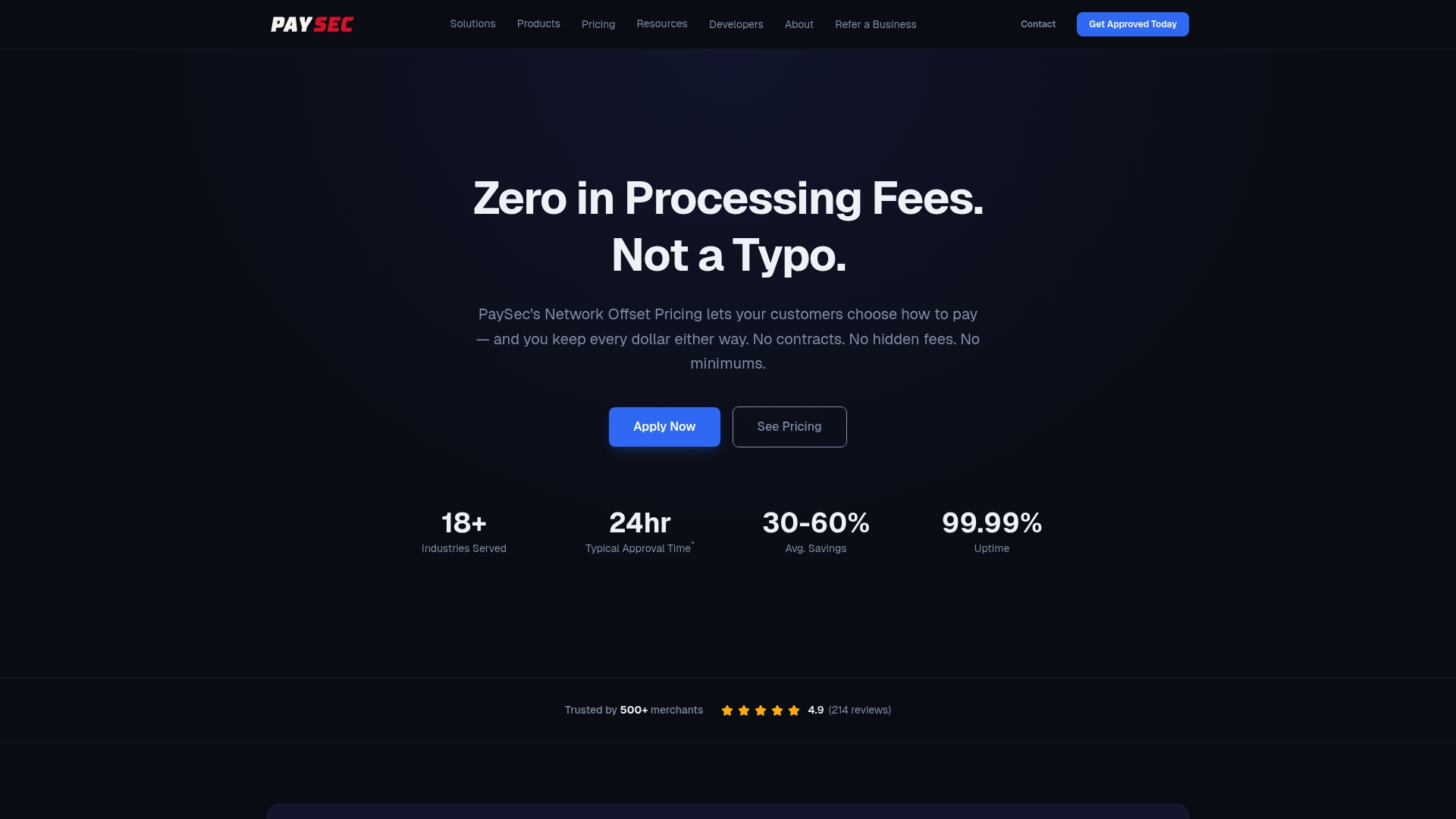
Paysec maintains multiple acquiring bank relationships for CBD accounts, which means your processing does not depend on a single banking partnership staying intact. Dedicated compliance monitoring keeps your account in good standing through regulatory shifts. There are no long-term contracts and no minimums. Check Paysec's pricing options to see exactly what your CBD business would pay, and explore payment terminal solutions built for retail CBD environments.
FAQ
What is the chargeback ratio limit for CBD merchant accounts?
CBD merchants must maintain a chargeback ratio below 1%. Exceeding this threshold triggers account reviews, fund holds, and often immediate termination by the processor.
Why do CBD businesses get labeled high-risk by payment processors?
Processors label CBD businesses high-risk because of regulatory ambiguity between the 2018 Farm Bill and FDA restrictions, elevated chargeback rates in eCommerce, and reputational risk for acquiring banks.
How long does CBD payment processor approval take?
Approval timelines range from 3 to 7 business days when documentation is complete. Missing documents can delay the process by weeks or result in outright rejection.
What documents do CBD merchants need for processor approval?
Required documents typically include business registration, government-issued ID for all principals, current COAs from ISO-accredited labs, three to six months of processing statements, and a compliant website free of FDA-prohibited health claims.
What are rolling reserves and how do they affect CBD businesses?
Rolling reserves are funds processors hold back as a buffer against future chargebacks. For CBD merchants, these reserves can be held for 90 to 180 days post-termination, locking up significant operating capital and requiring proactive cash flow planning.