

TL;DR:
- A high-risk merchant account enables businesses with elevated fraud, chargeback, or regulatory risks to process payments. Approval depends on industry type, operational patterns, and transparency, with higher fees and reserves common for high-risk sectors. Managing chargebacks, reserves, and documentation proactively ensures stable processing and avoids sanctions.
A high-risk merchant account is a specialized payment processing account that allows businesses with elevated exposure to fraud, chargebacks, or regulatory scrutiny to accept credit and debit card payments. Banks and payment networks like Visa and Mastercard assign this classification based on industry type, transaction patterns, and financial history. Without this account type, businesses in sectors like CBD, adult entertainment, travel, and subscription services would face outright rejection from standard processors. Understanding what triggers the classification, what the approval process demands, and how fee structures like rolling reserves affect your cash flow is the difference between processing payments confidently and losing your account without warning.
What is a high-risk merchant account?
A high-risk merchant account is the industry term for a payment processing account underwritten with additional controls to offset elevated financial risk. Standard merchant accounts, offered by processors like Square or traditional acquiring banks, are built for businesses with predictable, low-dispute transaction profiles. High-risk accounts exist for businesses that fall outside those parameters.

The classification comes from two sources: the industry you operate in and the operational characteristics of your business. Payment networks and acquiring banks evaluate both before approving any account. A business can be labeled high-risk even if it has never had a single chargeback, simply because it operates in a sector with historically high fraud rates.
High-risk business types include CBD retail, adult entertainment, travel agencies, subscription box services, digital goods, nutraceuticals, firearms dealers, and heavily regulated healthcare services. Each of these industries carries patterns that processors view as financial exposure: high refund rates, delayed delivery disputes, or regulatory complexity.
The practical consequence is real. High-risk merchants pay higher processing fees, face rolling reserves on their settlements, and operate under stricter monitoring. Knowing this upfront lets you negotiate better terms and build a processing relationship that holds.
What criteria define a business as high-risk?
Payment networks and acquiring banks use a defined set of criteria to classify merchants. No single factor triggers the label automatically. Processors weigh a combination of industry signals and operational data.
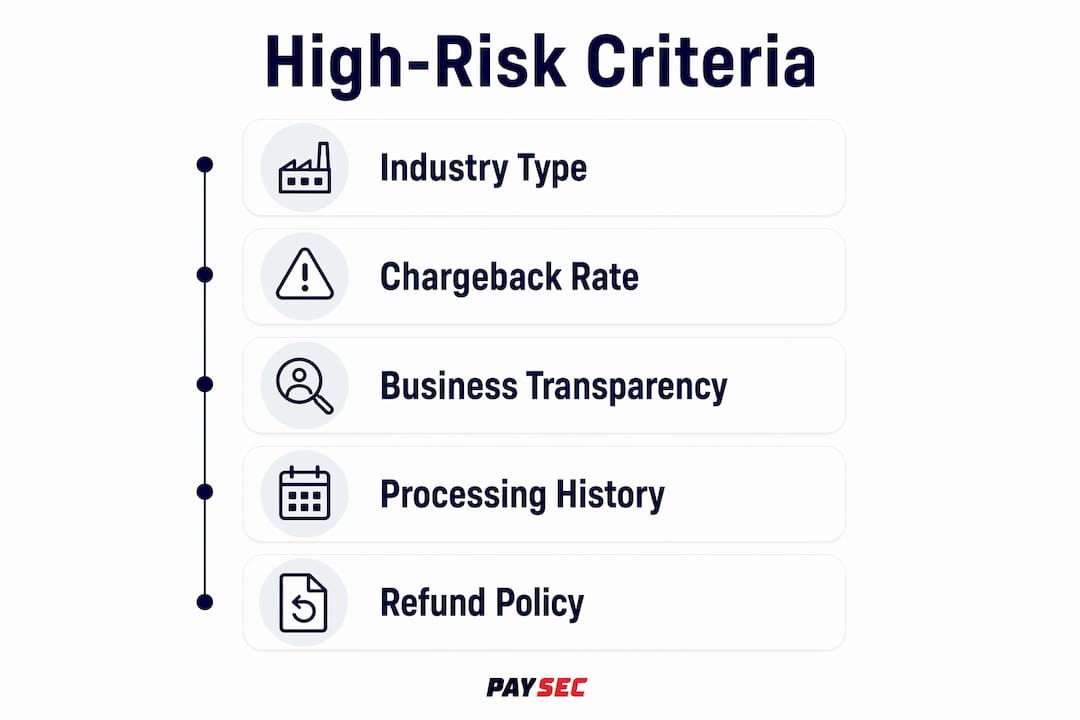
Industry and product type carry the most weight. Businesses selling products with legal ambiguity, age restrictions, or high dispute potential land in the high-risk category by default. This includes CBD and hemp products, firearms and ammunition, adult content, online gambling, travel booking, and telehealth services. What is high-risk merchant healthcare? Any healthcare business processing recurring billing, telemedicine subscriptions, or high-ticket elective procedures fits the profile because of elevated refund and dispute rates.
Transaction patterns are the second major factor. Processors flag businesses that:
- Process a high volume of international transactions, which carry elevated fraud exposure
- Operate on subscription or recurring billing models, which generate more disputes
- Have average ticket sizes above $500, since high-value transactions increase chargeback dollar exposure
- Show inconsistent monthly processing volumes, which signals unpredictable risk
- Operate in card-not-present environments like eCommerce, where fraud rates run higher than in-person sales
Processing history matters significantly during underwriting. A business with a chargeback rate above 1% or a history of terminated merchant accounts will face stricter terms or outright rejection from standard processors. New businesses with no processing history also receive high-risk classification by default because there is no track record to evaluate.
Business model transparency rounds out the assessment. Processors look at whether your refund policy is clearly posted, whether your website matches your actual product or service, and whether your customer service infrastructure can handle disputes before they escalate to chargebacks.
Pro Tip: If you are unsure whether your business qualifies as high-risk, run a self-assessment using a high-risk merchant account evaluation checklist before approaching any processor. Knowing your risk profile in advance gives you negotiating leverage on reserve rates and fees.
How do you get a high-risk merchant account?
Getting a high-risk merchant account approved requires thorough preparation across five document categories. Underwriting for high-risk accounts demands documentation covering business identity, ownership verification, financial stability, processing history, and website compliance. Submitting incomplete files is the most common reason for delays or rejections.
Here is the standard document checklist processors require:
- Business formation documents. Articles of incorporation, LLC operating agreement, or business license. These confirm your legal entity exists and is in good standing.
- Ownership identification. Government-issued photo ID for all owners holding 25% or more equity. Some processors require a Social Security Number or EIN for background checks.
- Financial records. Three to six months of business bank statements and, for established businesses, recent tax returns. Processors use these to verify revenue stability and identify unusual cash flow patterns.
- Processing history. Three to six months of merchant statements from your current or previous processor. These show your chargeback rate, refund rate, and average monthly volume. If you are a new business with no history, a detailed business plan and projected volume help fill the gap.
- Website and compliance disclosures. Your website must display a clear refund and return policy, terms of service, privacy policy, and accurate product descriptions. For regulated industries like CBD or healthcare, you may also need to show regulatory licenses or compliance certifications.
Operational transparency is not just a formality. Processors verify that what your website says matches what customers actually experience. A refund policy buried in fine print or a product description that overpromises will raise red flags during underwriting.
Approval timelines for high-risk accounts typically run 3–7 business days for straightforward applications and up to 2–3 weeks for complex industries like online gaming or international healthcare. Preparing your documents in advance cuts that timeline significantly.
Pro Tip: Before submitting your application, audit your own website as if you were a customer filing a dispute. If your refund policy, contact information, or product descriptions are unclear, fix them first. Clean KYC documentation and a transparent website are the two factors most within your control.
How do rolling reserves affect your cash flow?
Rolling reserves are the most misunderstood cost in high-risk payment processing. A rolling reserve is a percentage of your daily settlements that the processor holds back for a set period to cover potential future chargebacks or refunds. Rolling reserves typically hold 5–15% of settlements for 90–180 days before releasing those funds back to you.
The three reserve structures you will encounter are:
| Reserve Type | How It Works | Cash Flow Impact |
|---|---|---|
| Rolling Reserve | A fixed percentage held from each batch, released after 90–180 days | Ongoing, predictable reduction in daily cash flow |
| Upfront Reserve | A lump sum deposited before processing begins | Large one-time cash requirement at account opening |
| Enhanced Reserve | Higher percentage held during elevated risk periods or after chargeback spikes | Variable, triggered by performance metrics |
Rolling reserves are the most common structure for established high-risk businesses. Upfront reserves appear more often for new businesses or those with no processing history. Enhanced reserves are applied reactively when a processor detects a spike in disputes.
The reserve's core purpose is to protect the processor against delayed chargebacks, not to penalize you. Card network rules allow customers to dispute transactions for up to 120 days after purchase in many cases. The reserve ensures the processor can cover those disputes even if your account is closed.
The cash flow math matters. If you process $100,000 per month and your processor holds 10% for 180 days, you have $60,000 in reserves at any given time that you cannot access. For businesses with thin margins, that is a meaningful constraint on operations.
Pro Tip: Negotiate your reserve terms before signing. Ask for a reserve reduction clause tied to chargeback performance. If your dispute rate stays below 0.5% for six consecutive months, a well-structured contract will reduce your reserve rate automatically.
What chargeback thresholds trigger monitoring programs?
Chargeback rates are the most critical metric in high-risk credit card processing. Visa and Mastercard both operate formal monitoring programs that impose escalating consequences on merchants who exceed defined thresholds.
Visa's Dispute Monitoring Program triggers at a 0.9% chargeback rate with at least 100 disputes in a single month. Mastercard's Excessive Chargeback Program triggers at 1.5% over two consecutive months. These are not soft warnings. Once enrolled in a monitoring program, merchants face monthly fines, additional fees per disputed transaction, and a formal remediation timeline.
The consequences escalate in stages:
- Early Warning: Processor notifies you of elevated dispute rates. No fines yet, but you are on record.
- Standard Monitoring: Monthly fines begin. Visa fines range from $50 to $100 per dispute depending on the program tier. Mastercard fines can reach $200 per chargeback at higher thresholds.
- Excessive Monitoring: Fines increase significantly. Processors may require a remediation plan or impose additional reserve requirements.
- Account Termination: Persistent violations result in account closure and possible placement on the MATCH list, which makes obtaining a new merchant account extremely difficult.
Chargeback rates below 0.5% are considered healthy across all industries. Rates above 0.9% put you in the danger zone regardless of your industry. The practical target for any high-risk merchant is to stay below 0.5% consistently.
Preventive measures that actually move the needle include:
- Sending clear order confirmation emails with your business name as it appears on the customer's card statement
- Offering proactive refunds for dissatisfied customers before they escalate to their bank
- Using fraud screening tools like 3D Secure or AVS (Address Verification Service) to block fraudulent transactions at the point of sale
- Monitoring your chargeback metrics weekly, not monthly, so you catch spikes before they compound
The businesses that maintain healthy processing relationships long-term treat chargeback rate as a leading indicator, not a lagging one. By the time your monthly statement shows a problem, you are already behind.
Key takeaways
A high-risk merchant account requires proactive management of chargebacks, reserves, and compliance documentation to maintain stable payment processing and avoid network sanctions.
| Point | Details |
|---|---|
| Classification is industry and operational | Both your industry type and transaction patterns determine high-risk status, not just one factor. |
| Documentation drives approval | Prepare five document categories including KYC, financials, and website compliance before applying. |
| Rolling reserves lock working capital | Reserves of 5–15% held for 90–180 days reduce accessible cash flow and must be factored into margins. |
| Chargeback rate is the key metric | Keep your dispute rate below 0.5% to stay clear of Visa and Mastercard monitoring programs. |
| Transparency reduces risk | Aligning your website, pricing, and refund policies with actual customer experience lowers disputes and improves underwriting outcomes. |
The uncomfortable truth about high-risk classification
PaySec Marketing Team
After working with merchants across CBD retail, healthcare, and subscription eCommerce, the pattern is consistent: most businesses that struggle with high-risk accounts are not struggling because of their industry. They are struggling because they underestimated how much processors care about operational evidence.
The classification itself is almost secondary. What underwriters actually want to see is proof that your business runs cleanly. A CBD retailer with a clear refund policy, responsive customer service, and a chargeback rate under 0.4% will get better terms than a standard eCommerce business with a 1.2% dispute rate. The label matters less than the numbers behind it.
Rolling reserves are where most merchants get caught off guard. The math is straightforward, but the timing is not. When you are growing fast and processing $200,000 per month, a 10% rolling reserve at 180 days means $120,000 in held funds at steady state. That is not a fee. It is working capital you cannot deploy. Negotiating that reserve rate down from day one, or building a reserve reduction clause into your contract, is worth more than negotiating a lower per-transaction rate.
The other thing most articles do not say plainly: chargeback monitoring programs are not a warning system. By the time Visa or Mastercard formally enrolls you, the fines are already running. The only effective strategy is to treat your dispute rate as a real-time operational metric, not a monthly accounting entry. Businesses that review chargeback data weekly and act on it immediately stay off the monitoring lists. Businesses that review it quarterly do not.
The high-risk payment processing space rewards merchants who treat compliance as a competitive advantage, not a bureaucratic hurdle. The ones who do the documentation work, maintain transparent operations, and manage disputes proactively end up with lower reserve rates, better fee structures, and processing relationships that last.
— PaySec Marketing Team
How Paysec supports high-risk merchants
Paysec provides dedicated merchant accounts built for businesses that standard processors turn away. Whether you operate in CBD retail, healthcare, subscription eCommerce, or any of the 18-plus industries Paysec serves, the account structure is designed to handle elevated transaction complexity without hidden fees or long-term contracts.
Paysec's Network Offset Pricing gives high-risk merchants access to wholesale interchange rates, which means the processing cost savings are real and measurable. Clients across high-risk sectors report 30–60% reductions in processing costs compared to traditional tiered pricing models. Detailed transaction reporting gives you the visibility to monitor chargeback trends in real time, so you stay ahead of network thresholds. Explore Paysec's transparent pricing options to see how the numbers work for your specific processing volume and industry.
FAQ
What is a high-risk merchant account?
A high-risk merchant account is a specialized payment processing account for businesses with elevated exposure to chargebacks, fraud, or regulatory risk. It allows those businesses to accept credit and debit card payments under stricter underwriting terms than standard accounts.
Which industries are considered high-risk for payment processing?
Industries including CBD, adult entertainment, travel, online subscriptions, digital goods, nutraceuticals, firearms, and certain healthcare services are classified as high-risk due to elevated dispute rates or regulatory complexity.
What chargeback rate triggers a monitoring program?
Visa's Dispute Monitoring Program triggers at a 0.9% chargeback rate with at least 100 disputes in a month. Mastercard's Excessive Chargeback Program triggers at 1.5% over two consecutive months, with escalating fines and potential account termination.
How does a rolling reserve work?
A rolling reserve holds back 5–15% of your daily settlements for 90–180 days to cover future chargebacks or refunds. Those funds are released back to you on a rolling cycle once the holding period expires.
What documents do you need to get a high-risk merchant account?
You need business formation documents, owner identification, three to six months of bank statements, processing history, and a compliant website with visible refund and privacy policies. Complete, clean documentation significantly improves approval speed and terms.