

CBD merchants lose payment accounts because underwriters classify the entire product category as high-risk, then close accounts fast when compliance gaps, prohibited health claims, or chargeback spikes confirm that risk. The pattern shows up everywhere: 67% of hemp businesses report significant payment-processing challenges, and 43% have been terminated by processors despite operating legally.
If your account was just frozen or flagged, do three things in the next hour. First, stop running new transactions through any channel where your product pages make health claims or list Delta-8/Delta-10 products, since those are the fastest way to turn a review into a termination. Second, preserve every piece of documentation you have: lab certificates of analysis (COAs), supplier invoices, product descriptions, and your full transaction history. Third, contact your processor in writing to ask what triggered the review, and start a parallel application with a processor that underwrites CBD specifically rather than waiting to see if the first one reverses itself.
- Screenshot or PDF your current product pages before you edit them (you'll need the "before" version for the appeal).
- Pull your last 6 months of transaction and chargeback data from your processor dashboard.
- Pause paid ads and email campaigns that mention "pain relief," "anxiety," "cures," or similar therapeutic language.
- Have your COAs and business licenses in one folder, ready to upload.
Pro Tip: Don't wait for a termination letter to build your documentation folder. Underwriters at CBD-specialist processors move faster when a merchant already has COAs, licenses, and clean product copy ready on day one of the application.
Key Takeaways
CBD payment accounts get closed when category-level risk, compliance gaps, and chargeback patterns intersect, and stability comes from treating documentation and marketing compliance as ongoing operations, not onboarding checkboxes.
| Point | Details |
|---|---|
| Category risk drives closures | Underwriters treat CBD as high-risk regardless of individual compliance, so a clean business can still lose an account. |
| Health claims are a top trigger | FDA-style therapeutic language on product pages is one of the fastest ways to draw a termination review. |
| Reserves protect against disputes | Expect 5% to 10% rolling reserves held for 90 to 180 days as standard CBD account structure. |
| Documentation prevents delays | Current COAs, licenses, and transaction history speed up both onboarding and remediation after a freeze. |
| Paysec offers CBD-ready stability | Paysec provides CBD-dedicated underwriting, transparent Network Offset Pricing, and PCI DSS/SOC 2 compliant processing. |
Table of Contents
- Why Banks and Processors Terminate CBD Merchant Accounts
- Operational and Marketing Triggers That Cause Sudden Freezes
- What Processors Require During Onboarding
- Reserves, Fees, and Why CBD Sellers Pay More
- The Regulatory Backdrop Driving Bank Behavior
- Step-by-Step: What to Do If Your Account Is Frozen
- Keeping Your Account Healthy After Approval
- How Paysec Supports Stable CBD Payment Processing
- How Stripe, PayPal, Shopify Payments, and Square Handle CBD
- Managing Risk Across Your CBD Product Line
- How Long It Takes to Recover or Secure a New CBD Account
- Recent Legal and Compliance Shifts Affecting CBD Payments
- The View From Paysec: Prevention Beats Reaction Every Time
- Keep Processing With Transparent, CBD-Ready Pricing
- Sources
- FAQ
Why Banks and Processors Terminate CBD Merchant Accounts
Payment underwriters don't evaluate your business individually first. They evaluate your merchant category code, and CBD sits in a bucket that carries baggage from three sources: unresolved federal guidance, inconsistent state law, and years of merchant behavior that produced outsized chargebacks and regulatory action across the category. That's category-level risk scoring, and it means a spotless business can still get swept up in a bank's decision to exit the vertical entirely.
Several conditions turn that background risk into an actual termination notice:
- Federal regulatory uncertainty around hemp-derived products, especially anything resembling a therapeutic claim.
- Product THC content that drifts above the legal hemp threshold, even accidentally, due to batch variation.
- Marketing language that implies a product treats, cures, or prevents a medical condition.
- Chargeback ratios climbing above the thresholds card networks set for high-risk categories.
- Sudden, unexplained spikes in transaction volume that look like fraud to automated monitoring.
- Adding intoxicating hemp derivatives like Delta-8 or Delta-10 THC to a catalog the processor approved for standard CBD only.
The FDA has repeatedly stated that CBD cannot be lawfully added to food or marketed as a dietary supplement, and it continues to issue warning letters to sellers making unapproved health claims. That agency posture is exactly what payment underwriters monitor when deciding whether a CBD account is worth the exposure.
Mainstream, general-purpose gateways tend to apply this high-risk label uniformly, which is why merchants get declined or later terminated regardless of individual compliance. The account isn't being punished for something it did. It's being priced and reviewed as part of a category the processor decided carries too much collective risk.
Operational and Marketing Triggers That Cause Sudden Freezes
Underwriting decisions happen at two speeds: a slow initial review, and a fast automated one that runs continuously after approval. The fast one is what catches most merchants off guard, and it's almost always triggered by something visible on your own website or in your own transaction pattern.
The most common triggers, in order of how often they surface in account reviews:
- A mismatch between what you disclosed at signup (say, "general wellness retailer") and what you're actually processing, which automated systems detect quickly once transaction descriptors don't match the approved business type.
- Health or therapeutic claims that crept back onto product pages after a copywriter or new hire didn't get the compliance memo.
- Expired, missing, or inconsistent COAs, especially when a new batch ships without an updated lab report.
- Delta-8, Delta-9, or Delta-10 products added to a catalog the processor never approved for intoxicating derivatives.
- Subscription billing disputes, where customers forget they signed up for recurring shipments and file a chargeback instead of canceling.
- A traffic spike from a viral post or influencer mention that triples your transaction volume overnight with no advance notice to your processor.
Here's a pattern that plays out constantly: a merchant gets approved with a clean, compliant product page. Six months later, a marketing intern updates the copy to boost conversions, adds a line like "clinically shown to reduce anxiety," and nobody flags it internally. The processor's compliance scan catches it within weeks. That single sentence, unsupported by FDA-recognized evidence, is enough to trigger a manual review and, in repeat cases, termination.
Pro Tip: You can describe what a product does without making a medical claim. Instead of "relieves chronic pain," write "formulated with 25mg of full-spectrum CBD per serving" and let the ingredient speak for itself. Underwriters and the FDA both react to claims, not ingredients.
What Processors Require During Onboarding
Getting approved by a processor that actually underwrites CBD comes down to showing your paperwork before they ask twice. The documentation bar is higher than a standard retail account, but it's a known fixed list, not a moving target.
Expect to provide:
- Business registration and EIN documentation.
- State and local licenses where your state requires them for hemp-derived product sales.
- Supplier invoices and chain-of-custody records showing where your hemp inputs originated.
- Batch-level COAs from an independent lab confirming THC content stays within the legal hemp threshold.
- Product labeling and SKU-level descriptions that match what's actually on your website.
- A written refund and cancellation policy.
- Sample product page copy that describes ingredients and use without therapeutic claims (for example, "may support relaxation" is safer than "treats insomnia").
| Onboarding Stage | Typical Focus | What Slows It Down |
|---|---|---|
| Initial application review | Business legitimacy, product category, website compliance | Missing licenses or vague product descriptions |
| Lab and document verification | COA accuracy, THC compliance, supplier chain | Outdated COAs or unmatched batch numbers |
| Bank/acquirer approval | Risk pricing, reserve terms, processing limits | High-risk classification requiring additional underwriting sign-off |
| Live processing | Transaction monitoring begins | Volume or chargeback patterns that don't match disclosed projections |
Reserves, Fees, and Why CBD Sellers Pay More
CBD processing costs more because the pricing itself is the risk mitigation tool. A CBD-specialist provider builds the expected dispute and chargeback exposure directly into the rate and the reserve structure, rather than declining the account outright.
Typical components of a CBD merchant's pricing stack:
- Interchange-plus spread: the base card network rate, plus the processor's markup.
- Fixed per-transaction fee: a flat charge added on top of the percentage rate.
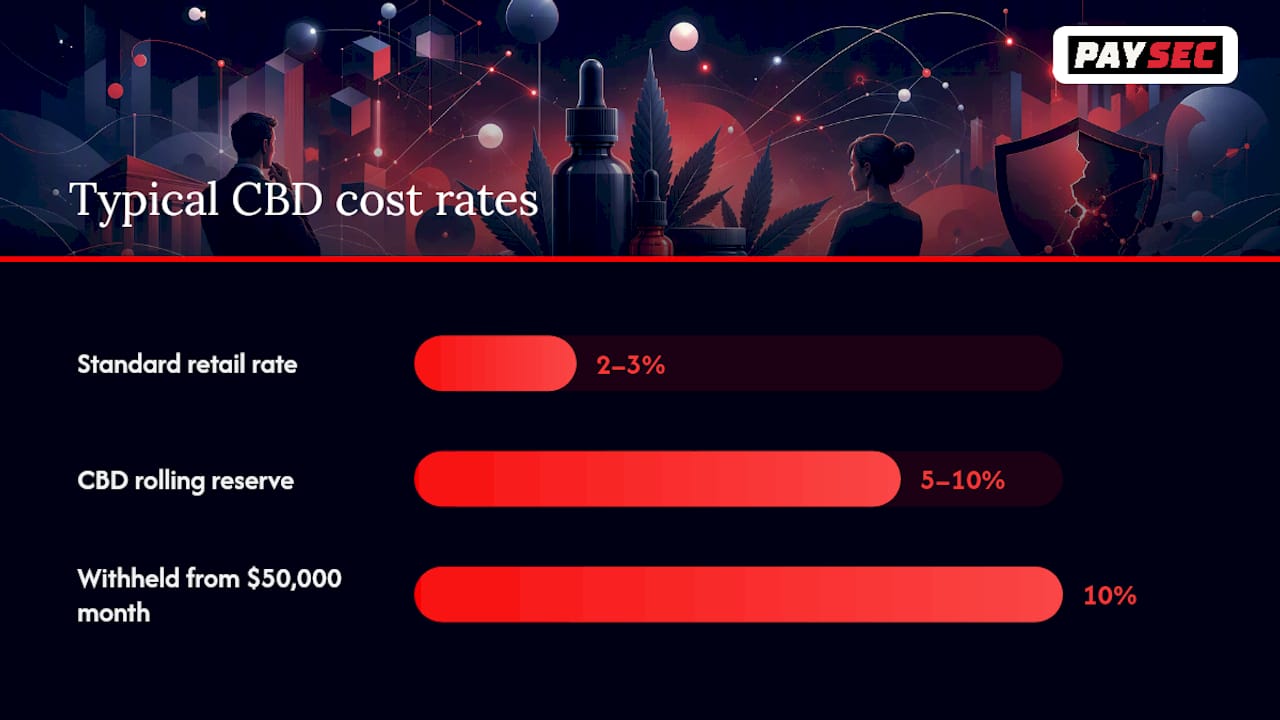
- High-risk category markup: typical CBD processing rates run higher than those for standard retail transactions, compared to 2 to 3% for standard retail.
- Rolling reserve: a percentage of each transaction held back for a set period to cover future chargebacks, commonly 5% to 10% for CBD merchants.
| Fee Component | Standard Retail | Typical CBD Range |
|---|---|---|
| Processing rate | 2% to 3% | higher than standard retail rates |
| Rolling reserve | Rare | 5%–10% |
| Reserve hold period | Not applicable | 90–180 days |
That's $5,000 gone from a $50,000 month before payroll, inventory, or ad spend even enter the picture.
Pro Tip: Reserve percentages aren't fixed forever. Processors typically reduce them after 6 to 12 months of clean processing history with low chargeback ratios. Ask for a documented reserve-reduction schedule at onboarding, in writing, so it's not left to a case-by-case renegotiation later.
The Regulatory Backdrop Driving Bank Behavior
But it didn't settle the questions that actually matter to a payment underwriter, because federal legalization at the agricultural level never resolved how CBD could be marketed, sold as food, or labeled as a supplement.
That gap is where the FDA's posture takes over. The agency has consistently maintained that CBD cannot be lawfully added to conventional food or sold as a dietary supplement, and it backs that position with enforcement letters aimed at sellers making unapproved health claims. Every warning letter the FDA publishes becomes a data point a bank's compliance team can point to when deciding the category is still too unsettled to underwrite comfortably.
State law compounds the problem. Some states restrict or ban ingestible hemp products entirely, others regulate Delta-8 separately from CBD, and a merchant selling nationally has to satisfy the strictest state in its shipping footprint, not just the most permissive one.
For a national acquiring bank, that patchwork means a single merchant account can carry fifty different compliance profiles depending on where the customer lives. Underwriters price and monitor for the worst-case state, which is a major reason CBD accounts get flagged even when the merchant believes it's fully compliant everywhere it sells.
Step-by-Step: What to Do If Your Account Is Frozen
The moment you get a freeze notice or a termination email, the clock starts on both fund recovery and finding a replacement processor. Move through these steps in order.
- Preserve evidence immediately. Save the termination or freeze notice, your last product page versions, COAs, and transaction logs before anything gets altered or deleted.
- Stop noncompliant sales. Pull any product or ad copy that could have triggered the review, particularly therapeutic claims or unapproved derivatives.
- Gather your documentation packet. Compile COAs, business licenses, supplier invoices, and six months of transaction history into one file.
- Request a formal funds-release review. Ask the processor in writing what specifically triggered the action and what evidence would support releasing held funds.
- Send a written remediation plan. Show the processor what you've changed: removed claims, updated catalog, tightened refund policy.
- Prepare a replacement onboarding packet. Apply with a processor built to underwrite CBD from the start rather than waiting on a reversal that may never come.
A sample funds-release request might read: "We received notice that our account was placed under review on [date]. We have removed the flagged product listings and are prepared to provide current COAs, updated product descriptions, and full transaction history. We request a timeline for review and clarification on any conditions for reinstatement or fund release."
Expect reserve funds to sit for 90 to 180 days while the processor covers potential chargebacks from transactions already processed. In some cases, a closed account also lands the merchant in a shared industry database that other processors check, which can complicate reboarding for years afterward.
Keeping Your Account Healthy After Approval
Approval isn't the finish line. The merchants who keep their accounts stable for years treat compliance as an ongoing operational habit, not a one-time onboarding task.
Build these controls into your regular operations:
- Audit COAs on a fixed schedule (monthly or per batch) instead of only when a processor asks.
- Keep your catalog conservative: exclude Delta-8, Delta-9, or Delta-10 products unless your processor has explicitly approved them.
- Publish a clear, easy-to-find refund and cancellation policy, and honor it consistently.
- Follow up on customer service tickets before they escalate into chargebacks.
- Monitor your chargeback ratio monthly and investigate any month that trends upward.
- Send subscription renewal reminders before each charge, not just at signup.
Sample subscription language that reduces disputes: "Your next shipment and charge will process on [date]. Reply STOP or manage your subscription anytime at [link]." That single reminder line does more to prevent friendly-fraud chargebacks than almost anything else in a subscription flow, because subscription billing and chargebacks disproportionately drive high-risk scoring for CBD sellers.
Pro Tip: Structure trial periods with a mandatory card-on-file confirmation email 3 days before the trial converts to a paid subscription. That one touchpoint catches most customers who forgot they signed up, before they call their bank instead of you.
How Paysec Supports Stable CBD Payment Processing
Everything covered so far points to one conclusion: CBD merchants need a processor that underwrites the category on purpose, not one that tolerates it until the first compliance scare. Paysec builds its CBD merchant accounts around that principle from the start.
- CBD-dedicated underwriting that evaluates your actual compliance documentation instead of applying a blanket high-risk decline.
- Transparent Network Offset Pricing and interchange-plus rate structures, so merchants see exactly what they're paying and why.
- Rolling-reserve policies that can be adjusted as your processing history and dispute ratios improve.
- PCI DSS Level 1 and SOC 2 compliance, backed by documented security controls that satisfy acquiring-bank requirements.
- Real-time, transaction-level reporting that gives finance teams full visibility into holds, disputes, and settlement timing.
One CBD retailer worked with Paysec to secure approval within 48 hours after being declined three times by other providers, moving from stalled sales to live processing almost immediately.
Onboarding follows a clear compliance checklist covering licenses, COAs, and product page review, backed by acquiring-bank relationships built specifically for high-risk verticals. For merchants that also need help documenting their own internal security controls, resources like Sentrix's PCI DSS compliance automation guidance offer a useful reference point alongside Paysec's own CBD payment compliance guide.
How Stripe, PayPal, Shopify Payments, and Square Handle CBD
General-purpose platforms weren't built with CBD's regulatory profile in mind, and their terms of service reflect that. PayPal's acceptable use policy has historically excluded CBD and hemp-derived products from standard merchant accounts, which means an account that starts processing CBD transactions risks a freeze the moment automated monitoring flags the mismatch. Stripe applies a similarly restrictive stance for most CBD product categories, with limited exceptions handled through specialized review.
Shopify Payments follows the same logic: Shopify as a storefront platform tolerates CBD listings in many cases, but Shopify Payments, the built-in processor, often does not, forcing merchants toward a third-party gateway anyway. Square has gone further, directly instructing businesses to stop selling hemp and CBD products in response to shifting federal rules, giving merchants a hard deadline rather than a gradual warning.
The pattern across all four platforms is the same: they're optimized for low-risk, high-volume mainstream retail, and CBD doesn't fit that profile no matter how compliant the individual merchant is. Platform policy shifts can become the proximate cause of a merchant disruption with little warning, which is why relying on a general-purpose platform as your only processing path carries structural risk a CBD-specialist account doesn't.
Managing Risk Across Your CBD Product Line
Not every CBD SKU carries the same processing risk, and treating your whole catalog as one risk profile is a mistake. Tinctures and topicals with clear, conservative labeling tend to draw far less scrutiny than ingestible products marketed with wellness claims, and anything resembling an intoxicating derivative sits in its own high-scrutiny tier entirely.

A workable risk framework segments your catalog into tiers: standard CBD products with clean COAs and neutral labeling, subscription or recurring-billing products that need extra dispute monitoring, and any Delta-8 or similar derivative that may need a separate merchant account entirely rather than folding into your main processing relationship. Transaction pattern monitoring matters just as much as product classification.
How Long It Takes to Recover or Secure a New CBD Account
Recovery timelines vary by how the account was lost and how prepared your documentation is going in. A frozen account under review, where the processor hasn't fully terminated yet, can sometimes resolve in 2 to 4 weeks if you respond fast with a clean remediation packet. A full termination is a longer road: expect 4 to 8 weeks to secure a new CBD-specialist merchant account if your documentation (COAs, licenses, transaction history) is ready on day one, and longer if you're assembling it from scratch.
Held reserve funds follow their own separate timeline, typically 90 to 180 days regardless of how quickly you get a new account running. That means most merchants end up running two processing tracks simultaneously for a stretch: a new account handling live sales, while the old account's reserve funds work through their hold period. Planning for that overlap, rather than assuming funds release the moment you're approved elsewhere, prevents a cash-flow surprise on top of an already stressful transition.
Recent Legal and Compliance Shifts Affecting CBD Payments
The regulatory ground under CBD payments keeps moving, and every shift changes what underwriters watch for.
Platform-level policy changes compound the legal uncertainty. When a major platform like Square tells merchants to stop selling hemp and CBD products ahead of anticipated federal rule changes, it signals that processors are getting ahead of regulation rather than waiting for it to finalize. Merchants who only track FDA and Farm Bill news, without also watching processor and platform policy announcements, tend to get caught off guard by these shifts. The safest posture is treating platform terms-of-service updates with the same urgency as an actual law change, since for payment access purposes, they function the same way.
The View From Paysec: Prevention Beats Reaction Every Time
The CBD merchants who keep their payment accounts long term share one trait: they treat compliance as infrastructure, not paperwork. Every pattern in this article, from mismatched product disclosures to expired COAs to subscription disputes, traces back to a business that treated onboarding as a one-time hurdle instead of an ongoing operating discipline. That's the gap prevention-focused merchants close and reactive ones don't.
The industry conversation tends to focus on which processor will say yes, but the harder and more valuable question is which processor will still say yes in eighteen months. A merchant that builds documentation habits, monitors its own chargeback ratio, and keeps marketing copy honest about ingredients rather than outcomes puts itself in a fundamentally different risk category than one hoping to slide under the radar. Explore the CBD payment processor options guide and reach out to a compliance-focused specialist before your next batch ships, not after your account gets flagged.
Keep Processing With Transparent, CBD-Ready Pricing
Paysec is built for merchants who need a processor that treats CBD as a known, underwritten category rather than a liability to avoid. That means Network Offset Pricing that shows exactly what you're paying with no hidden markups, rolling-reserve terms structured around your actual processing history, and PCI DSS Level 1 and SOC 2 compliance documentation ready for your own due diligence.
Onboarding follows a defined compliance checklist covering COAs, licenses, and product page review, so there's a clear path from application to live processing rather than an open-ended wait. If your CBD business needs stable, compliant processing without long-term contracts or minimums, check current interchange-plus and network-offset rates and request a compliance-ready onboarding packet today.
Sources
- FDA — Regulation of Cannabis and Cannabis-Derived Products, Including Cannabidiol (CBD)
- CBD Payment Processing: Complete Guide for Hemp Businesses | HempData
- Why CBD Brands Get Declined by Traditional Payment Gateways — The Marijuana Herald
- Common Reasons CBD Merchant Accounts Get Shut Down — Bullz-Eye
- Square tells businesses to stop selling hemp and CBD products in light of upcoming federal ban — Marijuana Moment
This article is general information, not a substitute for advice from a qualified financial advisor. Consult a qualified financial professional about your own circumstances before acting on anything here.
FAQ
Does PayPal allow CBD sales?
PayPal's standard merchant terms have historically excluded CBD and hemp-derived products from typical accounts, so most CBD sellers need a dedicated high-risk or CBD-specialist processor instead of relying on PayPal as their primary gateway.
What does CBD mean in payment processing terms?
In payment processing, CBD is classified as a high-risk merchant category, meaning underwriters apply stricter documentation requirements, higher per-transaction fees, and rolling reserves regardless of an individual business's compliance record.
What happens when your business payment account gets closed?
When a payment account closes, remaining funds are typically held in a rolling reserve for 90 to 180 days to cover potential chargebacks, and the merchant needs to secure a new processor to resume live transactions.
How long does it take to get a new CBD merchant account after termination?
With documentation ready (COAs, licenses, transaction history), most merchants secure a new CBD-specialist account within 4 to 8 weeks, though held reserve funds from the prior account still follow their own separate 90 to 180 day timeline.
Can Paysec help a CBD business that was already declined elsewhere?
Yes. Paysec underwrites CBD merchants directly and has approved retailers that were previously declined by other providers, including one case where approval came within 48 hours after three prior declines.