

What is the role of payment analytics in ecommerce?
Payment analytics transforms raw transaction data into clear, actionable intelligence that ecommerce businesses use to recover lost revenue, reduce declines, and improve the customer checkout experience. At its core, it answers a question every merchant faces: why are payments failing, and what can be done about it right now?
The role of payment analytics in ecommerce goes well beyond reporting totals. It covers the full transaction lifecycle, from the moment a customer clicks "pay" through authorization, capture, settlement, refunds, and disputes. Every step generates data. Payment analytics turns that data into decisions.
Here is what payment analytics directly impacts:
- Authorization rates: Identifies which issuers, geographies, or card types are declining transactions and why
- Revenue recovery: Flags retryable soft declines so merchants can recapture transactions before they are permanently lost
- Fraud detection: Monitors transaction patterns in real time to catch fraud signals early, before chargebacks compound
- Cash flow forecasting: Tracks settlement timelines and payment volumes to give finance teams accurate projections
- Customer experience: Faster, more reliable payment processing builds trust and reduces checkout abandonment
A one-percentage-point gain in authorization rate recovers revenue with no additional customer acquisition spend. That makes payment analytics one of the most capital-efficient growth levers available to any ecommerce operation.
Understanding payment analytics: what it covers and how it works
Payment analytics is a specialized intelligence layer built specifically for the nuances of transaction flows, card network rules, and processor behavior. It is not the same as general business intelligence. A standard BI tool can report aggregate payment totals, but it lacks the domain-specific logic needed to interpret decline codes, issuer behavior patterns, or the friction caused by 3DS authentication. General BI lacks the context to close the loop between a checkout event and its financial outcome.
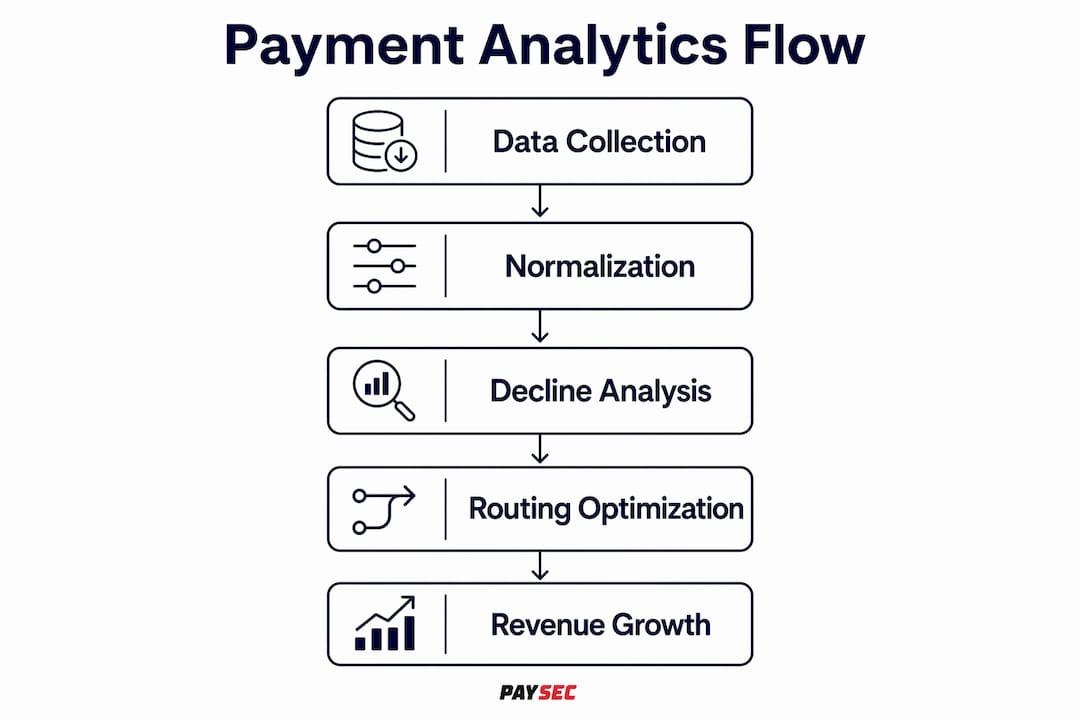
The full transaction lifecycle
Payment analytics begins the moment a customer initiates a payment and tracks data through every stage:
- Authorization: Was the transaction approved or declined? By which issuer? For what reason?
- Capture: Did the authorized amount get captured successfully?
- Settlement: How long did funds take to reach the merchant's account?
- Refunds: What is the refund rate by product, channel, or payment method?
- Disputes and chargebacks: Which transaction types generate the most disputes?
Key data sources and dimensions
Effective payment analytics pulls from multiple sources and segments data across dimensions that aggregate reporting misses entirely:
- Payment method (credit, debit, digital wallets, buy-now-pay-later)
- Geography and currency
- Issuing bank and card brand
- Device type and sales channel
- Processor and gateway used
Core metrics tracked
The metrics that matter most include authorization rate, approval rate, decline rate, payment conversion rate, average order value, chargeback rate, refund rate, and settlement time. Advanced implementations also measure performance by issuing bank and device type to identify gaps at a granular level. These are the numbers that tell you where money is leaking and where the fix is straightforward.
Why payment analytics is vital for ecommerce businesses
The strategic case for payment analytics is direct. Payment analytics helps track sales patterns, forecast cash flow, and reduce costly mistakes by identifying errors before they affect customers. For ecommerce businesses processing thousands of transactions daily, even small inefficiencies compound fast.
Here are the core benefits that make payment analytics worth prioritizing:
- Improved authorization rates: Data-driven routing and retry logic push more transactions through successfully. Merchants using data-driven routing outperform peers by 2–4 percentage points on authorization rate, a gap that translates to material revenue at any meaningful transaction volume.
- Revenue recovery without extra spend: Recovering failed transactions through analytics costs far less than acquiring new customers to replace lost sales.
- Fraud identification: Real-time monitoring surfaces unusual patterns before fraud scales into a chargeback problem.
- Operational efficiency: Analytics pinpoints bottlenecks in payment flows, such as slow settlement times or high decline rates on specific processors, so teams can act on root causes rather than symptoms.
- Competitive advantage: Merchants who understand their payment data make faster, better decisions than those relying on gut instinct or monthly reports.
- Customer trust: Reliable, fast payment processing reduces friction at checkout, which directly affects repeat purchase rates and lifetime value.
Finance experts now treat payment analytics as a core competency, not an optional add-on, in complex payment ecosystems. The businesses building resilient, customer-focused operations are the ones treating their transaction data as a strategic asset.
Key insights payment analytics gives you and the questions it answers
Payment analytics answers specific, high-value questions that aggregate reporting cannot. The insights it surfaces are precise enough to drive immediate operational decisions.
Decline code analysis is where most merchants find their biggest quick wins. Every decline carries a code that explains the reason: insufficient funds, do not honor, card expired, lost or stolen, and dozens more. Grouping declines by code, issuer, and time window reveals patterns. A spike in "do not honor" responses from a single issuer on weekend evenings points to a routing problem, not a customer problem.
Authorization rates by issuer and geography show where your payment stack is underperforming. A merchant processing cards from multiple countries may find that one processor handles European issuers well but struggles with certain US regional banks. That insight directly informs routing decisions.

Processing latency effects matter more than most merchants realize. Slow authorization responses increase checkout abandonment. Analytics that correlates latency with conversion rates quantifies the revenue cost of a slow processor.
Additional insights payment analytics delivers:
- Retry logic optimization: Soft declines such as "insufficient funds" or "do not honor" are retryable. Analytics identifies which decline codes respond best to retries and at what interval.
- Real-time alerts: Automated monitoring triggers alerts on sudden spikes in specific decline codes or authorization rate drops, letting payment teams act before losses compound over hours.
- Benchmarking: Comparing your authorization rate against historical baselines or industry norms shows whether a drop is a processor issue or a broader market shift.
Pro Tip: Set up real-time alerts for authorization rate drops exceeding 2 percentage points from your 7-day baseline. That threshold catches genuine processor issues without generating noise from normal daily variance.
How payment analytics optimizes ecommerce payment processes
Payment analytics does not just report what happened. It drives specific operational changes that improve payment performance going forward.
Data-driven routing
Routing rules determine which processor handles a given transaction. Without analytics, routing is often static, based on a contract signed years ago. With analytics, routing becomes dynamic. Merchants can direct transactions to the processor with the highest authorization rate for a specific card brand, issuer, or geography. Multi-processor benchmarking eliminates the blind spots that occur when performance data sits siloed inside separate provider dashboards.

Retry strategies for soft declines
Not all failed transactions are permanent losses. Soft declines are retryable, and the timing and method of the retry matter. Analytics-driven retry strategies can recover 20–40% of soft-declined transactions that would otherwise be lost. The key is knowing which decline codes to retry, how quickly, and on which processor.
A/B testing checkout UX
Payment analytics links checkout design changes to measurable conversion outcomes. When a merchant tests a new payment form layout or adds a digital wallet option, analytics shows whether the change improved authorization rates and payment conversion rate, not just clicks. That closes the loop between UX decisions and financial results.
Process integration best practices
- Normalize data across all processors before analysis to avoid comparing metrics that use different definitions
- Review operational metrics like authorization rate daily; review strategic metrics like chargeback rate weekly or monthly
- Feed analytics insights back into routing configurations without requiring engineering deploys where possible
- Connect payment analytics to your ecommerce payment stack so data flows automatically rather than requiring manual exports
Pro Tip: When you add a new payment method, segment its authorization rate separately for the first 30 days. Blending it into your overall rate immediately hides whether the new method is performing or dragging your numbers down.
How payment analytics impacts customer experience and revenue growth
The connection between payment analytics and customer experience is direct. Monitoring transaction data detects fraud patterns early and enhances payment speed, contributing to improved trust and customer satisfaction. A customer who hits a false decline at checkout does not usually try again. They leave, and often do not come back.
Higher authorization rates mean more completed purchases from the same traffic. That is revenue recovered without spending another dollar on advertising or acquisition. Segmenting payment success by payment type and consumer behavior enables targeted improvements in checkout flows and payment acceptance rates, which compounds over time as more customers complete purchases on their first attempt.
The revenue impact breaks down across several dimensions:
- Increased sales conversion: Fewer false declines mean more completed transactions from existing visitors
- Higher customer lifetime value: Customers who experience smooth, reliable payments return more often
- Reduced chargeback costs: Early fraud detection through analytics cuts the operational cost of disputes
- Better cash flow: Accurate settlement time tracking gives finance teams reliable data for planning
Ecommerce businesses that identify top-performing payment methods and checkout optimizations through analytics consistently see measurable gains in revenue. The improvement is not theoretical. It shows up in authorization rates, conversion rates, and repeat purchase behavior.
Real-world examples of payment analytics in action
These examples show how ecommerce merchants apply payment analytics to solve specific, costly problems.
Authorization rate recovery through routing changes: A merchant processing cards across multiple US issuers notices through analytics that one regional bank's cards decline at nearly twice the rate of national bank cards. The root cause is a processor that handles that issuer's BIN range poorly. Routing those specific BINs to a different processor raises the authorization rate for that segment and recovers revenue that had been silently leaking for months.
Decline code analysis driving retry logic: A subscription ecommerce business finds that a large share of its monthly renewal failures carry "insufficient funds" decline codes clustered on the first of the month. Analytics shows that retrying those transactions on the 3rd or 4th of the month, after payroll cycles, recovers a meaningful portion of the failed renewals. Without the decline code data, the business would have simply churned those subscribers.
Checkout UX optimization linked to conversion: A merchant runs an A/B test adding Apple Pay to its mobile checkout. Payment analytics tracks not just click-through but actual authorization rate and payment conversion rate for the new method versus the existing card form. The data shows Apple Pay converts at a higher rate on mobile, justifying a permanent change to the checkout layout.
Fraud detection through pattern analysis: Payment analytics identifies that a specific payment method is disproportionately associated with fraudulent transactions on a particular sales channel. The merchant pauses that combination while investigating, stopping the fraud before it escalates into a chargeback rate problem that would trigger card network penalties.
Merchants applying analytics-driven retry strategies have documented recovery of 5–15% of otherwise lost transactions, improving overall sales velocity without changing their product or marketing.
Expert insights on transforming payment data into business value
Finance specialists who work inside payment ecosystems are consistent on one point: payment analytics is not a reporting tool. It is an operational system.
"Payment analytics transforms raw transaction data into meaningful insights that inform smarter decision-making. By tracking and analyzing sales patterns, businesses can forecast cash flow more accurately, optimize budgets, and uncover inefficiencies within their payment processes. Payment analytics is no longer an optional add-on but a core component of building a modern, efficient, and customer-focused business."
— Penny Townsend, writing for Finextra
That framing matters. Merchants who treat payment analytics as a monthly reporting exercise miss the operational value entirely. The businesses extracting the most value run analytics continuously, with real-time alerts and automated routing adjustments that respond to data within minutes.
Specialized payment analytics differs from general BI because it is purpose-built for the context of authorization flows, card network rules, and processor behavior. A general BI dashboard can tell you that revenue dropped on Tuesday. Payment analytics tells you that authorization rates dropped 3 points on Tuesday because a specific processor had a latency spike affecting Visa debit cards from three issuing banks, and here is the routing change that fixes it.
The ROI case is also clearer than most merchants expect. A one-percentage-point improvement in authorization rate recovers revenue with no incremental acquisition spend. At meaningful transaction volume, that single metric improvement outperforms most marketing campaigns in cost efficiency. The iterative nature of payment analytics means each improvement compounds: better routing leads to better data, which leads to better routing decisions in the next cycle.
What tools and technologies power payment analytics for ecommerce?
Payment analytics capabilities range from basic gateway dashboards to purpose-built platforms with real-time data normalization and cross-processor benchmarking. Understanding what each tier offers helps merchants choose the right level of investment for their transaction volume.
Payment gateway dashboards are the starting point for most merchants. They provide basic transaction reporting, decline summaries, and refund tracking. They are useful for low-volume operations but lack the cross-processor view and granular decline code analysis that growing ecommerce businesses need.
Dedicated payment analytics platforms go significantly further. They normalize response codes across multiple processors, provide real-time authorization rate monitoring by issuer and geography, and support automated routing rule updates based on live data. These platforms are purpose-built for the payment context that general BI tools miss.
Payment orchestration layers combine analytics with routing execution. Rather than analyzing data in one system and implementing changes in another, orchestration platforms use analytics as the intelligence layer driving routing decisions directly. This reduces the lag between insight and action.
Business intelligence tools integrated with payment data (such as Tableau or Looker connected to a payment data warehouse) give analysts flexibility but require significant data engineering to normalize payment-specific metrics correctly. They work well for strategic reporting but are slower for operational decisions.
Key technology capabilities to evaluate:
- Real-time decline code monitoring and alerting
- Cross-processor authorization rate benchmarking
- Multi-currency and multi-geography data normalization
- Cohort analysis by payment method, card brand, and issuer
- API access for connecting analytics to routing and retry logic
- Fraud detection integration that surfaces false decline patterns alongside genuine fraud signals
For ecommerce merchants evaluating their payment solution features, real-time reporting and analytics dashboards are now table-stakes capabilities, not premium add-ons.
Challenges of implementing payment analytics
Payment analytics delivers clear value, but implementation involves real technical and organizational challenges that merchants should plan for.
Data fragmentation is the most common obstacle. Merchants using multiple processors, gateways, and payment methods receive data in different formats with different metric definitions. An "authorization rate" calculated by one processor may exclude certain transaction types that another processor includes. Normalizing this data before analysis is a prerequisite for accurate insights, and it requires either a dedicated analytics platform or significant data engineering work.
Legacy system limitations compound the problem. Many payment processors built their reporting infrastructure decades ago for batch processing and internal use, not real-time merchant-facing analytics. Accessing granular, up-to-the-minute data from these systems often requires custom integrations or workarounds.
Organizational alignment is a less technical but equally real challenge. Payment analytics generates insights that require action from multiple teams: engineering to update routing configurations, finance to adjust cash flow models, and product to change checkout UX. Without clear ownership and cross-functional processes, insights sit in dashboards without driving change.
Volume thresholds for statistical significance matter more than most merchants acknowledge. Authorization rate analysis at low transaction volumes produces noisy data. A merchant processing a few hundred transactions per day may see wide swings in daily authorization rates that reflect normal variance rather than a genuine problem. Meaningful payment analytics typically requires sufficient transaction volume to distinguish signal from noise.
Privacy and compliance requirements add another layer. Payment data is sensitive. Analytics implementations must comply with PCI DSS standards, and any use of customer-level data for segmentation or behavioral analysis must align with applicable privacy regulations. Building analytics infrastructure that is both powerful and compliant requires deliberate architecture decisions from the start.
Future trends in payment analytics for ecommerce
Payment analytics is evolving quickly, driven by advances in machine learning, real-time data infrastructure, and the growing complexity of global payment ecosystems.
Machine learning for predictive authorization is moving from experimental to mainstream. Rather than reacting to decline patterns after they appear, ML models trained on historical transaction data can predict which transactions are likely to decline and pre-route them to the processor most likely to approve them. Early implementations show meaningful authorization rate improvements over static routing rules.
Real-time data normalization across payment methods is becoming a baseline expectation. As digital wallets, buy-now-pay-later options, and account-to-account payments grow alongside traditional card payments, merchants need analytics that treats all payment methods with equal granularity. Platforms that normalize data across this expanding set of methods in real time will define the next generation of payment analytics.
Embedded analytics in payment infrastructure reduces the gap between insight and action. Rather than exporting data to a separate analytics tool, merchants will increasingly work with payment platforms where analytics and routing execution are part of the same system. Routing rules update automatically based on live performance data, without requiring manual intervention or engineering deploys.
AI-driven fraud analytics will sharpen the distinction between genuine fraud and false declines. Current fraud models sometimes block legitimate transactions, creating revenue loss and customer frustration. More sophisticated models trained on larger datasets will reduce false positive rates while maintaining fraud detection accuracy, recovering revenue that overly aggressive fraud rules currently suppress.
Ecommerce keyword research and traffic analytics are also converging with payment data. Merchants who connect ecommerce traffic analytics with payment conversion data gain a complete picture of where revenue is won or lost, from the search query that brought a visitor to the payment outcome that closed or killed the sale.
The direction is clear: payment analytics will become more automated, more predictive, and more tightly integrated with the payment infrastructure it informs. Merchants who build the data foundations now will be positioned to act on these capabilities as they mature.
Paysec gives you the payment data clarity your business needs
Most ecommerce merchants know their revenue numbers. Far fewer know exactly where their payment stack is leaking money. Paysec closes that gap with real-time transaction reporting that gives you clear visibility into authorization rates, processing fees, and payment performance across your entire operation.
Paysec's detailed transaction reporting is built for merchants who want financial transparency without complexity. You see exactly where fees go, which payment methods perform best, and where declines are costing you revenue. Combined with Paysec's Network Offset Pricing, merchants across 18+ industries have cut processing costs by 30–60%, with documented results including a 42% reduction in processing costs. No hidden fees, no minimums, and no long-term contracts. Getting started with Paysec is straightforward: connect your payment data, review your reporting dashboard, and start making decisions based on what your transactions actually show.
FAQ
What does payment analytics do for an ecommerce business?
Payment analytics converts transaction data into specific insights about authorization rates, decline causes, and payment method performance, helping merchants recover lost revenue and reduce checkout failures.
How much revenue can payment analytics recover?
Merchants applying analytics-driven retry strategies can recover 20–40% of soft-declined transactions. Merchants applying analytics-driven retry strategies have also documented recovery of 5–15% of overall lost transactions.
What is the difference between payment analytics and general business intelligence?
Payment analytics is purpose-built for transaction-level details like decline codes, issuer behavior, and processor performance. General BI tools report aggregate totals but lack the domain logic to interpret why payments fail or how to fix them.
How does Paysec support payment analytics for ecommerce merchants?
Paysec provides real-time transaction reporting and detailed payment dashboards that give merchants clear visibility into processing fees, authorization performance, and payment trends, without requiring complex integrations or long-term commitments.
How often should ecommerce merchants review their payment analytics data?
Operational metrics like authorization rate and decline volume should be monitored daily or in near real time. Strategic metrics like chargeback rate and payment conversion rate are typically reviewed weekly or monthly to guide longer-term routing and checkout decisions.
Key Takeaways
Payment analytics is the highest-ROI operational investment available to ecommerce merchants because a one-percentage-point gain in authorization rate recovers revenue with zero additional acquisition spend.
| Point | Details |
|---|---|
| Authorization rate is the core metric | Merchants using data-driven routing outperform peers by 2–4 percentage points on authorization rate, directly increasing revenue. |
| Soft declines are recoverable | Analytics-driven retry strategies recover 20–40% of soft-declined transactions and have documented recovery of 5–15% of overall lost transactions. |
| Real-time alerts prevent compounding losses | Automated monitoring triggers alerts on authorization rate drops so payment teams act in minutes, not hours. |
| Payment analytics differs from general BI | Purpose-built payment analytics interprets decline codes and issuer behavior that standard BI tools cannot process. |
| Paysec delivers transaction-level clarity | Paysec's real-time reporting and Network Offset Pricing help merchants cut processing costs by 30–60% with full financial transparency. |