

TL;DR:
- Ecommerce stores should support multiple payment methods, including cards, digital wallets, BNPL, and ACH transfers, to reduce cart abandonment. A secure and transparent payment infrastructure with native integrations and real-time reporting improves conversion rates and operational efficiency. Prioritizing these features helps merchants save costs, protect revenue, and make informed business decisions.
The payment solution features ecommerce stores need go far beyond accepting a credit card. The right payment infrastructure determines your checkout conversion rate, your monthly processing costs, and how much your customers trust your store. Stores that offer at least 3–4 payment methods including cards, digital wallets, and bank transfers see measurable drops in cart abandonment. Platforms like Paysec, BigCommerce, and PayPal have each built feature sets that reflect this reality. This article breaks down every critical feature category so you can evaluate your current setup and close the gaps.
1. What payment methods should an ecommerce payment solution support?
Payment method diversity is the single biggest lever for reducing cart abandonment. Shoppers who do not see their preferred payment option at checkout leave. That lost sale rarely comes back.
A complete payment stack covers four categories:
- Major credit and debit cards: Visa, Mastercard, American Express, and Discover are non-negotiable for any U.S. store. International stores must also consider regional card networks.
- Digital wallets: Apple Pay, Google Pay, and PayPal are now expected by a large share of mobile shoppers. They reduce checkout friction because card details are pre-stored.
- Buy Now Pay Later (BNPL): Services like Afterpay and Klarna convert shoppers who want to spread payments. BNPL is especially effective for higher average order values.
- ACH bank transfers: ACH fees run 0.5%–1% compared to card rates that often exceed 2.5%. For B2B ecommerce or high-ticket items, ACH is a direct cost-saving tool.
Building a diverse payment stack also protects you from single-provider outages. If one processor goes down, your other payment rails keep sales flowing.
Pro Tip: If you sell internationally, prioritize local payment methods for each target market. A shopper in Germany expects to see Klarna or SEPA. A shopper in Brazil expects Boleto. Global expansion without local payment options is a conversion problem waiting to happen.

2. How do ecommerce payment solutions ensure security and prevent fraud?
Payment security is not optional. A single data breach can destroy customer trust and trigger regulatory penalties. The best payment solutions for stores embed security at every layer of the transaction.
The four core security features every ecommerce payment solution must have:
- Tokenization: Replaces actual card numbers with a unique token during transmission. Even if intercepted, the token is useless to attackers. This is the foundation of secure ecommerce payments.
- 3D Secure 2.0: Authentication protocols like Visa Secure and Mastercard Identity Check add a verification step that shifts fraud liability away from the merchant. This directly reduces chargeback exposure.
- PCI DSS compliance: BigCommerce supports 65+ PCI-compliant gateways for global markets. Choosing a pre-certified gateway means you inherit compliance rather than building it yourself.
- Machine learning fraud detection: Real-time scoring of each transaction flags anomalies before they complete. This is now standard in enterprise payment platforms and increasingly available to mid-market stores.
Paysec builds compliance and fraud prevention into its merchant services, so stores do not need to bolt on separate security tools. That integration reduces both cost and complexity.
Pro Tip: Never treat PCI compliance as a one-time checkbox. Your compliance status must be re-validated annually, and any new integration, plugin, or payment method you add can change your compliance scope. Audit your payment stack every time you add a new tool.
3. Which fee transparency and pricing features benefit ecommerce stores?
Hidden fees are the most common source of payment processing frustration for store owners. You sign up for a rate, then discover monthly minimums, batch fees, PCI non-compliance fees, and statement fees buried in your invoice. Transparent pricing eliminates that guesswork.
The fee features that matter most:
| Fee Feature | What to Look For | Why It Matters |
|---|---|---|
| Uniform card rates | Same rate across Visa, Mastercard, AmEx | Prevents surprise spikes on premium cards |
| ACH pricing | 0.5%–1% flat | Cuts costs on high-ticket or B2B transactions |
| No monthly minimums | Zero floor on transaction volume | Protects low-volume months |
| Real-time fee dashboard | Per-transaction cost visibility | Catches billing errors immediately |
| No long-term contracts | Month-to-month terms | Preserves flexibility to switch |
Paysec's Network Offset Pricing takes fee transparency further. It routes transactions through wholesale interchange rates and passes those savings directly to the merchant. Paysec clients report processing cost reductions of 30–60% compared to standard processor rates. That is not a rounding error. For a store processing $50,000 per month, a 40% reduction in fees is a material improvement to margin.
Understanding ecommerce processing fees in detail helps you negotiate better rates and spot overcharges before they compound.
Pro Tip: Ask any payment processor for a sample monthly statement before signing. If they cannot show you a clear, line-item breakdown of every fee, that is a signal the pricing model is designed to obscure costs.
4. What integrations and technical features streamline ecommerce payment processing?
A payment solution that does not connect to your existing tech stack creates manual work. Integrating payment gateways with your order management system, accounting software, and point-of-sale hardware is what separates a functional payment setup from one that actually saves time.
Native platform integrations
Your payment solution should connect directly to your ecommerce platform without a custom build. WooCommerce's native PayPal Enterprise integration includes Fastlane, a checkout acceleration tool that pre-fills guest checkout fields using stored customer data. Fastlane reduces the number of keystrokes required to complete a purchase. Fewer keystrokes mean fewer abandoned carts.
Embedded versus third-party gateways
Embedded payment solutions live inside your platform and share data natively. Third-party gateways require API connections that must be maintained separately. Embedding payments within your POS and OMS enables omnichannel capabilities like Buy Online, Pick Up In Store (BOPIS) without technical friction. Salesforce Retail Cloud demonstrates this with native POS integrations that unify in-store and online transactions in one data layer.
Accounting software connections
Automated reconciliation with tools like Xero, QuickBooks, or SAP eliminates the daily manual matching of deposits to orders. Without native integration, that matching process can consume hours of accounting time each week. With it, reconciliation runs automatically and flags exceptions for human review.
Payment orchestration layers
Payment orchestration routes each transaction through the optimal payment rail based on card type, geography, and transaction size. ESW Global Checkout, for example, offers 35+ global and local payment methods with smart routing to improve transaction success rates. A single orchestration layer replaces the need to manage multiple fragmented payment providers.
Pro Tip: Before evaluating any payment solution, map your current tech stack. List your ecommerce platform, OMS, accounting software, and any POS hardware. Then verify native integration support for each. A solution that requires custom development for basic connections will cost more than its stated price.
5. How do advanced financial reporting and analytics improve ecommerce store management?
Financial reporting is where most payment solutions fall short. Basic reporting shows you what processed. Advanced reporting shows you what it cost, where it failed, and what you can do about it.
The reporting features that deliver real operational value:
- Real-time transaction dashboards: Visibility into every transaction as it happens lets you catch processing errors, failed payments, and unusual activity before they become larger problems.
- Chargeback and dispute tracking: A dedicated view of chargebacks, refunds, and open disputes gives your team the data needed to respond within processor deadlines. Missing a chargeback deadline means an automatic loss.
- Fee breakdown by transaction: Knowing the exact cost of each transaction type lets you identify which payment methods are most profitable and adjust your checkout presentation accordingly.
- Automated reconciliation reports: Native accounting integrations generate reconciliation reports that match deposits to orders without manual intervention. This is especially valuable for stores processing hundreds of transactions daily.
- Multi-channel reporting: If you sell online and in-store, unified reporting across both channels gives you a single view of revenue, fees, and settlement. Managing two separate reporting systems doubles the administrative burden.
Paysec provides detailed transaction reporting across all payment types, giving merchants a clear picture of processing costs, settlement timelines, and fee structures. That level of visibility is what makes financial planning reliable rather than reactive.
Pro Tip: Set a weekly review cadence for your payment analytics. Look specifically at your authorization rate by payment method. A declining authorization rate on a specific card type often signals a processor routing issue that can be fixed before it compounds into significant revenue loss.
Key takeaways
The most effective payment infrastructure for ecommerce combines diverse payment methods, layered security, transparent pricing, deep integrations, and real-time reporting to protect revenue at every stage of the transaction.
| Point | Details |
|---|---|
| Offer 3–4 payment methods | Cards, wallets, BNPL, and ACH together reduce cart abandonment across customer segments. |
| Embed security at every layer | Tokenization, 3D Secure 2.0, and PCI-compliant gateways protect data and shift fraud liability. |
| Demand fee transparency | Network offset pricing and real-time fee dashboards prevent hidden costs from eroding margin. |
| Integrate your full tech stack | Native connections to your OMS, accounting software, and POS eliminate manual reconciliation work. |
| Use reporting to drive decisions | Real-time dashboards and chargeback tracking turn payment data into a management tool, not just a record. |
The features most store owners overlook until it costs them
I have worked with ecommerce merchants across retail, SaaS, and healthcare. The pattern is consistent. Store owners spend time choosing a platform and designing their checkout, then pick a payment processor almost as an afterthought. That decision ends up being one of the most expensive ones they make.
The mistake I see most often is treating payment processing as a commodity. Merchants assume all processors charge roughly the same rates and offer roughly the same features. They do not. The difference between a processor with transparent interchange optimization and one with bundled flat-rate pricing can be tens of thousands of dollars per year at meaningful transaction volumes.
The second mistake is underinvesting in integration. A payment solution that does not connect natively to your accounting software creates a hidden labor cost. Someone on your team is manually reconciling deposits every day. That time has a dollar value that never shows up on your payment invoice but absolutely shows up in your operating costs.
The third mistake is ignoring the reporting layer entirely. Most merchants I speak with cannot tell me their authorization rate by payment method, their average chargeback rate, or their effective processing rate after all fees. Without that data, you cannot make informed decisions about which payment methods to promote, which processor to negotiate with, or where your checkout is leaking revenue.
The stores that get this right treat their payment infrastructure as a revenue function, not a cost center. They audit their fee statements monthly. They test new payment methods against conversion data. They use reconciliation automation to free up accounting hours for higher-value work. That mindset shift is what separates stores that grow efficiently from those that leave money on the table.
— PaySec Marketing Team
How Paysec helps ecommerce stores cut costs and gain clarity
Paysec is built specifically for merchants who want to stop overpaying for payment processing and start making decisions with clean financial data.
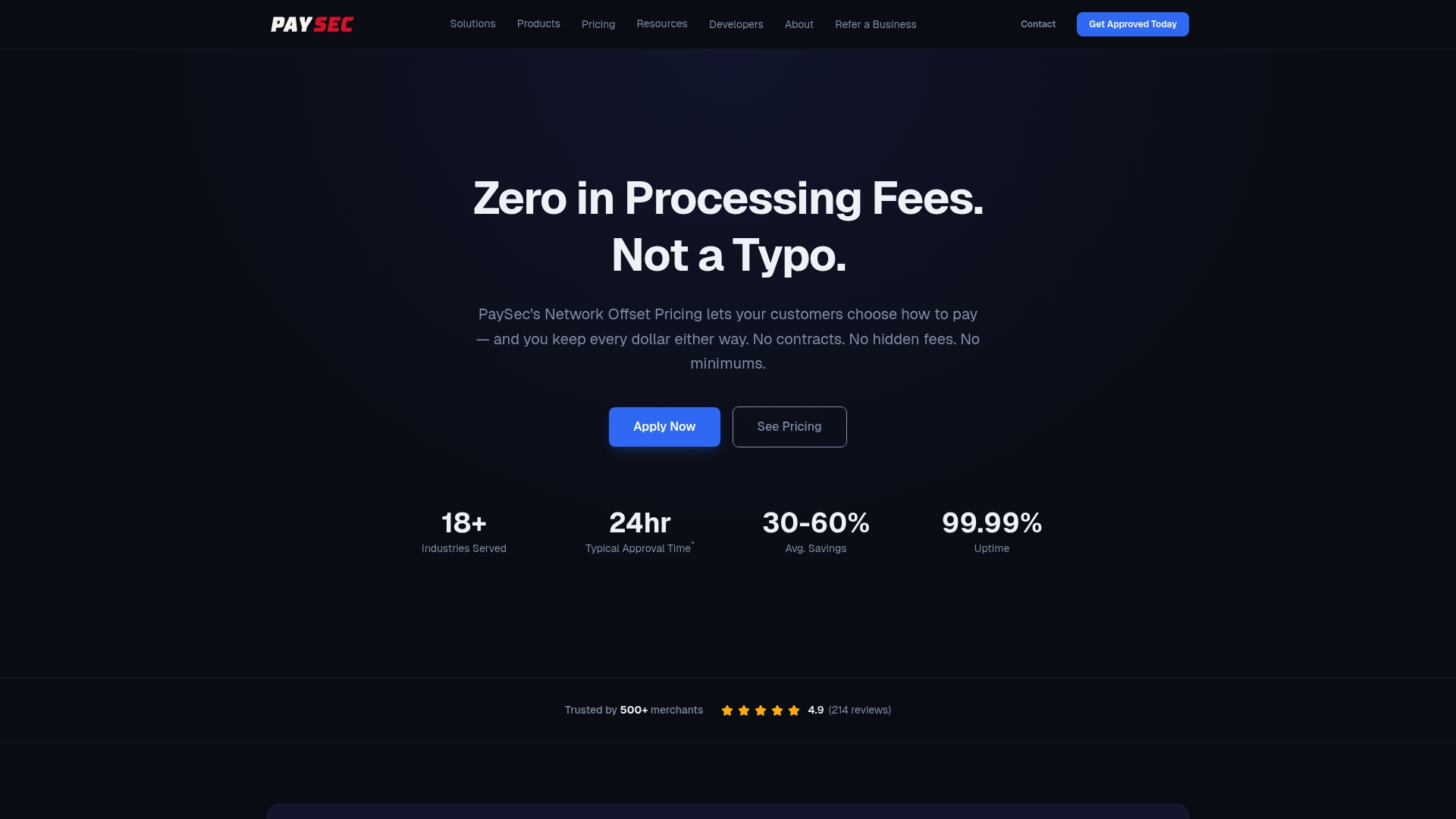
Paysec's Network Offset Pricing routes transactions through wholesale interchange rates, delivering verified savings of 30–60% on processing fees with no hidden charges, no minimums, and no long-term contracts. Merchants across 18+ industries, including ecommerce, SaaS, and healthcare, use Paysec's detailed transaction reporting to track fees, manage chargebacks, and reconcile accounts without manual work. Paysec's dedicated merchant services connect to your existing ecommerce platform and accounting tools so your payment stack works as one system. If you are ready to see what your store could save, explore Paysec's pricing and merchant services today.
FAQ
What are the most critical payment solution features for ecommerce?
The most critical features are diverse payment method support, PCI-compliant security, transparent fee structures, native platform integrations, and real-time financial reporting. Together, these features protect revenue, reduce costs, and improve checkout conversion.
How does ACH compare to card payments for ecommerce fees?
ACH transactions cost 0.5%–1% compared to card rates that typically exceed 2.5%. For high-ticket or B2B ecommerce transactions, offering ACH as a payment option directly reduces processing costs.
What is payment orchestration and why does it matter?
Payment orchestration routes each transaction through the best available payment rail based on card type, geography, and transaction size. A single orchestration layer improves authorization rates and reduces the complexity of managing multiple payment providers.
How does tokenization protect ecommerce customer data?
Tokenization replaces a customer's actual card number with a unique, randomly generated token during transmission. Even if that token is intercepted, it cannot be used to complete a fraudulent transaction because it carries no real card data.
What should I look for in ecommerce payment reporting?
Look for real-time transaction dashboards, per-transaction fee breakdowns, chargeback tracking, and automated reconciliation reports. These features give you the visibility needed to manage costs, respond to disputes on time, and identify checkout performance issues before they compound.