

TL;DR:
- Payment processor risk appetite defines the level of financial, fraud, and regulatory risk a processor is willing to accept. It influences underwriting decisions, chargeback thresholds, reserve requirements, and volume caps to manage exposure. Different processors have varying risk tolerances based on their priorities, leading to diverse approvals for the same merchant profile.
Payment processor risk appetite is defined as the specific level of financial, fraud, and regulatory risk a processor is willing to accept to pursue its revenue and growth objectives. This threshold governs every underwriting decision a processor makes, from merchant onboarding to transaction volume caps. Understanding what is payment processor risk appetite gives finance professionals a direct line of sight into why processors approve, restrict, or decline merchant accounts. Visa and Mastercard network rules, combined with regulatory oversight from bodies like the FDIC and OCC, set the outer boundaries. Within those boundaries, each processor draws its own line based on commercial priorities, compliance capacity, and portfolio strategy.
What is payment processor risk appetite and how does it shape underwriting?
Payment processor risk appetite functions as a strategic guardrail for every approval, enhanced due diligence review, or decline decision a processor makes. It is not a single number. It is a policy framework that translates a processor's tolerance for loss, fraud, and regulatory exposure into concrete underwriting criteria.

The underwriting process applies that framework through a set of measurable thresholds. Processors track chargeback ratios as the primary performance indicator. A chargeback ratio above 1% creates a significant barrier to approval. A ratio above 1.5% eliminates most processors from consideration entirely. That single metric tells a processor more about a merchant's operational quality than almost any other data point.
How transaction size and business model affect approval
Average ticket size carries serious weight in underwriting. Merchants with average transactions over $200 face stricter reserve requirements because each disputed transaction represents a larger potential loss. A $500 average ticket in a card-not-present environment compounds that exposure significantly. Processors respond by mandating 3D Secure 2.0 authentication for merchants operating entirely online, adding a layer of fraud liability protection before any approval is granted.
Business model structure also shapes the underwriting path. Subscription billing, future-delivery models, and high-refund industries all trigger enhanced due diligence because the gap between payment and fulfillment creates chargeback risk. Processors maintain internal approved-vertical lists that determine onboarding paths and due diligence levels based on where a merchant's category falls within their risk appetite framework.
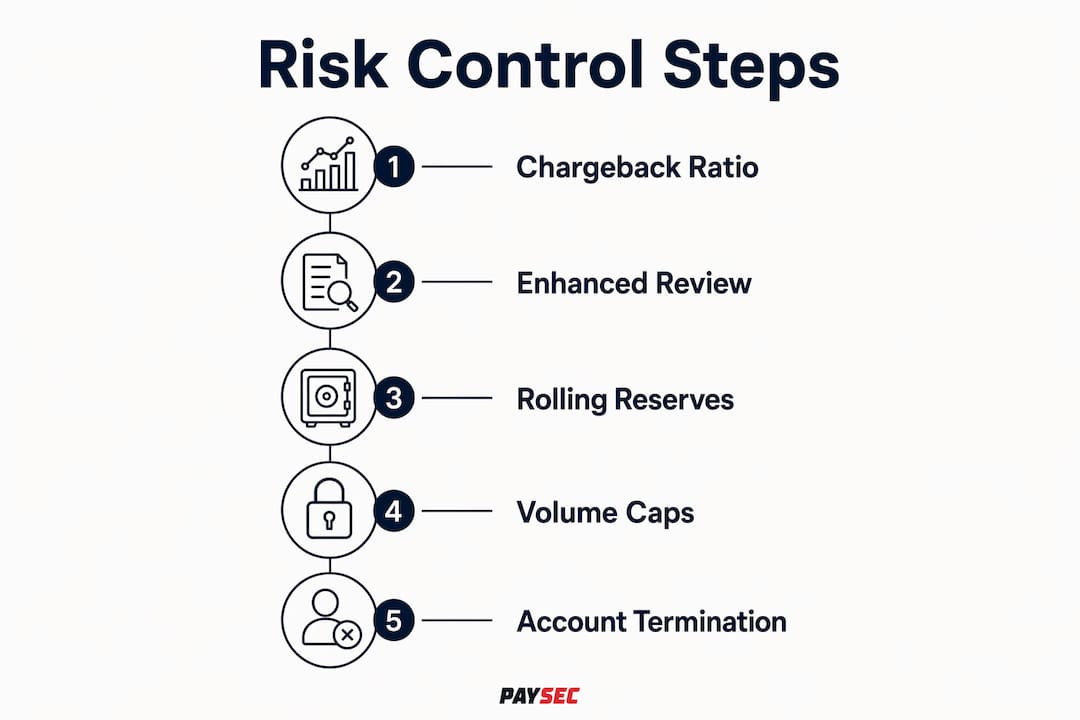
Rolling reserves and volume caps as risk controls
Rolling reserves are not penalties. They are calculated risk management tools that protect processors from chargeback exposure during the period when disputes can still be filed. Reserve percentages range from 5–7% for moderate-risk merchants up to 15% or more for high-risk profiles, with holding periods spanning 90–365 days depending on the merchant's risk score.
Volume caps follow the same logic. A processor's risk appetite typically sets initial monthly caps at $25,000–$50,000 for new or unproven merchants. Those caps expand as the merchant demonstrates clean processing history. The structure protects the processor's portfolio while giving merchants a clear path to higher volume approvals.
Pro Tip: Request a written explanation of your reserve structure and volume cap schedule before signing any processing agreement. Processors with clear, documented policies are far easier to work with as your business scales.
The table below maps the key underwriting criteria to the risk controls processors apply at each threshold.
| Underwriting Factor | Risk Control Applied |
|---|---|
| Chargeback ratio above 1% | Enhanced due diligence, possible reserve requirement |
| Chargeback ratio above 1.5% | Severe restriction on processor options |
| Average ticket above $200 | Stricter rolling reserve, 3DS mandate |
| Card-not-present only | 3D Secure 2.0 authentication required |
| New merchant, unproven history | Volume cap of $25,000–$50,000 monthly |
| High-risk vertical | Internal vertical list review, elevated due diligence |
Why does risk appetite vary so much between processors?
Risk tolerance in payment processing is a commercial decision, not a scientific one. Different processors accept or decline the exact same merchant category based on their own business interests, portfolio composition, and operational capacity. Two processors looking at an identical CBD retailer application will reach opposite conclusions because their risk appetites reflect different profit models and compliance burdens.
This variability produces a market where merchant category risk is genuinely subjective. A processor with a large compliance team and a high-margin fee structure can absorb the administrative load of a nutraceutical or travel merchant. A processor built around low-margin, high-volume retail transactions cannot. The same merchant profile looks entirely different through each lens.
Several factors drive that divergence:
- Compliance burden: High-risk verticals require more manual review, more documentation, and more ongoing monitoring. Processors with lean compliance teams avoid these categories regardless of the merchant's actual financial health.
- Portfolio concentration: A processor already carrying heavy exposure in one vertical will decline additional merchants in that category to avoid concentration risk, even if the individual merchant is well-qualified.
- Profitability math: Higher-risk merchants pay higher processing fees. Processors willing to invest in risk infrastructure can generate strong margins from categories that standard processors reject.
- Regulatory pressure: Network rules from Visa and Mastercard, combined with evolving guidance from banking regulators, push processors to tighten their risk appetite in categories that attract regulatory scrutiny.
- Reputational considerations: Some processors avoid legal services, firearms, or adult content categories entirely because of reputational risk, regardless of the merchant's chargeback history.
"High-risk merchant designations are commercial judgments reflecting administrative load versus profit, not purely objective risk science. A merchant labeled high-risk by one processor may be a preferred client for another with the right infrastructure and appetite for that category."
Risk appetite statements function as strategic documents that help executives balance risk acceptance with compliance and market objectives. Boards are required to clearly articulate risk appetite as a foundation for prioritizing compliance investments and market exposures. That governance requirement means processor risk appetite is not static. It shifts as leadership priorities, regulatory environments, and portfolio performance change.
How does processor risk appetite affect your transaction strategy?
Mismatched risk appetite between a merchant and its processor is the leading cause of sudden account terminations. A processor that approved a merchant at $30,000 monthly volume may terminate that account when volume spikes to $150,000 without prior notice, because the merchant has moved outside the processor's risk tolerance band. Finance professionals who understand this dynamic build volume growth plans that align with processor expectations from the start.
Fee structures reflect risk appetite directly. Merchants operating in categories that sit at the edge of a processor's comfort zone pay higher interchange-plus margins, larger reserve percentages, and sometimes monthly risk fees. Those costs are not arbitrary. They represent the processor's price for accepting elevated exposure. Understanding that pricing logic helps finance teams negotiate more effectively and identify processors whose risk appetite genuinely matches their business model.
The cost of a mismatched processor relationship
Account termination carries consequences beyond the immediate loss of processing capability. A terminated merchant account generates a MATCH list entry, which is the industry's shared database of merchants terminated for cause. A MATCH listing makes it significantly harder to obtain processing with any major processor for up to five years. Avoiding that outcome requires selecting a processor whose risk appetite fits your business before problems develop.
Rejected applications carry a subtler cost. Each application generates an inquiry into the merchant's processing history. Multiple rejections in a short period signal instability to subsequent processors and reduce approval odds. The right approach is to research processor risk appetite before applying, not after receiving a decline.
Pro Tip: Before applying to any processor, request their merchant category code list and underwriting guidelines. Processors that publish these documents openly are signaling a transparent risk appetite framework, which is a strong indicator of a stable long-term relationship.
Selecting a processor whose risk appetite fits your business
The ecommerce processor selection process should start with a risk appetite audit of your own business. Map your chargeback ratio, average ticket size, card-not-present percentage, and industry vertical against the published or disclosed underwriting criteria of processors you are considering. That alignment exercise eliminates poor fits before you invest time in applications.
Fraud prevention infrastructure also influences approval odds. Processors under Visa's VAMP program enforce portfolio-wide fraud rate accountability, which means your fraud rate affects the processor's standing with Visa. Merchants who arrive with documented fraud controls already in place, including 3D Secure 2.0, CVV/AVS matching, and velocity controls, demonstrate that they will not degrade the processor's portfolio metrics.
Key metrics and best practices for managing your risk profile
Your chargeback ratio is the single most important number in your relationship with any processor. Keep it below 0.75% to maintain a comfortable buffer below the 1% threshold that triggers enhanced scrutiny. Monitor it weekly, not monthly. A spike that goes undetected for 30 days can push you into a danger zone before you have time to respond.
The following practices form the foundation of a strong risk profile:
- Chargeback management: Use chargeback alert services like Ethoca or Verifi to intercept disputes before they become chargebacks. Respond to every retrieval request within the required timeframe.
- Fraud controls: Implement 3D Secure 2.0 for all card-not-present transactions. Enable CVV and AVS matching on every transaction. Set velocity controls that flag unusual purchase patterns in real time.
- Financial documentation: Maintain clean bank statements, current financial statements, and a clear corporate structure. Merchants with unstable financial patterns or prior terminations face increased underwriting scrutiny because they signal higher perceived risk.
- Realistic volume projections: Submit processing applications with volume projections that match your actual business plan. Overstating projected volume to access higher caps creates a mismatch that processors will flag during review.
- Transparent documentation: Provide complete, accurate merchant documentation on every application. Incomplete applications signal disorganization and increase the probability of a decline or a request for additional information that delays approval.
Pro Tip: Build a merchant processing portfolio document that includes your chargeback history, fraud rate, financial statements, and fraud prevention technology stack. Presenting this proactively during underwriting demonstrates operational maturity and shortens approval timelines.
Maintaining a strong risk profile is not a one-time exercise. Processors conduct periodic reviews of existing merchant accounts, and a deteriorating chargeback ratio or fraud rate can trigger reserve increases or volume reductions even on established accounts. Treat your payment risk assessment as an ongoing operational discipline, not a one-time onboarding task.
Key Takeaways
Payment processor risk appetite is a commercial policy framework that sets the boundaries for merchant approval, fee structures, reserve requirements, and volume caps across every processor relationship.
| Point | Details |
|---|---|
| Risk appetite drives underwriting | Processors use chargeback ratios, ticket size, and vertical category to set approval criteria. |
| Thresholds are specific | A chargeback ratio above 1% triggers scrutiny; above 1.5%, most processors will not onboard the merchant. |
| Risk appetite varies commercially | Two processors can reach opposite decisions on the same merchant based on their own business priorities. |
| Mismatches cause terminations | Selecting a processor whose risk appetite does not fit your business model leads to account closures and MATCH listings. |
| Strong risk profiles improve terms | Documented fraud controls and clean chargeback history reduce reserve requirements and improve fee negotiations. |
The commercial reality of risk appetite that most guides miss
The Paysec Marketing Team has worked with merchants across more than 18 industries, and the most common misconception we encounter is that processor risk appetite is a fixed, objective standard. Finance professionals often assume that if their chargeback ratio is clean and their financials are solid, any processor should approve them. That assumption leads to wasted applications and genuine frustration.
The reality is that processor risk appetite shifts constantly. A processor that actively recruited CBD merchants in 2023 may have tightened its vertical list entirely by 2026 because of regulatory pressure or portfolio losses in that category. The merchant did nothing wrong. The processor's risk appetite simply moved. This is why we advise finance teams to treat processor relationships the way they treat banking relationships: with ongoing communication, not just a one-time application.
The other pattern we see consistently is merchants underinvesting in fraud prevention technology before they apply for processing. Processors under Visa's VAMP framework are accountable for their entire portfolio's fraud rate. A merchant who arrives without 3D Secure 2.0 or velocity controls is not just a risk to themselves. They are a risk to the processor's standing with the card networks. Demonstrating that your fraud infrastructure is already in place changes the underwriting conversation entirely.
The finance professionals who navigate this environment most effectively treat their risk profile as a living document. They update their chargeback data monthly, review their fraud controls quarterly, and communicate proactively with their processor when volume is about to grow significantly. That posture builds the kind of trust that translates into better reserve terms, higher volume caps, and stable long-term processing relationships.
— Paysec Marketing Team
How Paysec supports merchants across the risk spectrum
Paysec works with merchants across more than 18 industries, including sectors that standard processors routinely decline. Its Network Offset Pricing model eliminates the inflated interchange markups that high-risk merchants typically absorb, replacing them with wholesale interchange rates and full pricing transparency. That structure directly reduces the cost burden that comes with operating in categories where processor risk appetite is limited.
Paysec's real-time reporting dashboards give finance teams the transaction-level visibility they need to monitor chargeback ratios, fraud rates, and volume trends before they become underwriting problems. No hidden fees, no long-term contracts, and no minimums mean merchants can align with Paysec's processing infrastructure without the commitment risk that often accompanies high-risk merchant accounts. Clients across SaaS, ecommerce, healthcare, and CBD retail have documented processing cost reductions of 30–60%, with one merchant achieving a 42% reduction in total processing costs.
FAQ
What is payment processor risk appetite?
Payment processor risk appetite is the defined level of financial, fraud, and regulatory risk a processor is willing to accept when onboarding and processing transactions for merchants. It functions as a policy framework that drives every underwriting, reserve, and volume cap decision the processor makes.
Why do chargeback ratios matter so much to processors?
A chargeback ratio above 1% signals operational problems that expose the processor to financial loss and network penalties from Visa and Mastercard. Ratios above 1.5% place the processor's portfolio standing at risk, which is why most processors will not onboard merchants at that level.
Can the same merchant be approved by one processor and declined by another?
Yes. Different processors apply variable risk appetites based on their own commercial priorities, compliance capacity, and portfolio composition. The same merchant category can be a preferred client for one processor and a declined application at another.
How do rolling reserves relate to risk appetite?
Rolling reserves are a direct expression of a processor's risk appetite. Processors set reserve percentages of 5–15% or more, with holding periods of 90–365 days, based on the merchant's risk score and the processor's own exposure tolerance for that merchant category.
What steps reduce the risk of a processor account termination?
Keeping your chargeback ratio below 0.75%, implementing fraud controls like 3D Secure 2.0 and CVV/AVS matching, maintaining accurate financial documentation, and communicating proactively with your processor before significant volume increases all reduce termination risk substantially.