

TL;DR:
- Payment processor due diligence involves evaluating a provider’s compliance, financial health, and operational reliability before partnership. It uses a six-block framework covering legal, licensing, AML/KYC, financial, operational, and strategic risks to prevent regulatory and financial problems. AI enhances this process by enabling real-time, dynamic risk assessments and continuous monitoring at scale.
Payment processor due diligence is the comprehensive evaluation of a payment service provider's compliance record, risk profile, and operational reliability before your business commits to working with them. This process covers six critical assessment blocks: legal standing, regulatory licensing, AML/KYC practices, financial health, operational resilience, and strategic sustainability. Regulatory frameworks like PCI DSS, PSD2, and AMLD set the baseline requirements every processor must meet. Financial professionals and business owners who skip this process expose themselves to frozen funds, regulatory penalties, and reputational damage that can take years to repair. Understanding what is payment processor due diligence, and executing it well, is the difference between a payment partnership that scales your business and one that derails it.
What is payment processor due diligence and why does it matter?
Payment processor due diligence is the formal risk assessment process used to verify that a payment service provider meets legal, financial, and operational standards before you integrate their systems into your business. The industry term for this broader practice is "third-party risk management," and due diligence is its most rigorous application. Both terms apply here, and understanding the distinction helps you speak the same language as compliance officers, auditors, and regulators.
The stakes are concrete. A processor with weak AML controls can trigger regulatory investigations that freeze your merchant account. A processor with undisclosed reserve policies can lock up your working capital for months. A processor that lacks PCI DSS certification exposes your customers' card data to breach liability. None of these risks appear on a pricing sheet, which is exactly why the due diligence process exists.
Effective due diligence requires analyzing six critical blocks: legal, regulatory/licensing, AML/KYC, financial/tax, operational/cybersecurity, and strategic business sustainability, each tailored by business risk category. That tailoring matters because a SaaS company processing subscription payments faces different risk vectors than a CBD retailer or a healthcare provider. The framework adapts to the risk profile, not the other way around.

What are the six key blocks in payment processor due diligence?
The six-block framework covers the essential areas of any thorough payment service provider assessment. Each block targets a distinct category of risk, and weaknesses in any one of them can compromise the entire relationship.
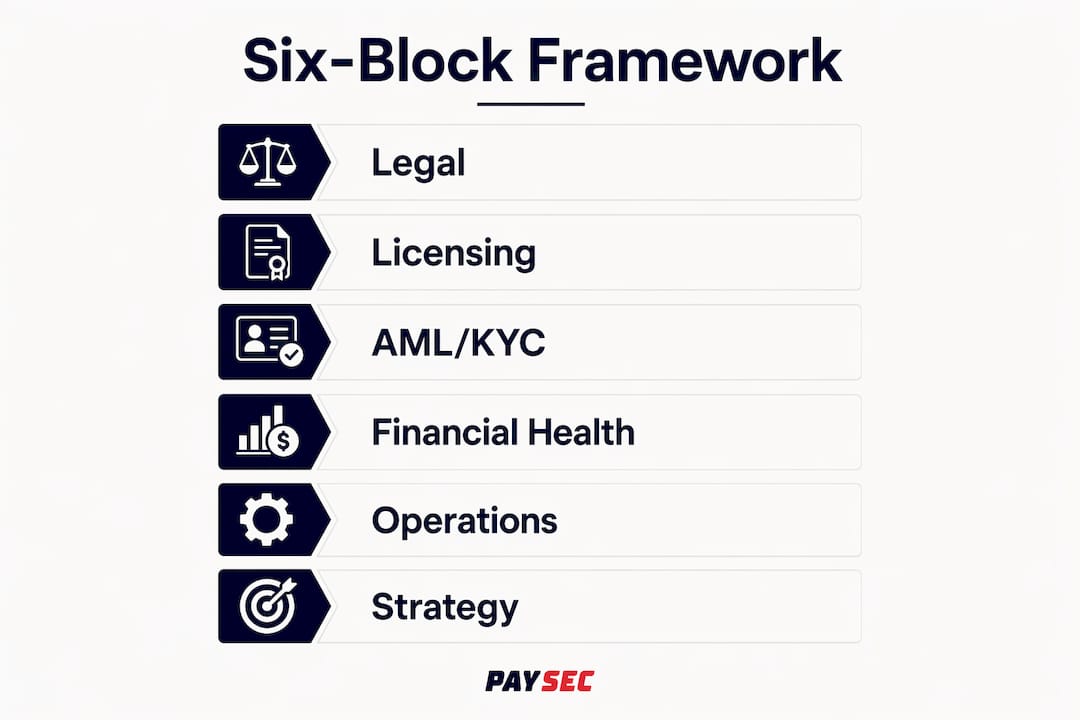
Legal standing
Legal due diligence confirms the processor's corporate structure, ownership chain, and litigation history. You are looking for undisclosed beneficial owners, pending lawsuits, and regulatory sanctions. Contradictory ownership narratives are an immediate red flag. Consistency in documentation regarding flow-of-funds and ownership prevents immediate rejection during due diligence, because contradictory narratives signal either incompetence or concealment.
Regulatory licensing
Every legitimate payment processor holds licenses issued by recognized financial regulators. In the United States, this means state money transmitter licenses and, where applicable, federal registration with FinCEN. In Europe, PSD2 governs payment institution licensing. Verify the license numbers directly with the issuing authority. A processor that cannot produce current, verifiable licenses is not a processor you should work with.
AML/KYC practices
Anti-money laundering and Know Your Customer controls are the most consequential block in the entire assessment. AML/KYC due diligence is critical to deal survival and ongoing compliance, with 80% of M&A success depending on thorough risk reviews in these areas. That figure applies equally to vendor selection. A processor with weak KYC onboarding will attract bad actors to their network, and your business sits inside that network.
Financial and tax health
Request audited financial statements for the past three years. Look for adequate capitalization, clean tax filings, and no undisclosed liabilities. A processor operating on thin margins with no capital reserves is a business continuity risk. If they hit a liquidity crunch, your settlement funds are the first casualty.
Operational resilience and cybersecurity
Operational due diligence includes assessment of governance, incident management, business continuity, and key team expertise critical for licensed payment service provider technology. Ask for actual uptime data, not theoretical targets. Review their incident response plan and confirm they carry cyber liability insurance.
Strategic and business model sustainability
Evaluate the processor's revenue model, client concentration, and growth trajectory. A processor that derives 60% of revenue from one client segment is fragile. Assess whether their technology roadmap aligns with your integration needs over the next three to five years.
Pro Tip: Use a risk heatmap to translate your findings across all six blocks into a visual impact matrix. This tool helps you prioritize remediation, structure negotiations, and communicate risk to your board or executive team in a format they can act on.
| Block | Primary risk if ignored |
|---|---|
| Legal standing | Undisclosed sanctions or ownership fraud |
| Regulatory licensing | Operating with an unlicensed provider |
| AML/KYC practices | Regulatory investigation and account termination |
| Financial health | Settlement fund loss during processor insolvency |
| Operational resilience | Downtime losses and data breach liability |
| Strategic sustainability | Forced migration when the processor fails or pivots |
How has AI changed payment processor due diligence in 2026?
Manual due diligence has a structural flaw: it produces a point-in-time snapshot. A processor that passes review in january may be under regulatory scrutiny by april. Traditional rule-based systems cannot detect that shift without a scheduled re-review, which most businesses never conduct.
AI-driven risk management enables real-time, dynamic risk assessments that surpass inconsistent manual reviews by reducing both false positives and false negatives. That means fewer legitimate transactions flagged as fraud and fewer actual fraud attempts that slip through. The practical result is faster merchant onboarding and more accurate transaction monitoring at scale.
"Manual reviews create high variability and are prone to errors, whereas AI supports consistent, scalable, real-time risk detection across millions of transactions. The shift from periodic audits to continuous monitoring is not incremental. It is a fundamental change in how risk is managed across payment networks."
The capabilities AI brings to the due diligence process include:
- Automated document verification: AI systems cross-reference corporate filings, license databases, and sanctions lists in seconds, a process that takes human analysts hours or days.
- Dynamic risk scoring: Rather than a static pass/fail assessment, AI assigns continuously updated risk scores based on transaction behavior, geographic patterns, and counterparty data.
- Pattern recognition at scale: AI identifies anomalous transaction clusters that no human analyst could detect across millions of daily records.
- Fraud detection integration: Machine learning models trained on historical fraud data flag emerging schemes before they reach material loss thresholds.
For financial professionals evaluating processors, the practical implication is clear. Ask prospective processors whether their compliance infrastructure uses AI-assisted monitoring or relies on manual rule-based review. The answer tells you a great deal about their operational maturity. You can also learn how AI-driven financial verification is reshaping real-time due diligence processes across fintech, which mirrors the shift happening inside payment processing compliance.
What practical steps should you use to assess payment processors?
A structured approach to evaluating payment processors removes guesswork and creates a defensible record of your assessment. The steps below apply whether you are selecting a new processor or re-evaluating an existing relationship.
-
Verify legal registration and licensing. Pull the processor's corporate registration documents and cross-check their payment institution licenses with the issuing regulatory authority. Do not accept copies. Verify directly.
-
Review AML/KYC policies in writing. Request the processor's full AML compliance program, including their customer due diligence procedures, transaction monitoring thresholds, and suspicious activity reporting protocols. Weak or vague documentation here is a disqualifying red flag.
-
Audit financial statements. Request three years of audited financials. Confirm adequate capitalization, clean tax compliance, and no material undisclosed liabilities. For processors in high-risk merchant categories, confirm they hold sufficient reserves to cover potential chargebacks.
-
Demand published uptime metrics. Businesses should demand actual uptime metrics over the past 12 months and a clear incident communication policy for technical failures. Theoretical targets mean nothing. Real performance data does.
-
Get reserve and chargeback policies in writing. Request written guarantees about reserve policies and perform chargeback dispute interface walkthroughs to avoid unexpected working capital freezes. Oral assurances about reserves are not enforceable. Written contracts are.
-
Test integration and support quality. Run a technical integration assessment before signing any contract. Evaluate API documentation quality, sandbox environment availability, and the responsiveness of their technical support team during the evaluation period.
-
Check PCI DSS certification status. Confirm the processor holds a current PCI DSS Level 1 certification, the highest standard for payment data security. Ask for their Attestation of Compliance directly. For more on what this means for your business, the guide on payment data security covers the operational implications in detail.
-
Assess cybersecurity posture. Request their most recent penetration testing report and confirm they carry cyber liability insurance. Ask specifically about their data breach notification procedures and timelines.
Pro Tip: When reviewing a processor's chargeback management tools, walk through an actual dispute scenario in their interface. A processor that cannot demonstrate a clear, functional dispute workflow during the sales process will not perform better after you sign the contract.
For businesses in specialized sectors, the high-risk payment processing considerations add additional layers to this checklist, particularly around reserve requirements and chargeback thresholds.
How do compliance changes and risk-based approaches shape ongoing monitoring?
Due diligence is not a one-time event. Regulatory frameworks like PSD2, AMLD, and PCI DSS evolve continuously, and a processor that was compliant at onboarding may fall out of compliance within 18 months. Continuous due diligence and monitoring are mandatory due to changing compliance regulations, and risk-based approaches ensure resources focus on emerging threats and high-risk transactions.
A risk-based approach means you allocate monitoring intensity based on the actual risk profile of each processor relationship. A processor handling low-volume, low-risk transactions requires less frequent review than one processing high-ticket international payments in regulated industries. The key ongoing monitoring activities include:
- Quarterly license verification: Confirm that all payment institution licenses remain active and in good standing with the issuing authority.
- Annual AML/KYC policy review: Request updated compliance documentation each year and compare it against the prior version for any weakening of controls.
- Transaction pattern monitoring: Review monthly settlement reports for anomalies in chargeback rates, refund volumes, or geographic transaction shifts.
- Regulatory news tracking: Monitor enforcement actions issued by FinCEN, the CFPB, and relevant European regulators against payment processors in your network.
- Incident log review: Request a summary of all system incidents, data events, and regulatory inquiries on a semi-annual basis.
Due diligence as a strategic decision-making tool requires alignment across legal, finance, and operational teams to calibrate risk tolerance with business objectives. That alignment does not happen at onboarding and then disappear. It requires a standing internal process with assigned ownership and a review calendar. Businesses that treat compliance as a one-time checkbox consistently underperform those that build it into their operational rhythm.
Key Takeaways
Payment processor due diligence is a structured, six-block risk assessment process that financial professionals and business owners must conduct at onboarding and maintain continuously to protect compliance, working capital, and operational integrity.
| Point | Details |
|---|---|
| Six-block framework | Assess legal, licensing, AML/KYC, financial health, operations, and strategic fit for every processor. |
| AML/KYC is the priority | Weak AML controls create regulatory exposure that pricing advantages cannot offset. |
| Written guarantees only | Reserve and chargeback policies must be documented in contracts, not verbal assurances. |
| AI improves accuracy | AI-driven monitoring reduces false positives and detects fraud patterns no manual review can match. |
| Continuous monitoring required | PSD2, AMLD, and PCI DSS changes mean annual re-assessment is the minimum standard. |
The real cost of treating due diligence as a formality
The Paysec Marketing Team has reviewed hundreds of payment processor relationships across SaaS, eCommerce, healthcare, and retail. The pattern that causes the most preventable damage is not choosing the wrong processor. It is choosing a processor without a structured assessment and then discovering the problem after integration.
The most common failure point is AML/KYC. Businesses focus on pricing, integration speed, and feature sets during the selection process. They treat compliance documentation as a box to check rather than a signal to analyze. Then, six months into the relationship, a regulatory inquiry surfaces, or a reserve hold freezes working capital at the worst possible moment. The due diligence process exists precisely to surface these risks before they become your problem.
The second failure point is treating due diligence as a one-time event. Regulatory environments shift. Processors get acquired, change ownership, or quietly reduce their compliance staffing. A processor that earned your trust in 2024 may look very different in 2026 without a re-assessment. The businesses that avoid these problems build a standing review calendar and assign internal ownership to the process.
The most effective due diligence combines structured frameworks with cross-functional input. Legal, finance, compliance, and operations teams each see different risks in the same processor. A finance team sees reserve policy risk. A compliance team sees AML exposure. An operations team sees integration fragility. No single function sees all of it. The businesses that get this right treat due diligence as a collaborative, living process, not a document that gets filed and forgotten.
— Paysec Marketing Team
How Paysec supports payment processor due diligence
Paysec gives financial professionals and business owners the tools to maintain compliance and pricing transparency without the guesswork that comes with opaque processor relationships.
Paysec's Network Offset Pricing eliminates hidden fees and delivers measurable cost reductions of 30–60% across 18+ industries, with no minimums and no long-term contracts. That pricing structure is itself a due diligence signal: transparent fee models are a marker of a processor with nothing to hide. Paysec's real-time reporting dashboards give you transaction-level visibility that supports ongoing compliance monitoring, chargeback management, and financial reconciliation. For businesses ready to move from a processor that obscures costs to one that publishes them, Paysec is the direct next step.
FAQ
What is payment processor due diligence?
Payment processor due diligence is the structured evaluation of a payment service provider's legal standing, regulatory compliance, AML/KYC controls, financial health, and operational reliability before engagement. It protects businesses from regulatory penalties, frozen funds, and data breach liability.
Which due diligence block carries the most risk if ignored?
AML/KYC is the highest-risk block. Weak anti-money laundering controls expose your business to regulatory investigations and account termination, and 80% of payment processor deal failures trace back to overlooked compliance issues in this area.
How often should you re-assess a payment processor?
Annual re-assessment is the minimum standard, with quarterly license verification and semi-annual incident log reviews in between. Regulations like PSD2 and AMLD change frequently enough that a processor's compliance status can shift materially within 12 months.
What written documents should you require from a payment processor?
Require audited financial statements, a written AML compliance program, PCI DSS Attestation of Compliance, published uptime data for the past 12 months, and written reserve and chargeback policies. Verbal assurances on any of these points are not enforceable.
How does AI improve payment processor risk assessment?
AI enables real-time, dynamic risk scoring and pattern recognition across millions of transactions, replacing static manual reviews that produce point-in-time snapshots. The result is faster fraud detection, reduced false positives, and continuous monitoring rather than periodic audits.