

TL;DR:
- High-risk payment processing uses dedicated merchant accounts for industries with high fraud or chargeback risks. Effective management of chargebacks and transparent fee structures are essential for long-term account stability. Paysec offers cost-saving solutions and analytics tools tailored for high-risk businesses across multiple industries.
High-risk payment processing is defined as a specialized category of payment services designed for businesses that face elevated fraud exposure, high chargeback rates, or significant regulatory scrutiny. Industries like CBD retail, online gaming, adult content, nutraceuticals, and subscription billing all fall into this category. Card networks such as Visa and Mastercard set the classification standards, and acquiring banks apply them during underwriting. Understanding how this system works is the first step toward managing it effectively.
What is high-risk payment processing and how does it differ?
High-risk payment processing operates through dedicated merchant accounts rather than the aggregated accounts used by standard processors. With an aggregated model, one account serves many merchants. With a dedicated merchant account, your business gets its own account, which means risk from other merchants does not affect your processing stability. This structure is the foundation of how high-risk processing works.
Acquiring banks that specialize in high-risk industries take on greater liability when they approve a merchant. That liability drives every structural difference you will encounter. Approval timelines for high-risk merchant accounts typically span 3–10 business days due to manual underwriting, compared to the instant approvals common in low-risk models. Some providers can move faster when documentation is complete, but manual review is the norm.
The underwriting process itself is thorough. Processors review your business model, compliance policies, chargeback history, and financial statements before approving your account. High-risk processors vet detailed business models and compliance policies before approval, which results in longer onboarding timelines but improved operational stability. That depth of review is a feature, not a delay. It means the processor understands your business and is less likely to terminate your account unexpectedly.
Rolling reserves are another structural feature unique to this category. Processors hold a percentage of your revenue in reserve to cover potential future chargebacks. Rolling reserves typically range from 5–10% of revenue, held for 90–180 days. That reserve protects the processor, but it also ties up your working capital. Planning for this cash flow dynamic is non-negotiable for any high-risk merchant.
Pro Tip: Request a rolling reserve schedule in writing before signing any agreement. Knowing exactly when funds are released lets you build an accurate cash flow forecast.
What are the common fees in high-risk payment processing?
The Merchant Discount Rate (MDR) is the primary cost structure in high-risk payment processing. The MDR includes three components: interchange fees paid to the card-issuing bank, scheme fees paid to Visa or Mastercard, and the processor's markup. For high-risk merchants, MDR rates can be significantly above standard rates because the processor assumes greater risk. Understanding each component helps you negotiate and budget more accurately.
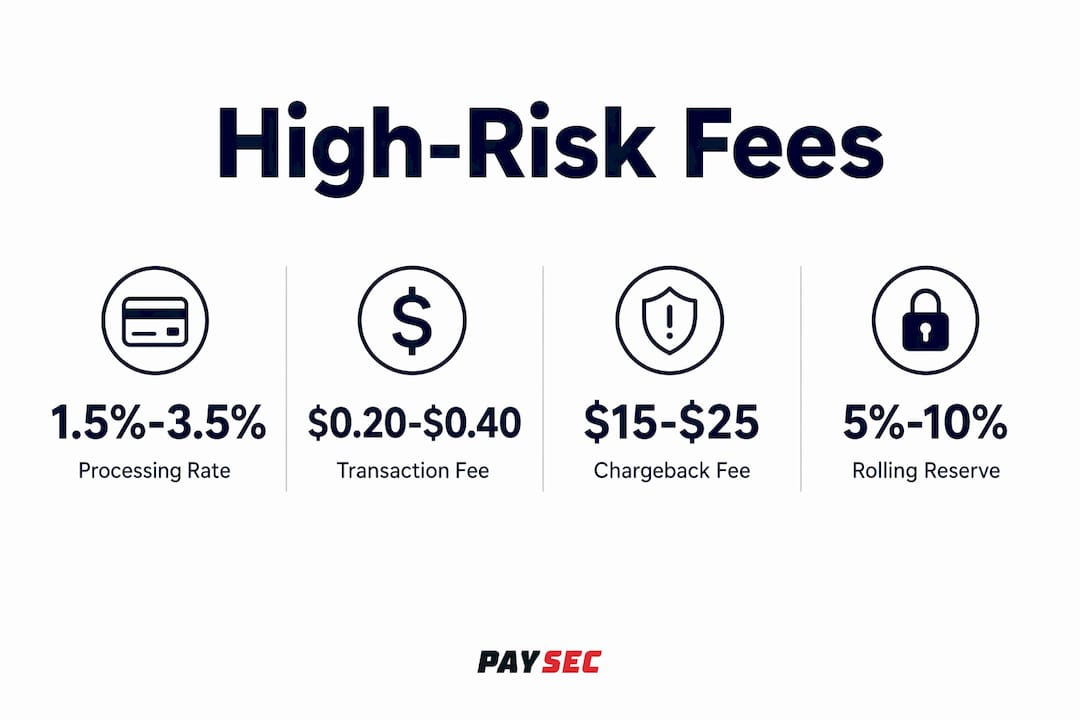
Processing fees for high-risk accounts commonly range from 1.5% to 3.5% plus per-transaction fees. That range reflects the elevated fraud and regulatory risk the processor absorbs. A CBD retailer processing $100,000 per month at 3% pays $3,000 in processing fees alone, before any other charges. That number makes it clear why fee transparency matters.
Beyond the MDR, high-risk merchants face several additional cost categories:
- Chargeback fees. Processors charge a flat fee per dispute, typically ranging from $20 to $100 per chargeback. These chargeback fees add incremental cost beyond the base MDR and can significantly affect profitability if dispute volumes are not controlled.
- Gateway fees. Monthly fees for payment gateway access vary by provider and are separate from processing costs.
- Monthly account fees. Some processors charge a flat monthly maintenance fee for high-risk accounts.
- Rolling reserve deductions. While not a fee in the traditional sense, the 5–10% reserve withheld from your revenue affects your available cash every month.
- Early termination fees. High-risk contracts often include penalties for early cancellation, so read the terms carefully before signing.
The most effective way to manage these costs is to treat them as a line item in your operating budget from day one. Merchants who treat processing fees as a variable afterthought consistently underestimate their true cost of revenue. Paysec's wholesale interchange pricing model is built specifically to reduce this burden by passing interchange costs directly to merchants without hidden markups.
| Fee Type | Typical Range | Impact |
|---|---|---|
| Processing rate (MDR) | 1.5%–3.5% + per-transaction | Primary cost driver |
| Rolling reserve | 5%–10% held 90–180 days | Cash flow constraint |
| Chargeback fee | $20–$100 per dispute | Profitability risk |
| Gateway fee | Varies by provider | Fixed monthly overhead |
| Early termination fee | Varies by contract | Contract exit cost |
Which industries are classified as high risk?
High-risk classification is not arbitrary. Card networks and acquiring banks assign it based on measurable risk factors: chargeback frequency, fraud exposure, legal complexity, and regulatory scrutiny. Industries commonly classified as high risk include CBD, adult content, online gaming, nutraceuticals, crypto, forex, firearms, and subscription billing businesses.

Each of these industries shares at least one trait that elevates risk. Subscription billing models generate chargebacks when customers forget they signed up or dispute recurring charges. CBD and nutraceutical businesses face regulatory ambiguity that makes some acquiring banks unwilling to take on the liability. Online gaming and forex involve large transaction volumes with high fraud exposure. Firearms businesses face legal restrictions in certain jurisdictions that complicate processing agreements.
Some categories carry even greater risk than others. Crypto exchanges and adult entertainment platforms often face the most restrictive terms because they combine high chargeback rates with regulatory complexity. Merchants in these categories may need to work with specialized offshore acquiring banks or accept stricter reserve requirements.
The practical implication for any business in these sectors is straightforward. Your merchant account will be underwritten differently, your fees will be higher, and your contract terms will be stricter. High-risk merchant accounts often impose longer rolling reserve periods, higher chargeback thresholds, and limits on certain transaction types. Knowing this before you apply puts you in a stronger negotiating position.
How can high-risk businesses reduce processing risks?
Chargeback management is the single most important operational discipline for any high-risk merchant. Chargeback ratios above 1.5% can cause immediate account termination. That threshold is set by card networks, and processors enforce it strictly. Staying well below 1% is the target for any merchant who wants long-term account stability.
The most effective approach treats chargeback management as a separate business function, not a task delegated to your payment processor. Experienced merchants use dedicated dispute management tools independent of their processor to control chargeback ratios proactively. Paysec integrates with tools like Xcaliber and Chargeblast to give merchants real-time dispute visibility and representment support.
A practical risk reduction plan includes these steps:
- Monitor transaction patterns daily. Unusual spikes in refund requests or disputes are early warning signs. Catching them early prevents ratios from climbing.
- Use clear billing descriptors. Customers who do not recognize a charge on their statement file chargebacks. A clear, recognizable descriptor reduces friendly fraud significantly.
- Implement fraud screening at checkout. Address Verification Service (AVS) checks, CVV verification, and 3D Secure authentication all reduce fraudulent transactions before they become disputes.
- Build a redundant processor stack. Building a payment stack with multiple processors using different acquiring banks ensures operational continuity if one partner changes its risk appetite. A single processor relationship is a single point of failure.
- Respond to disputes immediately. Most processors require representment within 7–10 days of a chargeback notice. A fast, documented response wins more disputes and signals account health to your processor.
Pro Tip: Set an internal chargeback alert at 0.75% of monthly transactions. That gives you a buffer to act before you approach the 1% threshold that triggers processor scrutiny.
What should you look for in a high-risk payment provider?
Choosing the right provider is a decision that affects your cash flow, account stability, and long-term growth. The wrong choice can result in sudden account termination, frozen reserves, or fee structures that erode your margins. The right choice gives you a stable processing environment with clear terms and genuine support.
Evaluate every provider against these criteria:
- Industry experience. A provider that has processed payments for CBD merchants, subscription businesses, or online gaming operators understands the specific compliance and chargeback dynamics of your sector. Generic processors often terminate high-risk accounts when dispute rates rise.
- Multi-bank routing. High-risk payment service providers that offer multi-bank routing help maintain processing continuity and reduce single points of failure. This feature is critical for businesses with sensitive cash flows.
- Rolling reserve terms. Ask for the exact reserve percentage, the holding period, and the release schedule. Providers who cannot answer these questions clearly are not worth your time.
- Dispute management support. Does the provider offer representment tools or integrate with third-party dispute platforms? Providers who leave you to manage chargebacks alone are a liability.
- Fee transparency. Every fee should be itemized in your contract. Hidden fees in high-risk processing are common and costly.
- Approval process and onboarding. A provider with a clear, well-documented onboarding process gets you processing faster and with fewer surprises.
The comparison below shows how to evaluate providers by category rather than by name:
| Evaluation Criteria | Entry-level processors | Specialized high-risk providers |
|---|---|---|
| Industry-specific underwriting | Rarely | Standard practice |
| Multi-bank routing | Uncommon | Widely available |
| Dispute management tools | Limited | Integrated or partnered |
| Rolling reserve transparency | Variable | Clearly documented |
| Approval timeline | Instant to 2 days | 3–10 business days |
Approval timelines for high-risk accounts are longer by design. Providers who promise instant approval for high-risk merchants without documentation review are often aggregators, not dedicated processors. That distinction matters enormously for account stability.
Key Takeaways
High-risk payment processing requires dedicated merchant accounts, proactive chargeback management, and transparent fee structures to maintain long-term account stability and protect cash flow.
| Point | Details |
|---|---|
| Dedicated accounts are non-negotiable | Dedicated merchant accounts prevent risk contamination and improve long-term processing stability. |
| Rolling reserves affect cash flow | Reserves of 5–10% held for 90–180 days require careful cash flow planning from day one. |
| Chargeback ratios must stay below 1.5% | Ratios above 1.5% trigger account termination; target below 1% for a safe operational buffer. |
| Fee structures have multiple components | MDR, chargeback fees, gateway fees, and reserve deductions all contribute to total processing cost. |
| Redundant processors reduce risk | A payment stack with at least two processors using different acquiring banks prevents processing disruptions. |
The hard lessons most high-risk merchants learn too late
Most merchants enter high-risk payment processing focused entirely on getting approved. That focus is understandable, but approval is just the beginning. The merchants who struggle are the ones who treat their processor relationship as a passive utility, like electricity. It is not. It is an active risk relationship that requires ongoing management.
The biggest mistake I see is merchants who ignore their chargeback ratio until it becomes a crisis. By the time a processor sends a warning letter, the ratio is often already above 1%. At that point, you are managing a fire, not preventing one. The merchants who build long-term stability treat chargeback management as a dedicated function with its own tools, reporting, and accountability.
Rolling reserves are the second area where merchants consistently underestimate the impact. A 10% reserve held for 180 days on a business processing $200,000 per month means $20,000 in working capital is tied up at any given time. That number compounds quickly. Merchants who do not model this before signing a contract often find themselves cash-constrained within the first quarter.
The providers worth working with are the ones who explain these dynamics upfront, not the ones who minimize them to close a deal. Transparency about fees, reserve terms, and dispute processes is the clearest signal that a provider understands your business and intends to support it long-term. A comprehensive fraud protection strategy and a provider who supports it are not optional extras. They are the foundation of a durable payment operation.
— Paysec Marketing Team
How Paysec supports high-risk merchants
Paysec works with merchants across 18+ industries, including CBD retail, eCommerce, and SaaS, to reduce processing costs and maintain stable payment operations. Its Network Offset Pricing model passes wholesale interchange rates directly to merchants, with no hidden fees, no minimums, and no long-term contracts. Merchants using Paysec report processing cost reductions of 30–60%, with some achieving a 42% reduction in total processing costs.
Paysec's merchant analytics tools give high-risk businesses detailed transaction reporting and real-time visibility into their payment operations. That level of transparency is exactly what high-risk merchants need to stay ahead of chargeback thresholds and fee exposure. Getting started with Paysec is straightforward, with a clear onboarding process designed to get merchants processing quickly and confidently.
FAQ
What is a high-risk merchant account?
A high-risk merchant account is a dedicated payment processing account issued to businesses in industries with elevated fraud, chargeback, or regulatory risk. Unlike aggregated accounts, dedicated accounts isolate your risk profile and provide greater long-term stability.
What fees should I expect with high-risk payment processing?
High-risk processing fees typically include an MDR of 1.5%–3.5%, per-transaction fees, chargeback fees per dispute, gateway fees, and rolling reserve deductions of 5–10% held for 90–180 days.
How do I keep my high-risk merchant account in good standing?
Keep your chargeback ratio below 1% by using dedicated dispute management tools, clear billing descriptors, and fraud screening at checkout. Monitoring transaction patterns daily is the most effective preventive measure.
Is CBD considered high-risk for payment processing?
Yes. CBD businesses are classified as high risk due to regulatory ambiguity at the federal and state level, which makes many standard acquiring banks unwilling to process transactions in this category.
How long does it take to get approved for a high-risk merchant account?
Approval typically takes 3–10 business days because processors conduct manual underwriting of your business model, compliance policies, and financial history. Complete documentation at the time of application speeds up the process.