

TL;DR:
- Choosing the right ecommerce payment processor involves calculating true costs and negotiating appropriately.
- Strong fraud controls and clear compliance features ensure smoother operations and better risk management.
An ecommerce payment processor is the technology layer that moves money from your customer's bank to your merchant account every time someone buys online. Choosing the wrong one costs you more than just fees. Hidden charges, rigid risk controls, and weak fraud tools can drain revenue and freeze cash flow at the worst moments. This ecommerce payment processor comparison guide breaks down pricing models, compliance requirements, negotiation tactics, and common mistakes so you can make a confident, cost-effective decision for your business in 2026.
How do pricing models impact the total cost of ecommerce payment processing?
Pricing is the single biggest variable in any payment processing comparison, and the headline rate almost never tells the full story. The effective processing rate is often 0.3%–1.3% higher than advertised because of non-qualified card surcharges, international transaction fees, and fixed per-transaction costs. That gap compounds fast at scale.
Flat-rate pricing vs. interchange-plus pricing
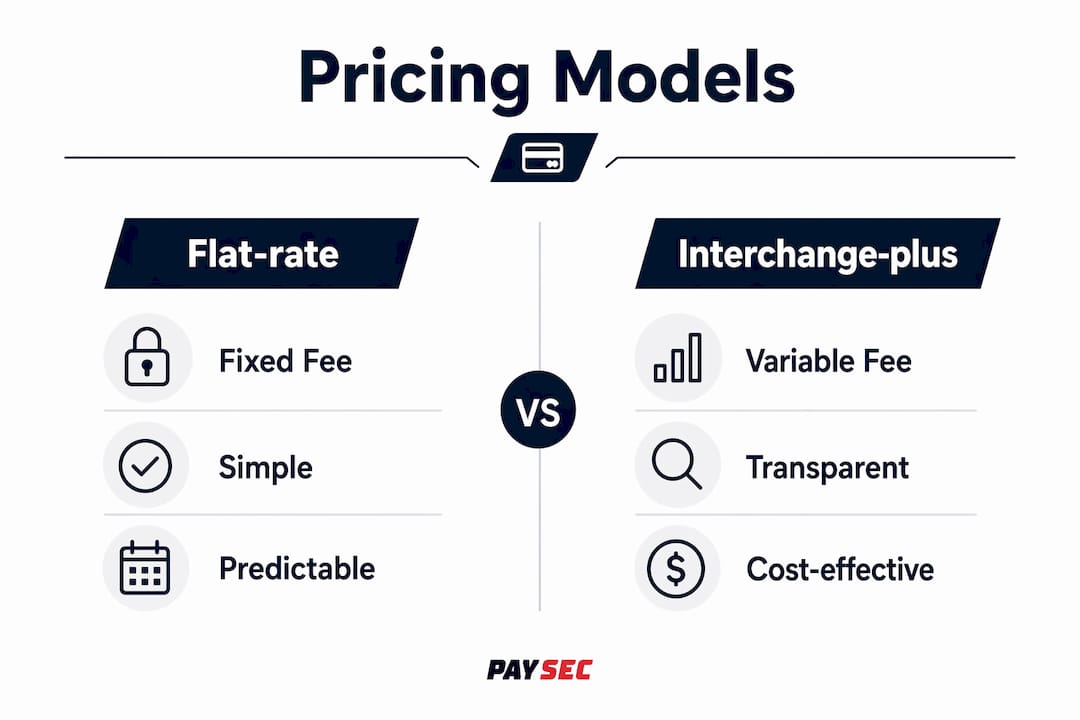
Flat-rate pricing charges one fixed percentage on every transaction, regardless of card type. It is simple to understand and easy to budget, which makes it popular with low-volume merchants. The problem is that the processor pockets the difference between your flat rate and the actual interchange cost, which grows as your volume grows.
Interchange-plus pricing passes the actual card network cost through to you, then adds a fixed markup. At $250,000 in monthly volume, interchange-plus pricing may reduce costs by roughly $13,500 per year compared to flat-rate fees. That is not a rounding error. It is a meaningful budget line that scales with your business.
The hidden fees that inflate your real cost
- Chargeback fees. Most processors charge $15–$35 per dispute, win or lose. High-ticket merchants absorb this cost fast.
- Refund fees. Some processors keep the percentage-based fee on refunded transactions. When refund rates reach 10%, this policy alone adds roughly 0.3% to your effective rate.
- International surcharges. Cross-border transactions typically carry an additional 1%–2% on top of the base rate.
- Non-qualified card surcharges. Corporate cards, rewards cards, and government cards often trigger higher interchange tiers that flat-rate pricing obscures.
Comparing pricing only by advertised rates ignores a 3.0%–4.5% spread in effective merchant costs caused by Amex acceptance, refund policies, and international surcharges. The only way to see your true cost is to calculate your effective rate using real transaction data. Divide your total processing fees by your total processing volume for any given month. Do this across three to six months and you will see patterns that no sales sheet reveals.
You can also review the types of ecommerce payment processing fees in detail to understand exactly which line items to watch on your monthly statement.
Pro Tip: Ask any processor you are evaluating to run a sample statement analysis using three to six months of your actual transaction data. A processor confident in its pricing will do this without hesitation. One that refuses is telling you something.
What essential features and compliance aspects should ecommerce merchants evaluate?
Price matters, but the features a processor offers determine whether your business runs smoothly or spends hours managing disputes, failed transactions, and compliance gaps. Strong fraud controls save more money than small fee reductions on processing. That is the calculus most merchants get wrong.
Understanding the three-layer payment stack
A payment gateway, a merchant account, and a payment processor are three distinct components. The gateway encrypts and transmits transaction data. The merchant account holds funds before they settle to your bank. The processor routes the transaction between the card networks, the issuing bank, and your merchant account. Some providers bundle all three. Others sell them separately. Knowing which layer a provider covers tells you exactly what you are buying.

The compliance and security checklist
Before committing to any processor, verify these features:
- PCI DSS compliance. The Payment Card Industry Data Security Standard is non-negotiable for any merchant accepting card payments. Confirm the processor maintains current PCI DSS certification and supports your own compliance obligations.
- Fraud detection tools. Look for velocity checks, address verification (AVS), card verification value (CVV) matching, and 3D Secure 2.0 support. These tools reduce chargebacks before they happen.
- Chargeback management. A processor should provide dispute evidence tools, clear timelines, and proactive alerts when a chargeback is filed.
- Digital wallet support. Apple Pay, Google Pay, and PayPal are table-stakes for ecommerce in 2026. Processors without these integrations cost you conversions.
- Recurring billing. If you run subscriptions or retainers, confirm the processor handles tokenized card storage and automatic retry logic for failed payments.
- Global payment support. Cross-border selling requires multi-currency acceptance and local payment method support in your target markets.
Settlement speed varies widely across processors. Negotiate for 1–2 day payout timelines and reserve terms tied to your actual risk profile, not arbitrary volume thresholds. Faster settlements protect your working capital, especially during high-volume sales periods.
Pro Tip: Build a feature checklist before you talk to any processor. Score each candidate on PCI DSS status, fraud tools, chargeback support, wallet integrations, and settlement speed. A scored comparison removes emotion from the decision.
For businesses in elevated-risk categories, the ecommerce payment processing options available to you include specialized fraud controls and reserve structures designed for your industry.
How can merchants negotiate better rates and terms with payment processors?
Negotiation is not reserved for enterprise accounts. Merchants processing $100,000 or more per month have real leverage, and most never use it. Custom processor rates that are 0.2%–0.5% lower than published fees are routinely available to merchants at this volume. The savings are there. You just have to ask.
Here is a practical negotiation sequence:
- Calculate your effective rate first. You cannot negotiate from a position of strength without knowing your current true cost. Use three to six months of statements to establish your baseline.
- Get at least three competing quotes. Processors respond to competition. A written quote from a competitor is the most effective negotiating tool you have.
- Negotiate the markup, not just the rate. On interchange-plus pricing, the processor's markup is the only number they fully control. Push for the lowest markup your volume justifies.
- Address reserve policies directly. Rolling reserves and upfront reserves tie up your working capital. Negotiate reserve terms based on your actual chargeback history, not industry averages. Reserve requirements and payout timelines are negotiable based on merchant risk profile.
- Read the contract length and exit terms. Month-to-month agreements give you flexibility. Long-term contracts with early termination fees lock you in even if the service deteriorates. Transparent pricing with no long-term contracts, like what Paysec offers, eliminates this risk entirely.
Tracking your processing costs alongside other business expenses is easier when you use a dedicated system. Tools that help you track business expenses give you the data you need to spot fee creep and negotiate from an informed position.
Pricing transparency is a negotiation outcome in itself. A processor that discloses every fee category upfront, with no minimums and no hidden charges, removes the need to audit your statement every month for surprises.
What common pitfalls should ecommerce businesses avoid when selecting a payment processor?
The most expensive mistakes in payment processing are not obvious at signup. They show up three months later in your effective rate, your cash flow, or your ability to accept certain card types. Knowing what to watch for before you sign protects you from all of them.
- Choosing by popularity instead of fit. Some widely used flat-rate processors freeze funds aggressively based on chargeback thresholds, creating cash flow disruption for merchants in higher-risk or high-ticket categories. A processor's brand recognition tells you nothing about how it handles your specific business type.
- Ignoring the effective rate. Evaluating the effective rate rather than headline fees gives you a clearer picture of actual processing costs, especially when Amex acceptance and refund policies are factored in. Merchants who skip this step routinely overpay.
- Overlooking refund fee policies. Processors that keep the percentage-based fee on refunded transactions penalize merchants with higher return rates. If your product category carries a 10%+ refund rate, this policy materially raises your cost.
- Accepting automated risk controls without review. Automated fund holds triggered by volume spikes or chargeback ratios can freeze your operating capital without warning. Understand exactly what triggers a hold before you process a single transaction.
- Skipping the independent payment review. Most merchants accept the first offer they receive. An independent review of your current processing costs against market rates takes less than a week and frequently identifies savings of 30%–60%.
Pro Tip: Before signing with any processor, request a written explanation of every scenario that could trigger a fund hold or account termination. If the answer is vague, that is your answer.
Businesses in specialized sectors should also review the high-risk merchant account options available to them, since standard processors often apply blanket risk controls that do not reflect the actual risk profile of well-run businesses in those categories.
Key Takeaways
Choosing the right ecommerce payment processor requires comparing effective rates, not headline fees, and negotiating terms that match your actual risk profile and volume.
| Point | Details |
|---|---|
| Effective rate beats headline rate | Calculate your true cost using 3–6 months of statements before comparing processors. |
| Interchange-plus saves money at scale | At $250,000 monthly volume, interchange-plus pricing can save roughly $13,500 per year versus flat-rate. |
| Hidden fees compound fast | Refund policies, Amex surcharges, and international fees create a 3.0%–4.5% spread in real merchant costs. |
| Negotiation starts at $100,000/month | Merchants at this volume can typically secure rates 0.2%–0.5% below published fees with competing quotes. |
| Risk fit matters more than brand recognition | Processors with automated fund-freeze policies can disrupt cash flow for high-ticket or higher-risk merchants. |
What I've learned from watching merchants choose the wrong processor
The pattern I see most often is merchants who sign with a well-known flat-rate processor because the signup was fast and the rate sounded simple. Six months later, they are paying an effective rate that is 1.2% above what they expected, they have had one fund hold that lasted 10 days, and they are locked into a contract with a termination fee. The processor was not dishonest. The merchant just did not ask the right questions.
Transparent interchange-plus pricing is not a premium feature. It is the baseline standard for any merchant processing meaningful volume. If a processor will not show you the interchange pass-through on your statement, that opacity is a business decision on their part. It benefits them, not you.
The merchants I have seen scale most efficiently are the ones who treat payment processing as a managed cost, not a fixed expense. They review their effective rate quarterly. They renegotiate when their volume crosses a new threshold. They know their chargeback ratio, their refund rate, and their international transaction percentage. That data gives them leverage, and leverage gets results.
Fraud controls deserve the same attention as pricing. A single fraud wave that generates 50 chargebacks costs more in fees and lost merchandise than a year of rate savings. Processors with strong AVS, CVV, and 3D Secure 2.0 tools pay for themselves in prevented losses. Do not trade fraud protection for a lower headline rate.
The right processor for your business is the one that prices transparently, fits your risk profile, supports your growth, and gives you the data to verify all of the above every month.
— PaySec Marketing Team
Paysec's transparent pricing for ecommerce merchants
Paysec's Network Offset Pricing gives ecommerce merchants access to wholesale interchange rates with no hidden fees, no minimums, and no long-term contracts. Merchants across 18+ industries have reduced processing costs by 30%–60%, with documented results including a 42% reduction in processing costs.
Paysec provides detailed transaction reporting so you can monitor your effective rate in real time, not just at statement time. The onboarding process is direct and built for merchants who want to start saving immediately. You can review the full wholesale interchange rates and see exactly what your business would pay before committing to anything. No guesswork, no surprises, and no contracts holding you in place if your needs change.
FAQ
What is a payment processor in ecommerce?
A payment processor is the technology that routes transaction data between your customer's bank, the card network, and your merchant account to authorize and settle online payments. It is the core engine behind every card transaction on your site.
What is the difference between flat-rate and interchange-plus pricing?
Flat-rate pricing charges one fixed percentage on every transaction, while interchange-plus pricing passes the actual card network cost through to you plus a fixed markup. Interchange-plus is typically more cost-effective for merchants processing $25,000 or more per month.
How do I calculate my effective processing rate?
Divide your total processing fees for a given month by your total processing volume for that same month. Run this calculation across three to six months to account for card mix and seasonal variation.
When should I negotiate with my payment processor?
Merchants processing $100,000 or more per month have enough volume to negotiate custom rates. Bring at least two competing written quotes to the conversation and focus on reducing the processor's markup on interchange-plus pricing.
What compliance standard applies to ecommerce payment processing?
PCI DSS (Payment Card Industry Data Security Standard) applies to every merchant that accepts card payments online. Your processor should maintain current PCI DSS certification and support your own compliance obligations through tokenization and secure data handling.