

TL;DR:
- No-contract payment processing offers ecommerce merchants transparent pricing, flexible month-to-month terms, and lower costs through interchange-plus or network-offset models. It allows merchants to switch processors easily, avoid early termination fees, and access detailed fee breakdowns for better cost control. This approach benefits most ecommerce stores processing over $25,000 monthly, providing substantial savings and operational flexibility.
No-contract payment processing gives ecommerce merchants three things most traditional agreements don't: pricing transparency, the freedom to switch without penalty, and lower total costs when interchange-plus or network-offset math is applied to real transaction volume. The benefits of no-contract payment processing for ecommerce are most visible on the monthly statement, where line-item interchange fees replace opaque blended rates and hidden markups disappear.
Here's what contract-free processing delivers at a glance:
- No early termination fees (ETFs): Cancel anytime without a penalty, which matters most when your business model shifts or a better rate appears.
- No monthly minimums: Pay only for what you process, keeping fixed costs low during slow seasons.
- Transparent interchange-level pricing: See exactly what Visa, Mastercard, and Discover charge versus what your processor adds on top.
- Month-to-month terms: Seasonal stores, startups, and rapidly scaling merchants aren't locked into multi-year commitments.
- Faster pricing visibility: Interchange-plus and network-offset statements break out every fee category, making audits straightforward.
- Simplified cash-flow planning: Predictable per-transaction costs replace variable blended rates that shift with your card mix.
Table of Contents
- What does "no-contract" payment processing actually mean for your store?
- The core benefits of no-contract payment processing for ecommerce, explained
- How pricing models change what you actually pay
- Which ecommerce merchants benefit most from contract-free processors?
- When a negotiated contract or different pricing approach may be a better fit
- How to evaluate a no-contract payment processor before you commit
- How Paysec delivers contract-free benefits with real savings evidence
- Key Takeaways
- Why contract-free pricing is the right default for most ecommerce merchants
- Paysec's contract-free pricing cuts ecommerce processing costs without the commitment
- Useful sources for further reading
- FAQ
What does "no-contract" payment processing actually mean for your store?
Contract-free payment processing means month-to-month service with no minimum term, no early termination fee, and no equipment lease tied to the processing agreement. For an ecommerce merchant, that translates to the ability to switch processors, renegotiate rates, or shut down a product line without paying a penalty that can run into thousands of dollars.
The term is sometimes confused with "no monthly fee," but those are different things. A processor can charge a monthly platform fee and still be contract-free, as long as you can cancel without penalty. What actually matters is whether the merchant agreement includes an ETF clause, an auto-renew provision that locks you in for another term, or a separate equipment lease that survives account cancellation.
That last point is where many merchants get caught. Some POS terminals reach merchants through reseller ISOs bundled with 36–48 month processing agreements and equipment leases that survive cancellation. Canceling the processing account doesn't end the lease payments. For a pure ecommerce operation with no physical terminals, this risk is lower, but merchants who add a POS channel should read every page of the merchant agreement before signing.
True contract-free terms include:
- No ETF in the merchant agreement
- No minimum processing volume requirement
- No auto-renew clause that extends the term without explicit consent
- Equipment either owned outright or on a month-to-month rental, not a multi-year lease
The core benefits of no-contract payment processing for ecommerce, explained
1. Transparent pricing you can actually audit
Interchange-plus and network-offset pricing models pass the actual interchange rate from Visa or Mastercard directly to the merchant, then add a fixed processor markup. That structure makes every line on your statement auditable. You can verify that a Visa Rewards card was billed at the correct interchange category, and you can see exactly what your processor earns per transaction.
Blended flat-rate models don't offer that visibility. The processor absorbs interchange risk and charges a single rate regardless of card type, which means a debit card transaction and a premium rewards card transaction cost you the same, even though the underlying interchange differs by more than a full percentage point.
2. Lower total cost at meaningful volume
Flat-rate blended pricing can include an effective markup of 0.40%–0.55% above interchange on a typical retail card mix. At $10,000 per month, that's $40–$55 in excess markup. At $50,000 per month, it's $200–$275. At $150,000 per month, the difference between a blended rate and an interchange-plus rate can exceed $600 per month, before accounting for any subscription fee offset.

Interchange-plus processors pass through the actual interchange cost and charge a fixed markup, often in the range of 0.10%–0.25% plus a small per-transaction fee. The math favors interchange-plus for most merchants processing above $25,000 per month.
3. Operational flexibility for seasonal and growing stores
Month-to-month terms let you add or remove payment channels without penalty. A seasonal outdoor retailer that processes $80,000 in May and $8,000 in January doesn't need to pay for a processor sized for peak volume all year. A subscription box startup that's testing its first 200 subscribers doesn't need to commit to a two-year agreement before it knows whether the model works.

4. Cash-flow clarity and working capital impact
Next-day funding is standard with most contract-free processors, and some offer same-day options for an upcharge. Knowing exactly when funds hit your bank account matters for inventory purchasing, payroll timing, and supplier payments. Blended-rate processors sometimes bundle funding speed into their pricing, making it harder to separate the cost of capital from the cost of processing.
5. Ecommerce integrations and developer tooling
Contract-free processors built for ecommerce typically offer REST APIs, hosted payment pages, recurring billing support, and pre-built integrations for Shopify, WooCommerce, BigCommerce, and similar platforms. The ecommerce payment stack includes a payment gateway, acquiring bank, and tokenization layer. Confirm that your processor handles tokenization natively so stored card data never touches your servers, which simplifies your PCI DSS scope.
6. Security and PCI DSS compliance built in
PCI DSS compliance is non-negotiable regardless of contract structure. Contract-free processors typically bundle standard compliance tools, including tokenization, encryption, and fraud screening, but merchants should confirm the scope of the processor's PCI attestation and understand which controls remain the merchant's responsibility.
Strong authentication and fraud detection reduce chargeback risk and are a key reason ecommerce sites need secure payment processing. Online payments carry inherent fraud risk, including identity theft and account takeover, so confirming that your processor includes 3D Secure, AVS, and CVV verification is worth the five minutes it takes to ask.
7. No penalty for switching when a better option appears
This is the most underappreciated benefit. A merchant locked into a three-year agreement at 2.7% blended has no leverage to renegotiate when interchange rates shift or a better pricing model becomes available. Month-to-month terms mean you can run a 90-day pilot with a new processor, compare statements side by side, and switch without writing a check to exit.
Pro Tip: Before switching, convert your current statement into a standardized fee template: interchange + assessments + processor markup + per-transaction fees + monthly fees. Divide the total by your monthly volume to get your effective rate. That single number is what you're trying to beat with any new processor.
8. Level 2 and Level 3 data optimization for B2B merchants
Ecommerce merchants selling to businesses on commercial cards can reduce card costs by roughly 0.50%–1.00% on commercial card volume by passing Level 2 and Level 3 data with each transaction. Level 2 adds tax amount and customer code; Level 3 adds line-item detail. Most flat-rate processors don't support this optimization. Interchange-plus and network-offset processors that do support it can produce meaningful savings on B2B invoices processed through an ecommerce checkout.
How pricing models change what you actually pay
The three dominant pricing models for ecommerce payment processing are flat-rate blended, interchange-plus, and subscription (sometimes called network-offset or wholesale pricing). Each has a different cost structure, and the right choice depends on your monthly volume and card mix.
Flat-rate blended
One rate for all card types. Simple to understand, easy to budget, but expensive at scale because the processor absorbs interchange risk by charging a premium above the actual interchange cost. Effective markups on a typical retail mix run 0.40%–0.55% above interchange.
Interchange-plus
Actual interchange rate plus a fixed processor markup (e.g., interchange + 0.20% + $0.10 per transaction). Transparent, auditable, and typically lower cost above $25,000 per month. The statement is more detailed, but the fee line items are exactly what you need to audit your effective rate.
Subscription / network-offset
A monthly flat fee replaces the percentage markup. The merchant pays interchange at cost plus a small per-transaction fee (often $0.05–$0.15). Above roughly $80,000 per month, subscription-style pricing can save $100–$400 per month versus markup-based blended processors, after accounting for the monthly subscription fee.
Side-by-side cost comparison
| Fee component | Flat-rate blended | Interchange-plus | Subscription / network-offset |
|---|---|---|---|
| Interchange | Bundled into flat rate | Passed through at cost | Passed through at cost |
| Assessments | Bundled | Passed through | Passed through |
| Processor markup | ~0.40%–0.55% above interchange | Fixed % + per-transaction fee | Monthly flat fee only |
| Per-transaction fee | Included in flat rate | $0.05–$0.15 | $0.05–$0.15 |
| Monthly fee | None or low | None or low | — |
| Best volume range | Under $10K/month | $25K–$80K/month | Above $80K/month |
Worked examples at three volume levels
$10,000/month: Flat-rate blended at 2.9% + $0.30 costs roughly $290 in percentage fees plus per-transaction fees. Interchange-plus at interchange (~1.80% average blended) + 0.25% + $0.10 costs roughly $205 plus per-transaction fees. Flat-rate wins on simplicity; interchange-plus saves roughly $85 before per-transaction differences.
$50,000/month: The same flat-rate model costs roughly $1,450 in percentage fees. Interchange-plus at the same parameters costs roughly $1,025. The $425 monthly difference more than covers any small monthly fee.
$150,000/month: Flat-rate costs roughly $4,350. A subscription model at $99/month plus interchange at cost (~$2,700) plus $0.10 per transaction (assume 3,000 transactions) costs roughly $3,099. Savings approach $1,250 per month.
Statistic callout: Above $80,000 in monthly card volume, subscription-style pricing can save $100–$400 per month versus markup-based blended processors, after the subscription fee.
To run this math on your own statement: Pull your last three months of statements. Extract total interchange paid, total assessments, total processor markup, total per-transaction fees, and any monthly fees. Add them up and divide by total volume. That's your effective rate. Compare it against the interchange-plus or subscription model your prospective processor quotes.
Which ecommerce merchants benefit most from contract-free processors?
Not every merchant saves the same amount by switching to interchange-plus or network-offset pricing. Volume, card mix, and business type all affect the outcome.
Under $25,000/month
Flat-rate simplicity often makes sense here. The absolute dollar savings from interchange-plus are modest, and the simpler statement reduces accounting overhead. That said, a contract-free flat-rate processor is still preferable to a locked-in agreement, because it preserves the option to switch as volume grows.
$25,000–$80,000/month
This is where interchange-plus starts producing clear savings. For U.S. merchants processing $25K to $500K per month, interchange-plus pricing with automatic volume discounts and no early termination fee delivers both cost savings and pricing transparency. The monthly savings at this volume band typically fall in the $100–$400 range, depending on card mix.
Above $80,000/month
Subscription or network-offset pricing becomes the strongest option. The monthly fee is offset quickly by the elimination of percentage markups, and the per-transaction cost structure rewards high average order values. Merchants in this band should model both interchange-plus and subscription options against their actual card mix before committing.
Use cases that benefit most
- Seasonal sellers: Month-to-month terms mean no penalty during off-peak months with low volume.
- Subscription box startups: Test the model without a multi-year processing commitment.
- B2B ecommerce merchants: Level 2/3 data optimization on commercial cards can reduce costs by 0.50%–1.00% on that card volume, a benefit only available through interchange-pass-through models.
- Marketplace sellers: Use a PayPal fee calculator to model the cost difference between wallet-based checkout fees and interchange-plus rates before deciding on your checkout mix.
- High-return merchants: Month-to-month terms let you switch if chargeback thresholds or dispute fees become a problem with a specific processor.
- Merchants adding a POS channel: Contract-free processors that offer owned terminals (not leased) let you expand to in-person sales without equipment lock-in.
When a negotiated contract or different pricing approach may be a better fit
Contract-free processing isn't the right answer for every merchant. There are real scenarios where a negotiated long-term agreement produces lower total cost.
High-volume enterprise deals. Above $500,000 per month, custom interchange rebates and volume guarantees from a direct acquiring relationship can produce lower effective rates than any published month-to-month pricing. Enterprise merchants with stable, predictable volume have negotiating leverage that smaller merchants don't.
Bundled hardware fleets. A restaurant group or omnichannel retailer deploying dozens of terminals may find that a vendor-managed equipment financing package, even with a multi-year term, produces a lower total cost of ownership than purchasing terminals outright. The calculus changes when hardware cost is factored in alongside processing rates.
Heavy commercial card volume with negotiated Level 3 pricing. Merchants processing large B2B invoices on corporate purchasing cards may negotiate custom Level 3 interchange rates directly with their acquiring bank, producing savings that exceed what a standard interchange-plus pass-through delivers.
Red flags that a "no-contract" offer may not be what it claims:
- The merchant agreement references a separate equipment lease schedule.
- The agreement includes an auto-renew clause that extends the term by 12 months unless canceled in writing 30 days before expiration.
- The "no ETF" language applies only to the processing agreement, not to a bundled gateway or terminal lease.
- Funding terms are vague ("2–3 business days") with no SLA or recourse if funding is delayed.
Always read the full merchant agreement, including all schedules and addenda, before signing anything labeled "no-contract."
How to evaluate a no-contract payment processor before you commit
A structured evaluation takes less than a week and protects you from surprises after onboarding. Follow these steps in order.
- Request the full merchant agreement. Ask for every page, including all schedules, addenda, and any equipment lease. If the sales team can't produce it before you sign, that's a red flag.
- Pull your last three months of processing statements. Convert them into a standardized template: interchange, assessments, processor markup, per-transaction fees, monthly fees. Compute your effective rate on each month's volume.
- Model three pricing scenarios. Take the prospective processor's quoted rates and apply them to your actual statement data. Calculate the effective rate under flat-rate, interchange-plus, and subscription models at your real volume.
- Ask these specific questions:
- What is the exact ETF language in the merchant agreement?
- Is there an auto-renew clause, and what is the cancellation notice window?
- Does the agreement include any equipment lease, and is it separate from the processing agreement?
- What is the funding SLA, and what happens if funding is delayed?
- Does the processor support Level 2/3 data for B2B card-not-present transactions?
- What is the chargeback dispute SLA, and what fees apply per dispute?
- What reporting granularity is available, and can you export interchange-level transaction data?
- Run a 90-day pilot. Most contract-free processors allow you to run a pilot without commitment. Process real volume, pull three months of statements, and compare your effective rate against your baseline. The switching process for most ecommerce platforms takes days, not weeks.
- Verify PCI DSS scope. Confirm whether the processor's PCI DSS compliance covers your checkout flow or whether you carry additional compliance responsibilities. Tokenization and hosted payment pages typically reduce your scope to SAQ A, the simplest self-assessment questionnaire.
- Check the chargeback and fraud tools. Confirm that 3D Secure, AVS, and CVV verification are included, not add-ons. Fraud detection measures reduce chargeback risk and are a key reason ecommerce sites need secure payment processing.
How Paysec delivers contract-free benefits with real savings evidence
Paysec's Network Offset Pricing is built specifically to eliminate the markup layer that drives up costs on traditional processing agreements. Instead of charging a percentage above interchange, Paysec passes interchange at cost and applies a network offset structure that merchants in ecommerce, SaaS, healthcare, and high-risk retail have used to reduce processing costs by 30%–60%, with a documented case example of a 42% reduction in processing costs.
Statistic callout: Paysec clients report processing cost reductions of 30%–60% through Network Offset Pricing, with example savings exceeding $2,000 per month for qualifying merchants.
Paysec operates with no long-term contracts, no monthly minimums, and no hidden fees. Merchants get dedicated merchant accounts, real-time transaction reporting through Paysec's reporting dashboard, and PCI DSS Level 1 and SOC 2 compliance built into the platform. The ecommerce-specific pricing page shows how the network offset model applies to common ecommerce scenarios.
For merchants evaluating Paysec, ask these specific questions during onboarding:
- What is the effective rate on my current card mix under network offset pricing versus my current blended rate?
- How does Paysec handle Level 2/3 data optimization for B2B transactions in my catalog?
- What is the funding timeline, and is same-day funding available for my account type?
- What ecommerce platform integrations are supported, and what is the typical go-live timeline?
- How does the real-time reporting dashboard break out interchange, assessments, and offset fees?
Paysec supports merchants across 18+ industries, and the contract-free structure means you can verify the savings on your own statements within the first 90 days without any long-term commitment.
Key Takeaways
No-contract payment processing saves ecommerce merchants the most when interchange-plus or network-offset pricing is applied to real volume above $25,000 per month, with Paysec's Network Offset Pricing delivering documented reductions of 30%–60% in processing costs.
| Point | Details |
|---|---|
| Pricing transparency matters | Interchange-plus and network-offset statements show exact fee breakdowns; blended rates hide processor markup. |
| Volume determines the best model | Flat-rate suits under $10K/month; interchange-plus fits $25K–$80K; subscription or network-offset wins above $80K. |
| Subscription savings at scale | Above $80K/month, subscription-style pricing can save $100–$400 per month versus blended processors. |
| Evaluate before you commit | Run a 90-day pilot, model three pricing scenarios on your actual statements, and verify the full merchant agreement for ETF and auto-renew clauses. |
| Paysec for contract-free ecommerce | Paysec's Network Offset Pricing, no long-term contracts, and real-time reporting make it a strong fit for ecommerce merchants ready to reduce processing costs. |
Why contract-free pricing is the right default for most ecommerce merchants
The conventional wisdom in payment processing is that volume earns you better rates, and better rates require a long-term commitment. That logic made sense when processors needed volume guarantees to justify custom pricing. It makes less sense now, when interchange-plus and network-offset models can pass wholesale rates to merchants at any volume tier without requiring a multi-year lock-in.
What most merchants underestimate is the cost of staying in a bad agreement. A merchant processing $60,000 per month on a blended rate that's 0.45% above interchange is paying roughly $270 per month in excess markup. Over a three-year contract, that's over $9,700 in avoidable fees, plus the ETF if they try to leave early. The "security" of a long-term agreement often costs more than the flexibility it replaces.
The merchants who benefit least from contract-free pricing are the ones with genuinely complex enterprise needs: custom interchange rebates, vendor-managed hardware fleets, or direct acquiring relationships. For everyone else, month-to-month terms with interchange-level transparency are the stronger default. The ability to run a 90-day pilot, compare statements, and switch without penalty is a structural advantage that no negotiated rate can replicate.
Paysec's approach reflects this directly. No contracts, no minimums, and interchange-level reporting mean merchants can verify the savings on their own statements and make decisions based on real data, not sales projections.
Paysec's contract-free pricing cuts ecommerce processing costs without the commitment
Most ecommerce merchants overpay on processing fees because they're locked into blended-rate agreements with no visibility into what interchange actually costs. Paysec's Network Offset Pricing changes that. Merchants get wholesale interchange rates, no long-term contracts, no monthly minimums, and real-time reporting that shows every fee category on every transaction.
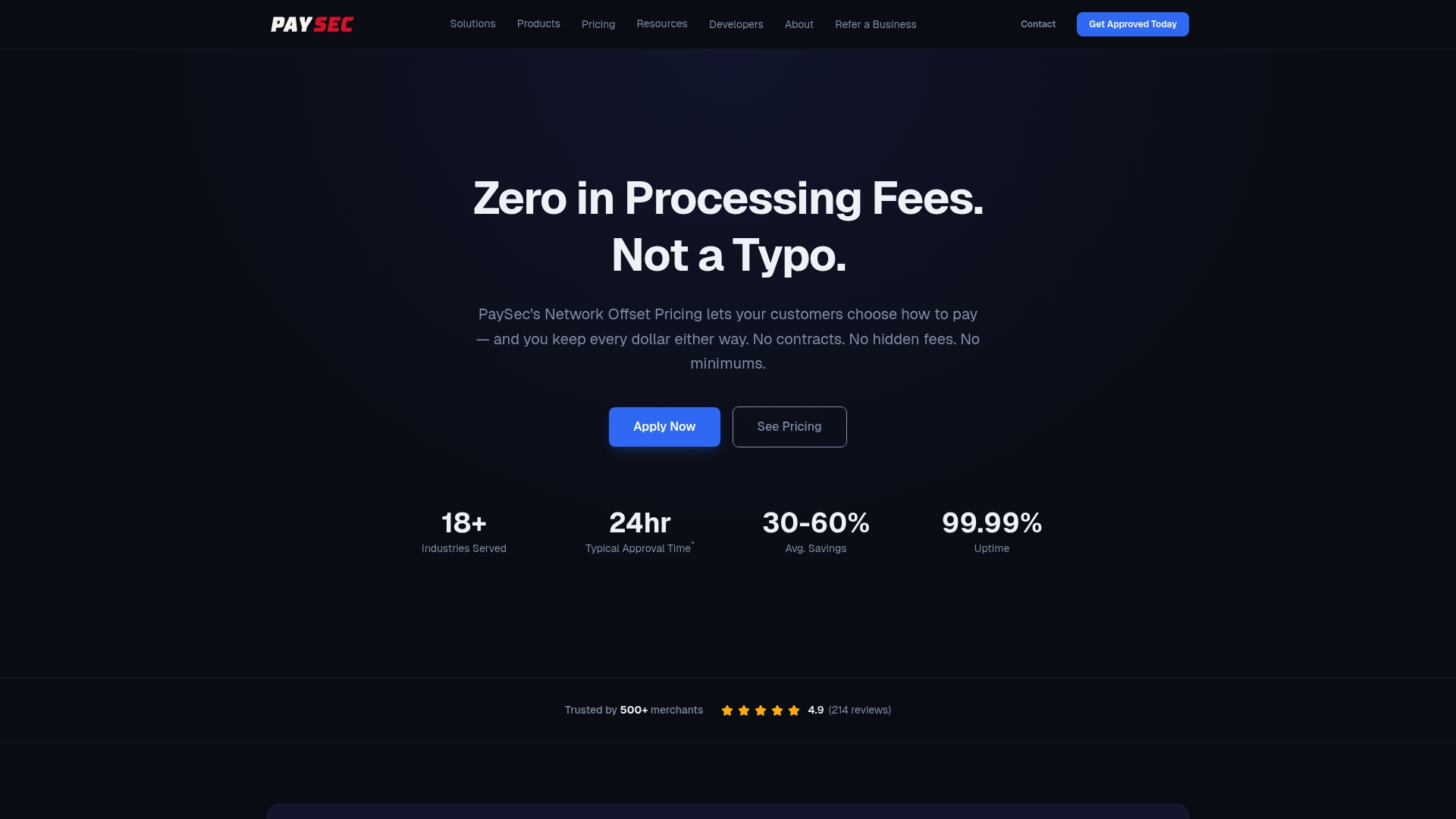
Clients across ecommerce, SaaS, healthcare, and high-risk retail have achieved notable reductions in processing costs, with documented monthly savings in some cases exceeding a few thousand dollars. Paysec supports PCI DSS Level 1 and SOC 2 compliance, integrates with major ecommerce platforms, and provides dedicated merchant accounts with fast funding. Check the pricing structure or request a statement analysis to see exactly what your store would save under network offset pricing.
Useful sources for further reading
- PCI DSS Standards — The authoritative source for payment security requirements; use for all PCI compliance claims.
- PCI Security Standards Council — Governance body for PCI DSS; cite for scope and attestation questions.
- Best No-Contract Payment Processors 2026 | myPayAdvisor — Industry analysis covering pricing model comparisons, volume breakeven points, and hardware lease cautions.
- Fortify Your E-Commerce: Top Strategies for Secure Online Payment — Security guidance on authentication, fraud detection, and chargeback risk reduction.
- Paysec Network Offset Pricing — Paysec's explanation of how network offset pricing reduces transaction costs for ecommerce merchants.
- Ecommerce Payment Processor Comparison Guide for 2026 — Detailed comparison of pricing models and processor features for ecommerce merchants.
- Types of Ecommerce Payment Processing Fees Explained — Line-item breakdown of fee categories merchants should extract from their statements.
FAQ
What does "no-contract" payment processing mean for an ecommerce store?
No-contract processing means month-to-month service with no early termination fee, no minimum volume requirement, and no equipment lease tied to the processing agreement. Merchants can cancel or switch processors at any time without a financial penalty.
What is the cheapest way to accept payments online?
For most ecommerce merchants processing above $25,000 per month, interchange-plus or network-offset pricing produces the lowest effective rate because the processor passes interchange at cost rather than bundling it into a blended markup. Paysec's Network Offset Pricing is designed specifically to deliver wholesale interchange rates without a long-term contract.
Why do ecommerce websites need secure payment processing?
Online payments carry fraud risk including identity theft, account takeover, and chargebacks. Strong authentication and fraud detection reduce chargeback exposure, and PCI DSS compliance protects cardholder data throughout the transaction flow.
What are the main disadvantages of ecommerce payment systems?
The primary risks include fraud exposure, reliance on internet connectivity, and technical interruptions that can disrupt checkout. Choosing a processor with built-in 3D Secure, AVS, CVV verification, and real-time fraud screening addresses most of these risks directly.
Is no-contract payment processing better than a traditional agreement?
For most ecommerce merchants, yes. Month-to-month terms preserve the ability to switch when a better rate or model appears, and interchange-plus pricing typically costs less than blended rates above $25,000 per month. The exception is high-volume enterprise merchants who can negotiate custom interchange rebates that beat published month-to-month pricing.