

Credit card rewards cost merchants because payment networks fund those points and cash-back offers by raising interchange and other merchant-facing charges. That means the mileage a customer earns on a business flight or the 5% cash back on groceries comes directly out of a merchant's processing bill, not from the bank's own pocket. The average U.S. merchant fee runs around 2.2% of each transaction, and while the Durbin Amendment capped debit interchange, credit rewards funding sits largely outside that cap. Companies like PaySec exist specifically because this gap between what merchants pay and what they'd pay under fairer pricing has grown wide enough to justify an entirely different pricing model.
That 2.2% shows up on every card swipe whether a merchant likes it or not, and it comes with real consequences:
- Higher per-transaction processing expense that scales with sales volume, not profit.
- Steady pressure on margins, especially in low-margin categories like grocery and fuel.
- A forced choice: raise prices, absorb the cost, or restructure how payments are priced.
The reward points your customer earns tonight were paid for by the fee taken from your sale this afternoon.
Key Takeaways
Credit card rewards cost merchants because networks fund cardholder perks by raising interchange and merchant-discount fees on every transaction, and merchants can offset that cost with the right pricing model.
| Point | Details |
|---|---|
| Rewards are fee-funded | Interchange and network assessments pay for cardholder points, not the issuer's own revenue. |
| Average fee runs ~2.2% | That rate compounds fast on thin-margin sales and directly reduces net profit per transaction. |
| Costs get redistributed | Estimates put annual transfers from cash/debit users to reward cardholders at $15 billion to $30 billion. |
| Merchants have real levers | Interchange-plus pricing, surcharging where legal, and payment-method incentives all reduce exposure. |
| PaySec targets this gap directly | Network Offset Pricing has delivered documented savings for merchants across multiple industries. |
Table of Contents
- Why Credit Card Rewards Cost Merchants: the Fee Mechanics
- Why Do Payment Networks Raise Fees to Fund Rewards?
- Who Actually Pays for Credit Card Rewards?
- What Rewards Cost Your Margins, and How to Push Back
- Network Markup Fees Beyond Interchange
- How Rewards Shape Merchant Pricing Strategy
- How Loyalty Programs Affect the Merchant-Customer Relationship
- Cut the Cost Rewards Are Adding to Your Processing Bill
- Sources
- FAQ
Why Credit Card Rewards Cost Merchants: the Fee Mechanics
Rewards cost merchants because the money to fund them has to come from somewhere, and it comes from the fee charged on every card swipe. Understanding where that fee goes starts with following the transaction itself: a cardholder swipes, the issuer approves the charge, the network routes it, the acquirer settles it, and the merchant receives what's left. Each hop takes a cut.
The issuer (the bank that gave the customer their card) collects interchange, the largest single component, and uses part of it to fund rewards, sign-up bonuses, and cardholder perks. The network (Visa, Mastercard, or American Express) collects a separate assessment fee for running the rails the transaction travels on. The acquirer, the merchant's own payment processor, adds its own margin on top. Together, these three pieces make up the merchant discount rate, the all-in percentage a merchant loses off the top of every card sale.
U.S. interchange for credit cards typically runs 1% to 3% depending on card type and industry, while regulated debit interchange sits closer to 0.7% under Durbin Amendment caps. Premium rewards cards, the ones offering the richest points and cash back, tend to carry the highest interchange rates because issuers need more revenue to cover what they're giving back to cardholders.
Here's the math on a $100 sale at the commonly cited 2.2% average merchant fee:
| Line Item | Amount |
|---|---|
| Gross sale | $100 |
| Merchant discount fee (2.2%) | $2.20 |
| Merchant net proceeds | $97.80 |
That $2.20 gets split among interchange, network assessment, and acquirer margin before a merchant ever sees settlement. Visa's own merchant guidance confirms the interchange reimbursement fee is a transfer between the acquiring and issuing bank, bundled into what a merchant pays as one discount rate. Most merchants never see the split on their statement, which is exactly why understanding interchange fees as a distinct line item matters.
Why Do Payment Networks Raise Fees to Fund Rewards?
Networks and issuers can push merchant fees higher because consumers chase rewards while merchants tolerate fees to stay competitive. That asymmetry is the entire engine behind rising interchange.
Consumers are rewards sensitive. They pick a card because it earns 3% back on dining or unlocks a companion airfare ticket, and issuers compete hard for that loyalty. Merchants, meanwhile, are comparatively fee insensitive: accepting cards drives more sales than the fee costs them, so most businesses swallow the charge rather than risk losing a transaction. Research summarized by Kellogg Insight frames this directly: card acceptance can lift merchant sales by roughly 30%, which gives merchants a strong reason to keep accepting even richer cards rather than push back on the fee.
That dynamic creates a self-reinforcing chain:
- Consumers demand better rewards to choose one card over another.
- Issuers compete by richer sign-up bonuses and cash-back rates.
- Issuers need more revenue to fund those perks, so they negotiate for higher interchange.
- Networks raise merchant-facing rates to cover the rewards budget.
Rewards aren't free money from the bank. They're a transfer, engineered so merchants fund the perks that keep cardholders loyal to a particular card, not a particular store.
Interest income and annual fees fund part of this too, according to NerdWallet's breakdown of rewards funding sources, but interchange remains the piece merchants feel on every single sale.
Who Actually Pays for Credit Card Rewards?
Merchants pay the fee first, then decide whether to pass it along through higher prices or absorb it and shrink their margin. Most choose some blend of both, and either way, the cost doesn't disappear. It moves.
A Federal Reserve analysis estimates reward credit cards drive roughly $15 billion in annual redistribution across consumer segments, with higher-FICO cardholders capturing more value from rewards while lower-FICO cardholders and cash payers effectively subsidize them through baked-in prices. Press coverage summarizing broader academic work puts the transfer even higher, estimating about $30 billion a year moves from cash and debit users to premium credit card holders. Separate NBER research confirms the same pattern: when merchants set one price for everyone, card fees get baked into that price for all customers, cash payers included.
Picture a coffee shop charging $5 for a latte regardless of payment method. The cash customer pays $5 flat. The rewards cardholder pays $5 too, but earns points worth maybe $0.15 back. The merchant's fee on that card swipe, layered into the $5 price from day one, means the cash customer just helped cover a reward they'll never receive.
- Grocery stores and big-box retailers often negotiate lower rates due to volume, softening the subsidy effect.
- Small convenience stores and independent gas stations frequently pay the highest effective rates and pass more cost through to every customer.
- Merchant category and negotiating leverage change how much of that transfer any single business absorbs versus passes on.
What Rewards Cost Your Margins, and How to Push Back
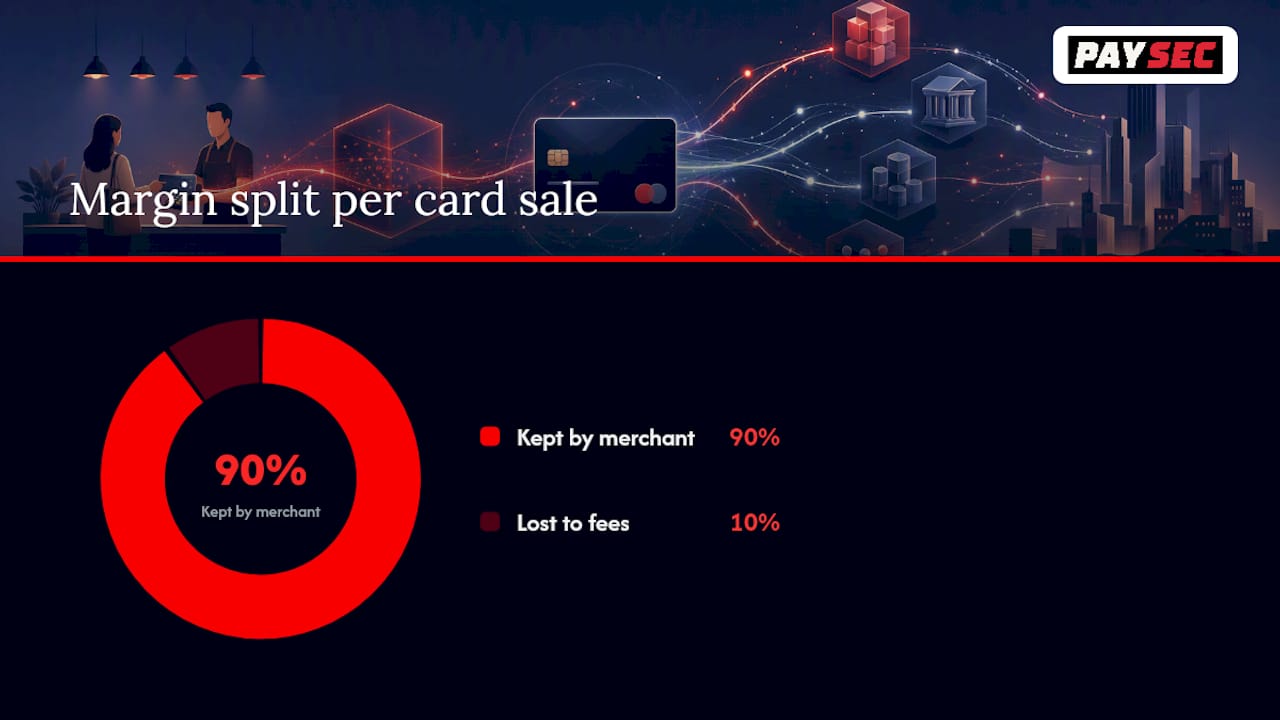
A business running 20% net margins loses roughly one-tenth of that margin to card fees alone on every card sale, and that's before factoring in premium rewards cards that carry higher-than-average interchange.
Merchants aren't powerless here. A few moves consistently reduce exposure:
- Negotiate interchange-plus pricing instead of flat-rate or tiered pricing, so you see the real cost instead of a padded markup.
- Test network-offset pricing, which shifts the processing cost structure so the business keeps more of each transaction.
- Implement cash discounts or compliant surcharging where state law allows it, so cardholders using premium rewards cards help cover the cost of the perks they're earning.
- Encourage debit and cash payments for lower-margin transactions, since regulated debit interchange runs far below credit.
- Review processing reports monthly to spot spikes in premium-card volume that quietly erode margin.
Pro Tip: *Pull your monthly processing statement and sort transactions by card type.
Pro Tip: Before adding a surcharge, calculate what your average customer's rewards card actually earns them per purchase. If your surcharge exceeds that value, you risk losing the sale entirely rather than just offsetting the fee.
One guardrail worth knowing before making changes: the Durbin Amendment governs debit interchange caps, and most states allow credit card surcharging within specific disclosure rules, so check your state's requirements before adding one. A resource on surcharge program rules covers the disclosure basics merchants need to stay compliant.
Network Markup Fees Beyond Interchange
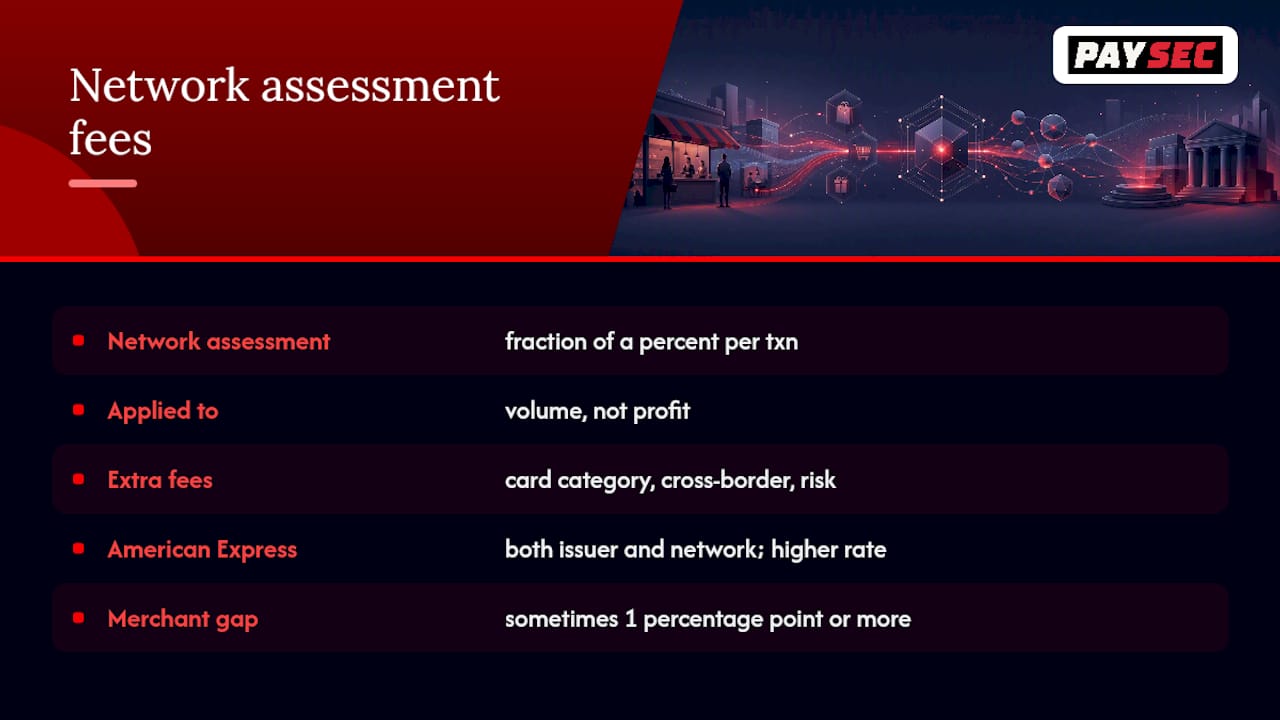
Interchange gets most of the attention, but it's not the only piece of the merchant discount rate feeding the rewards machine. Visa and Mastercard both charge separate network assessment fees, sometimes called network markup, on top of interchange. These fees fund the infrastructure that processes billions of transactions daily and, indirectly, subsidize marketing and co-brand partnerships that make premium rewards cards attractive in the first place.
Network assessments are typically small on a per-transaction basis, often a fraction of a percent, but they apply to volume, not profit, so high-transaction merchants feel them at scale. American Express operates differently: as both the issuer and the network, it collects a merchant discount rate that's frequently higher than Visa or Mastercard, partly because it funds richer rewards directly without splitting revenue with a separate bank issuer.
Card brands also charge additional fees tied to specific card categories, cross-border transactions, and even risk classifications. A merchant accepting a premium travel rewards card often pays more in combined interchange and network assessment than accepting a basic no-rewards debit card, sometimes by a full percentage point or more. That spread is precisely how the card ecosystem funds increasingly generous sign-up bonuses and travel perks without the issuer absorbing the cost directly. Merchants rarely see this fee broken out on a statement, but it's baked into the types of processing fees every card-accepting business pays.
How Rewards Shape Merchant Pricing Strategy
Rewards programs force merchants into pricing decisions that have nothing to do with their product costs. When card acceptance costs vary by card type, and most merchants can't charge different prices for different rewards tiers under standard card network rules, businesses end up pricing to the average fee rather than the actual fee on each transaction.
This creates real competitive tension. A merchant competing against a larger chain with negotiated volume discounts often pays a materially higher effective rate on the same transaction mix, which squeezes their ability to price competitively. Retailers in categories with thin margins, like gas stations and convenience stores, sometimes respond by setting one price for cash and a higher price for card, a practice permitted in most states as long as it's clearly disclosed.
Rewards also change customer expectations in ways that ripple into pricing. Shoppers increasingly expect to earn something back on every purchase, and merchants competing for that same customer base sometimes offer their own loyalty incentives just to stay even, layering additional cost onto an already fee-heavy transaction. That's a second cost stack sitting on top of the first, and few merchants model both together when setting prices. The businesses that come out ahead tend to be the ones tracking their true processing fees against profit margin line by line instead of estimating.
How Loyalty Programs Affect the Merchant-Customer Relationship
Cardholder loyalty programs don't just cost merchants directly through interchange. They also reshape how customers relate to a merchant's own brand, often in ways that work against the business footing the fee bill.
A customer loyal to their travel rewards card cares more about maximizing points than about which specific store they shop at, which weakens brand loyalty a merchant might otherwise earn through service or price. That's an indirect cost: the merchant funds the card issuer's loyalty program through fees while getting none of the loyalty benefit in return. Some merchants respond by building their own loyalty programs, but that adds a second layer of cost and complexity on top of the interchange they're already paying.
There's a subtler effect too. Businesses that accept a wide range of premium cards, hoping to capture rewards-motivated spenders, often see average transaction sizes rise, since cardholders chasing points tend to spend more per visit to hit bonus thresholds. That can offset some of the fee cost through higher basket sizes, but it's an uneven trade that varies heavily by industry and customer base. Restaurants and eCommerce retailers tend to see this lift more consistently than service-based businesses, according to patterns reported alongside industry fee data from the NBC News coverage of rising merchant card costs.
A Publisher's View on the Rewards Tradeoff
Rewards aren't going away, and merchants shouldn't expect networks to lower fees out of goodwill. What's changed is that merchants finally have real pricing alternatives instead of just accepting whatever their processor quotes. PaySec's Network Offset Pricing model exists because merchants deserve to see the actual interchange cost instead of a padded blend, and clients using it have reported measurable reductions in processing costs. The lever most merchants overlook isn't fighting the card networks. It's fixing the pricing structure sitting between them and their acquirer.
Cut the Cost Rewards Are Adding to Your Processing Bill
PaySec's Network Offset Pricing and interchange-plus options exist specifically to close the gap between what rewards cost merchants and what merchants actually have to pay for accepting cards.
That kind of result comes from three specific advantages: transparent pricing with no hidden markups, no minimums or long-term contracts locking a business in, and real-time reporting that shows exactly which card types are driving up costs. If premium rewards cards are quietly eating into your margin every month, the fix starts with seeing the real numbers. Check your current rate against Network Offset Pricing and find out what you're actually leaving on the table.
Sources
- NBER working paper (w35067)
- Kellogg Insight — Who pays for generous credit-card rewards?
- Visa — U.S. interchange reimbursement fees (merchant guidance PDF)
This list is a starting point for merchants doing their own due diligence before renegotiating a processing contract.
This article is general information, not a substitute for advice from a qualified financial advisor. Consult a qualified financial professional about your own circumstances before acting on anything here.
FAQ
Why do credit card rewards cost merchants money?
Rewards are funded through interchange and network fees charged to merchants on every transaction, so richer rewards generally mean higher merchant costs.
What is the average merchant fee for accepting credit cards?
The commonly cited U.S. average is around 2.2% per transaction, though premium rewards cards often carry higher interchange than standard cards.
Does the Durbin Amendment limit credit card rewards fees?
The Durbin Amendment caps debit interchange, not credit interchange, which is why credit card rewards funding remains largely unregulated compared to debit transactions.
Can merchants legally pass rewards costs to cardholders?
Many states allow surcharging or cash discounting with proper disclosure, letting merchants offset some of the fee tied to premium rewards cards.
How can merchants reduce the cost of credit card rewards?
Negotiating interchange-plus pricing, adopting Network Offset Pricing models like PaySec's, and encouraging lower-cost payment methods are the most direct ways to cut exposure.