

TL;DR:
- A surcharge program allows merchants to add a percentage fee to credit-card transactions to recover processing costs, but it must be legally compliant and transparent. It applies only to credit cards, caps at 3% or actual acceptance costs, and requires registration with an acquiring processor before implementation. An alternative approach called Network Offset Pricing recovers costs without a visible surcharge, simplifying compliance and maintaining clear posted prices.
A surcharge program lets merchants add a percentage-based fee to credit-card transactions to recover card-acceptance costs, including interchange, assessments, and processor markup. Visa's merchant surcharging guidelines confirm that surcharges apply only to credit cards, never to debit or prepaid cards. U.S. card-network rules generally cap that fee at 3% or the merchant's actual cost of acceptance, whichever is lower. On a $100 sale with a 3% surcharge, the customer pays $3.00 more, and the receipt shows this as a separate line item. Before enabling any program, confirm your state's rules: a handful of states restrict or ban credit-card surcharging outright.
Table of Contents
- How surcharge programs work in practice
- U.S. card-network rules and legal requirements you must follow
- Surcharge vs. cash discount: which model fits your business?
- How to set up a compliant surcharge program step by step
- Common compliance mistakes and how to fix them
- Real numbers: what a surcharge actually recovers
- Should your business implement a surcharge program?
- Key Takeaways
- The case for measuring before you commit
- Paysec's Network Offset Pricing recovers your processing costs without a posted surcharge
- Useful sources for verifying surcharge rules
- FAQ
How surcharge programs work in practice
The mechanics are straightforward. When a customer pays by credit card, the merchant's system adds the surcharge percentage to the posted price. The cardholder pays the combined total. The surcharge offsets costs the merchant would otherwise absorb:
- Interchange fees — paid to the card-issuing bank
Not every card type qualifies. Surcharges are excluded from debit cards (even when run as credit), prepaid cards, and certain government-issued card products. This is a network rule, not a merchant choice. Charging a surcharge on an excluded card type is a compliance violation.
Disclosure is built into the mechanics. The surcharge must appear at the point of entry (your store entrance or website landing page), at the point of sale (checkout screen or payment terminal), and as a separate labeled line item on the receipt. A sample receipt line looks like this:
That visibility is what separates a compliant program from a hidden fee.
U.S. card-network rules and legal requirements you must follow
Card-network rules cap surcharges at 3% or the merchant's actual cost of acceptance, whichever is lower. Exact caps and allowed card products are network-determined and can change, so verifying current Visa and Mastercard merchant rules directly is always the right move before launch.

Registration with your acquiring processor is required before you can legally surcharge. You cannot simply flip a switch in your POS settings. The processor notifies the card networks on your behalf, which creates the compliance record that protects you.
Compliance checklist before you enable surcharging:
- Confirm surcharging is legal in your state (see state restrictions below)
- Calculate your actual Merchant Discount Rate (MDR) to set the surcharge at or below actual cost
- Register with your acquiring processor and receive written confirmation
- Update point-of-entry signage with required disclosure language
- Configure your POS or eCommerce checkout to display the surcharge before payment is completed
- Verify that receipts print the surcharge as a separate, labeled line item
- Train staff to explain the surcharge clearly and consistently
Pro Tip: Set your surcharge rate at your actual MDR rather than the 3% network cap. If your MDR is 2.4%, charging 3% puts you out of compliance. Capping at actual cost keeps you clean and avoids network penalties.
State law adds another layer. States such as New York and Colorado have specific statutes governing how surcharges must be disclosed or whether they are permitted at all. New York's surcharge legislation and Colorado's SB21-091 are two examples of state-level rules that go beyond network requirements. Always check your state's current statute before going live.
This article is general information, not legal or financial advice. Confirm current rules with your acquiring processor, card networks, and a qualified professional before implementing a surcharge program.
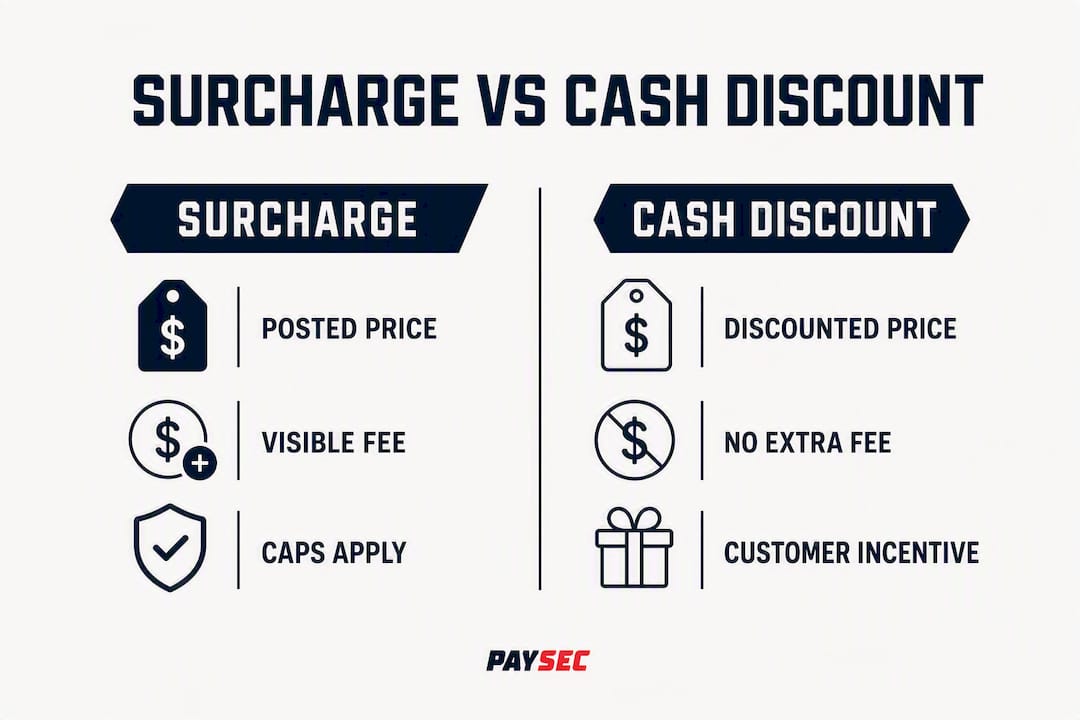
Surcharge vs. cash discount: which model fits your business?
These two approaches both recover card-acceptance costs, but they work differently and carry different customer perceptions.

| Feature | Surcharge | Cash Discount / Dual Pricing |
|---|---|---|
| How price is displayed | Posted price is the base; surcharge added at checkout for credit cards | Posted price includes card cost; cash customers receive a discount |
| Who pays the fee | Credit-card customers only | Card customers pay full posted price; cash customers pay less |
| Disclosure requirement | Must disclose at point of entry, point of sale, and on receipt | Must clearly label both prices; "cash price" and "card price" must be visible |
Surcharging tends to suit merchants whose posted prices are already established and who want to add a visible, itemized fee only for card transactions. Cash discounting, sometimes called dual pricing, works well for merchants who prefer to build the card cost into the shelf price and reward cash-paying customers with a lower amount. The decision often comes down to customer experience sensitivity: businesses with price-sensitive customers or high average tickets sometimes find that a visible surcharge creates more friction than a dual-pricing model does.
How to set up a compliant surcharge program step by step
Implementation is manageable when you follow the steps in order. Skipping registration or signage is where most merchants run into trouble.
- Confirm state law. Check whether your state permits surcharging and whether any disclosure format is mandated beyond network rules.
- Calculate your actual MDR. Pull your most recent processing statement and identify your effective rate. This is your surcharge ceiling. Understanding hidden fees in your processing statement first helps you get an accurate number.
- Register with your acquiring processor. Submit the required notification. Get written confirmation. Do not go live before this step is complete.
- Update your POS or eCommerce platform. Configure the surcharge percentage in your payment settings. For eCommerce, the surcharge must display before the customer confirms payment.
- Install point-of-entry signage. Post the disclosure at every entrance customers use before reaching the checkout. Sample wording: "We charge a [X]% surcharge on credit card transactions. This surcharge is not greater than our cost of acceptance. Debit and prepaid cards are not subject to this surcharge."
- Add a checkout disclosure. For in-person terminals, the surcharge must appear on the payment screen. For online checkout, display it in a modal or summary line before the customer clicks "Pay."
- Test receipts and reporting. Run a test transaction and confirm the surcharge prints as a separate labeled line item. Verify your reporting dashboard captures it correctly.
- Train your staff. Employees should be able to explain the surcharge calmly and accurately. A one-sentence script helps: "We add a small fee for credit card payments to cover our processing costs. Debit cards don't have that fee."
Timeline: Simple single-location POS setups can be live in hours. Integrated eCommerce platforms or multi-location rollouts typically take a few days to a few weeks, depending on your processor and POS vendor.
Common compliance mistakes and how to fix them
Most surcharge violations fall into a short list of predictable errors.
Failing to register with the acquirer. This is the most common and most serious mistake. Fix: complete registration before enabling any surcharge in your system.
Exceeding the allowed cap. Charging 3% when your MDR is 2.2% puts you over the actual-cost limit. Fix: set the surcharge at your verified MDR and review it whenever your processing costs change.
Charging on excluded card types. Debit and prepaid cards cannot be surcharged. Most modern POS systems can detect card type automatically, but verify this with your processor. Fix: confirm your terminal or gateway is configured to suppress the surcharge on non-credit transactions.
Missing or inadequate signage. A small sticker near the register does not meet the point-of-entry requirement. Fix: post clear, readable signage at every customer entry point and at the checkout terminal.
Incorrect receipt itemization. Bundling the surcharge into the total without a separate line item is a violation. Fix: test your receipt format before going live and keep a printed sample on file.
Handling disputes and chargebacks. When a customer disputes a surcharge, the strongest defense is documented disclosure. Keep records of your signage, your registration confirmation, and your receipt format. Clear disclosures at point of entry and checkout materially reduce chargeback disputes because customers are less likely to be surprised by a separate line-item fee.
Real numbers: what a surcharge actually recovers
Three scenarios show how the math works across different transaction sizes.
Scenario 1:
- Posted price: $50.00
- Surcharge: a small percentage added
- Customer total: $50 plus surcharge
- Merchant recovers the processing cost on that transaction
Scenario 2:
- Posted price: $100.00
- Surcharge (3%): $3.00
- Customer total: $103.00
- Merchant recovers processing cost, but must ensure surcharge does not exceed actual cost to stay compliant.
Scenario 3: $1,200 high-ticket sale (relevant for professional services firms or high-ticket retail)
- Posted price: $1,200.00
- Surcharge (2.5%): $30.00
- Customer total: $1,230.00
- Merchant recovers $30.00 in processing costs on a single transaction
The gap between your surcharge percentage and your MDR determines net recovery. If you cap at actual cost, recovery is close to complete on the surcharged transactions. The variable is customer behavior: some cardholders will switch to debit or cash when they see a surcharge, which reduces the volume of surcharged transactions but also reduces your processing cost on those sales. Tracking your payment method mix before and after launch tells you the real net impact.
Should your business implement a surcharge program?
Pros:
- Recovers card-acceptance costs directly from the transactions that generate them
- Preserves your posted price without raising shelf prices across the board
- Creates a transparent, itemized fee rather than absorbing costs silently
Cons:
- Some customers react negatively to a visible surcharge, particularly in price-sensitive markets
- State-level bans or restrictions apply in certain jurisdictions
- Requires registration, signage, and ongoing compliance monitoring
Three-question decision checklist:
- Are most of your transactions paid by credit card? If yes, the recovery potential is significant.
- Does your state permit surcharging without additional restrictions? If no, surcharging is not an option.
- Can you clearly disclose the surcharge at every customer touchpoint? If yes, compliance is achievable.
If surcharging does not fit, alternatives include network offset pricing, interchange-plus pricing, or adjusting your posted prices to absorb costs. Each approach has different visibility to customers and different compliance requirements.
Key Takeaways
A surcharge program recovers credit-card processing costs by adding a disclosed, capped fee to credit-card transactions only, with registration and signage required before going live.
| Point | Details |
|---|---|
| Core definition | A surcharge adds a percentage fee to credit-card transactions to recover interchange, assessment, and processor costs. |
| Network cap | Surcharges are capped at 3% or your actual MDR, whichever is lower — never charge above your real cost. |
| Debit and prepaid excluded | Surcharges apply to credit cards only; debit and prepaid cards must never be surcharged. |
| Registration required | You must register with your acquiring processor before enabling any surcharge — this step is non-negotiable. |
| Paysec alternative | Paysec's Network Offset Pricing recovers processing costs without a posted surcharge, with no hidden fees and no long-term contracts. |
The case for measuring before you commit
Merchants who pilot a surcharge program on a single location or product category before a full rollout consistently get better data than those who launch everywhere at once. The two metrics that matter most are net processing cost recovered per transaction and the shift in payment method mix after launch. If a meaningful share of customers switch to debit or cash, your surchargeable volume drops, and the net recovery may be lower than the headline math suggests.
That does not mean surcharging is the wrong choice. It means the right choice depends on your specific customer base, average ticket, and card mix. A high-ticket service business with mostly credit-card customers will see strong recovery. A high-volume, low-ticket retailer with a mixed payment base may find the administrative overhead outweighs the gain. Run the pilot, measure both KPIs, and let the data drive the decision rather than the theory.
Paysec's Network Offset Pricing recovers your processing costs without a posted surcharge
Processing fees are a real cost, and recovering them should not require putting a visible surcharge line in front of every credit-card customer. Paysec's Network Offset Pricing offsets interchange costs at the backend, so your posted prices stay clean and your customers see a straightforward checkout. Merchants across 18+ industries report processing cost reductions of 30–60%, with one documented outcome showing a 42% reduction in processing costs.
What sets Paysec apart from a standard surcharge setup:
- No hidden fees — and no long-term contracts
- Real-time reporting and analytics — so you can track cost recovery per transaction
If you have reviewed the surcharge compliance requirements and want a simpler path to the same financial outcome, see how Network Offset Pricing works and compare it against your current processing costs.
Useful sources for verifying surcharge rules
Before enabling a surcharge program, read the primary sources. Rules change, and a processor's summary is not a substitute for the network's own documentation.
- Visa U.S. Merchant Surcharge Q&A — the definitive network-level guidance on caps, disclosure, and excluded card types
- Federal Reserve Regulation II interchange data — useful for understanding average interchange rates when calculating your MDR
- CFPB credit card resources — consumer-facing context that helps merchants understand how customers view card fees
- Paysec: Surcharging vs. Network Offset Pricing — a direct comparison of the two main cost-recovery approaches
- Paysec: Flat-Rate vs. Interchange-Plus vs. Network Offset Pricing — helps merchants estimate which pricing model fits their volume and card mix
Confirm your state's current statute with a qualified attorney or your acquiring processor before going live. Paysec can also provide a compliance review as part of onboarding.
FAQ
What is a surcharge program?
A surcharge program is a merchant practice that adds a percentage fee to credit-card transactions to recover card-acceptance costs. Surcharges apply only to credit cards, not debit or prepaid cards, and are capped at 3% or the merchant's actual cost of acceptance, whichever is lower.
What is an example of a surcharge?
A merchant with a 3% surcharge adds $3.00 to a $100.00 credit-card purchase, so the customer pays $103.00. The $3.00 appears as a separate labeled line item on the receipt.
Why am I being charged a surcharge?
Merchants charge a surcharge to recover credit-card processing fees, including interchange and network assessments, that they would otherwise absorb as a business cost. The fee must be disclosed before you pay, and it cannot exceed the merchant's actual processing cost.
How do I avoid paying surcharge fees?
Pay with a debit card, prepaid card, or cash. Surcharges apply only to credit-card transactions, so switching your payment method eliminates the fee entirely.
Does Paysec require a surcharge to recover processing costs?
No. Paysec's Network Offset Pricing recovers interchange costs at the backend without adding a visible surcharge to customer transactions, giving merchants a compliant alternative that keeps posted prices clean.