

Telehealth payment processing is the specialized infrastructure that handles two distinct money flows: patient out-of-pocket payments collected on PCI DSS card rails, and insurance reimbursements transmitted as X12 electronic claims on HIPAA/EDI rails. It is not standard e-commerce with a healthcare skin. It is a compliance-first revenue function that requires tokenization, Business Associate Agreements (BAAs), healthcare-aware underwriting, and correct Merchant Category Code (MCC) classification to keep revenue predictable and patient data protected.
The practical bottom line: without the right payment infrastructure, telehealth operators face frozen funds, rejected insurance claims, and HIPAA exposure simultaneously. The right setup prevents all three.
Here is what a complete telehealth payment system manages:
- Patient card payments: copays, deductibles, self-pay balances, and subscription plans collected via virtual terminal, hosted payment page, or mobile capture
- Insurance reimbursement: 837 claim submission through a clearinghouse, 835 Electronic Remittance Advice (ERA) reconciliation, and eligibility verification (270/271) before the visit
- Recurring billing: subscription plans for chronic care, direct primary care, or membership programs
- Audit-ready reporting: transaction logs, refund records, and chargeback documentation for compliance reviews
Table of Contents
- How telehealth payment processing differs from standard e-commerce
- What core features should a telehealth payment solution include?
- How do integrations connect payments to EHRs and billing systems?
- What security and compliance controls does telehealth payment processing require?
- How do you prevent frozen funds, chargebacks, and underwriting problems?
- How do telehealth payment processors charge, and what drives cost?
- How do you evaluate and select a telehealth payment processor?
- What does the research say about specialized telehealth payment processors?
- Key Takeaways
- Why payments are a strategic function in telehealth, not just a back-office task
- Paysec gives telehealth providers a HIPAA-aware payments foundation
- Useful sources and further reading
- FAQ
How telehealth payment processing differs from standard e-commerce
Standard e-commerce runs on one rail: card payment governed by PCI DSS. Telehealth runs on two rails that must stay separate, and that structural difference changes almost everything about how you select, configure, and audit your payment stack.
The two rails:
- PCI DSS card rail: Collects patient payments (credit, debit, HSA/FSA). The processor must never receive or store Protected Health Information (PHI) alongside raw card data unless it has signed a BAA. Keep these paths non-overlapping.
- HIPAA/EDI rail: Submits X12 837 claims to payers, receives 835 remittances, and runs 270/271 eligibility checks. This rail is governed by HIPAA, not PCI DSS, and flows through a clearinghouse or payer portal.
Mixing the two, or letting PHI bleed into card metadata fields, creates a compliance exposure that neither PCI DSS nor HIPAA alone addresses cleanly. Two separate workflows are the baseline design requirement.
Why underwriting scrutiny is higher:
Telehealth transactions are card-not-present by definition. Add recurring subscription billing, prescription-adjacent services, and cross-state licensure, and processors classify many telehealth merchants as elevated risk. Banks and card networks now evaluate telehealth underwriting using clinical, marketing, and subscription-billing signals as part of merchant reviews, not just revenue volume.
Chargeback patterns are different too. Patients who dispute a telehealth charge often cite "service not received" because the visit was virtual and they have no physical receipt. Subscription plans for chronic care generate friendly fraud at higher rates than one-time in-person copays. Specialized healthcare-aware underwriting accounts for these patterns; general-purpose processors typically do not.
Pro Tip: Keep card metadata fields PHI-free. Never populate the "order description" or "customer note" field with a diagnosis, medication name, or visit type unless your processor has signed a BAA covering that data. Use an opaque visit ID instead.
What core features should a telehealth payment solution include?
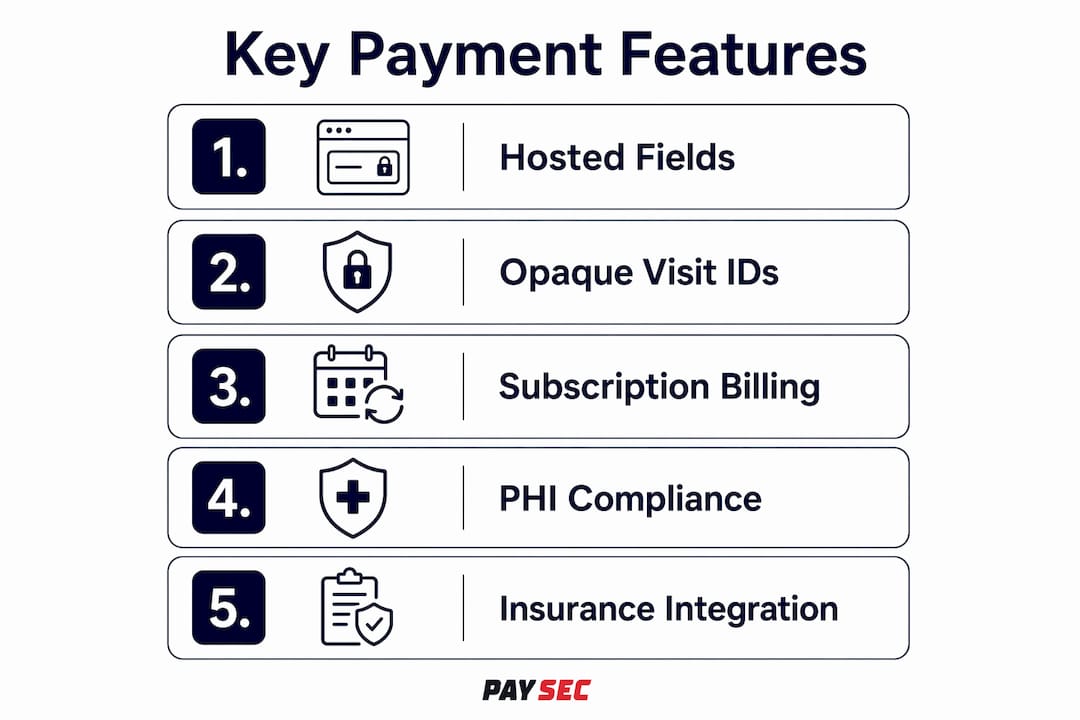
The functional building blocks map directly to clinical workflows. Every feature below has a specific telehealth use case, and missing even one creates a gap in your revenue cycle.

| Feature | Why it matters for telehealth | Common implementation |
|---|---|---|
| Virtual terminal | Collect copays by phone or staff-initiated entry | Browser-based, no hardware required |
| Hosted payment page | Pre-visit self-pay collection without PHI on card path | Hosted by processor, embedded via iframe |
| Saved-card tokenization | Recurring billing without storing raw PANs | Processor-side token vault |
| Recurring/subscription billing | Chronic care plans, direct primary care memberships | API or dashboard-configured schedules |
| Invoicing | Post-visit balance billing after insurance adjudication | Email or patient portal delivery |
| ACH/bank transfer | High-ticket balances where card fees are prohibitive | Direct bank debit, lower per-transaction cost |
| Mobile payments | Field clinicians, hybrid practices, home visit follow-ups | Mobile app or mobile payment capture |
| Specialized merchant account | HSA/FSA acceptance, correct MCC, healthcare underwriting | Direct account, not aggregator sub-merchant |
| Settlement reporting | Reconcile card receipts against ERA remittances | Real-time dashboard, exportable ledger |
How these features work in practice:
- A patient books a virtual psychiatry visit. The platform sends a hosted payment link for the $40 copay before the appointment starts. The card token is saved for future recurring billing if the patient enrolls in a monthly plan.
- A direct primary care clinic charges a $99 monthly membership. The recurring billing engine charges the saved token on the first of each month, sends an automated receipt, and logs the transaction against the patient's account ID (not their name or diagnosis).
- After a telehealth visit, the billing team posts the 837 claim. The ERA (835) comes back with a $60 patient responsibility. The system auto-generates an invoice and sends it to the patient portal.
Hosted fields and opaque visit IDs are the two implementation choices that most directly reduce PHI leakage on the card rail. Keeping raw PANs off provider servers by using browser-hosted capture is the fundamental rule for reducing PCI scope.
How do integrations connect payments to EHRs and billing systems?
Payment processing does not operate in isolation. For telehealth, the integration map typically includes five systems, and a gap in any connection creates manual reconciliation work or compliance risk.
Primary integration targets:
- EHR / practice management system: Patient demographics, visit records, and balance data flow to and from the payment system. The integration should exchange opaque visit IDs, not PHI, across the card payment path.
- Telehealth platform (video): Pre-visit payment links or consent capture should trigger from the scheduling workflow inside the video platform.
- Clearinghouse / EDI system: 837 claim submission and 835 ERA receipt. Run eligibility checks (270/271) pre-visit when possible to reduce post-visit denials.
- Patient portal: Deliver invoices, collect self-pay balances, and display payment history without exposing raw card data.
- CRM / billing system: Reconcile card receipts against insurance payments and flag outstanding balances for follow-up.
Safe integration checklist for IT and revenue teams:
- Use hosted checkout (iframe or redirect) so card capture happens on the processor's domain, not yours
- Exchange opaque visit IDs between EHR and payment system; never pass diagnosis codes or medication names in payment metadata
- Require a signed BAA from every vendor that touches PHI in the payment flow
- Send 270 eligibility requests before the visit to confirm coverage and estimate patient responsibility
- Map 835 ERA fields to your practice management system for automatic reconciliation
- Test with synthetic card numbers before go-live; verify tokenization is active and PANs are not logged
For IT teams evaluating vendors, a healthcare payment gateway integration guide can structure the technical due diligence process. The Paysec and AdvancedMD integration is one example of how a payments provider can connect directly with clinical software to reduce manual steps between scheduling, billing, and settlement.
What security and compliance controls does telehealth payment processing require?
HIPAA and PCI DSS are not interchangeable. They govern different data types, and understanding where each applies is the first step to building a compliant stack.
HIPAA applies when a payment transaction involves PHI: a patient name linked to a diagnosis, a medication tied to a visit record, or any data element that identifies a patient and relates to their health condition or care. Any vendor that handles PHI in the payment flow must sign a BAA. Without a BAA, the provider bears full liability for that vendor's data handling.

PCI DSS applies to cardholder data: the Primary Account Number (PAN), expiration date, and CVV. PCI DSS does not govern PHI, but the two datasets often travel together in telehealth workflows, which is why keeping them on separate paths matters.
Required controls checklist:
- BAA signed with every payment processor, gateway, and integration partner that touches PHI
- Hosted fields or redirect-based card capture so PANs never touch provider servers
- Tokenization replacing PANs with processor-issued tokens in all stored records
- Encryption in transit (TLS 1.2 or higher) and at rest for all cardholder and patient data
- Role-based access controls limiting who can view transaction records and patient payment history
- Audit logging with tamper-evident records for compliance reviews
- PCI DSS Self-Assessment Questionnaire (SAQ) scope reduction through tokenization (SAQ A or SAQ A-EP rather than SAQ D)
Questions to ask potential processors:
- Will you sign a BAA, and what PHI does it cover?
- What tokenization approach do you use, and does it keep PANs off my servers?
- What SAQ level does your solution support?
- Do you provide SOC 2 Type II or PCI DSS audit reports on request?
- What is your breach notification SLA?
Statistic callout: Telehealth providers that use hosted tokenization and a signed BAA reduce their PCI DSS assessment scope to SAQ A, the lowest-burden category, compared to SAQ D for providers that store or transmit raw PANs directly. Correct compliance controls are not just a legal requirement; they are a frontline compliance signal that banks and card networks now use to evaluate merchant risk.
For a detailed compliance checklist, the HIPAA-compliant payment processing requirements guide covers BAA considerations and control verification steps in depth.
How do you prevent frozen funds, chargebacks, and underwriting problems?
Frozen funds are the most disruptive operational event a telehealth practice can face. They usually stem from one of three causes: incorrect MCC classification, a sudden chargeback spike, or an aggregator platform-level reserve action. Each has a specific prevention strategy.
Underwriting preparation:
- Choose the right MCC. MCC 8099 (Medical Services) is generally better positioned for HSA/FSA acceptance than MCC 5912 (Drug Stores) for most telehealth practices. Confirm your MCC with legal, billing, and your payments partner before go-live.
- Document your business model clearly. Provide the processor with your state licensure, prescribing practices, refund policy, and subscription terms upfront. Processors that specialize in healthcare underwriting expect this documentation and use it to set appropriate reserves.
- Avoid aggregator sub-merchant accounts for high-volume telehealth. Aggregators can hide merchants under a master account, which limits autonomy and exposes you to platform-level reserve actions. A direct merchant account underwritten for healthcare provides more predictable settlement.
- Separate merchant accounts for products vs. professional services. If you sell both prescriptions and clinical consultations, separate accounts improve HSA/FSA acceptance and reduce cross-contamination of chargeback rates.
If a fund hold occurs:
- Contact your processor's risk team directly (not general support) within 24 hours
- Provide your state medical license, business registration, and a transaction sample showing service delivery
- Submit your refund policy and subscription cancellation terms in writing
- Request a written explanation of the hold reason and the specific documentation needed to release funds
- If the hold is MCC-related, ask for reclassification with supporting documentation
Chargeback prevention:
- Use clear, recognizable statement descriptors (practice name, not a generic processor name)
- Send pre-visit confirmation emails with the charge amount and cancellation policy
- Capture patient consent for recurring billing in writing before the first charge
- Respond to disputes within 72 hours with visit documentation, consent records, and the signed billing authorization
Pro Tip: Maintain a separate merchant account for subscription plans and one for one-time copay collection. This isolates chargeback rates by transaction type and protects your primary account from a spike in subscription disputes.
How do telehealth payment processors charge, and what drives cost?
Understanding the fee structure before signing a contract is the difference between a predictable cost line and a surprise on your monthly statement.
Common pricing models:
- Interchange-plus: The processor passes through the actual interchange rate set by Visa/Mastercard and adds a fixed markup. This is the most transparent model and the easiest to benchmark.
- Flat rate: A single percentage applied to every transaction regardless of card type. Simpler to forecast but often more expensive for high-ticket or card-present transactions.
- Subscription/membership pricing: A fixed monthly fee plus a small per-transaction cost. Works well for high-volume practices where the per-transaction savings outweigh the monthly fee.
Sample fee line items:
| Fee type | Typical range | Telehealth note |
|---|---|---|
| Interchange (card network) | — | Higher for card-not-present, rewards cards |
| Network/assessment fees | — | Set by Visa/Mastercard, non-negotiable |
| Processor markup | — | Negotiable; compare across vendors |
| Gateway fee | — | Some processors bundle this |
| Chargeback fee | — | Telehealth has elevated exposure |
| Monthly account fee | — | Varies by model; some waive it |
Telehealth-specific cost drivers:
- Card-not-present transactions carry higher interchange than in-person swipes
- Recurring subscription plans may trigger higher-risk pricing tiers
- Cross-state operations can complicate settlement and add compliance overhead
- Prescription-adjacent services may attract risk premiums from some processors
Paysec's Network Offset Pricing model gives providers a way to offset processing costs while maintaining pricing transparency, with no hidden fees, no monthly minimums, and no long-term contracts. Healthcare clients have reported fee savings in the 30–60% range using this approach.
Pro Tip: Always request a fee breakdown that separates interchange, network assessment fees, and processor markup. A processor that bundles all three into a single percentage makes it impossible to evaluate whether their markup is competitive. Interchange-plus pricing with itemized statements is the clearest basis for comparison.
For a detailed breakdown of healthcare payment processing fees, the cost drivers specific to medical practices are covered in depth.
How do you evaluate and select a telehealth payment processor?
A structured selection process prevents the most common mistake: choosing a processor based on rate alone and discovering compliance gaps after go-live.
Prioritized selection checklist:
Immediate must-haves (non-negotiable before contract):
- BAA availability confirmed in writing
- Hosted tokenization that keeps PANs off your servers
- PCI DSS scope reduction to SAQ A or SAQ A-EP
- Healthcare-aware underwriting with direct merchant account (not aggregator sub-merchant)
- Clear MCC classification plan reviewed with legal and billing
Near-term needs (required within 90 days of go-live):
- Recurring billing with patient consent capture and cancellation management
- EHR or practice management integration (hosted checkout or API)
- ACH/bank transfer support for high-balance invoices
- Real-time settlement reporting and exportable transaction logs
Growth capabilities (evaluate for year-two planning):
- Multi-merchant account support for product vs. service separation
- HSA/FSA acceptance verified by MCC and processor network
- International payment support if cross-border telehealth is planned
Questions to ask in vendor demos:
- What is your standard onboarding timeline from contract to first live transaction?
- What is your settlement timing (same-day, next-day, two-day)?
- Do you hold reserves, and under what conditions?
- How do you handle chargebacks, and what is your dispute response SLA?
- What happens to my data and merchant account if I need to migrate away?
- Can I access raw transaction data via API or export for my own reporting?
Suggested onboarding timeline and ownership:
| Phase | Timeline | Owner |
|---|---|---|
| BAA review and signing | Week 1 | Legal |
| Merchant account application | Week 1–2 | Finance / billing |
| Integration and tokenization setup | Week 2–3 | IT |
| Test charges and EDI mapping | Week 3–4 | IT + billing |
| Staff training and go-live | Week 4–5 | Clinical ops |
Contract terms to watch: Rolling reserves (percentage of revenue held back), early termination fees, and auto-renewal clauses are the three most common sources of friction at contract end. Negotiate a reserve release schedule tied to chargeback performance, and confirm that your transaction data is exportable in a standard format at any time.
For a broader view of healthcare payment best practices, the integration and compliance considerations for 2026 are covered in detail.
What does the research say about specialized telehealth payment processors?
Payment processing has moved from back-office function to frontline compliance signal. Banks and card networks now evaluate telehealth merchants using clinical, marketing, and subscription-billing signals, not just revenue volume. That shift has direct consequences for how providers choose and manage their payment infrastructure.
Statistic callout: Telehealth operators that start with general-purpose aggregators frequently encounter frozen funds or account termination as their volume grows. Direct merchant accounts underwritten for healthcare provide more predictable settlement behavior and reduce the reserve actions that disrupt provider payroll and operations.
The CMS telehealth billing guidance makes clear that correct place-of-service codes and CPT/HCPCS modifiers are required for Medicare reimbursement. Providers that integrate payment and billing systems with accurate POS code mapping reduce claim denials and the manual rework that follows. The HHS telehealth billing resources confirm that Medicare, Medicaid, and commercial payer reimbursement rules continue to evolve, making real-time eligibility verification and accurate claim coding a revenue-protection priority.
Paysec's healthcare clients have reported processing cost reductions of 35% for individual practices, with the broader client base seeing 30–60% fee savings through Network Offset Pricing. The metrics worth tracking after a payment processor migration include: chargeback rate by transaction type, settlement predictability (days from charge to deposit), percentage of HSA/FSA-eligible transactions accepted, and claim denial rate by POS code.
Actionable next steps for measuring ROI:
- Baseline your current chargeback rate and settlement timing before migration
- Track HSA/FSA acceptance rate by MCC in the first 60 days post-migration
- Compare interchange costs line-by-line using itemized statements from the new processor
- Review 835 ERA reconciliation accuracy monthly for the first quarter
Key Takeaways
Telehealth payment processing requires two separate compliance rails, healthcare-aware underwriting, and correct MCC classification to protect revenue and patient data simultaneously.
| Point | Details |
|---|---|
| Two rails, not one | Keep PCI DSS card payments and HIPAA/EDI insurance claims on separate, non-overlapping paths. |
| BAA is non-negotiable | Every vendor that touches PHI in the payment flow must sign a Business Associate Agreement before go-live. |
| Tokenization reduces PCI scope | Hosted card capture and processor-side tokenization can reduce your SAQ level from D to A. |
| MCC classification matters | MCC 8099 (Medical Services) generally improves HSA/FSA acceptance compared to retail drug store codes. |
| Paysec for healthcare | Paysec offers HIPAA-aware processing, Network Offset Pricing, and healthcare underwriting with reported fee savings of 30–60% for healthcare clients. |
Why payments are a strategic function in telehealth, not just a back-office task
The conventional wisdom treats payment processing as infrastructure: set it up, forget it, review the statement monthly. For telehealth, that approach is expensive and risky. Payment infrastructure is where compliance, revenue, and patient experience intersect, and getting it wrong affects all three at once.
What most operators underestimate is how quickly a payment problem becomes a clinical operations problem. A frozen merchant account does not just delay revenue. It disrupts payroll, forces manual collection workarounds, and erodes patient trust when recurring charges fail unexpectedly. The providers who treat payment selection with the same rigor they apply to EHR selection tend to avoid these cascading failures.
The 2026 environment makes this more urgent. Processors are now evaluating telehealth merchants on subscription billing transparency, cross-state licensure, and marketing claims, not just transaction volume. A practice with clean compliance documentation, correct MCC classification, and a signed BAA on file is a fundamentally different underwriting profile than one that onboarded through a general-purpose aggregator with no healthcare context.
The practical priority is straightforward: design the payment stack around the two-rail model from day one, get the BAA signed before the first live transaction, and choose a processor that understands healthcare underwriting. Everything else, including fee optimization and reporting depth, is easier to address once the compliance foundation is solid.
Paysec gives telehealth providers a HIPAA-aware payments foundation
Telehealth practices that have built their payment stack on general-purpose processors often discover the gaps at the worst possible time: a fund hold during a growth phase, a chargeback spike that triggers a reserve, or a compliance review that surfaces a missing BAA. Paysec is built to prevent those scenarios from the start.
Paysec's healthcare payment processing includes HIPAA-aware transaction handling, hosted tokenization that keeps PANs off your servers, and direct merchant accounts underwritten for healthcare business models. The Network Offset Pricing model eliminates hidden fees, requires no monthly minimums, and carries no long-term contracts, so providers retain full revenue flexibility. Healthcare clients have reported fee savings in the 30–60% range after migration.
Setup is straightforward: BAA signing, merchant account configuration, integration with your EHR or telehealth platform, and test charges typically complete within four to five weeks. Real-time payment reporting and analytics give billing and finance teams the transaction visibility they need for reconciliation, chargeback monitoring, and audit preparation.
To see how Paysec's healthcare processing fits your practice's payment volume and compliance requirements, visit the healthcare payment processing page or contact the team directly to start the conversation.
Useful sources and further reading
- CMS Telehealth & Remote Monitoring (MLN901705): Official CMS guidance on Medicare telehealth billing, POS codes, CPT/HCPCS modifiers, and the Q3014 originating site facility fee.
- HHS Telehealth Billing and Reimbursement: Federal resource covering Medicare, Medicaid, and commercial payer reimbursement rules for telehealth providers.
- Medicare Telehealth Coverage: Patient-facing Medicare coverage summary, useful for understanding what patients expect to pay and how cost-sharing applies.
- Pharmacy Times: Payment Processing and Compliance in Telehealth: Industry analysis of how banks and processors now evaluate telehealth merchants, including MCC classification and subscription billing scrutiny.
- StrategyDriven: What Telehealth Providers Should Know Before Setting Up Online Payment: Practical guide covering POS codes, BAAs, PCI/HIPAA interplay, and patient consent documentation.
- Forasoft: Telemedicine Payments, Insurance & Claims: Technical explanation of the two-rail model, tokenization practices, and the X12 837/835 claim loop.
- Paysec HIPAA-Compliant Payment Processing: Detailed checklist of HIPAA and BAA compliance controls for telehealth payment setups.
- AMA Telehealth Policy, Coding & Payment: AMA summary of federal and state telehealth policy, coding guidance, and payment considerations for physicians.
FAQ
What is telehealth payment processing?
Telehealth payment processing is the specialized infrastructure that handles patient card payments on PCI DSS rails and insurance reimbursements on HIPAA/EDI rails, using tokenization, BAAs, and healthcare-aware underwriting to keep revenue predictable and patient data protected.
Are insurance companies still paying for telehealth visits?
Yes. Medicare covers many telehealth services, and Medicaid and commercial payers have broadly expanded telehealth coverage, though reimbursement rules vary by payer and state.
What payment methods do telehealth patients typically use?
Telehealth patients pay with credit cards, debit cards, HSA/FSA cards, ACH bank transfers, and in some cases digital wallets. HSA/FSA acceptance depends on correct MCC classification, with MCC 8099 (Medical Services) generally supporting broader eligibility than retail drug store codes.
What does "payment processing" mean in a telehealth context?
It means collecting patient out-of-pocket payments via card or bank transfer and submitting insurance claims electronically through a clearinghouse, then reconciling the remittance against the patient's account balance. Both flows must comply with their respective regulatory frameworks: PCI DSS for card data and HIPAA for health information.
How does Paysec support telehealth payment compliance?
Paysec provides HIPAA-aware payment processing with hosted tokenization, BAA availability, healthcare-specific underwriting, and Network Offset Pricing that has delivered 30–60% fee savings for healthcare clients, with no long-term contracts or monthly minimums required.