

Healthcare payment gateway integration is the process of embedding secure, compliant payment processing directly into healthcare IT systems, including Electronic Health Records (EHR) platforms and Practice Management Systems (PMS). Done right, it eliminates the gap between clinical workflows and financial transactions, giving your billing team a single, auditable record of every payment.
The stakes are real. Around 36% of patients have switched healthcare providers in recent years specifically because of billing complications or unclear costs. That number alone makes payment integration a revenue retention issue, not just an IT project.
Here is what effective integration delivers:
- Billing accuracy: Charges flow directly from clinical records to payment requests, cutting manual entry errors.
- HIPAA compliance: HIPAA-compliant merchant accounts protect sensitive patient payment data at every transaction point.
- PCI DSS scope reduction: Payment gateways can send transaction data directly from the patient's browser to the gateway, bypassing provider systems entirely and reducing your compliance obligations.
- Multiple payment methods: Credit, debit, ACH, text-to-pay, and recurring billing all handled through one platform.
- Revenue cycle clarity: Integration creates a single source of truth for remittance activity, which simplifies financial auditing and reduces staff workload.
Modern revenue cycle management depends on this kind of connectivity. When payment data lives in a silo outside your EHR, reconciliation takes longer, errors multiply, and patients get confusing statements. Integration fixes all three.
What are the best healthcare payment processing solutions for 2026?

The US market offers a wide spectrum of options, from general-purpose processors that support healthcare to purpose-built clinical payment platforms. The right choice depends on your organization's size, EHR environment, risk profile, and pricing priorities.

| Solution | Best For | EHR/PMS Integration | Key Features | Security & Compliance | Patient Payment Experience |
|---|---|---|---|---|---|
| Chase Payment Solutions | Large healthcare organizations | Extensive integration capabilities | Diverse payment options, banking-grade infrastructure | PCI compliant, HIPAA-ready | Multi-channel payment acceptance |
| Square | Small to midsize practices | Business tool integrations, open API | Point-of-sale, invoicing, card-on-file | PCI compliant | Simple, intuitive patient checkout |
| Stax | High-volume practices | Customizable API connections | Subscription pricing, advanced reporting | PCI compliant, HIPAA-ready | Flexible payment options |
| PaymentCloud | High-risk or complex providers | Flexible gateway connections | Specialized underwriting, multiple gateway options | PCI compliant, high-risk expertise | Standard multi-channel acceptance |
| Jane | Clinics wanting all-in-one management | Native PMS integration | Scheduling, charting, billing in one platform | HIPAA compliant | Integrated patient portal payments |
| Podium | Practices prioritizing patient engagement | Communication platform integrations | Text-based payments, review management | PCI compliant | Payment via text message |
| Helcim | Practices wanting transparent pricing | Open API, standard integrations | Interchange-plus pricing, no monthly fees | PCI compliant | Online and in-person payment options |
| Bank of America Healthcare Payment Solutions | Large provider networks | Integrates with major EMR solutions in the US | Cloud-based device management, omni-channel gateway | PCI-validated P2PE gateway, HIPAA-ready | Broad payment method support |
| Jane Payments | Jane platform users | Fully native to Jane PMS | Built-in payment processing within Jane workflow | HIPAA compliant | Frictionless in-platform checkout |
| Podium Payments | Providers combining communication and billing | Podium platform native | Payments within messaging threads | PCI compliant | Text-to-pay convenience |
| Stripe | Custom API integrations | Developer API, extensive webhooks | HIPAA Business Associate Agreement available, flexible APIs | PCI DSS Level 1, HIPAA BAA | Highly customizable patient checkout |
Solutions worth a closer look
Bank of America Healthcare Payment Solutions stands out for enterprise networks. Its proprietary PCI-validated gateway integrates with the largest EMR solutions in the US, and its cloud-based device management lets administrators control payment terminals across multiple locations from a single dashboard. For health systems running dozens of facilities, that centralized control is a practical operational advantage.
Stripe is the strongest choice when your team has developer resources and needs a fully custom patient payment experience. Stripe offers a HIPAA Business Associate Agreement, making it one of the few general-purpose processors that formally supports HIPAA-covered transactions. Its API depth lets engineering teams build exactly the checkout flow the clinical workflow requires.
Jane and Jane Payments function as a single ecosystem. Scheduling, charting, and billing share one database, so a charge created during a visit flows directly to a payment request without any manual re-entry. Practices already running Jane's PMS gain the most from Jane Payments because the integration is native, not bolted on.
Stax uses a subscription pricing model rather than a percentage-per-transaction structure, which benefits high-volume practices where per-transaction fees compound quickly. Its API supports custom integrations with existing EHR environments.
PaymentCloud fills a specific gap: healthcare providers with complex payment profiles or higher-risk classifications who struggle to get approved through standard processors. Its flexible underwriting process accommodates providers that standard gateways decline.
Podium and Podium Payments center on patient communication. Payments arrive inside the same text thread where appointment reminders and follow-ups live. For practices where collections lag because patients ignore paper statements, this channel shift can meaningfully improve payment rates.
Helcim publishes its interchange-plus pricing openly, with no monthly minimums and no long-term contracts. Smaller practices that process modest monthly volumes often find this structure more predictable than flat-rate or tiered pricing.
Square offers the fastest path to accepting payments for a small or new practice. Setup requires no technical expertise, and its card-on-file and invoicing tools cover most outpatient billing scenarios without custom development.
Chase Payment Solutions brings banking infrastructure and broad integration capabilities suited to large organizations that want a single financial relationship covering both banking and payment processing.
How do you choose and integrate the right payment gateway?
Selecting a healthcare payment gateway is a financial and compliance decision before it is a technical one. Start with these criteria:
- HIPAA and PCI DSS compliance: The gateway must support a Business Associate Agreement and operate within PCI DSS standards. Both are non-negotiable for any US healthcare provider handling patient payment data.
- EHR/PMS compatibility: Confirm the gateway has a documented integration path with your specific EHR. Native integrations reduce implementation time; API-based connections offer flexibility but require developer resources.
- Pricing structure: Compare interchange-plus, flat-rate, and subscription models against your actual monthly volume. High-volume practices typically save more with subscription or interchange-plus pricing.
- Patient payment channels: Verify the gateway supports the channels your patients actually use: online portals, text-to-pay, in-office terminals, and recurring billing for treatment plans.
- Support and implementation resources: Confirm the vendor provides dedicated onboarding support and documentation specific to healthcare workflows.
Step-by-step integration process
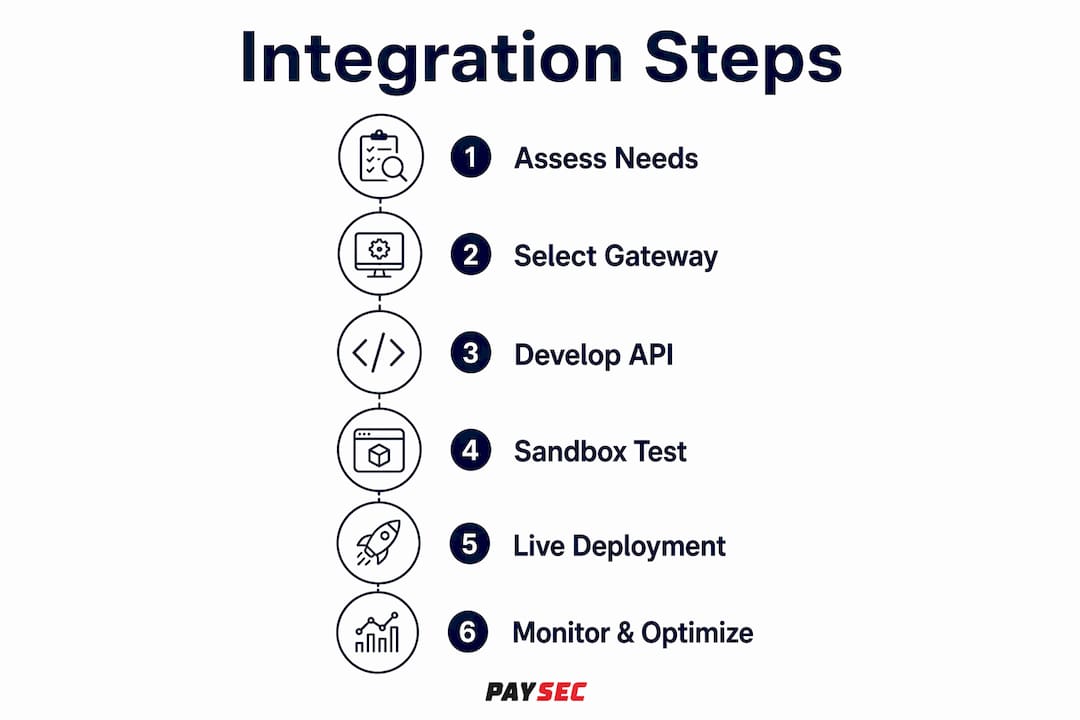
- Audit your current billing workflow. Map every point where payment data is created, transferred, or stored. Identify where manual steps introduce errors or delays.
- Select your gateway and confirm the BAA. Execute a HIPAA Business Associate Agreement with the gateway provider before any patient data touches their systems.
- Engage your EHR vendor. Most major EHR platforms publish integration guides or certified partner lists. Work within that framework to reduce custom development risk.
- Configure and test in a sandbox environment. Run end-to-end payment scenarios using test credentials before going live. Include edge cases: partial payments, refunds, and failed transactions.
- Train billing and front-desk staff. The technology only works if the people using it understand the new workflow. Plan structured training before go-live.
- Monitor post-launch. Track payment success rates, reconciliation accuracy, and patient payment completion rates for at least 60 days after launch.
Common technical challenges include mismatched data formats between the gateway and EHR, token storage conflicts when replacing an existing processor, and firewall rules that block gateway API calls. Address each during the sandbox phase, not after go-live.
Pro Tip: Treat payment integration as a core financial strategy, not a one-time IT task. Platforms that create a single source of truth for all remittance activity simplify auditing, reduce staff workload, and give finance teams the real-time visibility they need to manage revenue cycle performance.
Stakeholder alignment matters as much as technical execution. Billing managers, compliance officers, and clinical leadership all have a stake in how payment data flows. Bring them into the selection process early, and document the compliance rationale for every configuration decision.
How can healthcare organizations reduce payment processing costs?
Approximately 36% of patients have left a provider due to billing friction. That figure represents lost revenue that no amount of clinical quality can recover. Reducing that friction starts with the payment platform itself.
Unified payment platforms reduce administrative burden and support financial auditing by creating a single source of truth for all remittance activity. When billing staff spend less time reconciling mismatched records, they handle more accounts with fewer errors.
Here are the most effective strategies for cutting processing costs:
- Switch to interchange-plus or subscription pricing. Flat-rate pricing is simple but expensive at volume. Interchange-plus passes the actual card network cost to you plus a fixed markup, which is almost always lower for practices processing above a modest monthly threshold.
- Use network offset pricing. This model passes a small convenience fee to patients who pay by card while offering a discount for cash or ACH payments. Providers retain full revenue on non-card transactions.
- Automate recurring billing. Automated recurring payments for treatment plans and membership programs reduce collections effort and build predictable revenue.
- Enable text-to-pay. Secure payment links sent via text from the patient chart increase payment completion rates by meeting patients on the device they already use.
- Automate 1099 processing and electronic EOBs. Automated 1099 support and electronic Explanation of Benefits delivery reduce administrative overhead and improve provider payment clarity.
- Audit your fee structure annually. Processing fees change as card mix, volume, and gateway contracts evolve. A fee audit every 12 months catches unnecessary costs before they compound.
For healthcare organizations seeking digital visibility alongside payment efficiency, aligning payment infrastructure with broader patient acquisition strategy compounds the return on both investments.
Transparent pricing models give finance teams the data they need to forecast accurately. Hidden fees and bundled rates make it impossible to know your true cost per transaction, which makes budgeting for revenue cycle management a guessing exercise.
Paysec offers healthcare providers a better path on processing costs
Healthcare organizations that have compared their options on processing fees consistently find the same problem: standard processors charge rates built for retail, not for the specific transaction mix and compliance requirements of a medical practice.
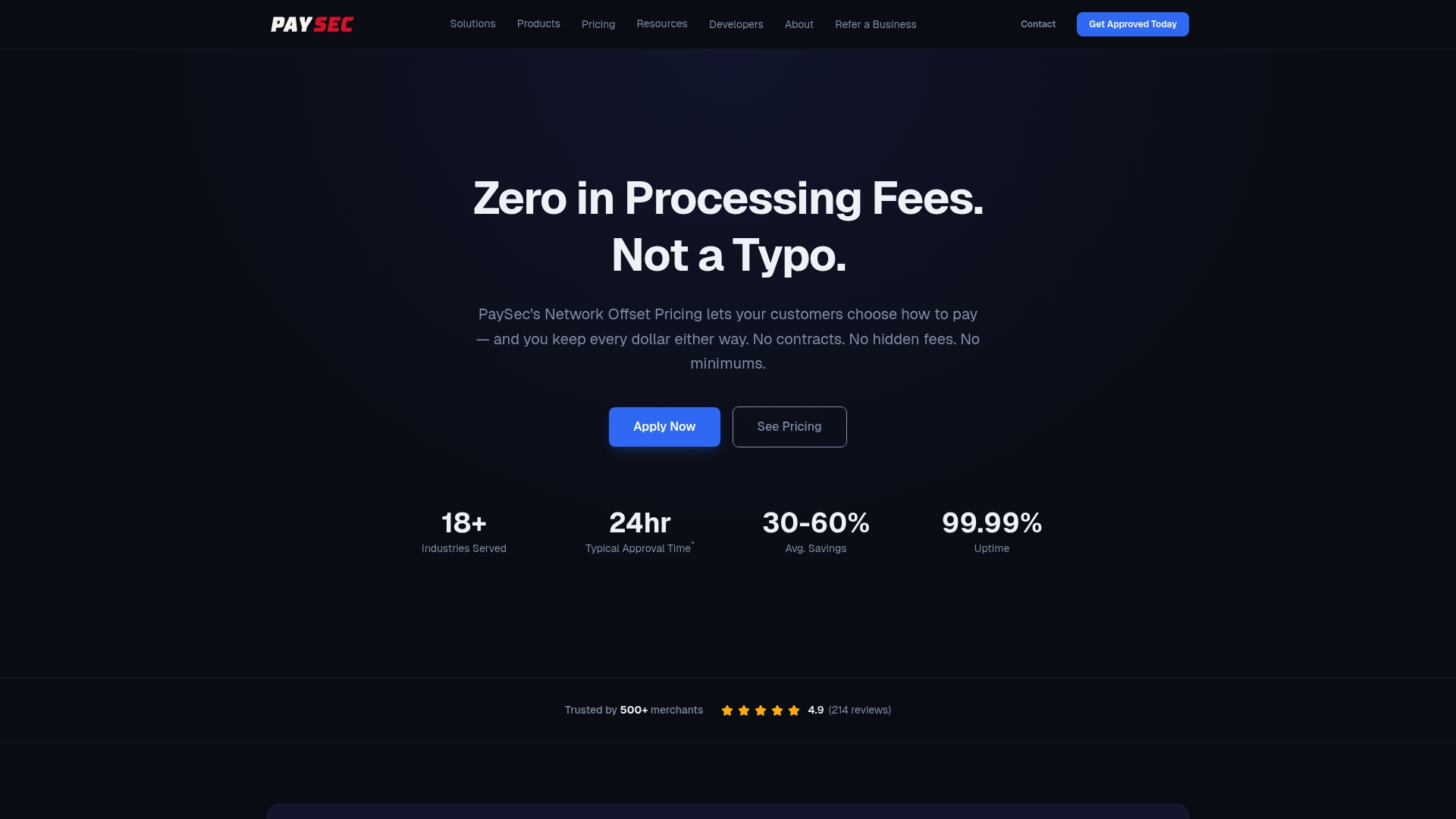
Paysec's Network Offset Pricing model aims to reduce transaction fees with no hidden charges, no monthly minimums, and no long-term contracts. Healthcare clients report notable savings in processing costs after switching. Paysec provides HIPAA-compliant merchant accounts built specifically for healthcare providers, covering the compliance requirements that general-purpose processors often leave to the practice to figure out independently.
Key benefits for healthcare payment gateway integration:
- Network Offset Pricing: Patients who pay by card absorb a small convenience fee; providers keep full revenue on ACH and cash transactions.
- No hidden fees: Every charge is itemized in real-time reporting dashboards, giving finance teams complete visibility.
- EHR/PMS integration: Paysec's developer-friendly API connects with EHR and practice management platforms including AdvancedMD, Insync, ClinicHQ, Experity Health, and Chirotouch.
- HIPAA-compliant processing: Merchant accounts are structured to meet HIPAA requirements from day one.
- Real-time analytics: Transaction reporting gives billing managers the data they need to monitor revenue cycle performance without waiting for end-of-month reconciliation.
For healthcare IT leaders who want processing costs that reflect actual interchange rates rather than retail markups, Paysec is worth a direct conversation.
FAQ
What is a healthcare payment gateway?
A healthcare payment gateway is a technology service that authorizes and processes patient payments within healthcare IT systems, including EHR and practice management platforms, while maintaining HIPAA and PCI DSS compliance.
What compliance standards apply to healthcare payment gateways?
Healthcare payment gateways must comply with HIPAA through a Business Associate Agreement and with PCI DSS standards for card data security. Both apply to any US provider handling patient payment information.
How does EHR payment integration reduce billing errors?
When payment processing connects directly to the EHR, charges flow from clinical records to payment requests without manual re-entry, removing the most common source of billing discrepancies.
What pricing model saves the most for high-volume practices?
Subscription or interchange-plus pricing typically costs less than flat-rate pricing for practices with high monthly transaction volume. Network offset pricing, used by Paysec, can reduce net processing costs by 30–60% by shifting card fees to an optional patient convenience fee.
How long does healthcare payment gateway integration take?
Integration timelines vary by EHR environment and gateway complexity, but most practices complete sandbox testing and go-live within four to eight weeks when working with a gateway that has a documented EHR integration path.
Key Takeaways
The most effective healthcare payment gateway integration combines HIPAA-compliant processing, direct EHR connectivity, and a transparent pricing model to reduce billing errors, cut processing costs, and retain patients who would otherwise leave over billing friction.
| Point | Details |
|---|---|
| Patient attrition from billing | 36% of patients have switched providers due to billing complications, making payment clarity a retention issue. |
| Compliance requirements | Every US healthcare payment gateway must operate under a HIPAA BAA and meet PCI DSS standards before processing patient data. |
| Pricing model matters | Interchange-plus and network offset pricing consistently outperform flat-rate models for practices with meaningful monthly volume. |
| Integration as financial strategy | Unified payment platforms create a single remittance record that simplifies auditing and reduces billing staff workload. |
| Paysec for cost reduction | Paysec's Network Offset Pricing delivers 30–60% savings on processing fees with HIPAA-compliant accounts and direct EHR API integration. |