

The strongest healthcare payment processors for 2026 combine HIPAA and PCI DSS dual compliance, direct EHR integration, and transparent pricing into a single workflow. Getting that combination right protects your practice from costly breaches, reduces claim denials, and keeps patients satisfied with their billing experience. The table below maps the leading processors against the criteria that matter most to practice managers.
| Provider | Best For | HIPAA/PCI Compliance | EHR/PMS Integration | Key Features | Pricing Model |
|---|---|---|---|---|---|
| Chase Payment Solutions | Large health systems, multi-location | BAA available, PCI DSS | Extensive EHR integrations | Multi-location support, direct deposit, reporting | Custom/negotiated |
| Square | Small to medium practices | BAA available, PCI DSS | Limited native EHR | Transparent pricing, easy dashboard, FSA/HSA | Flat rate |
| Stax | Medium-sized practices | BAA available, PCI DSS | Integrated billing | Subscription pricing, recurring billing, analytics | Flat monthly + interchange |
| PaymentCloud | Specialty/high-risk providers | BAA available, PCI DSS | High-risk integrations | High-risk expertise, chargeback tools | Custom/negotiated |
| Jane | Boutique practices, therapy | BAA available, PCI DSS | Native practice management | Scheduling + payments, patient portal | Subscription tiers |
| Podium | Small practices, patient engagement | BAA available, PCI DSS | Limited | Messaging-based payments, reviews, communication | Monthly subscription |
| Helcim | Small to medium, flexible needs | BAA available, PCI DSS | API-based integrations | No hidden fees, fraud protection, interchange-plus | Interchange-plus, no monthly fee |
| EBizCharge | Mid to large facilities | BAA available, PCI DSS | Extensive EHR/PMS | ERA autoposting, direct deposit, reporting | Custom |
| InstaMed | Patient billing and payment plans | BAA available, PCI DSS | Healthcare network native | Patient-friendly billing, ERA, transparent statements | Custom/enterprise |
| PaySimple | Small practices | BAA available, PCI DSS | Billing dashboard | Recurring payments, invoicing, CRM | Monthly subscription |
| Stripe | Tech-savvy, large organizations | BAA available, PCI DSS L1 | API/custom integrations | Flexible APIs, FSA/HSA support, global payments | Interchange-plus or flat rate |
| Paysec | All practice sizes, cost savings | Full HIPAA/PCI, BAA | EHR integrations, ERA | Network Offset Pricing, 30–60% fee reduction, reporting | Network Offset (no hidden fees) |
| Jane Payments | Small therapy/wellness | BAA available, PCI DSS | Jane platform native | Embedded scheduling + payments | Included in Jane subscription |
| Podium Payments | Small clinics, messaging focus | BAA available, PCI DSS | Limited | Text-to-pay, simple interface | Included in Podium plan |
| GoCardless | Subscription/membership models | PCI DSS, BAA varies | API integrations | Direct debit, recurring billing, low fees | Per-transaction |
| Payment Depot | Cost-conscious practices | BAA available, PCI DSS | Limited native | Membership pricing, interchange-plus | Flat monthly + interchange |
| Host Merchant Services | Small to medium, custom billing | BAA available, PCI DSS | Multiple gateway options | Flexible billing, strong support | Custom |
| Leaders Merchant Services | Fraud prevention focus | BAA available, PCI DSS | Multiple options | Advanced security, dispute resolution | Custom |
| Luminous Payments | Small clinics, solo practitioners | PCI DSS | Mobile payments | Simple setup, mobile support | Custom |
| Flagship Merchant Services | Medium-size providers | BAA available, PCI DSS | Multiple integrations | Full merchant services, support | Custom |
| CreditCardProcessing.com | General providers, custom needs | BAA available, PCI DSS | Varied platforms | Personalized service, multiple options | Custom |
| Dharma Merchant Services | Practices valuing fair pricing | BAA available, PCI DSS | Limited | No hidden fees, ethical pricing, interchange-plus | Interchange-plus |
HIPAA's Privacy and Security Rules require covered entities to sign Business Associate Agreements with any vendor that handles protected health information. PCI DSS v4.0.1 has been fully enforced since March 31, 2025, raising the bar for every processor on this list. Any practice that skips either framework faces regulatory penalties and breach liability.
Pro Tip: Request a signed Business Associate Agreement before processing a single transaction. Verify PCI compliance through a Qualified Security Assessor attestation, not a self-assessment questionnaire. Minimize protected health information in payment descriptors and transaction metadata from day one.
How do the top healthcare payment processors compare?
Twenty-two processors appear in this comparison because the market genuinely fragments by practice type, volume, and technical capability. Grouping them by category makes the differences clearer.
Purpose-built healthcare platforms
InstaMed stands apart from general-purpose processors because its entire network was designed for healthcare billing. It connects payers, providers, and patients in one system, supports ERA autoposting, and delivers itemized patient statements that reduce billing disputes. EBizCharge takes a similar integration-first approach, with deep connections into practice management systems and automated ERA posting that cuts manual reconciliation time. Both suit mid-to-large facilities where billing volume justifies an enterprise contract.
Jane and Jane Payments serve a different segment entirely. The platform bundles scheduling, charting, and payment collection into one subscription, which means a therapy practice or wellness clinic never has to reconcile data between separate systems. The payment module is embedded, not bolted on.
General-purpose processors with healthcare support
Stripe and Chase Payment Solutions both offer BAAs and PCI DSS Level 1 certification, but they approach healthcare differently. Stripe's strength is its API flexibility: a tech-savvy practice or health system can build exactly the billing workflow it needs, including FSA/HSA card acceptance. Chase brings a large support network and strong multi-location capabilities, making it a practical choice for health systems that already bank with Chase.
Square occupies the small-practice end of the general-purpose market. Its flat-rate pricing is easy to budget, and its dashboard requires no training to use. The tradeoff is limited native EHR integration, which means practices with complex billing workflows may need a middleware solution.
Transparent and ethical pricing models
Helcim, Dharma Merchant Services, and Payment Depot all compete on pricing honesty. Helcim charges interchange-plus with no monthly fee and no hidden costs. Dharma applies the same interchange-plus model with a stated commitment to ethical pricing. Payment Depot uses a membership structure with a flat monthly fee and wholesale interchange rates, which benefits practices with consistent monthly volume.
Paysec's Network Offset Pricing works differently from all three. Rather than passing interchange costs to the practice, it structures pricing so that processing fees are offset, delivering significant documented savings compared to standard merchant rates. For a practice currently paying thousands per month in processing fees, that reduction is material. Paysec also provides full HIPAA compliance with BAA execution, QSA-validated PCI attestation, and detailed transaction reporting built in.
Engagement and communication platforms
Podium and Podium Payments are built around patient communication first. Text-to-pay links, review management, and appointment reminders all live in the same platform. For a small clinic where front-desk staff handle billing alongside scheduling, that consolidation reduces tool switching. The payment functionality is solid, though EHR integration is limited compared to dedicated billing platforms.
Specialty and high-risk providers
PaymentCloud specializes in merchant accounts that standard processors decline, including certain specialty healthcare categories. Its chargeback management tools and high-risk compliance expertise make it the practical choice for providers in areas like addiction treatment, telehealth, or compounding pharmacies where standard processors often exit without notice.
GoCardless focuses on recurring direct debit, which suits practices running membership wellness programs or subscription-based care models. Transaction fees are lower than card-based alternatives, and the automated debit schedule reduces failed payments.
Luminous Payments, Flagship Merchant Services, CreditCardProcessing.com, Leaders Merchant Services, and Host Merchant Services round out the list as full-service merchant providers with healthcare experience. Leaders emphasizes fraud prevention and dispute resolution. Host Merchant Services offers flexible billing configurations and responsive customer support. The others provide customizable merchant accounts suited to practices that want a dedicated account manager rather than a self-serve portal.
Pro Tip: When evaluating any processor, ask specifically whether their PCI compliance attestation carries a QSA signature rather than a self-completed questionnaire. Self-assessments do not meet the standard for healthcare payment environments where PHI and cardholder data coexist.
How do you choose the right healthcare payment processor?
The decision comes down to five concrete factors. Work through each one before requesting a demo or a quote.
Dual compliance: HIPAA and PCI DSS together
A processor that is PCI compliant but has no BAA process is not suitable for healthcare. HIPAA's Security Rule requires that any system handling electronic protected health information be covered by administrative, physical, and technical safeguards, and that business associates sign agreements before accessing that data. PCI DSS v4.0.1 governs cardholder data separately. Both frameworks apply simultaneously, and a gap in either creates liability.
EHR and practice management integration
Billing data that lives outside your EHR creates reconciliation work and introduces errors. Ask each vendor for a list of certified integrations with your specific system, whether that is Epic, athenahealth, Kareo, Jane, or another platform. ERA autoposting, the automatic posting of electronic remittance advice to patient accounts, is the single feature that most reduces manual billing labor. If a processor cannot autopost ERA to your PMS, budget for the staff time to do it manually.

Patient payment method support
FSA and HSA card acceptance is no longer optional for most practices. Patients increasingly use these accounts for copays, deductibles, and out-of-pocket expenses. Verify that the processor's terminal and gateway are certified to accept FSA/HSA cards without requiring a separate device or workflow.
Pricing structure and total cost
Flat-rate pricing is predictable but often more expensive at higher volumes. Interchange-plus pricing passes the actual card network cost to the practice plus a fixed markup, which is generally more cost-effective above a certain monthly volume. Network Offset Pricing, as offered by Paysec, shifts the fee structure further by offsetting processing costs directly. Request a fee analysis using three months of your actual transaction data before signing any agreement.
Scalability and support
A processor that works for a single-location practice may not handle multi-location billing, multiple tax IDs, or high transaction volume without additional configuration or cost. Ask about volume tiers, multi-location pricing, and dedicated support contacts. Dispute resolution response time matters too: a processor that takes weeks to respond to chargebacks creates cash flow gaps.
Checklist before you sign:
- Signed BAA in place before any data transfer
- PCI DSS compliance verified by QSA attestation, not self-assessment
- ERA autoposting confirmed for your specific EHR or PMS
- FSA/HSA card acceptance tested on your terminal type
- Fee analysis run on your actual transaction history
- Multi-location and scalability terms documented in the contract
- Dispute resolution SLA confirmed in writing
- Audit log export capability verified
Pro Tip: Negotiate the BAA terms before the service agreement, not after. Once a processor has access to your systems, leverage shifts. Review the BAA for breach notification timelines, subcontractor disclosure requirements, and data return or destruction obligations at contract end.
What are the best practices for compliant, efficient payment processing?
Healthcare payment processing best practices fall into three operational areas: compliance architecture, billing workflow automation, and patient communication. Getting all three right is what separates practices with clean revenue cycles from those constantly chasing denials and disputes.
Build dual compliance into your architecture
HIPAA's Security Rule requires system logs retained for six years, role-based access control, multi-factor authentication, and encryption for any system that stores or transmits ePHI. PCI DSS v4.0.1, fully enforced since March 31, 2025, adds requirements for network segmentation, vulnerability scanning, and penetration testing. The practical implication: your payment gateway, your EHR, and any middleware connecting them all fall within scope for both frameworks.
Tokenization and data segregation are the most effective technical controls for limiting breach impact. When cardholder data is replaced with a token at the point of capture, the actual card number never touches your internal systems. Keeping PHI and cardholder data in separate data stores further limits the scope of any compliance audit or forensic investigation.
Encryption standards matter too. TLS 1.2 or higher for data in transit and AES-256 for data at rest are the current minimums. Any processor still operating on older encryption protocols should be disqualified immediately.
Automate billing workflows to reduce errors
Most payment processing failures originate at patient registration, not in the payment gateway. Incomplete insurance data, incorrect policy numbers, and missing authorization codes cause downstream denials that take weeks to resolve. Implementing digital registration forms connected directly to your EHR eliminates the manual re-entry step where most errors occur.
Submit claims within 24–48 hours of service. ERA autoposting and direct deposit reduce the time between claim approval and funds in your account, and they eliminate the manual posting errors that create reconciliation headaches. Automated denial tracking, where your system flags denied claims by reason code and routes them for appeal, prevents revenue from slipping through without follow-up.
Audit logs must be tamper-evident and cover all access to PHI and cardholder data. Exportable logs that can be produced within 24 hours support forensic readiness and satisfy both HIPAA and PCI audit requirements without scrambling your IT team.
Communicate clearly with patients before and after the visit
Research published in PMC found that while nine in ten patients want to know their financial responsibility upfront, only two in ten actually know what they will owe after an appointment. That gap drives disputes, delayed payments, and patient dissatisfaction. Pre-visit eligibility checks, combined with a clear cost estimate delivered before the appointment, close that gap before it becomes a billing problem.

Itemized billing statements written in plain language reduce inbound calls to your billing team and reduce the likelihood of patients disputing charges they simply did not understand. Offering multiple payment channels, including online portal, text-to-pay, and in-office terminal, increases the rate at which patients pay their balance on time.
Key compliance and efficiency practices:
- Retain system logs for six years per HIPAA requirements
- Implement TLS 1.2+ for data in transit, AES-256 for data at rest
- Use tokenization to prevent cardholder data from entering internal systems
- Segregate PHI and cardholder data into separate data stores
- Verify insurance eligibility before every appointment
- Submit claims within 24–48 hours of service
- Enable ERA autoposting in your PMS
- Deliver itemized, plain-language billing statements
- Offer payment plans and multiple payment channels
- Maintain tamper-evident, exportable audit logs
Paysec cuts processing costs without cutting compliance
Healthcare practices already operating on tight margins pay thousands per month in processing fees that most processors treat as fixed costs. Paysec's Network Offset Pricing changes that equation. By structuring fees so that processing costs are offset rather than absorbed by the practice, Paysec delivers significant documented savings compared to standard merchant rates, with no hidden fees, no minimums, and no long-term contracts.
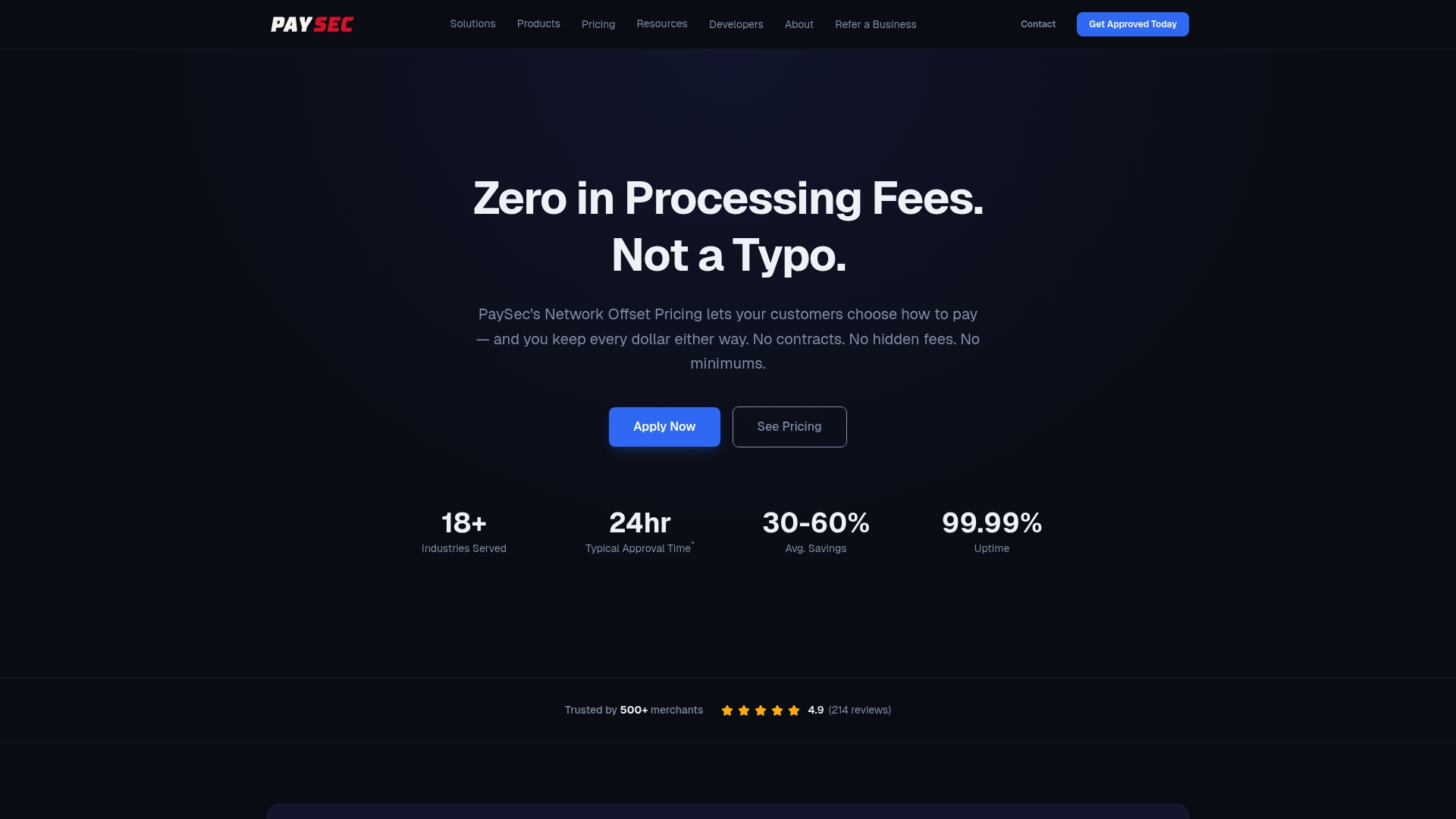
Compliance is built in, not added on. Paysec provides a signed Business Associate Agreement, QSA-validated PCI DSS attestation, and full HIPAA Security Rule coverage as standard. EHR integrations, automated ERA posting, direct deposit, and real-time reporting are included, so your billing team gets the tools it needs without managing multiple vendor relationships.
Paysec serves healthcare practices across all size categories, from solo practitioners to multi-location groups, across 18+ industries. The healthcare-specific processing page details how the pricing model applies to your practice type, and the team is ready to run a fee analysis on your actual transaction history so you can see the savings before you commit.
Why practices choose Paysec:
- Significant reduction in processing fees through Network Offset Pricing
- Full HIPAA compliance with BAA execution included
- QSA-validated PCI DSS attestation, not a self-assessment
- ERA autoposting and direct deposit support
- Detailed transaction reporting and real-time analytics
- No hidden fees, no minimums, no long-term contracts
- Dedicated support and chargeback management
FAQ
What compliance certifications should a healthcare payment processor have?
A healthcare payment processor must provide a signed Business Associate Agreement under HIPAA and a QSA-validated PCI DSS attestation. Self-assessment questionnaires do not meet the compliance standard for environments where PHI and cardholder data coexist.
What is ERA autoposting and why does it matter?
ERA autoposting automatically posts electronic remittance advice directly to patient accounts in your practice management system, eliminating manual entry and reducing reconciliation errors. Practices that enable ERA autoposting report faster payment cycles and fewer posting mistakes.
How does Network Offset Pricing differ from standard processing fees?
Standard processors pass interchange and markup costs directly to the practice. Paysec's Network Offset Pricing structures fees so that processing costs are offset, delivering significant savings with full pricing transparency and no hidden charges.
What causes most healthcare payment processing failures?
Most failures originate at patient registration, where incomplete insurance data or missing authorization codes trigger downstream claim denials. Fixing data capture at registration reduces denials more effectively than any downstream billing fix.
How should practices handle FSA and HSA card payments?
Practices should confirm that their payment terminal and gateway are certified to accept FSA and HSA cards before deployment. Most major processors on this list support FSA/HSA acceptance, but certification varies by terminal model, so verify with your specific hardware before assuming compatibility.
Key takeaways
Compliant, efficient healthcare payment processing requires dual HIPAA and PCI DSS coverage, ERA autoposting, clean data capture at registration, and transparent pricing that does not erode practice margins.
| Point | Details |
|---|---|
| Dual compliance is mandatory | Every processor must provide a signed BAA and a QSA-validated PCI DSS attestation, not a self-assessment. |
| Registration accuracy drives revenue | Most claim denials originate at patient registration; fixing data capture there reduces denials faster than any downstream fix. |
| ERA autoposting reduces errors | Automating remittance posting to your PMS cuts manual reconciliation time and accelerates payment cycles. |
| Transparent billing improves collections | Nine in ten patients want upfront cost estimates; itemized statements in plain language reduce disputes and speed payment. |
| Paysec reduces fees | Paysec's Network Offset Pricing delivers documented cost savings with full HIPAA/PCI compliance and no hidden fees. |