

TL;DR:
- The merchant discount rate is a bundled fee deducted from each card transaction before funds reach the merchant, with only the processor markup being negotiable. Merchants can reduce costs by understanding the fee components, choosing transparent pricing models, and negotiating processor markup based on their transaction data. Surcharging and cash discounts are legal in most states if proper rules are followed, but the processor markup remains the only part merchants can directly negotiate.
The merchant discount rate (MDR) is the total percentage fee deducted from every card transaction before the funds reach your bank account. In the U.S., that fee typically runs 1.5%–3.5% depending on your card mix, pricing model, and processor. The one piece you can actually control is the processor/acquirer markup — and that is exactly where negotiation should start.
Table of Contents
- What the merchant discount rate covers and why it exists
- The parts that make up your MDR
- How pricing models shape what you actually pay
- How to calculate your effective MDR
- Business and card-level factors that push your MDR up or down
- Are surcharges and cash discounts legal in the U.S.?
- How to lower your effective MDR — a practical playbook
- Key Takeaways
- Why pricing transparency is the real issue
- Cut your processing costs with Paysec
- Useful sources
- FAQ
What the merchant discount rate covers and why it exists
MDR is not a single fee charged by one company. It is a bundled total collected by your payment processor and then distributed across three separate parties: the card-issuing bank, the card network, and the processor itself. Every time a customer swipes, taps, or enters a card number, those three parties each take a cut before your settlement arrives.
Here is how the payment value chain works in plain terms. A customer pays with a Visa card. The transaction travels from your terminal or checkout page to your payment processor, which routes it through the Visa network to the customer's issuing bank for approval. The issuing bank authorizes the charge, the network confirms it, and the processor settles the funds into your merchant account — minus the MDR.
Practically speaking, this means:
- Your settlement is always less than the sale amount. A $100 sale at a 2.5% MDR nets you $97.50.
- The fee appears as a deduction on your processor statement, not as a separate invoice.
- You cannot opt out of the fee for card transactions, but you can influence part of it.
- Pricing decisions matter. Merchants who understand MDR can factor it into margins, surcharging strategies, or cash-discount programs.
The parts that make up your MDR
MDR bundles three distinct cost layers: interchange, network assessments, and the processor/acquirer markup. Knowing how they split helps you identify where savings are possible.
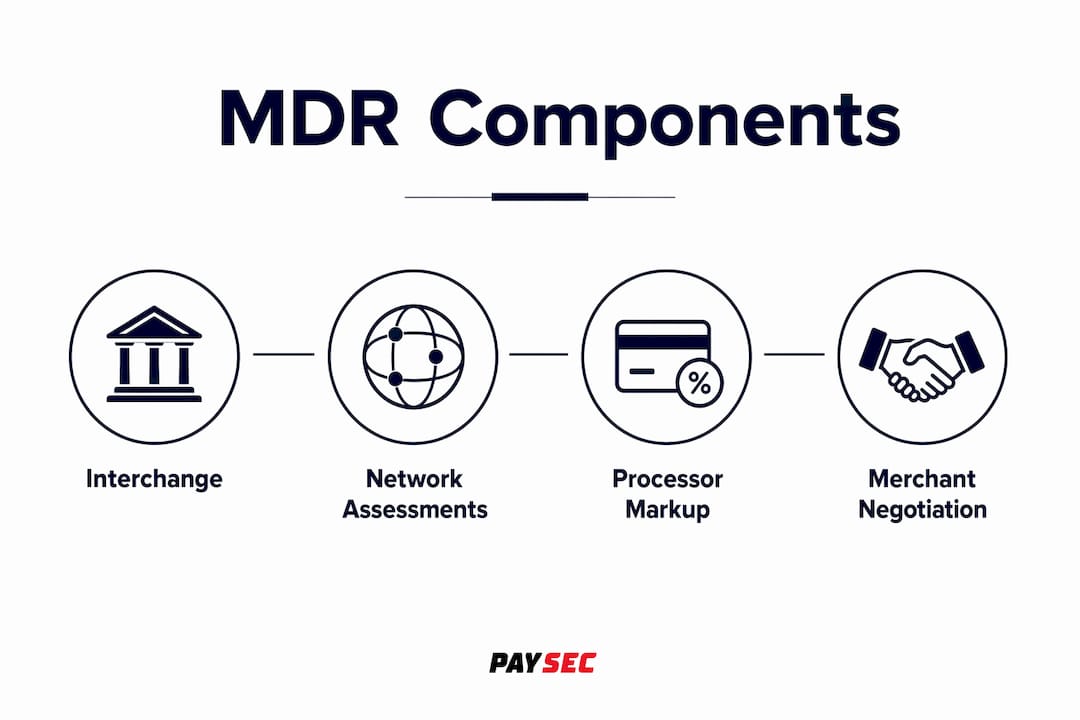
Interchange is the largest slice. It flows directly to the card-issuing bank as compensation for extending credit and absorbing fraud risk. Interchange rates vary by card product and transaction channel — a basic Visa debit card costs less than a premium travel rewards card, and a card-present swipe costs less than a manually keyed entry. You cannot negotiate interchange directly; it is set by the card networks and published in their rate tables.

Network assessments are fees paid to Visa, Mastercard, Discover, or American Express for using their rails. These are small — typically a fraction of a percent — and also non-negotiable.
Processor/acquirer markup covers authorization, settlement, gateway access, and any service tools the processor bundles in. This is the only layer you can negotiate.
| Fee Component | Who Receives It | Negotiable? | Typical Share of MDR |
|---|---|---|---|
| Interchange | Card-issuing bank | No | ~75% |
| Network assessments | Card network (Visa, Mastercard, etc.) | No | ~5–10% |
| Processor/acquirer markup | Payment processor | Yes | ~20% |
Worked examples at a 2.5% blended MDR:
- $10 sale: $0.25 total fee. Roughly $0.19 goes to interchange, $0.02 to assessments, $0.04 to the processor.
- $100 sale: $2.50 total fee. Roughly $1.90 to interchange, $0.20 to assessments, $0.40 to the processor.
The processor's $0.40 on a $100 sale is the portion a well-prepared merchant can reduce through negotiation or by switching to a more transparent pricing model.
How pricing models shape what you actually pay
Your pricing model determines how the MDR is presented and billed — and it has a direct effect on your effective rate.

| Pricing Model | Best For | Transparency | Key Trade-off |
|---|---|---|---|
| Interchange-plus | Mid-to-high volume merchants | High — interchange and markup shown separately | Requires statement literacy; rates vary by card type |
| Tiered | Low-volume or new merchants | Low — transactions bucketed into "qualified/mid/non-qualified" | Non-qualified buckets can be expensive and opaque |
| Flat-rate | Very low volume, simple operations | Medium — one rate for all cards | Predictable but often costs more at higher volumes |
| Subscription/membership | High-volume merchants | High — flat monthly fee plus interchange at cost | Monthly fee adds fixed overhead; saves most at scale |
Interchange-plus is the most transparent model. Your statement shows the actual interchange rate for each transaction type, plus a fixed markup (e.g., interchange + 0.30% + $0.10 per transaction). You see exactly what each party earns.
Tiered pricing groups transactions into buckets. Most swiped consumer debit cards land in the "qualified" tier at the lowest rate. Rewards cards, keyed entries, and business cards often get pushed to "non-qualified," which can run 0.5%–1.0% higher. Merchants rarely know which transactions will be downgraded until they read the statement.
Flat-rate pricing (common with entry-level processors) charges one rate regardless of card type — say 2.9% + $0.30 per transaction. Predictable, but a merchant running mostly low-cost debit transactions pays the same rate as one running premium rewards cards.
Subscription models charge a monthly fee (often $50–$200) and then pass interchange at cost with a small per-transaction fee. At high volumes, the math usually favors this model over flat-rate.
How to calculate your effective MDR
Effective MDR = Total processing fees ÷ Total card sales volume
This blended figure tells you what you actually pay across all card types, regardless of what your contract says. It is the number to use when comparing offers.
Step-by-step calculation:
- Pull your processor statement for the most recent full month.
- Find the line labeled "Total Fees," "Processing Fees," or "Service Charges" — add all fee lines together.
- Find "Total Card Volume" or "Gross Sales."
- Divide total fees by total card volume and multiply by 100.
Example A — Small restaurant:
- Monthly card volume: $30,000
- Total fees on statement: $720
- Effective MDR: $720 ÷ $30,000 = 2.40%
Example B — Mid-size eCommerce store:
- Monthly card volume: $150,000
- Total fees on statement: $3,150
- Effective MDR: $3,150 ÷ $150,000 = 2.10%
What to look for on your statement:
- Interchange fees or interchange pass-through — the base cost by card type
- Assessment fees or network fees — Visa/Mastercard charges
- Processor markup, discount rate, or service fee — the negotiable layer
- Monthly fee, gateway fee, PCI fee, batch fee — fixed charges that inflate your effective rate
If your statement shows only one blended line item with no breakdown, that is a transparency problem worth addressing with your processor.
Business and card-level factors that push your MDR up or down
Several variables determine where your effective rate lands within the 1.5%–3.5% industry range. Some you control; some you do not.
Factors that raise your MDR:
- Premium rewards and travel cards carry higher interchange than basic consumer cards. If your customer base skews toward high-reward cardholders, your blended rate will reflect that.
- Card-not-present transactions (eCommerce, phone orders, manually keyed entries) cost more than card-present swipes or taps because fraud risk is higher.
- High chargeback rates can trigger risk-based surcharges from your processor and may push you into a higher-risk pricing tier.
- International cards often carry additional cross-border fees on top of standard interchange.
- Low average ticket size means fixed per-transaction fees (like $0.10–$0.30) represent a larger percentage of the sale.
Factors that lower your MDR:
- High monthly card volume gives you negotiating leverage for better processor markup.
- Card-present, chip-read transactions qualify for lower interchange categories.
- Low chargeback rate signals a stable, low-risk merchant profile.
- Consistent, predictable ticket size makes you easier for a processor to price accurately.
Pro Tip: The single most effective lever for small-to-midsize merchants is presenting 12 months of clean volume data with a low chargeback rate. High-volume, low-risk merchants can often secure custom enterprise pricing or better interchange pass-through tiers — this is the biggest negotiation leverage point most merchants never use.
Are surcharges and cash discounts legal in the U.S.?
Cash discounts are legal in all 50 states. Surcharging — adding a fee to card transactions — is permitted in most states but requires specific compliance steps before you implement it.
Before adding a surcharge, run through this checklist:
- Confirm your state allows it. A small number of states have restrictions; verify with your state's consumer protection office or a qualified attorney.
- Check your processor's capability. Not all processors support compliant surcharging; confirm before you flip a switch.
- Notify your card networks. Visa and Mastercard require advance written notice before you begin surcharging.
- Post clear signage at the point of entry and point of sale. Customers must see the surcharge before they pay.
- Disclose the surcharge on the receipt as a separate line item.
- Cap the surcharge at your actual processing cost (card network rules cap it at 3% for Visa transactions).
- Apply it only to credit cards, not debit cards — surcharging debit is prohibited under network rules.
Surcharging is a compliance and customer-experience decision, not just a pricing tweak. Refund and chargeback handling gets more complex when a surcharge is involved, and some customers react negatively to seeing the fee. A cash-discount program — where you post a higher "regular" price and offer a discount for cash — achieves a similar economic result with simpler compliance requirements and often better customer reception.
This article provides general information, not legal or compliance advice. Verify current card-network rules and your state's requirements with a qualified professional before implementing surcharging.
How to lower your effective MDR — a practical playbook
The processor/acquirer markup is the only negotiable component of MDR. Reducing it by even 0.50% has a measurable impact. A merchant processing $50,000 per month saves $250 every month — $3,000 per year — from a half-point reduction alone.
Build your negotiation packet first:
- 12 months of processing statements (total volume, average ticket, monthly chargeback rate)
- Your current effective MDR (calculated using the formula above)
- A list of every fee line on your current statement
- Any competing offers you have received
Questions to ask your processor:
- "What is your exact markup above interchange, and can you show it as a separate line item?"
- "Do you offer interchange-plus pricing, and what is the markup rate?"
- "Which of my fees are fixed and which are negotiable?"
- "Is there a volume tier where my markup decreases?"
- "Are there month-to-month terms, or am I locked into a contract?"
Operational changes that reduce your effective MDR without renegotiating:
- Train staff to always dip or tap cards rather than manually key them — keyed entries cost significantly more.
- Reduce chargebacks through clear billing descriptors, prompt refund policies, and fraud screening tools.
- Use transaction-level reporting to identify which card types and transaction channels drive your highest costs, then adjust checkout flow accordingly.
- For B2B merchants, submit enhanced Level 2/Level 3 data on corporate card transactions to qualify for lower interchange categories.
Red flags when evaluating a new processor offer:
- A "low rate" quoted without specifying whether it is interchange-plus or tiered
- Monthly fees buried in the fine print (PCI fees, statement fees, batch fees)
- Bundled hardware leases that lock you into a multi-year agreement
- Vague statement labels that make it impossible to identify the processor markup
Eliminating hidden merchant fees is often as valuable as negotiating a lower headline rate. A 2.0% rate with $150 in monthly fixed fees can cost more than a 2.3% rate with no fixed fees, depending on your volume.
Key Takeaways
The merchant discount rate bundles interchange, network assessments, and processor markup into one deducted fee — and the processor markup is the only part merchants can negotiate.
| Point | Details |
|---|---|
| MDR definition | The total percentage fee deducted from every card transaction before settlement, generally within a typical industry range in the U.S. |
| Negotiable component | Only the processor/acquirer markup is negotiable; interchange and assessments are set by issuers and networks. |
| Calculate your rate | Divide total monthly processing fees by total card volume to find your effective MDR and use it as a negotiation baseline. |
| Biggest cost drivers | Premium rewards cards, card-not-present transactions, and high chargebacks push your effective rate up the most. |
| Paysec approach | Paysec's Network Offset Pricing and interchange-plus options give merchants transparent cost visibility and documented savings of 30–60%, with one documented case showing a 42% reduction. |
Why pricing transparency is the real issue
Most merchants overpay not because interchange is high, but because their processor statement is designed to obscure the markup. Tiered pricing, bundled fees, and opaque statement labels make it nearly impossible to know what you are actually paying for the service layer — the one part you can control.
At Paysec, we believe merchants deserve to see exactly where every dollar goes. Our approach to pricing puts the interchange cost and the processor markup on separate lines, so you always know what you are paying and why. Merchants who switch to transparent pricing structures consistently find savings they did not know were available — not because the interchange changed, but because the markup finally became visible.
If you want to see what your current effective MDR looks like compared to what it could be, explore Paysec's reporting tools and run the numbers yourself.
Cut your processing costs with Paysec
Merchants who understand their MDR are already ahead. Paysec takes that knowledge further by putting it to work through Network Offset Pricing — a structure that lets you retain full revenue while offering customers flexible payment options, with no hidden fees and no long-term contracts.
Paysec clients across restaurants, eCommerce, SaaS, healthcare, and CBD retail have reduced processing costs by 30–60%, with one documented case showing a 42% reduction. Features that make that possible include interchange-plus pass-through pricing, real-time transaction reporting, PCI DSS Level 1 and SOC 2 compliance, and commercial enhanced data optimization for B2B card savings. There are no monthly minimums and no lock-in — just transparent pricing and detailed analytics so you can track your effective MDR in real time.
Ready to see your actual savings potential? Request a pricing review and get a clear picture of what your processing costs should look like.
Useful sources
The following resources provide authoritative detail on merchant discount rates, interchange, and U.S. card-payment regulations:
- Federal Reserve — Regulation II: Average Interchange Fee — Official debit interchange data and regulatory context.
- Investopedia — Understanding Merchant Discount Rates — Clear definitions and surcharging rules.
- Capital One — Credit Card Processing Fees Explained — Benchmark ranges and fee structure overview.
- Corporate Finance Institute — Merchant Discount Rate (MDR) — Component definitions and value-chain explanation.
- Slash — What Is a Merchant Discount Rate and How Does It Work? — Effective MDR formula and negotiation insights.
- Stripe — What Is a Merchant Discount Rate? — Practical overview for merchants evaluating pricing models.
- Paysec — Interchange Fees Explained — Deep dive on interchange categories and cost-reduction strategies.
- Paysec — Payment Processing Markup Explained — Negotiation tactics and markup transparency guidance.
Next step: Pull your most recent processor statement, add up all fee lines, divide by your total card volume, and calculate your effective MDR. That single number tells you more about your processing costs than any rate quote from a sales rep.
FAQ
What is the merchant discount rate?
The merchant discount rate is the total percentage fee a merchant pays on each card transaction, covering interchange (paid to the issuing bank), network assessments (paid to Visa or Mastercard), and the processor's markup. It is deducted from the transaction amount before funds settle into the merchant's account.
What is a good merchant discount rate for U.S. merchants?
A competitive effective MDR for most U.S. merchants falls between 1.5% and 2.5%, depending on card mix, transaction method, and pricing model. Merchants on interchange-plus pricing with strong volume and low chargebacks tend to land at the lower end of that range.
How is the merchant discount rate calculated?
Divide your total monthly processing fees by your total monthly card sales volume — that gives you your effective MDR as a percentage. For example, $720 in fees on $30,000 in card sales equals a 2.40% effective MDR.
Is it legal to charge customers a fee for using a credit card in the U.S.?
Surcharging credit card transactions is legal in most U.S. states, provided merchants comply with card-network rules: advance notice to the network, clear signage, receipt disclosure, and a surcharge capped at the actual processing cost (no more than 3% for Visa). Surcharging debit cards is prohibited. Cash discounts are legal in all 50 states with no network restrictions.
What part of the MDR can merchants actually negotiate?
The processor/acquirer markup is the only negotiable component. Interchange and network assessments are set by card issuers and networks and cannot be changed through negotiation. Presenting 12 months of volume data with a low chargeback rate gives merchants the strongest basis to request a lower markup or a switch to interchange-plus pricing.