

TL;DR:
- Payment processing markup is the only negotiable fee added on top of fixed interchange and assessment fees. Understanding and auditing this markup allows merchants to reduce their transaction costs effectively.
Payment processing markup is the fee your payment provider charges on top of fixed interchange and assessment fees to cover their services, risk management, and profit margin. Most business owners see one total processing rate on their statement and assume it is a single, fixed cost. It is not. The markup portion is the only part of that total fee that is actually negotiable, and understanding it is the first step toward cutting your transaction processing costs in a meaningful way. Paysec works with merchants across 18+ industries specifically because this distinction matters to the bottom line.
What is payment processing markup and why does it matter?
Payment processing markup is defined as the incremental fee a payment processor adds on top of the wholesale costs set by card networks. The industry standard term for this concept is "processor markup," and it sits on top of two other fixed components: interchange fees and assessment fees. Processor markup is negotiable, percentage-based, flat per transaction, or structured as a monthly subscription, depending on the provider.

The reason this matters to you as a business owner is direct: interchange and assessment fees are set by Visa, Mastercard, and other card networks. You cannot negotiate them. The processor markup is the only lever you can pull. Merchants who do not separate markup from fixed fees routinely overpay without realizing it.
Total credit card processing fees typically range between 1.5% and 3.5% per transaction. On a $100 sale, that means a merchant retains roughly $97.76 after all fees. The markup portion of that total is where your negotiating power lives.
What are the components of payment processing fees?
Three distinct layers make up every payment processing fee. Each layer has a different source, a different rate, and a different level of flexibility.
Interchange fees are the largest component. Card networks like Visa and Mastercard set these rates, and they flow directly to the card-issuing bank. Interchange typically ranges from 1.0% to 3.0% depending on the card type, transaction method, and industry. A rewards credit card processed online carries a higher interchange rate than a basic debit card swiped in person.
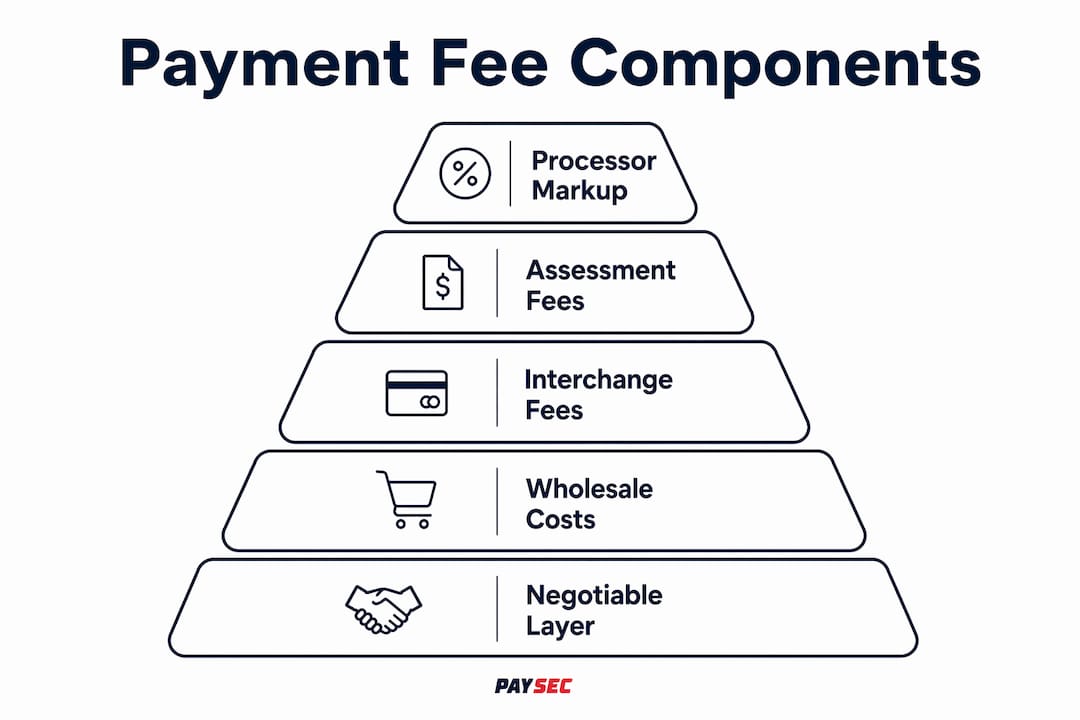
Assessment fees are charged by the card networks themselves, not the issuing bank. These are smaller, generally ranging from 0.13% to 0.25%, and they are also non-negotiable. Think of them as the network's toll for using its infrastructure.
Processor markup is the third layer and the only negotiable one. It covers the payment provider's cost of authorization, settlement, fraud screening, customer support, and their profit margin. Markup may appear as a percentage, a flat per-transaction fee, a monthly service fee, or a combination of all three.
| Fee Component | Typical Range | Set By | Negotiable? |
|---|---|---|---|
| Interchange fee | 1.0%–3.0% | Card networks (Visa, Mastercard) | No |
| Assessment fee | 0.13%–0.25% | Card networks | No |
| Processor markup | 0.10%–1.0%+ | Your payment processor | Yes |
| Total blended rate | 1.5%–3.5% | Combined | Partially |
The table above shows why focusing only on the total rate is misleading. Two processors quoting the same total rate can have very different markup structures. One might charge a lower markup but add monthly fees. The other might bundle everything into a higher flat rate. Breaking the fee into its components is the only way to make a fair comparison.
How do payment processors calculate and apply markup?
Processors apply markup through three main pricing models. Each model structures the markup differently, and the level of transparency varies significantly between them.
Interchange-plus pricing
Interchange-plus pricing, also called pass-through pricing, is the most transparent model. The processor passes the wholesale interchange rate directly to the merchant and adds a fixed markup on top. A typical structure looks like interchange plus 0.20% and $0.10 per transaction. You see exactly what the network charges and exactly what the processor charges. This model makes it straightforward to audit your statement and negotiate the markup portion.
Flat-rate pricing
Flat-rate pricing blends interchange, assessments, and markup into a single percentage. The rate is simple to understand, but the markup is invisible inside the blended number. Flat-rate pricing works well for very low-volume businesses where simplicity outweighs cost. For any business processing meaningful volume, the blended rate almost always costs more than interchange-plus because the processor builds a wider margin into the flat fee.
Tiered pricing
Tiered pricing is the least transparent model. Processors sort transactions into buckets labeled "qualified," "mid-qualified," and "non-qualified," each with a different rate. Tiered pricing structures are specifically designed to obscure markup, making it nearly impossible to audit what you are actually paying. Most rewards cards and business cards land in the non-qualified tier, which carries the highest rate. Merchants on tiered pricing frequently overpay without any clear way to identify why.
- Interchange-plus: Markup is explicit and auditable. Best for businesses that want cost control.
- Flat-rate: Markup is blended. Best for very low-volume or new businesses.
- Tiered: Markup is hidden in rate buckets. Rarely the best option for established businesses.
Pro Tip: Request an interchange-plus quote from any processor you evaluate. If a provider refuses to offer it or cannot explain their markup separately from interchange, treat that as a signal that their pricing is not built for your benefit.
What factors influence payment processing markup rates?
Markup fees are influenced by business risk, transaction volume, and industry. Processors price their markup based on how much risk and operational cost your account represents to them.
Business risk and transaction volume
High-risk industries, including CBD retail, online gaming, and certain healthcare categories, pay higher markup rates because processors face greater chargeback exposure. Low-volume businesses also pay more because the processor spreads fixed operational costs across fewer transactions. As your monthly volume grows, your negotiating position improves. High-volume merchants should negotiate markup directly, as volume discounts are a standard part of processor pricing.
Industry-specific markup patterns
- Retail (card-present): Lower markup due to lower fraud risk. Typical effective rates sit at the lower end of the 1.5%–3.5% range.
- Restaurants: Moderate markup. Tips and tab adjustments add complexity that some processors price into their margin.
- eCommerce: Higher markup than card-present because card-not-present transactions carry higher fraud risk.
- Healthcare and SaaS: Rates vary widely. Recurring billing and high average ticket sizes can work in your favor during negotiations.
- CBD retail: High-risk classification typically results in the highest markup rates across the board.
The effective rate as your real benchmark
The effective rate is the most honest measure of what you actually pay. Calculate it by dividing total fees paid by total transaction volume processed. A common benchmark for small businesses is keeping the effective rate under 2.7%. Rates significantly above that level signal that your pricing model or markup is worth re-evaluating. Tracking this number monthly gives you a clear, objective view of whether your costs are moving in the right direction.
How can businesses audit and reduce their payment processing markup?
Auditing your processing costs is a concrete, repeatable process. Most business owners skip it because monthly statements are designed to be confusing. Breaking it down into steps removes that barrier.
- Pull three months of statements. One month can be an outlier. Three months gives you a reliable average of your effective rate and fee composition.
- Separate fixed fees from variable fees. Fixed fees include monthly minimums, PCI compliance fees, and gateway fees. Variable fees include per-transaction charges and percentage-based fees. List each category separately.
- Calculate your effective rate. Divide total fees paid by total volume processed for each month. Average the three results. This is your baseline.
- Identify hidden fees. Focusing exclusively on headline rates ignores charges like PCI non-compliance fees, batch fees, and monthly minimums that can add hundreds of dollars per month. These are often larger than the markup itself.
- Request an itemized fee breakdown from your processor. Ask them to separate interchange, assessments, and their markup in writing. Any processor worth working with will provide this without hesitation.
- Benchmark your markup against interchange-plus rates. If you are on flat-rate or tiered pricing, request an interchange-plus quote and compare the projected cost against your current effective rate.
- Negotiate directly. Processor markup is the only negotiable portion of your total fees. Come to the conversation with your effective rate, your monthly volume, and a competing quote. Processors respond to data.
Pro Tip: Small operational changes, such as ensuring accurate transaction data entry and capturing card verification values consistently, can qualify your transactions for lower interchange categories. This reduces your total fee more than switching processors in many cases.
You can also explore the 7 hidden fees that commonly appear on processing statements. Addressing those alongside markup negotiation produces the largest combined savings.
For a broader view of how all payment processing fees fit together, reviewing the full fee structure helps you prioritize where to focus first.
Understanding how pricing models compare across flat-rate, interchange-plus, and Network Offset Pricing gives you the framework to evaluate any processor's quote objectively.
Key Takeaways
Processor markup is the only negotiable component of payment processing fees, and auditing it with your effective rate as the benchmark is the most direct path to reducing transaction costs.
| Point | Details |
|---|---|
| Markup is negotiable | Interchange and assessment fees are fixed; processor markup is the only cost you can negotiate. |
| Three pricing models exist | Interchange-plus is the most transparent; tiered pricing is the least, often hiding markup in rate buckets. |
| Effective rate is your benchmark | Divide total fees by total volume monthly; rates above 2.7% warrant a pricing review. |
| Hidden fees compound costs | PCI compliance, batch fees, and monthly minimums often exceed the markup itself and must be audited separately. |
| Volume improves your position | Higher monthly transaction volume gives you direct leverage to negotiate lower markup rates. |
The markup conversation most processors hope you never have
The Paysec Marketing Team has worked with merchants across retail, restaurants, eCommerce, healthcare, and CBD sectors. The pattern we see most often is not that businesses are paying outrageous rates. It is that they are paying slightly elevated rates across multiple fee categories simultaneously, and no single line item looks alarming enough to act on.
Tiered pricing is the primary culprit. A processor quotes a "qualified" rate that sounds competitive, and the merchant signs. Six months later, the majority of their transactions are landing in the non-qualified bucket because they accept rewards cards or process online. The effective rate is 3.4%, but the statement is so fragmented that identifying the source of the excess cost takes real effort.
The merchants who control their costs best treat markup review the same way they treat inventory audits: on a schedule, with a clear metric, and with a willingness to act on what they find. Interchange-plus pricing makes that review straightforward. When markup is a visible line item, you can track it, benchmark it, and negotiate it with confidence.
The other mistake we see is chasing the lowest headline rate while ignoring PCI compliance fees, monthly minimums, and gateway charges. A processor offering 2.4% flat rate with a $30 monthly minimum, a $10 PCI fee, and a $0.10 per-transaction gateway fee often costs more than a processor offering 2.6% with no additional fees. Run the math on your actual volume before you sign anything.
Markup transparency is not just a pricing preference. It is the foundation of a healthy relationship between a merchant and their processor. When you can see exactly what you are paying and why, you can make decisions based on facts rather than assumptions.
— Paysec Marketing Team
How Paysec's Network Offset Pricing reduces your markup burden
Paysec built its Network Offset Pricing model specifically to address the markup problem. Instead of blending fees into an opaque rate, Paysec passes wholesale interchange rates directly to merchants with minimal markup on top. There are no long-term contracts, no monthly minimums, and no hidden fees to hunt down on your statement.
Merchants in retail, SaaS, restaurants, healthcare, and eCommerce have reported processing cost reductions of 30–60% after switching to Paysec. One documented result is a 42% reduction in processing costs. Paysec also provides detailed transaction reporting so you can track your effective rate in real time and verify your savings month over month. Review the full pricing structure to see how wholesale interchange rates apply to your business.
FAQ
What is processor markup in payment processing?
Processor markup is the fee a payment provider adds on top of fixed interchange and assessment fees to cover their services and margin. It is the only negotiable component of total payment processing fees.
What is a good effective processing rate for small businesses?
A common benchmark is keeping your effective rate under 2.7%. Rates above this level suggest your pricing model or markup warrants re-evaluation.
How do I find the markup on my processing statement?
Calculate your effective rate by dividing total fees paid by total volume processed. Then request an itemized breakdown from your processor that separates interchange, assessments, and their markup as distinct line items.
Which pricing model gives the most visibility into markup?
Interchange-plus pricing is the most transparent model. It separates the wholesale interchange cost from the processor's markup, making it straightforward to audit and negotiate your fees.
Can businesses negotiate payment processing markup?
Yes. Processor markup is the only negotiable portion of payment processing fees. High-volume merchants have the strongest negotiating position, but any business with consistent monthly volume can request a markup reduction or a competing interchange-plus quote.