

The settlement period is the time between a captured card or ACH transaction and when the net funds land in your merchant bank account. For most U.S. merchants, that window runs T+1 to T+3 business days for card payments and T+1 to T+3 for standard ACH, with instant options settling in minutes to the same day. The single most important operational driver is your processor's daily batch cutoff time. Miss it, and your entire settlement cycle shifts by one full business day. Paysec is one provider that gives merchants transparent control over both funding cadence and reporting.
Key facts to know before reading further:
- Card networks (Visa/Mastercard credit): typically T+1 to T+2 clearing, T+2 to T+3 funding
- Debit cards: often clear and fund within one to two business days
- Standard ACH: typically settles within a few business days depending on processing windows
- Same-day ACH: can settle on the same business day if submitted before the cutoff
- Instant/real-time rails: typically settle in a matter of minutes to the same day, often with premium fees
- Batch cutoffs commonly occur in late afternoon to late evening depending on the processor
Table of Contents
- How does settlement differ by payment type?
- What factors speed up or slow down your funding?
- What are the typical settlement timelines for U.S. merchants?
- Is faster funding worth the extra cost?
- How do you monitor and reconcile settlement in your reports?
- What questions should you ask a payment processor about settlement?
- A real-world Friday settlement scenario
- Key Takeaways
- The case for optimizing cutoffs before buying speed
- Faster funding and clearer reporting with Paysec
- Useful sources for U.S. merchants
- FAQ
How does settlement differ by payment type?
Not every payment method moves at the same speed. Understanding the differences helps finance teams set realistic cash-flow expectations before signing with any processor.
Credit cards (Visa/Mastercard) follow a multi-step lifecycle: authorization, capture, batching, clearing, settlement, and funding. Most merchants only see capture and the final deposit, but the intermediate steps determine when money actually moves between banks. Standard credit card settlement typically completes within a couple of business days, with funding to the merchant account following shortly thereafter.
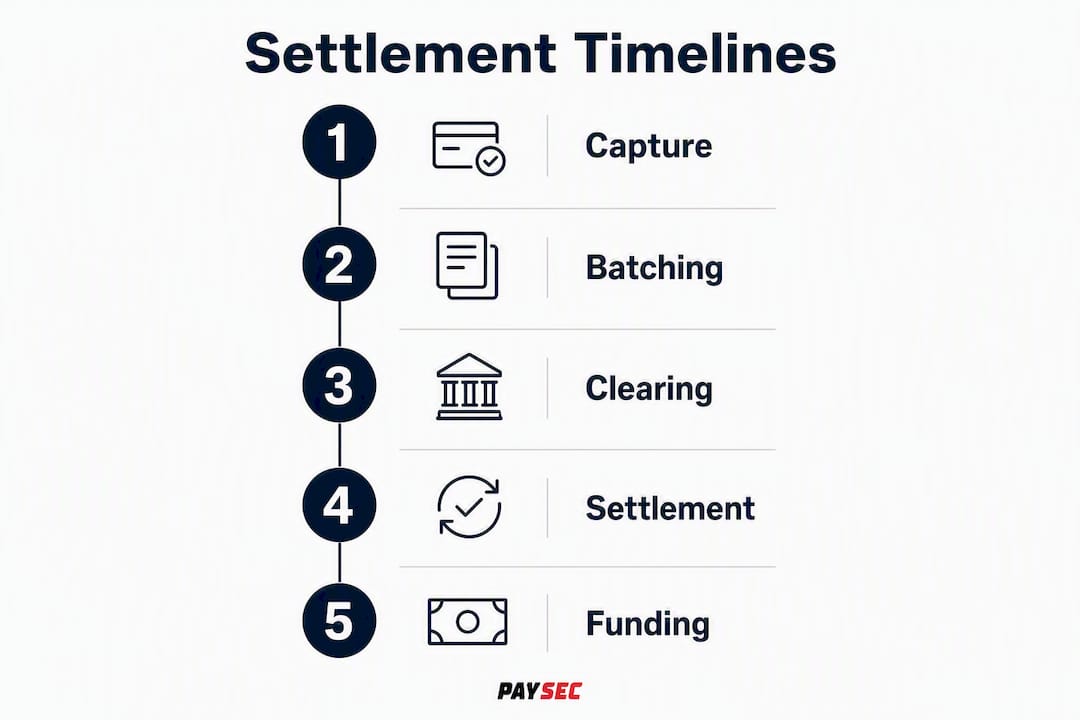
Debit cards (PIN and signature) tend to clear faster, often T+1 to T+2, because the funds are drawn directly from the cardholder's checking account and the authorization is stronger.

ACH payments run on the ACH Network under NACHA rules. Standard ACH settles across multiple Fed windows on business days, typically within a few business days. Same-day ACH compresses that to the same business day if submitted before the NACHA-defined cutoffs. ACH is common for high-dollar B2B transactions because fees are minimal, though processing times are generally longer than cards, often several business days for standard batches.
Wire transfers settle same-day or next-day through Fedwire or CHIPS, making them the fastest guaranteed option for large amounts. Reconciliation is simpler since each wire carries a unique reference number, but wires carry higher per-transaction fees.
Real-time payments (RTP) and FedNow settle in seconds, 24/7, including weekends and holidays. They are increasingly available through U.S. banks but require both the sending and receiving institution to be enrolled.
| Payment Type | Typical Clearing | Typical Merchant Funding |
|---|---|---|
| Visa/Mastercard credit | T+1 to T+2 | T+2 to T+3 |
| Debit (PIN/signature) | T+1 | T+1 to T+2 |
| Standard ACH | T+1 to T+2 | T+2 to T+3 |
| Same-day ACH | Same day | Same day to T+1 |
| Wire transfer | Same day | Same day to T+1 |
| RTP / FedNow | Seconds | Seconds to minutes |
What factors speed up or slow down your funding?
Several operational and policy variables affect when funds actually arrive, and most of them are within your control or negotiable with your processor.
- Batch cutoff time. Transactions captured after the cutoff roll into the next day's batch, adding a full business day to the cycle. Cutoffs commonly fall between 5:00 PM and midnight ET.
- Weekends and Federal Reserve holidays. The Fed's interbank settlement system does not operate on weekends or Federal Reserve holidays, so any batch submitted Friday after cutoff waits until Monday to begin clearing.
- Rolling reserves. New or high-risk merchants often face rolling reserves of 5–15% of daily volume held for 90–180 days. These don't delay technical clearing, but they have the same cash-flow effect as a hold.
- Manual fraud reviews. Flagged transactions can add 24–72 hours to funding beyond the standard settlement window.
- Chargebacks. An open chargeback on a transaction can freeze the associated funds until the dispute resolves.
- MCC and industry risk. Merchants in higher-risk categories (CBD, high-ticket retail, subscription billing) may face longer standard review windows or stricter reserve requirements.
Pro Tip: Schedule your payment captures to complete at least 30 minutes before your processor's batch cutoff. For field-service or mobile-POS businesses, set an end-of-day reminder to close the batch manually if your terminal doesn't auto-batch.
What are the typical settlement timelines for U.S. merchants?
For most card transactions, the definition of settlement period in practice means T+2 to T+3 from the sale date. ACH runs T+1 to T+3 depending on whether you're using standard or same-day processing.
| Payment Type | T = | Settlement | Funding to Merchant |
|---|---|---|---|
| Visa/Mastercard credit | Transaction date | T+1 to T+2 | T+2 to T+3 |
| Debit card | Transaction date | T+1 | T+1 to T+2 |
| Standard ACH | Submission date | T+1 to T+2 | T+2 to T+3 |
| Same-day ACH | Submission date | Same day | Same day to T+1 |
| Wire | Initiation date | Same day | Same day |
Friday late-batch example: A sale captured Friday after the cutoff enters Monday's batch. Clearing happens on the next business day, with funding following—resulting in several calendar days between sale and deposit due to weekends.
A Federal Reserve holiday inside that window pushes every step back by one more business day. A Monday holiday after a Friday late batch means the deposit doesn't arrive until Thursday.
All T+X references above are business days. Weekends and Fed holidays do not count.
Is faster funding worth the extra cost?
Accelerated funding options carry real fees. Instant payout fees typically charge a premium fee per transaction. Same-day ACH or next-day card funding options also usually involve additional fees or flat per-payout charges depending on the provider.
When faster funding makes sense:
- Cash-flow emergencies where a two-day gap creates a payroll or supplier shortfall
- High-margin, high-ticket transactions where the fee is a small fraction of the profit
- Seasonal spikes where volume surges and working capital is stretched
When it probably doesn't:
- Stable retail with predictable daily volume and adequate cash reserves
- Merchants processing under roughly $1,000/day, where the T+1 vs T+2 difference rarely justifies a premium fee
- Businesses where the fee compounds across thousands of small transactions
Pro Tip: Model the cost as an annualized interest rate. A 1% instant-payout fee on funds you'd receive in two days anyway equals roughly 182% annualized. For most stable businesses, optimizing your batch cutoff alignment costs nothing and delivers the same result.
For a broader look at how payout acceleration economics work across financial products, payout timing trade-offs follow similar cost-benefit logic regardless of industry.
How do you monitor and reconcile settlement in your reports?
Reliable reconciliation starts with knowing which report fields to track every day.
Fields that matter:
- Capture date — when the transaction was authorized and captured
- Batch ID — the unique identifier for the batch your transaction was grouped into
- Settlement date — when the card network or ACH cleared the funds
- Funding date — when your processor deposited net funds to your bank
- Net deposit — gross sales minus interchange, processor fees, and any reserve withholding
- Interchange/fees line — itemized so you can verify the rate applied
- Chargeback/reserve flags — any transaction held back from the current deposit
Daily reconciliation checklist:
- Pull the prior day's batch report and match each batch ID to your bank statement deposit.
- Confirm the funding date matches the expected T+X for each payment type.
- Flag any batch with a missing or delayed deposit and trace it to a reserve hold, chargeback, or cutoff miss.
- For ACH transactions, note the ACH trace number. Return codes R01–R04 typically resolve in 2 business days; unauthorized returns can extend up to 60 days.
- Reconcile net deposit against gross sales minus all fee lines to catch any unexplained deductions.
Pro Tip: Set an automated alert in your accounting system for any business day where the expected deposit doesn't post by noon. A single missed alert can turn a one-day delay into a three-day cash-flow gap before anyone notices.
Paysec's real-time reporting dashboards surface all of these fields in one view, so your finance team can reconcile without exporting multiple reports.
What questions should you ask a payment processor about settlement?
These are the exact questions that reveal how a processor's settlement policies will affect your cash flow.
Funding and cutoff questions:
- What is your daily batch cutoff time, and is it adjustable?
- What is your standard funding cadence — T+1, T+2, or T+3?
- Do you offer next-day or same-day funding, and what does it cost?
- How are weekends and Federal Reserve holidays handled in your funding windows?
Reserve and risk questions:
- Do you hold rolling reserves? What percentage, and for how long?
- What triggers a manual fraud review, and how long does it add to funding?
- How do chargebacks affect funds already in the settlement queue?
Reporting and integration questions:
- What fields appear in your settlement reports (batch ID, funding date, net deposit, interchange detail)?
- Do you provide API webhooks for funding events so we can automate reconciliation?
- How are ACH returns reported, and which return codes do you surface?
For high-risk industries, also ask how the processor handles MCC-specific reserve requirements and whether reserve percentages change with volume growth. Paysec's high-risk merchant account solutions address these questions directly with transparent reserve policies.
A real-world Friday settlement scenario
Here is how a single late-Friday sale plays out step by step.
- Friday, 7:30 PM ET: Customer pays by Visa credit card. Your processor's batch cutoff was 6:00 PM. The transaction misses Friday's batch.
- Monday morning: The transaction enters Monday's batch. (Saturday and Sunday are not Fed settlement days.)
- Tuesday: The card network clears the transaction. Funds move between banks.
- Wednesday: Your processor deposits the net amount to your merchant bank account.
Net result: five calendar days, T+2 from Monday's batch date.
Now add a Federal holiday on Monday. The batch doesn't open until Tuesday, clearing runs Wednesday, and funding arrives Thursday. That's six calendar days from the original sale.
If a rolling reserve applies, 5–15% of that transaction's net amount stays held for up to 90–180 days before it's released.
Mitigation moves:
- Shift your capture time to before the cutoff on Fridays
- Request next-day funding for high-value transactions
- Build a two-to-three-day cash buffer into your weekly operating plan to absorb weekend and holiday gaps
Key Takeaways
The settlement period in merchant payments is the elapsed time from transaction capture to net deposit, and your processor's batch cutoff is the single factor most within your control.
| Point | Details |
|---|---|
| Settlement period definition | Time from captured transaction to net funds deposited in your merchant bank account. |
| Typical card funding window | Visa/Mastercard credit funds in T+2 to T+3 business days; debit often T+1 to T+2. |
| Faster funding costs | Instant payout fees typically run 1%–1.5%; same-day ACH or next-day card funding runs 0.25%–0.5%. |
| Batch cutoff is the key lever | Missing your processor's cutoff (often 5:00 PM–midnight ET) adds one full business day to your cycle. |
| Paysec for transparent funding | Paysec offers next-day and expedited payout options with real-time reporting and no long-term contracts. |
The case for optimizing cutoffs before buying speed
Most finance teams ask the wrong question first. They want to know how to get funds faster, when the better question is: why are funds arriving later than they should?
In the majority of cases, the delay isn't a processor limitation. It's a batch cutoff the merchant never checked, a capture time that consistently misses the window, or a reserve policy that was never negotiated. Paying 1%–1.5% for instant payouts on top of an avoidable cutoff miss is paying twice for the same problem.
The smarter sequence is to lock in your cutoff alignment first, then evaluate whether instant funding adds genuine working capital value for specific transaction types. For most stable retail and B2B operations, optimized next-day funding at standard rates covers the need. Instant payouts earn their fee in specific scenarios: high-margin urgent jobs, seasonal cash crunches, or high-ticket transactions where the float cost is material.
Paysec's approach supports both paths. Transparent Network Offset Pricing means the cost of any funding tier is visible before you commit, and real-time reporting lets you measure whether faster funding is actually changing your cash position or just adding fees.
Faster funding and clearer reporting with Paysec
Merchants processing across retail, eCommerce, healthcare, and high-risk categories often lose working capital not to high rates but to opaque funding schedules and reports that don't show the full picture.
Paysec's Network Offset Pricing eliminates hidden fees so you see exactly what each funding tier costs. Next-day and expedited funding options are available without long-term contracts or volume minimums, and the real-time reporting dashboard surfaces every field your finance team needs: batch ID, settlement date, funding date, net deposit, and fee detail. Onboarding is straightforward, and Paysec's team supports you from day one. Review your current processor's settlement terms against Paysec's transparent pricing today.
Useful sources for U.S. merchants
These primary and authoritative references cover the settlement rules, ACH timelines, and processor documentation every merchant should verify directly.
- The ABCs of ACH — Nacha: NACHA's official guide to ACH Network rules, same-day ACH cutoffs, and return code timelines.
- Settlement Timing — Payments & Risk: Covers T+X ranges by payment type, batch cutoff impact, and Federal Reserve holiday effects.
- Settlement Lifecycle — Payments & Risk: Explains the authorization-to-funding lifecycle and where merchant control matters most.
- Payout Strategy — Payments & Risk: Guidance on reserve structures, accelerated funding fees, and payout optimization.
For processor-specific cutoff documentation, always request the processor's merchant agreement and funding schedule addendum. The batch cutoff time, reserve policy, and holiday calendar should appear in writing before you sign.
For Federal Reserve holiday schedules, consult the Federal Reserve's official calendar directly at federalreserve.gov. NACHA publishes its same-day ACH cutoff windows and return code definitions at nacha.org.
FAQ
What does settlement period mean in payment processing?
The settlement period is the time between a captured card or ACH transaction and when the net funds are deposited into the merchant's bank account, typically T+1 to T+3 business days for U.S. card payments.
How long is the settlement period for credit card payments?
Visa and Mastercard credit card transactions typically clear in T+1 to T+2 and fund to the merchant account at T+2 to T+3 business days from the transaction date.
Why did my Friday sale not deposit until Wednesday?
A sale captured after your processor's batch cutoff on Friday enters Monday's batch, clears Tuesday, and funds Wednesday. That's T+2 from Monday's batch, or five calendar days from the original sale.
What is the cost of instant or same-day funding?
Instant payout fees typically run a premium charge per transaction; same-day ACH or next-day card funding generally involves smaller additional fees depending on the processor and account tier.
How does Paysec handle settlement reporting?
Paysec provides real-time reporting dashboards that display batch ID, settlement date, funding date, net deposit, and itemized fee detail, giving finance teams a complete daily reconciliation view without manual exports.