

Payment audit trail compliance gives your business an immutable, searchable record proving who did what, when, and why on every transaction. That record is what stands between you and a failed audit, a lost dispute, or an undetected fraud pattern.
The stakes are documented. Standards like PCI DSS, SOX, HIPAA, and GDPR each require some form of traceable payment history, and a Deloitte compliance technology study found 72% of organizations had experienced violations tied to inadequate audit trails. Here's what that means for your operation:
- Regulators expect proof, not assurances
- Disputes get resolved by evidence, not memory
- Fraud gets caught by patterns in logs, not gut instinct
Paysec builds toward this reality directly, with compliance-aligned reporting and real-time dashboards that give your team the evidence trail auditors expect to see.
Key Takeaways
Payment audit trail compliance works because it turns every transaction into provable, searchable evidence that satisfies regulators, wins disputes, and catches fraud before it compounds.
| Point | Details |
|---|---|
| Audit trails are not receipts | A compliant trail captures the full event sequence, including failures and overrides, not just final outcomes. |
| Immutability is the differentiator | WORM storage, cryptographic hashing, and trusted timestamps separate real audit trails from basic logs. |
| Non-compliance carries real cost | PCI DSS violations can start with substantial monthly penalties and card networks can suspend processing. |
| Evidence wins disputes | Businesses with strong audit trails win 40 to 60% more payment disputes than those without them. |
| Paysec builds in the evidence layer | Real-time dashboards, detailed reporting, and PCI DSS Level 1/SOC 2 signals support audit readiness by default. |
Table of Contents
- What Is a Payment Audit Trail and What Records Does It Contain?
- Why Payment Audit Trail Compliance Matters to Your Business
- Core Components of a Compliant Payment Audit Trail
- Key Technical and Process Controls for Audit Trail Best Practices
- Audit Readiness Checklist: What Evidence Should You Have on Hand?
- How to Ensure Payment Compliance: Implementation Steps That Work
- How Paysec Supports Payment Audit Trail Compliance
- Why Getting This Right Matters More Than Most Teams Assume
- Get an Audit-Ready Payments Setup With Paysec
- Sources
- FAQ
What Is a Payment Audit Trail and What Records Does It Contain?
A payment audit trail is a chronological, tamper-evident record of every payment event and the metadata surrounding it. It's not a single document. It's a sequence, and that sequence has to hold up under scrutiny months or years after the fact.
A complete audit trail typically captures:
- Transaction ID and timestamp
- User ID or role that initiated or approved the action
- Device and IP information
- Authorization codes and status changes
- Settlement entries and reconciliation records
- Reason codes for declines, refunds, or overrides
- Change history for any administrative edits
Here's a distinction that trips up a lot of finance teams: a receipt is not an audit trail. A receipt shows the final state of a transaction. An audit trail shows the full sequence, including the failed authorization attempt before the success, the manual override an employee entered, and the refund that got reversed twice before it settled.
Why Payment Audit Trail Compliance Matters to Your Business
The role of compliance in payments comes down to three forces pulling on your business at once: regulators, fraud, and your own need for financial clarity.
Regulatory drivers. PCI DSS requires logging of access and transaction activity. SOX demands full financial transaction trails for public companies and their vendors. HIPAA adds payment access logs for anything touching patient billing. GDPR layers on data-access and deletion records for any personal data in the payment flow. Newer frameworks like DORA raise the bar further for financial services firms, with traceability expectations that didn't exist a decade ago and penalties that can reach into the millions for serious lapses.
Operational drivers. This is where audit trails pay for themselves. Businesses with comprehensive audit trails win 40 to 60% more payment disputes than those without them, simply because they can produce evidence instead of arguing intent. Reconciliation gets faster. Vendor due diligence gets easier when a partner can show you their own logging practices.
The cost of getting this wrong is not abstract. PCI DSS violations can start with substantial monthly penalties and escalate from there, with card networks holding the power to suspend processing entirely. Add audit costs and reputational fallout, and a weak logging practice becomes an expensive one fast.
Core Components of a Compliant Payment Audit Trail
Auditors don't grade effort. They grade evidence, and evidence has specific shapes.
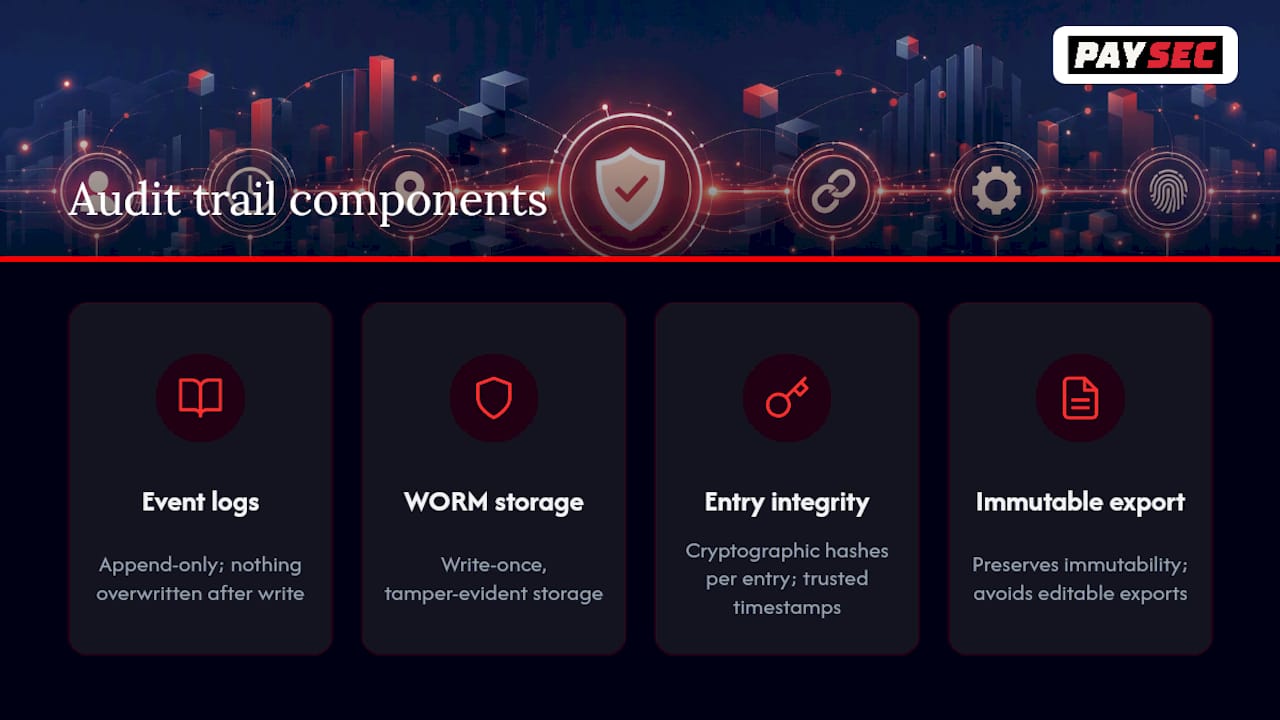
Technical components start with append-only event logs, so nothing gets overwritten once written. Add write-once-read-many (WORM) storage or an equivalent tamper-evident system, cryptographic hashes on each entry, and trusted timestamps from an external authority. Your export function needs to preserve that immutability, not flatten it into an editable spreadsheet.
Data elements cover the full transaction lifecycle: authorization, settlement, refund, and every status change in between. Pair that with user and role identifiers, device and IP data, any approval or override, and a change history log with retention metadata attached.
Access and governance round it out. Separation of duties matters here: the person who can approve a refund shouldn't be the same person who can edit the log of that refund. Access to the audit storage itself needs its own logging layer. Retention policies need a legal-hold mechanism that can freeze specific records without breaking the immutability of the rest, and the whole system needs to be exportable on demand for discovery requests.
Key Technical and Process Controls for Audit Trail Best Practices
Five controls separate a defensible payment audit trail from a liability waiting to surface during your next review.
Immutability controls. Combine WORM storage with per-entry cryptographic hashing and a trusted timestamp authority, then replicate the data for defense in depth. This is the technical stack the strongest audit trail systems rely on, and it's what turns "we have logs" into "we have proof."
Access controls. Apply least privilege by default. Separate who can write records from who can administer the system that stores them, and log every access to the audit trail itself, not just every payment event.
Encryption and data protection. Encrypt logs both in transit and at rest. Redact personally identifiable information where regulation allows it, and manage your encryption key lifecycle as carefully as you manage the logs those keys protect.

Monitoring and alerting. Real-time anomaly detection catches what a monthly review misses. Set alerts for suspicious sequences, a burst of failed authorizations, for example, and run periodic hash verification to confirm nothing in the historical record has drifted.
Retention and legal hold. Document retention schedules tied to the regulations that actually govern your sector, and build a legal-hold capability that can preserve specific records indefinitely without disrupting the immutability of everything else.
Vendor responsibilities. Your payments provider should hand you detailed transaction reporting, clean export formats, and visible compliance signals like SOC 2 and PCI DSS Level 1 certification. If a provider can't produce those on request, that's a gap in your own compliance posture, not just theirs.
Pro Tip: Run a quarterly hash verification on a sample of your archived logs. It takes an afternoon and it's the single fastest way to catch storage integrity problems before an auditor does.
Audit Readiness Checklist: What Evidence Should You Have on Hand?
Auditors move fast when you hand them organized evidence. They move slowly, and suspiciously, when you make them dig.
- Full event exports covering a representative sample period, not just the transactions you know are clean
- Evidence of immutability, meaning hash logs or equivalent tamper-evidence proof
- Access logs showing exactly who viewed or touched the audit records themselves
- Documented retention policies with at least one real legal-hold example on file
- Change-control records for any configuration change made to the payment system
Beyond the checklist, keep a set of supporting documents ready:
- PCI scan results and your Self-Assessment Questionnaire, if your merchant tier requires one
- SOC 2 report references from your processor
- Internal security policies and incident response logs
- Reconciliation and settlement reports covering the audit window
Presentation matters almost as much as content. Build a short timeline reconstruction for any incident under review, annotate your exports so a reviewer doesn't have to guess at column meanings, and keep a one-page "evidence index" mapping each requirement to the exact file that satisfies it. Auditors reward organization with shorter reviews.
How to Ensure Payment Compliance: Implementation Steps That Work
Building or upgrading your audit trail doesn't require a system overhaul. It requires sequence.
- Assess current logs and gaps. Inventory what you're already capturing and where the holes are.
- Map regulatory requirements. Match PCI DSS, SOX, HIPAA, or GDPR obligations to your specific transaction types.
- Instrument missing events. Prioritize authorization, settlement, refunds, and any manual override, since those are the events auditors and fraud investigators care about most.
- Secure immutable storage. Move logs into a WORM or equivalent tamper-evident environment.
- Automate verification and reporting. Set up scheduled reporting so evidence exports don't require manual reconstruction every time someone asks for them.
- Run tabletop audits. Simulate a real audit request internally, then fix whatever slowed the response down.
Pro Tip: Lean on your payment processor's exports to fill instrumentation gaps rather than building custom logging from scratch. It's faster and it keeps your evidence format consistent with what auditors already recognize.
Train your finance and operations teams on the checklist, update your incident response playbook to reference audit-trail evidence directly, and write down who owns the system of record. Vague ownership is one of the most common reasons audit prep runs long.
How Paysec Supports Payment Audit Trail Compliance
Paysec's reporting infrastructure is built around the same controls this guide walks through. Merchants get detailed transaction reporting and real-time dashboards that surface authorization, settlement, and refund activity as it happens, not after a monthly reconciliation.
- PCI DSS Level 1 and SOC 2 compliance signals built into the platform
- Network Offset Pricing, which has delivered an average 42% reduction in processing costs for merchants across 18+ industries
- Exportable, audit-ready reports designed to slot directly into the evidence packet auditors request
- Support across SaaS, restaurants, eCommerce, healthcare, and CBD retail, sectors with distinct regulatory profiles
Businesses using Paysec's reporting tools consistently cut down the time spent reconstructing evidence manually before an audit, since the dashboards already organize activity into the formats reviewers expect.
Why Getting This Right Matters More Than Most Teams Assume
Most businesses treat audit trail compliance as a checkbox exercise until the moment they actually need the evidence, and by then it's too late to fix gaps retroactively. The teams that get the most value from strong audit trails aren't the ones bracing for a regulator. They're the ones using the same evidence to win chargebacks, spot fraud earlier, and settle internal disputes about what actually happened on a given transaction.
The checklist in this guide isn't a compliance formality. It's an operational asset that pays for itself the first time a dispute goes your way instead of the customer's. Businesses that treat their audit trail as a strategic tool, reviewed quarterly and tested before regulators ask for it, consistently spend less time and money on compliance than those that only think about it during a crisis.
Get an Audit-Ready Payments Setup With Paysec
Building payment audit trail compliance from scratch means stitching together logging tools, storage systems, and reporting formats on your own. Paysec gives you that infrastructure already built in, with real-time dashboards and detailed transaction reporting that generate audit-ready evidence as transactions happen, not after the fact.
There are no long-term contracts and no hidden fees layered on top of your compliance stack.
See how the pricing model works on the Network Offset Pricing page, or explore the real-time reporting dashboards built to support your next audit.
Sources
Readers who want to go deeper into the regulatory and technical detail behind this guide can consult:
- Payments with Audit Trails Guide 2026 | InfluenceFlow
- Immutable Payment Audit Trails: Storage, Discovery, and Audits
This article is general information, not a substitute for advice from a qualified financial advisor. Consult a qualified financial professional about your own circumstances before acting on anything here.
FAQ
What Is the Role of Payment Audit Trail Compliance?
It provides an immutable, searchable record of every payment event, proving who did what and when, so businesses can satisfy regulators, win disputes, and detect fraud faster.
What's the Difference Between a Receipt and an Audit Trail?
A receipt shows the final transaction outcome, while an audit trail records the entire event sequence, including failed attempts, overrides, and administrative changes.
Which Regulations Require Payment Audit Trails?
PCI DSS, SOX, HIPAA, and GDPR each impose distinct logging and retention obligations, and frameworks like DORA raise traceability expectations further for financial services firms.
How Long Should Businesses Retain Payment Audit Trail Records?
Retention periods depend on which regulation applies to your transactions, but records should be documented in a formal retention schedule with legal-hold capability built in.
Does Paysec Help With Audit Trail Compliance?
Yes. Paysec provides real-time dashboards, detailed transaction reporting, and PCI DSS Level 1 and SOC 2 compliance signals that give merchants audit-ready evidence by default.