

TL;DR:
- Healthcare payment compliance involves safeguarding patient data and financial transactions under federal regulations like HIPAA and PCI DSS. Non-compliance exposes organizations to penalties, revenue loss, and trust erosion, emphasizing the need for ongoing operational controls and proper vendor management. Implementing robust technical safeguards and contractual governance ensures payment processes are compliant, secure, and support financial integrity.
Healthcare payment compliance is the discipline of ensuring every payment transaction protects patient data, aligns with federal regulations, and safeguards financial operations against fraud and error. For healthcare finance professionals, why healthcare payments require compliance is not an abstract question. It is a daily operational reality governed by HIPAA, PCI DSS, the False Claims Act, and the Anti-Kickback Statute. Non-compliance exposes organizations to federal penalties, revenue loss, and patient trust erosion. This guide breaks down the regulatory frameworks, common risks, and practical controls your team needs to operate with confidence.
Why healthcare payments require compliance: the regulatory foundation
Healthcare payment compliance sits at the intersection of two distinct but overlapping regulatory worlds: patient data protection and financial data security. Understanding both is the starting point for any finance team managing payment operations.

HIPAA (the Health Insurance Portability and Accountability Act) governs the handling of Protected Health Information, or PHI. In a payment context, PHI includes billing identifiers, diagnosis codes, treatment descriptions, and any data that links a patient to a healthcare service. The HIPAA Privacy Rule and Security Rule both apply to payment workflows, not just clinical records. If your payment portal transmits or stores data that connects a patient's identity to their care, HIPAA applies.
PCI DSS (the Payment Card Industry Data Security Standard) governs cardholder data: credit card numbers, expiration dates, and authentication values. PCI DSS is enforced by card networks like Visa and Mastercard, not the federal government, but violations still carry significant financial penalties and can result in loss of card processing privileges.
The critical point most finance teams miss: healthcare payment portals commonly fall under both HIPAA and PCI DSS simultaneously. A patient paying a bill online is both a cardholder and a patient. That single transaction triggers obligations under two separate frameworks. Meeting one does not satisfy the other.
Beyond HIPAA and PCI DSS, healthcare organizations must also contend with:
- The False Claims Act, which imposes treble damages and fines for submitting fraudulent claims to federal programs like Medicare and Medicaid.
- The Anti-Kickback Statute, which prohibits financial arrangements that could influence referrals or purchasing decisions.
- State-level privacy laws, which in some cases exceed HIPAA's requirements and apply to payment data handling.
Business Associate Agreements and why they are non-negotiable
When a payment processor accesses or transmits PHI on behalf of a covered entity, it becomes a Business Associate under HIPAA. That relationship must be formalized through a Business Associate Agreement (BAA). A BAA must specify permitted uses and disclosures of PHI, required safeguards, breach notification obligations, and subcontractor responsibilities. Operating without a BAA when PHI is involved is a direct compliance failure, regardless of how strong your technical controls are.
Pro Tip: Before signing any payment vendor contract, confirm whether the vendor will access PHI and require a BAA before processing begins. Many vendors offer standard BAA templates, but your legal team should review subcontractor clauses carefully.
Breach notification adds another layer of urgency. HIPAA requires business associates to notify covered entities of PHI breaches without unreasonable delay and no later than 60 days of discovery. Many BAAs set internal deadlines of 24 to 72 hours, which means your incident response workflows must be aligned with those contractual timelines, not just the federal maximum.
What are the common types of compliance risks in healthcare payment processing
Healthcare finance teams face compliance risks that are often invisible until they become enforcement actions. Recognizing these risks early is the difference between a correctable process gap and a federal investigation.
-
PHI embedded in payment documentation. Finance teams often treat receipts, invoice notes, and dispute records as purely administrative. In reality, these artifacts frequently contain ePHI, including patient names, account numbers tied to diagnoses, and treatment dates. HIPAA controls apply to all of them.
-
Vendor and subcontractor compliance gaps. Your payment processor may be fully compliant, but if they use subcontractors who are not covered by downstream BAAs, your organization carries the exposure. Vendor chains are a common blind spot in healthcare payment compliance programs.
-
Duplicate and improper payments. Duplicate payments and unclear approvals create False Claims Act enforcement risks and regulatory scrutiny. When payments go to vendors who are also referring physicians, the Anti-Kickback Statute adds criminal liability to the financial exposure.
-
Weak segregation of duties. When the same person who approves a vendor can also process and reconcile payments, the control environment breaks down. This is one of the most common findings in healthcare payment audits.
-
Misaligned breach notification workflows. Strong technical controls mean nothing if your operations team does not know how to escalate a suspected breach within the timeframes your BAAs require. Incident response in healthcare finance involves more than IT. Aligning breach notification timelines in BAAs with operational escalation procedures is critical to avoiding HIPAA failures even when your technical posture is strong.
-
Non-compliant payment portals. Using a payment portal that was not designed for healthcare creates immediate risk. Common failures include storing PHI in receipts, emailing unencrypted statements, and routing payments through systems that lack HIPAA-required audit logging.
One insight that surprises many finance leaders: many organizations incorrectly believe that meeting PCI DSS standards automatically covers healthcare compliance. PCI DSS protects cardholder data. HIPAA extends broader protections to patient-linked data that has nothing to do with card information. The two frameworks must be managed in parallel, not treated as substitutes for each other.
How do healthcare finance teams implement effective compliance programs
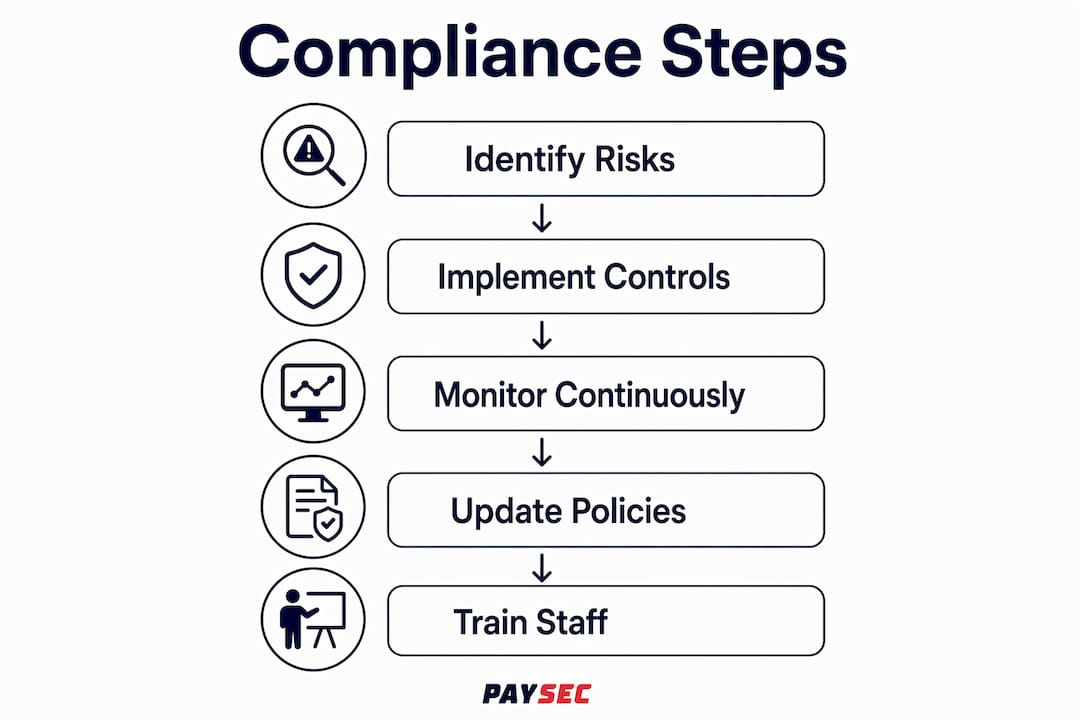
Compliance in healthcare billing is not a one-time certification. It is an ongoing operational discipline that requires technical controls, contractual governance, and staff accountability working together.
Technical safeguards that protect payment data
HIPAA-compliant payment systems must support encryption, role-based access control (RBAC), audit logging, and secure data handling across billing and payment workflows. These are not optional enhancements. They are baseline requirements. Finance teams should verify that every payment platform in use meets these standards before processing a single transaction.
Tokenization and least-privilege access limit PHI exposure and reduce audit scope. Segmenting payment data to isolate PHI from cardholder data reduces breach impact and simplifies compliance reporting. When a breach does occur, tokenized systems contain the damage more effectively than systems where PHI and payment data are commingled.
Pro Tip: Conduct a data flow mapping exercise for every payment workflow. Identify every point where PHI could be created, stored, or transmitted, including portal logs, email confirmations, and printed receipts. Then apply HIPAA controls to each touchpoint.
Operational controls for procure-to-pay compliance
| Control | Purpose | Implementation approach |
|---|---|---|
| Segregation of duties | Prevents single-person fraud and errors | Separate approval, processing, and reconciliation roles |
| Vendor BAA verification | Confirms third-party compliance obligations | Require BAAs before onboarding any payment vendor |
| Automated duplicate detection | Reduces False Claims Act exposure | Deploy procure-to-pay software with duplicate payment flags |
| Audit logging | Creates accountability trail for HIPAA | Enable logging on all payment portals and billing systems |
| Breach escalation protocol | Meets BAA notification timelines | Document and train staff on 24-to-72-hour escalation paths |
Regular risk assessments are the mechanism that keeps these controls current. Threat environments change, vendors change, and workflows evolve. A risk assessment conducted annually, at minimum, identifies gaps before regulators or auditors do.
Effective vendor management through detailed BAAs, breach reporting obligations, and operational controls ensures third parties are integrated into your compliance program rather than operating outside it. Finance leaders who treat vendor compliance as a procurement checkbox rather than an ongoing management responsibility are the ones who end up in enforcement actions.
For healthcare practices looking at real-world results, a healthcare practice compliance case study shows how one organization implemented HIPAA-compliant payment processing while reducing costs by 35%, demonstrating that compliance investment and financial efficiency are not mutually exclusive.
How does compliance in healthcare payments impact financial operations
The impact of compliance on payments extends well beyond avoiding penalties. It shapes revenue integrity, provider relationships, and the patient experience in ways that directly affect your organization's financial performance.
Revenue protection is the most direct financial benefit. False Claims Act violations carry treble damages, meaning a $1 million improper payment exposure becomes a $3 million liability before legal fees. Improper payments to vendors who are also referring physicians expose organizations to both False Claims Act liabilities and Anti-Kickback Statute penalties. Compliance controls that prevent these payments protect revenue far more efficiently than any recovery process.
Claim accuracy reduces denials and chargebacks. Healthcare reimbursement guidelines from CMS require precise coding, documentation, and billing practices. When compliance programs enforce these standards at the point of billing, denial rates fall. Fewer denials mean faster reimbursement cycles and lower administrative costs for rework and appeals.
Patient trust is a financial asset. A PHI breach in a payment system does not just trigger HIPAA penalties. It damages the patient relationship in ways that affect retention and referrals. Patients who experience a data breach are significantly more likely to change providers. Protecting payment data is, in practical terms, a patient retention strategy.
Provider and payer relationships improve with compliance maturity. Payers conduct audits of provider billing practices. Organizations with documented compliance programs, clean audit trails, and verified vendor controls move through those audits faster and with fewer findings. That translates to fewer payment holds, faster contract renewals, and stronger negotiating positions.
The hidden cost of processing fees compounds these pressures for medical offices. When compliance failures trigger chargebacks, fines, or payment holds, the effective cost of every transaction rises. Finance teams that treat compliance as a cost center miss the revenue protection math entirely.
- Compliance programs reduce the frequency and severity of payment audits.
- Documented controls accelerate payer contract negotiations.
- Clean payment data reduces billing errors that trigger CMS scrutiny.
- PHI protection in payment workflows directly supports patient retention.
- Vendor compliance oversight prevents liability transfer from third parties to your organization.
Key takeaways
Healthcare payment compliance protects revenue, patient data, and provider relationships by enforcing HIPAA, PCI DSS, and False Claims Act controls across every payment transaction and vendor relationship.
| Point | Details |
|---|---|
| Dual compliance obligation | Healthcare payment portals must satisfy both HIPAA and PCI DSS simultaneously, not one or the other. |
| BAAs are non-negotiable | Any payment processor accessing PHI requires a signed BAA before processing begins, including subcontractors. |
| PHI hides in payment documents | Receipts, invoice notes, and portal logs often contain ePHI and require full HIPAA controls. |
| Breach timelines are contractual | BAAs often set 24-to-72-hour internal notification deadlines, far shorter than the federal 60-day maximum. |
| Compliance protects revenue | False Claims Act treble damages and denial rates make compliance a direct revenue protection mechanism. |
The compliance complexity no one warns you about
By PaySec Marketing Team
After working with healthcare finance teams across multiple practice types, the pattern I see most often is not willful non-compliance. It is structural blindness. Finance teams are focused on payment accuracy and cash flow. IT teams are focused on system security. Nobody owns the intersection, which is exactly where the most serious compliance failures live.
The PHI-in-payment-documents problem is a perfect example. A billing coordinator generates a receipt that includes a patient's name, account number, and the name of the procedure. That receipt gets emailed unencrypted because the billing system was not configured for secure delivery. No one flagged it as a HIPAA issue because it looked like a financial document, not a medical record. That is how organizations end up in breach investigations without ever intending to cut corners.
The vendor management gap is equally underappreciated. I have reviewed BAAs that covered the primary payment processor but said nothing about the subprocessors that actually handle card tokenization or dispute resolution. Those subprocessors touch PHI. Without downstream BAA coverage, the covered entity carries the exposure.
My honest recommendation for finance leaders: treat compliance as a revenue protection investment, not a regulatory tax. The organizations that build compliance into their payment workflows from the start spend less on audits, recover faster from incidents, and negotiate better payer contracts. The ones that bolt it on after a finding spend multiples more and still carry residual risk.
The other thing worth saying plainly: PCI DSS compliance does not make you HIPAA compliant. I still encounter finance professionals who believe passing a PCI audit means their payment environment is covered. It covers cardholder data. HIPAA covers everything else that connects a patient to their care. Both frameworks require active management, and neither substitutes for the other.
— PaySec Marketing Team
How Paysec supports HIPAA-compliant healthcare payment processing
Healthcare finance teams should not have to choose between compliance and cost efficiency. Paysec's zero-fee payment processing is built for exactly this environment, combining HIPAA-compliant architecture with Network Offset Pricing that eliminates processing fees entirely.
Paysec supports Business Associate Agreements for healthcare clients, provides detailed transaction reporting for audit readiness, and integrates with healthcare billing platforms to keep PHI handling within compliant workflows. Clients in healthcare have achieved processing cost reductions of 30 to 60%, with one practice documenting a 42% reduction while maintaining full compliance. If your team is evaluating compliant payment solutions that reduce costs without adding regulatory risk, Paysec is worth a direct conversation.
FAQ
Why do healthcare payments require compliance?
Healthcare payments involve PHI and cardholder data, both of which are governed by federal law. HIPAA, PCI DSS, and the False Claims Act each impose specific obligations on how payment data is collected, stored, transmitted, and reported.
What is the difference between HIPAA and PCI DSS in healthcare payments?
HIPAA governs patient-linked health information, while PCI DSS governs credit and debit card data. Healthcare payment portals typically fall under both frameworks simultaneously, and meeting one does not satisfy the other.
What happens if a payment processor lacks a BAA?
Operating without a BAA when a payment processor accesses PHI is a direct HIPAA compliance failure. The covered entity carries full liability for any breach or misuse of PHI by that processor.
How quickly must a healthcare organization report a payment data breach?
Under HIPAA, business associates must notify covered entities of PHI breaches no later than 60 days after discovery. Many BAAs set internal escalation deadlines of 24 to 72 hours, which your operational workflows must reflect.
What are the financial consequences of non-compliance in healthcare payments?
False Claims Act violations carry treble damages on improper payment amounts, plus per-claim fines. HIPAA penalties scale with the level of negligence. Combined with increased denial rates and audit costs, non-compliance consistently costs more than the investment required to prevent it.
Recommended
- PCI Compliance for Small Businesses: What You Need to Know (And How to Stop Paying Non-Compliance Fees)
- Case Study: Healthcare Practice Saves 35% on Processing | PaySec
- Medical Offices: The Hidden Cost of Credit Card Processing Fees on Patient Payments
- SaaS Payment Reporting Best Practices for Finance Teams