

When built into payment operations from the start, compliance reduces net processing costs by preventing fines, lowering fraud losses, and unlocking routing and interchange optimizations. The role of compliance in payment savings is not theoretical — it is measurable, and it starts with three concrete levers.
- Fraud and chargeback reduction: Stronger KYC/KYB controls and transaction monitoring lower dispute rates and the fees that follow.
- Avoided penalties: Proactive compliance programs eliminate the remediation costs and fines that reactive programs absorb.
- Routing and interchange optimization: Clean audit trails and spend classification enable smarter routing decisions that recover basis points on every transaction.
Start by measuring your current chargeback rate, false-positive decline rate, and compliance staffing cost as a share of noninterest expense. Those three numbers tell you where the biggest savings opportunity sits.
Pro Tip: *Before investing in new tooling, run a one-week audit of your dispute workflow.
Key Takeaways
Compliance built into payment architecture is a direct source of measurable savings — not just a cost of doing business.
| Point | Details |
|---|---|
| Compliance cost burden | Small banks under $100M in assets spend roughly 10% of noninterest expense on compliance vs. 5% for larger institutions. |
| Top savings levers | Fraud reduction, avoided fines, interchange optimization, and dispute automation deliver the fastest ROI. |
| Architecture matters | Front-loading KYC/KYB/KYT into the transaction engine eliminates post-hoc review latency and reduces staffing cost. |
| KYC modernization gains | McKinsey data shows 20–40% reductions in administrative touchpoints when compliance and business teams collaborate on KYC. |
| Paysec approach | Paysec's PCI DSS Level 1 infrastructure and Network Offset Pricing help merchants achieve 30–60% reductions in processing costs. |
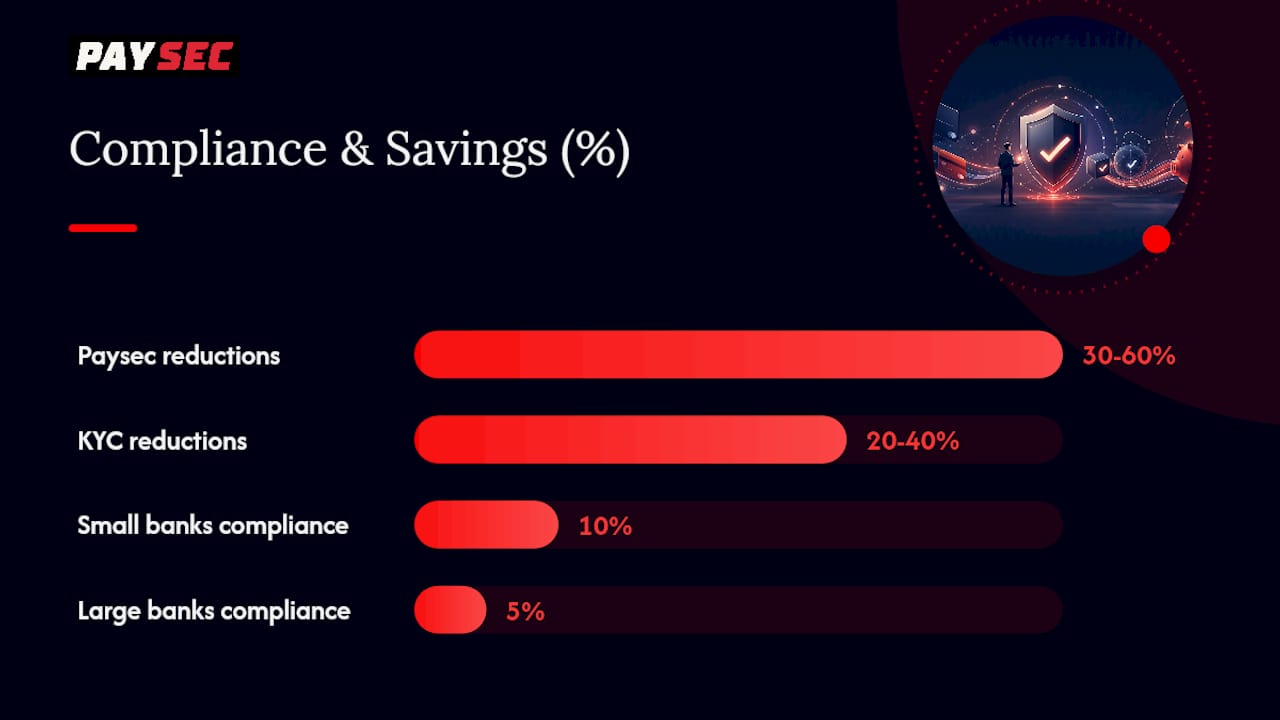
Table of Contents
- What is payments compliance, and who does it cover?
- Which U.S. regulations and standards shape payment costs and savings?
- How does compliance create costs across people, systems, and operations?
- How does compliance become a net source of payment savings?
- What operational changes convert compliance into measurable savings?
- How do you measure the ROI of compliance investments in payments?
- What does a practical compliance-to-savings roadmap look like?
- What are the biggest risks when converting compliance into savings?
- A real example of compliance-driven savings in payment processing
- Compliance as a strategic asset, not a cost center
- Paysec delivers compliance-aligned savings from day one
- Sources
- FAQ
What is payments compliance, and who does it cover?
Payments compliance is the set of rules, standards, and internal controls that govern how money moves — who can send it, how it is verified, how it is protected, and what gets reported. It covers every participant in the payment chain.
Compliance is not a department. It is an operating condition. Every merchant, processor, acquirer, sponsor bank, fintech platform, and third-party vendor that touches a payment flow carries compliance obligations — and the cost of ignoring them compounds over time.
That scope matters because compliance obligations do not stop at the bank. A SaaS company processing subscriptions, a restaurant accepting card-present transactions, a CBD retailer using a high-risk merchant account, and a healthcare provider handling patient payments each face distinct but overlapping requirements. CBD payment compliance and healthcare payment compliance illustrate how vertical-specific rules layer on top of baseline standards.
The core pillars every payments compliance program must track:
- AML/BSA controls: Anti-money laundering obligations under the Bank Secrecy Act, including Suspicious Activity Report (SAR) filing, transaction monitoring, and recordkeeping.
- KYC/KYB/KYT: Know Your Customer, Know Your Business, and Know Your Transaction checks that verify identity and flag risk before funds move.
- Fraud prevention: Controls that detect and block unauthorized transactions, reducing chargeback exposure and direct loss.
- Consumer protection (Reg E / CFPB): Error resolution rights, dispute timelines, and disclosure requirements that govern consumer payment accounts.
- Data security (PCI DSS / GLBA): Technical and operational standards for protecting cardholder data and financial information.
- Scheme rules: Card network operating regulations that carry penalty exposure for noncompliance.
- State privacy laws: CCPA/CPRA and equivalent state frameworks that govern data collection, storage, and consumer rights.
Compliance costs averaged approximately 10% of noninterest expense for banks with assets under $100M, compared to roughly 5% for banks between $1B and $10B in assets — a gap that shows how much architecture and scale matter when managing these obligations.
Which U.S. regulations and standards shape payment costs and savings?
The regulatory map for U.S. payments is wide, but each rule ties directly to either a cost exposure or a savings opportunity. Understanding both sides of that equation is where payment regulations and savings connect.
Standards and regulations that create cost exposure
- PCI DSS (PCI Security Standards Council): Defines technical and operational requirements for protecting cardholder data. Certification and annual audits carry direct costs, but implementing PCI controls correctly reduces breach exposure and the remediation costs that follow a data incident. Prioritize network segmentation and tokenization first — they deliver the highest breach-risk reduction per dollar spent. For practical guidance, the PCI compliance guide for small businesses covers how to stop paying non-compliance fees.
- BSA/AML (FinCEN): The Bank Secrecy Act requires transaction monitoring, SAR filing, and recordkeeping. The priority control is automated transaction monitoring — manual SAR processes are the single largest staffing cost in most AML programs.
- KYC/KYB/KYT: Identity verification requirements for customers, businesses, and individual transactions. Front-loading these checks at onboarding eliminates the latency and cost of post-hoc reviews.
- Reg E (Federal Reserve / CFPB): Governs error resolution and consumer protections for electronic fund transfers. Unresolved disputes create remediation costs and regulatory exposure. Prioritize dispute workflow automation to reduce resolution time and staffing overhead.
- CFPB supervision: The Consumer Financial Protection Bureau supervises nonbank payment companies and enforces consumer financial laws. Enforcement actions carry financial and reputational costs; proactive disclosure compliance reduces that exposure.
- FTC enforcement: The Federal Trade Commission enforces unfair or deceptive practices statutes that apply to payments and data privacy. A single enforcement action can generate costs that dwarf years of compliance investment.
- GLBA (Gramm-Leach-Bliley Act): Requires financial institutions to protect consumer financial data and provide privacy notices. Prioritize data inventory and access controls — they reduce both breach risk and audit preparation time.
- Regulation DD (CFPB): Requires disclosure of APY, interest rates, fee schedules, minimum-balance rules, and account-opening terms for deposit accounts. Regulation DD creates ongoing reporting and disclosure obligations that compliance programs must track and update.
- State privacy laws (CCPA/CPRA): California's framework — and similar laws in other states — governs data collection, consumer rights, and deletion requests. Prioritize a unified data inventory that serves both state privacy and federal obligations simultaneously.
- Scheme rules (card networks): Operating regulations from Visa, Mastercard, and other networks carry penalty exposure for noncompliance and fee optimization opportunities for compliant participants. Scheme-fee management and opt-out elections are among the fastest ROI levers available.
Federal supervisory oversight
The Federal Reserve's supervision and regulation framework sets examination expectations for banks and payment sponsors. Understanding what examiners look for — particularly around third-party risk management and BSA/AML program adequacy — lets compliance teams build documentation that reduces examination friction and remediation costs.
How does compliance create costs across people, systems, and operations?
Compliance spending is real, and understanding where it concentrates helps target the right savings levers. The costs fall into two categories: direct and indirect.
Direct costs are the most visible:
- Staffing: Compliance officers, BSA analysts, KYC reviewers, and legal counsel represent the largest line item for most payment organizations.
- Specialized tooling: Transaction monitoring platforms, identity verification APIs, case management systems, and audit software carry licensing and integration costs.
- Vendor fees: Third-party KYC/KYB data providers, sanctions screening services, and fraud detection vendors add per-transaction or per-check costs.
- Certification and audit: PCI DSS Level 1 assessments, SOC 2 audits, and external legal reviews are recurring annual expenses.
- Remediation and legal: When controls fail, the cost of investigation, remediation, and legal defense can dwarf the original compliance investment.
Compliance costs averaged approximately 10% of noninterest expense for banks under $100M in assets, compared to roughly 5% for banks between $1B and $10B. Smaller organizations pay a disproportionate share — which means the efficiency gains from automation and architecture matter more, not less, at smaller scale.
Indirect costs are often larger but harder to see:
- Onboarding latency caused by manual KYC/KYB reviews delays revenue and increases abandonment rates.
- False-positive declines block legitimate transactions, reducing approval rates and customer lifetime value.
- Reconciliation overhead from fragmented data systems adds hours of manual work per settlement cycle.
- Regulatory uncertainty slows product launches and increases legal review cycles.
Historical enforcement actions illustrate the upper bound of what poor compliance costs. Major financial institutions have faced multi-billion-dollar settlements tied to compliance failures — a scale of consequence that makes proactive investment look inexpensive by comparison.
How does compliance become a net source of payment savings?
The compliance impact on savings becomes clearest when you trace each control to the cost it eliminates or the revenue it protects.
Fraud and chargeback reduction
Stronger KYC/KYT controls and real-time transaction monitoring reduce fraud loss rates directly. Lower fraud rates translate to lower chargeback ratios, which reduces per-dispute fees, avoids scheme penalty thresholds, and protects card acceptance rights. Fraud prevention practices that are embedded in the transaction flow — rather than applied after the fact — catch more fraud at lower cost per case.

Avoided penalties and remediation
Proactive compliance programs with programmatic auditability avoid the two most expensive outcomes: regulatory fines and internal remediation projects. A compliance program that generates clean, timestamped audit trails reduces examination preparation time and makes it easier to demonstrate control effectiveness to regulators — which shortens examination cycles and reduces legal costs.
Operational efficiency at scale
McKinsey reports that collaboration between compliance and business teams can produce 10–30% improvements in customer satisfaction scores and 20–40% reductions in administrative touchpoints in KYC modernization examples. Fewer manual reviews, fewer reconciliation mismatches, and faster onboarding all reduce staffing costs while improving the customer experience.
Commercial and routing levers
Clean audit trails and accurate spend classification enable interchange optimization — routing transactions to the lowest-cost interchange category they qualify for. Scheme-fee management, including opt-out elections for certain network fees, delivers basis-point savings on every transaction. Scheme compliance modernization converts operational effort into measurable business-case metrics: resource cost reduction, penalty avoidance, and fee optimization.
The most underused savings lever in payments compliance is scheme-fee management. Most organizations focus on fraud and fines but leave interchange optimization and scheme opt-outs on the table — often because the audit trail required to qualify is incomplete.
Better approval rates, faster settlements, and improved client retention follow from a compliance program that reduces friction rather than adding it. Payment data security controls that protect cardholder data also protect the merchant's ability to accept cards — a revenue protection function, not just a cost.
What operational changes convert compliance into measurable savings?
Savings through compliance measures require deliberate architectural and process choices. The following interventions, sequenced by time-to-value, give payments ops and compliance teams a practical starting point.
Quick wins (weeks 1–8):
- Tune transaction monitoring rules to reduce false positives. Most programs over-alert on low-risk patterns; a rules review typically cuts alert volume by 20–40% without increasing missed-fraud rates.
- Consolidate vendors where overlapping tools serve the same function. Duplicate KYC data providers and redundant fraud tools are common in organizations that grew through acquisition.
- Automate dispute workflows to reduce manual handling time per case. Structured templates and routing rules cut average resolution time and staffing cost per dispute.
- Run a compliance risk assessment to identify the highest-exposure gaps. A structured compliance risk assessment gives you a prioritized list of controls to address first.
Mid-term (months 2–6):
- Automate transaction monitoring and SAR workflows end-to-end. Moving from spreadsheet-based case management to a purpose-built platform reduces analyst time per case and improves audit trail quality.
- Centralize data into a single audit trail. Fragmented KYC/KYB data stored across systems is the most common cause of examination delays and reconstruction costs. A unified data layer makes audits faster and cheaper.
- Implement policy-configurable onboarding rules with risk tiering. Low-risk customers move through automated checks; high-risk customers get enhanced due diligence. This reduces unnecessary manual reviews without increasing risk exposure.
- Automate regulatory compliance reporting where possible. Automating reporting workflows reduces the staffing cost of recurring filings and reduces the error rate that triggers follow-up examinations.
Long-term (months 6–18):
- Embed compliance as a precondition in the payment architecture. Front-loading KYC/KYB/KYT into the transaction engine produces deterministic, auditable transactions and eliminates the latency caused by post-hoc compliance checks. This is the "compliance as an OS" model — compliance runs as a layer of the infrastructure, not a gate after it.
- Build interchange optimization into routing logic. Clean spend classification and enhanced data submission qualify more transactions for lower interchange categories, recovering basis points at scale.
Pro Tip: Treating compliance as a bolt-on creates compliance debt — manual KYB/KYC processes, spreadsheet monitoring, and fragmented audit trails that raise retrofit costs every year. Front-loading controls into architecture is cheaper in year two than fixing them in year three.
How do you measure the ROI of compliance investments in payments?
A reproducible ROI model starts with a baseline and applies conservative improvement assumptions to each savings category. The KPIs below give compliance, payments ops, and finance teams a shared measurement framework.
Core KPIs to track:
- Chargeback rate (target: below scheme penalty thresholds, typically under 1%)
- False-positive decline rate (percentage of legitimate transactions blocked)
- SAR volume and average cost per SAR filed
- Time-to-onboard (days from application to first transaction)
- Average settlement time (days from transaction to funds availability)
- Compliance staffing FTEs as a percentage of total payments headcount
- Fines avoided (tracked against prior-year penalty exposure)
- Scheme penalty exposure (open items from network compliance reviews)
Sample ROI model (annual, illustrative):
These figures use conservative assumptions. Aggressive assumptions — higher fraud rates, larger fine exposure, or greater interchange recovery — produce proportionally larger savings. The right approach is to use your actual baseline numbers and apply the improvement percentages that your controls realistically support.
A short ROI calculation: if the compliance investment (tooling, staffing, and audit costs) totals $150,000 annually, and modeled savings are $333,000, the net annual benefit is $183,000 — a positive ROI in year one, before accounting for reputational and revenue-protection benefits.
What does a practical compliance-to-savings roadmap look like?
Moving from assessment to operational savings requires clear ownership, defined phases, and minimum deliverables at each stage.
Phase 1: Assess (weeks 1–4)
- Establish baseline KPIs: chargeback rate, false-positive rate, time-to-onboard, and compliance staffing cost.
- Map current compliance controls against regulatory requirements and identify gaps.
- Inventory data systems and identify fragmentation in KYC/KYB records.
- Produce a prioritized gap list with estimated cost and risk for each item.
Phase 2: Design (weeks 4–10)
- Define target-state controls architecture, including data centralization and automation priorities.
- Assign ownership: compliance owns policy and risk appetite; payments ops owns workflow automation; product and engineering own architecture changes; legal reviews regulatory interpretations; finance owns the ROI model.
- Set SLA targets for onboarding time and dispute resolution time.
- Build the automation backlog with effort estimates and sequencing.
Phase 3: Pilot (weeks 10–18)
- Implement quick wins on one product line or payment rail.
- Measure KPI changes against baseline.
- Document lessons learned and adjust automation rules before scaling.
Phase 4: Scale (months 5–12)
- Roll out automated monitoring, dispute workflows, and centralized audit trail across all products.
- Implement interchange optimization and scheme-fee management.
- Report savings monthly to finance and board-level stakeholders.
Phase 5: Continuous improvement (ongoing)
- Review transaction monitoring rules quarterly for drift and false-positive rates.
- Track scheme rule updates and assess penalty exposure proactively.
- Update the ROI model annually with actual savings data.
Governance and oversight:
- Board or audit committee: quarterly compliance and savings report.
- Compliance committee: monthly KPI review with payments ops and finance.
- Engineering: bi-weekly architecture review for compliance-as-OS progress.
Timeline callout: Quick wins (rules tuning, vendor consolidation, dispute automation) typically deliver measurable savings within 60–90 days. Architectural changes — centralized audit trails, front-loaded KYC/KYB, interchange optimization — take 6–18 months but produce the largest long-term savings.
What are the biggest risks when converting compliance into savings?
Not every cost-reduction move in compliance is safe. Some choices that appear to reduce spend actually increase regulatory or operational risk.
- Over-tuning rules to reduce false positives can increase false negatives. Cutting alert volume too aggressively means missing real fraud or suspicious activity. Set a floor on detection rates before tuning for efficiency.
- Vendor consolidation creates single points of failure. Consolidating to one KYC provider or one transaction monitoring platform reduces cost but concentrates operational risk. Maintain a contingency plan for critical vendor outages.
- Over-automation without oversight leads to model degradation. Transaction monitoring models drift over time as fraud patterns change. Automated systems require periodic human review and recalibration — set a quarterly model review cadence.
- Missing audit trails are a red flag in examinations. Fragmented KYC/KYB data and incomplete transaction logs are the most common triggers for extended examinations and remediation orders.
- Unplanned scheme noncompliance exposure. Card network rule changes happen on a rolling basis. Organizations without a scheme-update tracking process accumulate penalty exposure without knowing it.
The most expensive compliance mistake is not a fine — it is the remediation project that follows. Rebuilding audit trails, re-running KYC on an existing customer base, or retrofitting controls into a live payment stack costs multiples of what a well-designed program would have cost from the start. Compliance debt compounds the same way technical debt does — quietly, until it is unavoidable.
The FTC's enforcement authority on unfair or deceptive practices adds a consumer-protection dimension that payments teams sometimes underweight. A single enforcement action for deceptive billing or inadequate data protection can generate costs and reputational damage that no efficiency gain offsets.
A real example of compliance-driven savings in payment processing
A mid-market eCommerce merchant processing approximately $40M annually came to Paysec with three compounding problems: a chargeback rate approaching scheme penalty thresholds, a manual KYC onboarding process averaging 11 days for new business accounts, and no centralized audit trail for card network compliance reviews.
Interventions applied:
- Front-loaded KYC/KYB checks into the onboarding flow, replacing a manual document review queue with automated identity verification and risk tiering.
- Implemented real-time transaction monitoring with configurable rules tuned to the merchant's actual fraud patterns, reducing alert volume without increasing missed-fraud rates.
- Centralized transaction and compliance data into a single reporting layer, giving the merchant a complete audit trail for scheme compliance reviews.
- Applied interchange optimization through enhanced data submission on B2B transactions, recovering basis points on a significant share of volume.
Measured outcomes:
- Processing costs fell by 42% within the first year, driven by interchange recovery, reduced chargeback fees, and eliminated non-compliance penalties.
- Time-to-onboard dropped from 11 days to under 48 hours after front-loaded KYC automation went live.
- Chargeback rate moved below scheme penalty thresholds, eliminating the associated monitoring fees.
The compliance investment paid for itself within the first two quarters. The audit trail built during implementation also reduced the time required for the merchant's annual card network compliance review by more than half.
Pro Tip: Scale the model by starting with your highest-volume product line or payment rail. The data you collect in the pilot phase — baseline KPIs, rules performance, and audit trail quality — becomes the template for every subsequent rollout. Don't try to fix everything at once; fix the biggest cost driver first and use the savings to fund the next phase.
Compliance as a strategic asset, not a cost center
The conventional framing of compliance as a tax on the business misses the most important insight in modern payments operations: compliance infrastructure is also revenue infrastructure.
Every control that reduces fraud also protects approval rates. Every audit trail that satisfies an examiner also enables interchange optimization. Every automated KYC check that speeds onboarding also reduces the staffing cost of manual review. The functions are not separate — they are the same system, and the organizations that build them as one system capture savings that bolt-on compliance programs never see.
The governance and engineering collaboration required to build compliance as an OS is not a compliance project. It is a payments architecture project with compliance as the design constraint. That reframe matters because it changes who owns the outcome. When payments ops, product, engineering, and compliance share the same KPI — net cost per transaction — the savings follow.
Three priorities for teams ready to act:
- Invest in data first. A centralized, timestamped audit trail is the foundation of every other savings lever — interchange optimization, examination efficiency, and fraud detection all depend on it.
- Front-load checks. KYC/KYB/KYT at the point of onboarding costs less and catches more than the same checks applied post-transaction.
- Measure and report savings monthly. Compliance savings that are not reported to finance and the board are invisible — and invisible savings do not get reinvested.
Paysec delivers compliance-aligned savings from day one
Paysec is built for payment organizations that want compliance and cost efficiency to work together, not against each other. With Network Offset Pricing, merchants across SaaS, eCommerce, healthcare, restaurants, and high-risk retail retain full revenue while offering flexible payment options — no hidden fees, no minimums, no long-term contracts.
Paysec operates at PCI DSS Level 1 and SOC 2 standards, with real-time payment reporting and analytics that give merchants the audit trail and transaction visibility their compliance programs require. The architecture supports front-loaded KYC/KYB workflows, interchange optimization, and scheme-fee management — the same levers this guide identifies as the highest-ROI compliance investments.
To see where your compliance program is leaving savings on the table, review Paysec's pricing and solutions or contact the team to run the ROI model against your actual transaction volume.
Sources
Official regulatory and standards sources are the authoritative starting point for building and documenting compliance controls. Use these to establish your baseline and support examination documentation.
- Compliance costs, economies of scale, and compliance performance — Community Banking Research (PDF)
- Regulation DD (Truth in Savings) — Consumer Financial Protection Bureau
One practical tip: build your compliance baseline by mapping each control in your program to the specific regulatory citation that requires it. That mapping becomes your examination-ready documentation and your gap analysis in one document.
Compliance costs for smaller payment organizations run disproportionately high — the economies-of-scale data make the case for automation and architectural investment even at modest transaction volumes.
This article is general information, not a substitute for advice from a qualified financial advisor. Consult a qualified financial professional about your own circumstances before acting on anything here.
FAQ
What is compliance in payments?
Payments compliance is the set of regulations, standards, and internal controls that govern how payment transactions are initiated, verified, monitored, and reported. It covers AML/BSA, KYC/KYB, fraud prevention, data security (PCI DSS), consumer protection (Reg E), and scheme rules.
What does a payments compliance officer do in banking?
A payments compliance officer designs and oversees the controls that keep the organization aligned with applicable laws and standards — including transaction monitoring, SAR filing, KYC program management, and regulatory examination preparation. They also track regulatory changes and assess their impact on payment products and operations.
What are the key areas of compliance in banking?
The five core areas are: AML/BSA financial crime controls, consumer protection (Reg E, CFPB), data security and privacy (PCI DSS, GLBA, state privacy laws), fair lending and disclosure obligations (Regulation DD), and third-party and vendor risk management. Each area carries both cost exposure and savings opportunities when managed proactively.
How does compliance reduce payment processing costs?
Compliance reduces costs through four mechanisms: lower fraud and chargeback losses from stronger controls, avoided regulatory fines through proactive program management, interchange optimization enabled by clean audit trails and spend classification, and reduced staffing costs from automated monitoring and dispute workflows.
How does Paysec support compliance-driven savings?
Paysec operates at PCI DSS Level 1 and SOC 2 standards and provides real-time transaction reporting that supports audit trail requirements.