

The payment processing trends that matter most to U.S. merchants in 2026 are AI-driven shopping and fraud controls, pay-by-bank and digital wallets, stablecoin regulation, real-time payment rails, and closer scrutiny of processing costs. Each one changes how customers pay, how fast money arrives, or what a transaction costs you. This guide explains what is happening, what the data says, and what to do about it.
TL;DR
- AI is entering checkout. Agent-led purchases are still small, but fraud signals are already changing. Review your fraud tools now.
- Payment choice is widening. Wallets, pay-by-bank and tokenized cards are growing. Accept more methods without adding cost.
- Real-time rails are scaling. FedNow and RTP offer 24/7 settlement. Faster funding is becoming a baseline expectation.
- Cost transparency matters more. Interchange varies by card type and merchant category. Pricing models that pass it through plainly make costs easier to manage.
- Compliance is fully enforced. PCI DSS 4.0.1 requirements are assessed with no grace period.
Table of Contents
- The five big shifts in U.S. payments this year
- AI and agentic commerce reach checkout
- Wallets, tokenization and pay-by-bank change how customers pay
- Real-time payments and faster settlement
- Embedded and omnichannel payments blur the register
- Stablecoins move from idea to regulated rail
- Costs and pricing transparency
- Security and compliance in 2026
- Perspective: why transparent pricing is the 2026 advantage
- Put these trends to work with PaySec
- A 2026 action checklist
- FAQ
- Sources
The five big shifts in U.S. payments this year
PCMI's April 2026 report names five major trends shaping the U.S. payments market: a multi-rail world and the battle for micro-transactions, AI as a gateway to commerce, fragmenting cross-border payments, the great acquiring unbundling, and B2B payment modernization.
Forrester takes a similar view. Its Predictions 2026 report says 2026 will be a significant turning point, with agentic payments, stablecoins, next-gen biometrics and better standardization each finding their niche.
For a restaurant group, a healthcare practice, an online store or a SaaS marketplace, these shifts reduce to three practical questions:
- Can customers pay the way they want?
- Can you spot fraud when the checkout looks different?
- Do you know what each transaction really costs?
The sections below take each trend in turn.
AI and agentic commerce reach checkout
Customers are using AI to shop. PCMI reports that 61% of Americans used AI in the past six months and 57% have used it for shopping. Buying inside an AI chat is still rare: fewer than 5% of Americans have made a native AI-chat purchase, and it is about 1% of total merchant traffic.
So the volume is small today. The change that matters is in the data. PwC notes that many elements showing a transaction was agent-initiated are not consistently carried forward in card authorization messages. Traditional fraud signals may miss agent origination, and agentic signals may not reach issuing banks. PwC's team argues that "know your agent" will become as important as know your customer.
Riskified research reported by The Paypers found that up to 34% of the data used by existing fraud models was missing from one AI checkout flow. Device fingerprints, IP location and mouse movements do not exist when an agent buys.
What to do
- Confirm your gateway returns detailed decline and authorization data for every transaction.
- Use layered fraud controls, not a single check. Our fraud protection guide for merchants walks through the layers.
- Keep tokenization and real-time monitoring on, so new buyer types can be reviewed without slowing good customers.
Fraud pressure is already real for mid-sized firms. The Citizens 2026 Payment Trends Report finds that 67% of midsize company respondents remain concerned about fraud and 46% were affected in the past year. Real-time fraud monitoring and two-factor authentication are the most widely used defenses.
Wallets, tokenization and pay-by-bank change how customers pay
Customers no longer pay with a card number alone. Three methods are growing side by side.
Digital wallets
Wallets still lean on cards. The Federal Reserve reports that 65% of digital wallet users fund their wallet with a debit card, 53% with a credit card and 26% link a bank account directly. A wallet tap is a card payment underneath, so wallet acceptance does not remove card costs. It does speed up checkout, in store and online.

Network tokenization
Tokens replace card numbers with a secure stand-in. The U.S. Payments Forum reports that Mastercard has observed a three to six percent uplift in approval rates for merchants using network tokenization. For subscription businesses and stored-card checkouts, higher approval means fewer lost renewals.
Pay-by-bank
Pay-by-bank moves money from the customer's account without a card. It is early. The Fed notes that about 11 percent of U.S. adults made at least one open banking payment in the past year. eMarketer reports that only 12% of U.S. consumers have used an electronic withdrawal for an online purchase in the past year.
Interest is higher than use. A Phoenix Merchant Partners whitepaper reports that 46% of consumers say they want to use it, and it cites merchant savings of 40-85% versus card payments.
The gap between interest and use is the opportunity. Merchants that offer a bank-payment option early, especially on large tickets, can steer part of their volume to a lower-cost rail. For B2B and high-ticket sales, see how ACH compares with card fees on large payments. PaySec supports ACH and bank transfers alongside cards and mobile payments through our merchant services.
Real-time payments and faster settlement
Instant rails are now mainstream infrastructure. The Richmond Fed says FedNow and RTP deliver 24/7/365 near-instant transfers with immediate fund availability. As of Q1 2026, FedNow had 1,725 participating institutions, or 19.7% of U.S. financial institutions. RTP processed 128 million transactions worth $480 billion per quarter, with an average transaction of $3,750.
The Federal Reserve also raised the FedNow transaction limit from $1 million to $10 million in 2025. That opens the rail to larger B2B payments.
Among midsize companies that use instant payments, the Citizens report shows RTP share rising from 91% in 2025 to 97% in 2026, with FedNow usage roughly flat at 61%.
FedNow pricing is low. Per PYMNTS, the Fed's 2026 schedule sets 4.5 cents per originated credit transfer and 1 cent per request for payment. The $25 monthly participation fee is discounted to zero during 2026.
For a merchant, the lesson is simple. Customers and vendors will expect money to move faster. Fast funding on your card and ACH processing is part of the same expectation. Ask any processor you use how quickly funds settle and how deposits are reported.

Embedded and omnichannel payments blur the register
Payments are moving into apps, invoices, booking tools and marketplaces. The Atlanta Fed reports that card-not-present debit transactions were 32.1% of all debit card transactions in 2021, and that CNP debit volume has grown faster than card-present volume every year since 2009.
This matters for restaurants adding online ordering, healthcare practices offering portal payments, and SaaS platforms collecting recurring revenue. One reporting view across in-store, online and mobile channels is more useful than separate dashboards.
Practical steps:
- Use one processor for in-store, online, mobile and recurring payments, so reconciliation happens in one place.
- Save cards securely with tokens for repeat customers, members and subscribers. Our recurring billing solution is built for this.
- Choose a gateway with a clean API if you are building payments into your own product, such as the PaySec payment gateway.
Stablecoins move from idea to regulated rail
Stablecoins gained a legal framework with the GENIUS Act. The U.S. Payments Forum says it creates a clear regulatory framework for stablecoin issuance with separate paths for bank and qualified non-bank issuers. Payments Dive reports that federal regulators will assert new authority in 2026, while states step up oversight of buy now, pay later and earned wage access.
Deloitte projects that stablecoins could support about 2.5% of U.S. noncash transactions by 2030 through backend settlement, processing or funding, and that more than US$200 billion of U.S. retail payments will be stablecoin-enabled by then.
The near-term effect for most merchants is behind the scenes, in settlement and B2B flows, not at the checkout button. Watch the space, and keep a processor that adds new rails as they become practical.
Costs and pricing transparency
As methods multiply, the cost of each transaction becomes harder to read. The Kansas City Fed's August 2026 update documents regular and premium issuer interchange fees for different merchant categories and sizes. It also notes that some networks offer lower interchange than the published schedule to some large merchants.
Two things follow. First, the same sale can cost different amounts depending on the card, the merchant category and the business size. Second, a pricing model that bundles everything into one rate hides that variation.
PCMI points to "the great acquiring unbundling" as a trend for this reason. Merchants want to see each layer of cost, and processors are being asked to show it. Our guide to Visa and Mastercard fee changes in 2026 covers what network updates mean for merchants.
Read your statement line by line
A clear statement separates interchange, network assessments and processor markup. Our list of seven hidden fees on a processing statement shows where costs usually sit. Debit and credit also price differently, which we cover in five data-backed ways to lower debit and credit fees.
Surcharging and state rules
Some merchants add a surcharge to offset acceptance costs. Rules differ by state and by card type, so check them before you add a fee. Merchants in the largest state market can start with these credit card surcharge rules in California.
Network Offset Pricing
Our Network Offset Pricing is designed to pass through wholesale interchange rates and offset network costs, so businesses can offer flexible payment options while keeping full revenue. Merchants typically save 30-60% compared with major processors, and one client cut processing costs by 42%. Here is how Network Offset Pricing works, and our 90 day playbook to cut card network fees shows how to put it into practice.
B2B sellers have an additional lever. Commercial enhanced data optimization can qualify business-card transactions for lower rates, and PCMI notes that 68% of U.S. B2B payments are now digital through ACH, card and wire. Virtual cards lead U.S. commercial card growth, with spend rising to about $662 billion in 2025.
Security and compliance in 2026
PCI DSS 4.0.1 is the only active version in 2026. Since March 31, 2025, the 51 future-dated requirements are assessed with no grace period. Requirement 6.4.3 calls for an authorized inventory of payment-page scripts and tamper detection. That affects every business with an online payment page.
Logging is part of the standard as well. Our explainer on what PCI Requirement 10 demands covers it.
Banks are also adding account checks. The Federal Reserve announced Payee Name Verification as the latest FedDetect Notification Services addition, and a FedNow pilot is testing a pre-check on receiver accounts before an instant payment.
The simplest way to stay current is to work with a processor that carries the compliance load. PaySec is PCI DSS Level 1 and SOC 2 compliant, with fraud prevention built in.
Perspective: why transparent pricing is the 2026 advantage
We see every trend in this guide pointing the same way. Payments are getting faster, more varied and more automated. The merchants who benefit are the ones who can see what each payment costs and who keep that cost under control.
That is why we built Network Offset Pricing. It passes through true wholesale interchange, removes flat-rate markups and hidden fees, and lets a business offer flexible payment options while retaining full revenue. There are no minimums and no long-term contracts, so a restaurant group, a healthcare practice, an online store, a CBD retailer or a SaaS marketplace can adopt it on its own timeline.
New rails will keep arriving. Clear reporting, strong compliance and one platform across in-store, online, mobile, ACH and recurring billing let you add them without rebuilding. We handle approvals quickly, including high-risk verticals, and our industry-specific support team knows the requirements of each vertical.
PaySec Marketing Team
Put these trends to work with PaySec
PaySec gives merchants one platform for in-store processing, an eCommerce gateway, mobile payments, ACH, recurring billing, enhanced data optimization and fraud prevention, with real-time transaction reporting. Pricing options include Network Offset, Flat Rate and Custom Enterprise, with no minimums and no long-term contracts. Free terminal placement is $0 per month.
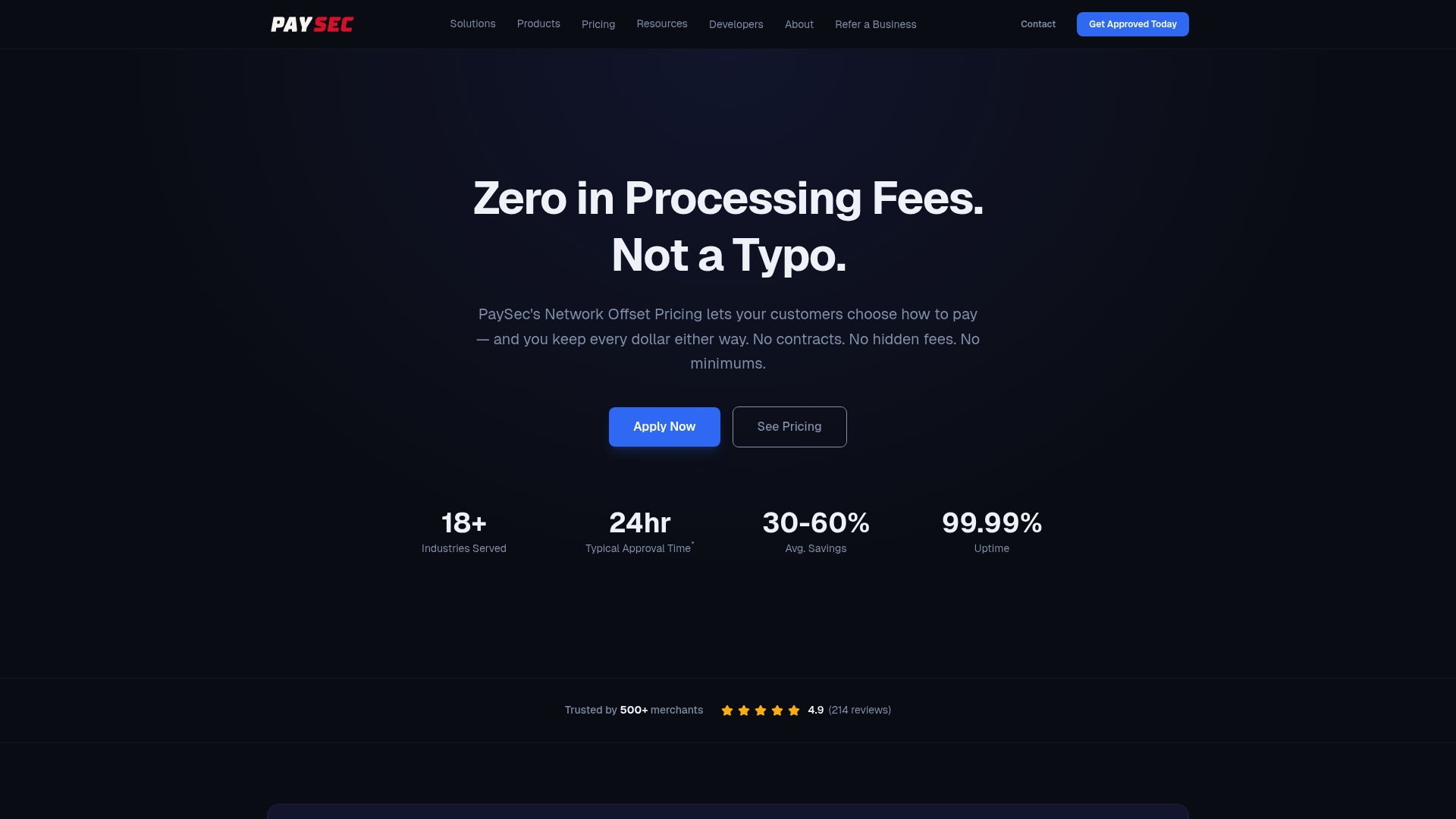
See PaySec pricing options, explore free terminal placement, or start at paysec.ai to see how much your business can save.
A 2026 action checklist
- Pull your last three statements. Identify interchange, assessments and markup.
- Accept the methods customers use. Cards, wallets, mobile, ACH and, where it fits, bank payments.
- Turn on tokenization. Use it for saved cards and recurring billing.
- Layer fraud controls. Add real-time monitoring and two-factor authentication.
- Check your payment pages against PCI DSS 4.0.1. Include script inventory.
- Review settlement speed. Match it to how your customers and vendors now expect to move money.
- Pick transparent pricing. Choose a model that shows every cost layer.
FAQ
What are the biggest payment processing trends in 2026?
The largest are AI and agentic commerce, wider use of wallets and pay-by-bank, regulated stablecoins, real-time rails such as FedNow and RTP, and a push for transparent acquiring costs. PCMI also lists B2B payment modernization as a main trend. Agentic purchases are still a small share of traffic, so fraud tools and data quality come first.
How is AI changing payment fraud prevention?
AI is used on both sides. Merchants use it to score transactions, while agent-led purchases remove signals such as device and mouse data that older models rely on. PwC says agent origination data is not consistently carried in authorization messages. Layered controls and detailed transaction reporting help close that gap.
Should my business accept pay-by-bank?
It is worth considering for high-ticket and B2B sales, where card fees weigh most. Use is still low, with only about 11 to 12% of U.S. consumers having tried it according to the sources above, but interest is higher. Adding ACH and bank transfer acceptance alongside cards is a practical first step.
What does PCI DSS 4.0.1 mean for small businesses?
All requirements are now assessed, including those that were future-dated. If you have an online payment page, that includes an inventory of scripts and tamper detection. A processor with PCI DSS Level 1 compliance, like PaySec, reduces the burden on your team.
How can I lower card processing costs in 2026?
Start by reading your statement to see interchange, assessments and markup separately. Then choose a pricing model that passes interchange through plainly. PaySec's Network Offset Pricing is designed for this, and merchants typically save 30-60% compared with major processors.
Sources
- US Payments Megatrends for 2026, PCMI
- Predictions 2026: Payments, Forrester
- Agentic commerce visibility and payment risk, PwC
- Agentic ecommerce: five key risks for merchants, The Paypers
- 2026 Payment Trends Report, Citizens
- Pay-by-Bank and the Merchant Payments Use Case, Federal Reserve
- US Pay by Bank Trends 2026, eMarketer
- US Payments Forum Summer Market Snapshot
- Payments Industry Update, Phoenix Merchant Partners
- FedNow and the Development of U.S. Fast Payments, Richmond Fed
- 2026 Fees and Payment System Enhancements, Federal Reserve Financial Services
- Free Instant Payments Still Need a Revenue Model, PYMNTS
- The Rise of Embedded and Invisible Payments, Atlanta Fed
- Stablecoins power next era payments, Deloitte Insights
- How payments will evolve: 6 industry trends to watch in 2026, Payments Dive
- Interchange fees assessed to merchants in the United States, Kansas City Fed
- PCI DSS 4.0.1 in 2026: What You Need To Know, SISA