
ACH costs less per transaction than credit cards in almost every scenario, and the gap widens fast as ticket size grows. Cards typically run between roughly one and four percent of the transaction, while ACH transfers cost pennies to a few dollars flat. The practical rule: route invoices, subscriptions, and B2B payments to ACH, keep cards for point-of-sale and consumer checkout where speed and convenience matter more than cost, and factor in that same-day ACH now closes most of the old speed gap.
TL;DR:
- Same-day ACH now nearly bridges the speed gap with credit cards, settling within hours for a small additional fee, reducing delays for bank-to-bank transfers.
- Using ACH for recurring, high-ticket, or B2B payments can cut processing expenses significantly without long-term contracts or minimum volume requirements.
- Credit card disputes pose higher risk of costly chargebacks and extended refunds, while ACH offers more predictable returns within tighter, regulated windows.
- Leaders suggest starting with large, recurring clients to test ACH adoption, then expanding based on observed returns and customer response.
Table of Contents
- ACH vs. Credit Card Fees: How the Two Payment Rails Actually Work
- Credit Card Fees vs. ACH Costs: The Real Numbers
- Cash Flow, Fraud, and Customer Experience: The Costs Beyond the Fee
- How to Cut Your Processing Costs This Quarter
- Where PaySec Fits in the ACH vs. Card Equation
- The Decision Rules That Actually Matter
- Start a Free Savings Review With PaySec
- Sources
- FAQ
ACH vs. Credit Card Fees: How the Two Payment Rails Actually Work
ACH stands for Automated Clearing House, a bank-to-bank transfer network governed by Nacha's operating rules. Money moves directly from a payer's bank account to a merchant's account, batched and processed through the Federal Reserve's ACH network. Standard ACH settles in one to two business days; same-day ACH clears within hours for a modest premium.
Credit card processing works differently. Every swipe, tap, or online entry triggers a chain: the card network (Visa, Mastercard, and similar), the issuing bank, and the acquiring bank all take a cut before the merchant sees the funds.
The fee structures diverge sharply:
- Credit cards charge a percentage of the transaction, built from interchange (paid to the issuing bank), assessment fees (paid to the network), and processor markup.
- ACH charges a flat fee or a small percentage with a low cap, since there's no card network or issuing bank collecting a cut.
- Settlement mechanics differ too. Cards authorize instantly but settle later; ACH clears in batches on a fixed schedule.
That structural difference is why ACH vs credit card fees comparisons almost always favor ACH on pure cost, and why the two rails serve different jobs.
Credit Card Fees vs. ACH Costs: The Real Numbers
Credit card processing fees typically land between about 1.5% and 3.5% per transaction, according to NerdWallet's breakdown of processing costs. Where you land in that range depends on card type (rewards and corporate cards carry higher interchange), channel (card-not-present transactions cost more than in-person swipes), and your processor's markup on top of interchange and assessment fees. WalletHub's rate tracking confirms that effective merchant rates across Visa, Mastercard, Amex, and Discover cluster in that same band.
ACH costs far less per transfer. Typical pricing runs roughly $0.20 to $1.50 per transaction, with enterprise and high-volume merchants often negotiating lower flat rates, per Ramp's analysis of ACH processing costs. Same-day ACH carries a small additional fee but still costs a fraction of card processing.
The math gets dramatic at scale:
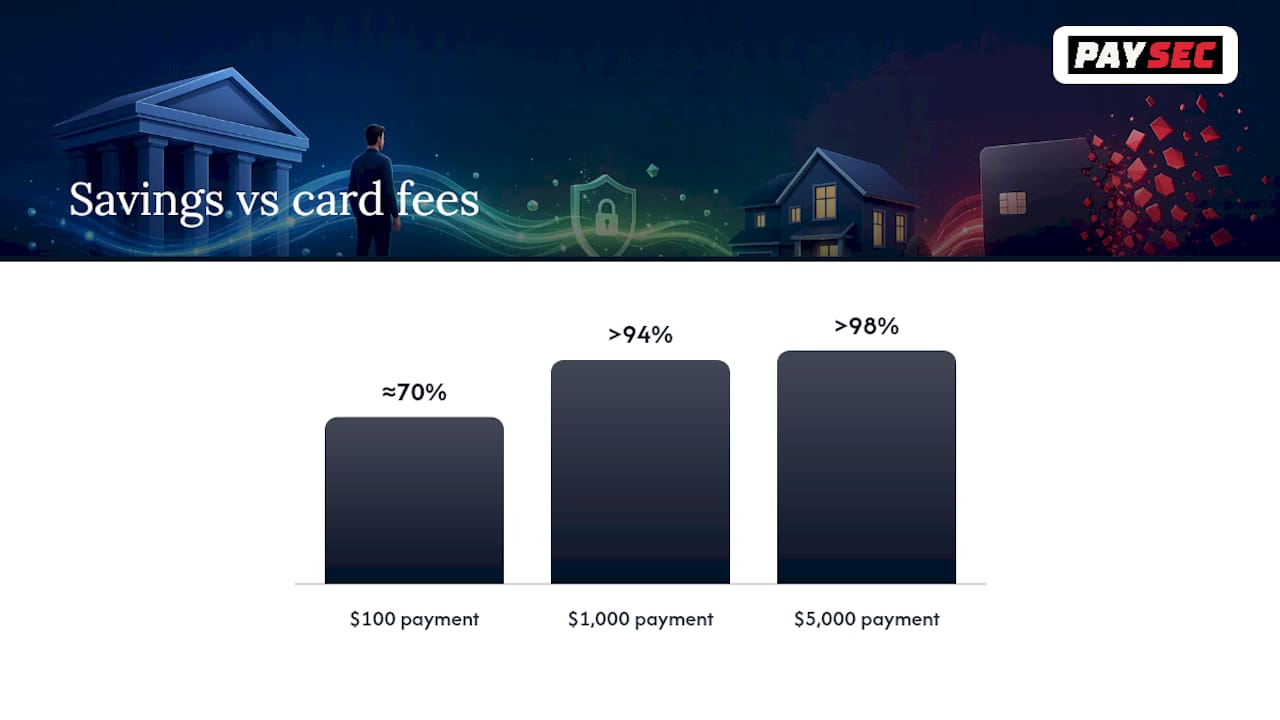
- On a $100 payment, a 2.5% card fee costs $2.50; ACH at $0.75 flat saves $1.75, roughly 70% less.
- On a $1,000 payment, the same 2.5% card fee costs $25; ACH still costs around $0.75 to $1.50, a savings of over 94%.
- On a $5,000 B2B invoice, card fees hit $125; ACH costs stay flat near $1.50, a savings north of 98%.
That gap is exactly why Plaid's research on payment processing costs points to average savings when merchants shift eligible volume from cards to bank-pay rails, especially for high-ticket and recurring transactions. Returns (ACH's version of a failed payment) and NSF fees run a few dollars each. Chargebacks on cards, by contrast, often carry $15 to $25 in processor fees on top of the disputed amount.
Cash Flow, Fraud, and Customer Experience: The Costs Beyond the Fee
The sticker price on a transaction is only part of the total cost. Settlement timing changes how fast money actually lands in your account. Cards authorize in seconds but often settle in one to two business days after the batch closes. Standard ACH clears in one to two business days as well, but same-day ACH, whose usage has climbed steadily according to Nacha's network volume data, now closes most of that timing gap for transfers submitted early enough.
Fraud and dispute mechanics diverge more sharply than settlement speed:
- Card chargebacks give cardholders broad dispute rights and can be filed weeks after a purchase, with the funds pulled back automatically while the merchant fights to recover them.
- ACH returns follow tighter, Nacha-defined windows and reason codes, giving merchants more predictable exposure.
- Reconciliation for ACH is often simpler since batch files map cleanly to bank statements, while card settlements can bury a merchant in AI productivity tools for small businesses that help with interchange categories and downgrade fees that take real effort to audit.
Customer experience cuts the other way. Cards are instant and familiar at checkout; ACH requires bank account details and feels less immediate to consumers, which is why it fits invoices and subscriptions better than a retail counter.
Pro Tip: Run a 60-day side-by-side: route your five largest recurring invoices to ACH and track how many days faster you get paid once returns and reconciliation time are factored in, not just the settlement date.
How to Cut Your Processing Costs This Quarter
- Audit your last three statements. Calculate your effective rate (total fees divided by total volume) rather than trusting the advertised rate. Reading your processing statement line by line usually turns up junk fees hiding in plain sight.
- Switch to interchange-plus pricing. Flat-rate and tiered pricing bundle in hidden markup; interchange-plus pricing shows the real interchange cost plus a transparent processor fee, which Capital One's guide to processing fees notes typically benefits higher-volume merchants most.
- Consider compliant fee-shifting. Dual pricing or card surcharging, where lawful and network-compliant, passes card costs to the customers who choose that method.
- Submit enhanced B2B data. For business and government card volume, providing Visa CEDP or Mastercard Level 3 line-item data often qualifies transactions for lower interchange tiers, per IntelliPay's merchant optimization guide.
- Steer eligible payments to ACH. Make bank payment the default on invoices and subscriptions, and offer a small discount to encourage adoption.
- Tighten operational controls. Require AVS and CVV matching where appropriate and batch settlements consistently to avoid downgrade penalties that silently inflate your effective rate.
Pro Tip: Start the ACH shift with your three highest-dollar recurring clients, not your whole customer base. A 60 to 90 day pilot on a handful of large invoices reveals conversion and dispute patterns before you roll it out wider.
Where PaySec Fits in the ACH vs. Card Equation
PaySec's Network Offset Pricing applies the same logic behind these levers directly to your processing setup. It gives merchants transparent, interchange-based pricing with no hidden markup, no long-term contracts, and no minimums, which lines up with the audit-and-switch strategy above.
Merchants across SaaS, restaurants, eCommerce, healthcare, and CBD retail have seen measurable results from this approach, including substantial savings on processing costs, depending on volume and vertical.
- Support across multiple industries, including retail categories that benefit from transparent pricing.
Comparing flat-rate, interchange-plus, and Network Offset Pricing side by side makes clear which model fits a given transaction mix.
The Decision Rules That Actually Matter
Default to ACH for anything recurring, high-ticket, or B2B: invoices, subscriptions, rent, vendor payments. Default to cards for point-of-sale and one-time consumer purchases where speed and familiarity drive conversion more than the fee does. Pilot the switch on your highest-dollar recurring clients first, watch returns and adoption for 60 to 90 days, then expand.
Spend your energy on interchange-plus and enhanced B2B data if your volume is card-heavy and hard to shift. Spend it on ACH incentives if your revenue comes from recurring or large-ticket transactions that customers can pay by bank. Both levers work. Few businesses need both at full intensity on day one.
— PaySec Marketing Team
Start a Free Savings Review With PaySec
If your invoices and subscriptions still run mostly through cards, you're likely paying a few percent on transactions that could clear for a flat fee under a dollar. PaySec's Network Offset Pricing is built for exactly this gap: merchants processing high-ticket, recurring, or B2B payments in SaaS, restaurants, eCommerce, healthcare, and CBD retail have cut processing costs by 30% to 60% without signing a long-term contract or hitting a minimum volume requirement.
Professional services and invoice-heavy businesses see some of the biggest gains, since B2B tickets are exactly where the ACH-versus-card gap is widest. Visit the professional services processing page to see how the savings apply to your invoice volume, or check PaySec's real-time reporting and analytics dashboard to see your current effective rate before you switch anything. Request a savings review and get a number, not a guess.
This article is general information, not a substitute for advice from a qualified financial advisor. Consult a qualified financial professional about your own circumstances before acting on anything here.
Sources
- Federal Reserve — About the ACH Network
- Nacha — ACH network volume and value statistics
- NerdWallet — Credit card processing fees: a guide for businesses
- Plaid — Payment processing costs and comparison
FAQ
Is It Better to Pay by Credit Card or ACH?
For large, recurring, or B2B payments, ACH is almost always cheaper since it charges a flat fee instead of a percentage. Cards make more sense for point-of-sale and one-time consumer purchases where instant confirmation matters more than cost.
Is It Legal to Charge a 3% Credit Card Fee?
Merchants need to check both state law and their processor's network compliance rules before adding a surcharge.
Can Merchants Charge a 2% Surcharge on Credit Card Payments?
Yes, in most states, as long as the surcharge doesn't exceed the actual cost of acceptance and the merchant discloses it clearly at checkout and on the receipt. A handful of states restrict or ban surcharging entirely, so confirm local rules first.
Is ACH Payment Safer Than Credit Card?
ACH returns follow tighter, Nacha-defined timeframes and reason codes, which gives merchants more predictable dispute exposure than card chargebacks. Cards carry broader consumer protections, meaning cardholders can dispute charges weeks after purchase, so "safer" depends on whether you're weighing merchant risk or cardholder protection.