

TL;DR:
- Payment processing approval confirms that transactions have cleared authorizations, fraud checks, and compliance validations for settlement. It involves external card authorization by banks and internal payment approvals by the finance team, both needing synchronization. Mistaking authorization for payment can cause cash flow issues and unrecognized revenue delays.
Payment processing approval is defined as the confirmation that a transaction has cleared all required authorizations, fraud checks, and compliance validations, making it ready for settlement or disbursement. For business owners, understanding this process is not optional. It directly affects cash flow, vendor relationships, and fraud exposure. The approval chain involves two distinct layers: external card authorization by issuing banks and internal payment approval workflows managed by your finance team. Both must work in sync for payments to move cleanly from request to settlement.
What does payment processing approval mean for card transactions?

Payment processing approval, in the context of card transactions, is the real-time decision an issuing bank makes to reserve funds for a purchase. The industry term for this step is authorization. It is not a transfer of money. It is a hold that confirms the card is valid, the funds exist, and the transaction does not trigger fraud flags.
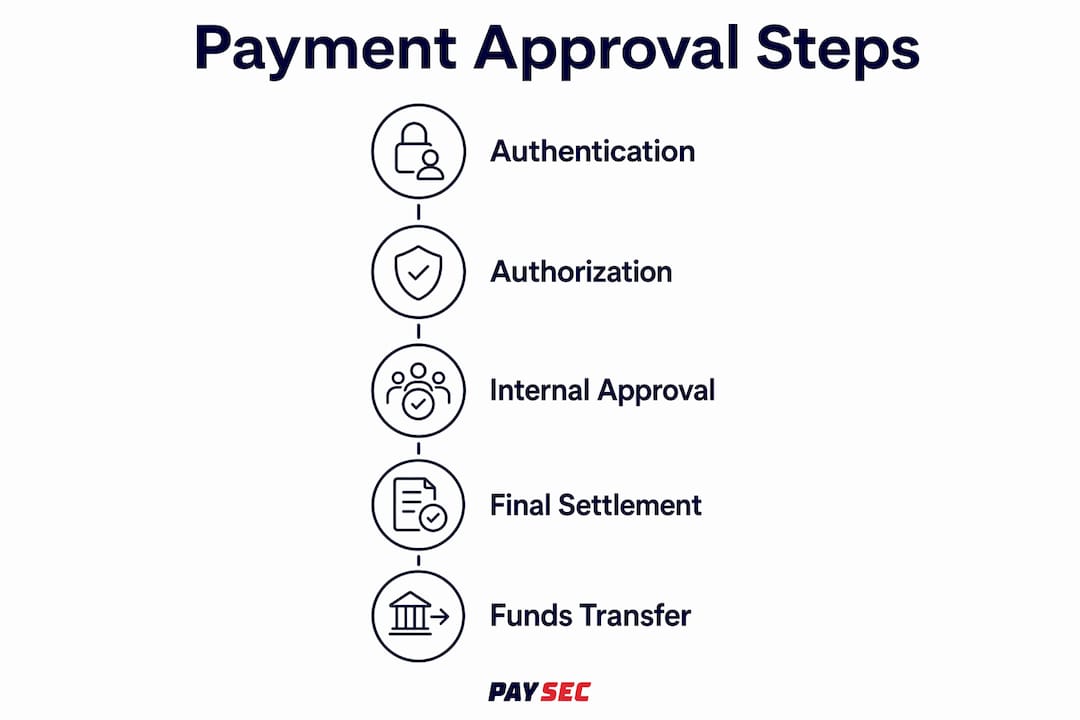
Here is how the payment authorization process works from start to finish:
- Customer initiates payment. The cardholder presents a card at a point-of-sale terminal or enters card details online.
- Merchant's acquiring bank receives the request. The acquiring bank forwards the transaction data through the card network (Visa, Mastercard, American Express) to the issuing bank.
- Issuing bank evaluates the transaction. The bank checks card validity, available balance, and fraud risk in real time.
- Approval or decline is returned. An approval code reserves the funds. A decline code identifies the reason, such as insufficient funds or suspected fraud.
- Funds are held, not moved. Authorization reserves funds but does not transfer money. Settlement occurs 1–3 business days later.
Authentication vs. authorization: what is the difference?
These two terms are often confused, and the confusion costs businesses money. Authentication verifies cardholder identity before authorization validates card status and funds. Tools like 3DS2 (Three-Domain Secure version 2) handle authentication, particularly for online or high-risk transactions. A transaction can pass authentication and still be declined at authorization if funds are insufficient or the issuing bank flags fraud risk. Understanding 3DS2 authentication helps merchants reduce false declines and chargebacks.
| Stage | What happens | Who acts | Timing |
|---|---|---|---|
| Authentication | Verifies cardholder identity | Card network, 3DS2 | Before authorization |
| Authorization | Reserves funds, checks fraud | Issuing bank | Real-time (seconds) |
| Capture | Converts hold to actual transfer | Merchant/acquirer | Within 5–10 days |
| Settlement | Moves money to merchant account | Acquiring bank | 1–3 business days |
Pro Tip: Set your payment terminal or gateway to auto-capture at the time of sale whenever possible. Delayed captures increase the risk of expired holds and lost revenue.
How does internal payment approval work in business accounts payable?
Internal payment approval is the process your finance team uses to review, authorize, and release payments to vendors, contractors, or employees. This is entirely separate from card authorization. Payment approval is the final control point before cash leaves your business, ensuring obligations are validated, authorized by the right roles, and reviewed for compliance and fraud prevention.
The distinction matters. Invoice approval confirms that goods or services were received and the invoice is accurate. Payment approval confirms that the invoice has been coded correctly, budget is available, and the right authority has signed off. Conflating these two steps is one of the most common sources of duplicate payments and audit failures.
Key steps in an internal payment approval workflow
- Invoice receipt and logging. The accounts payable (AP) team receives and records the invoice in the accounting system.
- Invoice verification. The AP specialist matches the invoice against the purchase order and delivery confirmation (three-way match).
- Expense coding. The transaction is assigned to the correct cost center, department, or project code.
- Budget check. The system or AP manager confirms the payment fits within the approved budget.
- Role-based authorization. Payment approval involves multiple roles: requestor, AP specialist, budget owner, and senior finance authority. Thresholds determine who must sign off. A finance manager may approve payments up to $10,000. A CFO approval is required above that.
- Final payment release. Once all approvals are complete, the payment is scheduled and executed.
Automated workflows reduce errors and enforce segregation of duties by design, preventing the same individual from approving both the invoice and the payment stages. That separation is not bureaucracy. It is your primary defense against internal fraud.
Pro Tip: Build threshold-based escalation into your approval workflow from day one. A $500 vendor payment and a $50,000 contractor invoice should never follow the same approval path.
How does payment approval differ from final settlement?
Authorization approval and final settlement are two completely different events, and treating them as the same thing creates serious cash flow problems. Authorization is a promise. Settlement is the actual movement of money.
When a customer's card is approved at your terminal, the issuing bank places a hold on the funds. Your business does not receive those funds yet. The capture step is what converts that hold into a real transfer. If capture does not happen within 5–10 days, the authorization hold expires and the funds are released back to the cardholder. That means an approved transaction can result in zero revenue if your system fails to capture it in time.
Here is a practical example. A hotel pre-authorizes a guest's card for $800 at check-in. The guest checks out three days later. If the hotel's property management system does not send the capture request promptly, the original hold expires. The hotel must re-authorize the card, which may now decline if the guest's available balance has changed.
| Payment lifecycle stage | What it means | Timing | Who controls it |
|---|---|---|---|
| Authorization | Funds reserved, transaction approved | Real-time | Issuing bank |
| Capture | Hold converted to transfer request | Within 5–10 days | Merchant |
| Clearing | Transaction data sent through card network | Same day as capture | Card network |
| Settlement | Funds deposited to merchant account | 1–3 business days | Acquiring bank |
Separating external payment authorization from internal payment approval workflows improves control and reduces reconciliation errors. Businesses that conflate these processes often discover discrepancies only at month-end, when correcting them is far more costly.
The timing gap between authorization and settlement also affects cash flow forecasting. A retailer processing $50,000 in weekend sales may not see those funds until Tuesday or Wednesday. Planning around authorization totals rather than settled amounts leads to inaccurate cash positions.
What are the common challenges in the payment approval process?
The most common payment approval problems are manual bottlenecks, unclear authorization thresholds, and the absence of automated routing. Each one slows down your operations and creates risk.
Manual invoice approval inboxes cause significant payment delays. When approvals depend on a single person checking email, one sick day or vacation can freeze your entire payables cycle. Vendors notice. Late payments damage supplier relationships and can trigger penalty fees or supply disruptions.
Common pitfalls to avoid
- No defined approval thresholds. Without clear dollar limits tied to roles, every payment becomes a judgment call. This creates bottlenecks and inconsistency.
- Role overlap. Allowing one person to request, approve, and release a payment eliminates the control that segregation of duties provides.
- No audit trail. Manual approvals via email or verbal sign-off leave no traceable record. Audits become painful and fraud investigations become nearly impossible.
- Delayed capture on card transactions. As covered above, failing to capture authorized funds within the hold window results in expired authorizations and lost revenue.
- Ignoring decline reason codes. A decline is not just a "no." Codes like "insufficient funds," "do not honor," or "card reported lost" each require different responses. Treating all declines the same wastes recovery opportunities.
Speed in the payment approval process correlates directly with supplier satisfaction and reduced operational bottlenecks. Automation delivers the most significant gains here.
Best practices for faster, more secure approvals
The most effective approach combines clear policy with technology. Define approval thresholds in writing and map them to specific roles. Implement a workflow tool that routes invoices automatically based on amount, vendor type, or department. Set up automated notifications so approvers are alerted immediately when action is required.
For card transaction approvals, work with your payment processor to configure auto-capture settings and monitor authorization-to-capture ratios. A high ratio of authorizations that never convert to captures signals a technical problem or a process gap worth investigating. Paysec's payment data security practices offer a strong framework for understanding how approval steps connect to fraud prevention at the transaction level.
Pro Tip: Track your authorization approval rate monthly. An approval rate below 85% signals a problem with your payment setup, your customer base, or your fraud filters. Each percentage point recovered translates directly to revenue.
Key takeaways
Payment processing approval covers two distinct processes: external card authorization by issuing banks and internal payment approval by your finance team, and both must be managed separately to protect cash flow and prevent fraud.
| Point | Details |
|---|---|
| Authorization is not payment | Card approval reserves funds only; settlement moves money 1–3 business days later. |
| Capture timing is critical | Authorized holds expire in 5–10 days; missed captures mean lost revenue and re-authorization. |
| Internal approval needs structure | Role-based thresholds and segregation of duties prevent fraud and duplicate payments. |
| Automation reduces delays | Automated routing and notifications eliminate manual bottlenecks that slow vendor payments. |
| Approval rate is a KPI | Monitoring your authorization approval rate monthly reveals processing issues before they compound. |
The part most business owners get wrong about payment approvals
From working with merchants across retail, SaaS, healthcare, and food service, one misunderstanding comes up more than any other: business owners treat an authorization approval as proof that they have been paid. They have not. They have received a promise.
This matters most during high-volume periods. A restaurant processing 300 covers on a Saturday night may see $12,000 in approved authorizations on the terminal. But if the POS system has a batch settlement delay, or if a handful of pre-authorizations were placed hours earlier and the hold windows are tightening, the actual settled amount can be lower. That gap between approved and settled is where cash flow surprises live.
The internal side of this equation is equally mismanaged. Many small and mid-size businesses run their entire accounts payable process through a shared email inbox. One person receives invoices, codes them, and approves payment. That is not a workflow. That is a single point of failure and a fraud risk that no amount of card-level security can compensate for.
My recommendation is to treat external authorization and internal payment approval as two separate systems that need to be designed, monitored, and improved independently. Align them at the reporting level so your finance team can reconcile authorized amounts against settled funds and against approved payables in one view. That alignment is where real financial control lives.
Businesses that invest in this structure do not just reduce fraud. They also close their books faster, respond to vendor inquiries with confidence, and make better cash flow decisions because their data is clean.
— Paysec Marketing Team
How Paysec helps you take control of payment processing
Paysec works with merchants across 18+ industries to reduce the cost and complexity of payment processing. Through Network Offset Pricing, Paysec passes wholesale interchange rates directly to merchants, delivering savings of 30–60% compared to standard processing fees. There are no hidden fees, no minimums, and no long-term contracts. Whether you operate in eCommerce, healthcare, SaaS, or food service, Paysec provides detailed transaction reporting that makes reconciling authorizations and settlements straightforward. Explore tailored solutions by industry or review merchant services options to see how Paysec fits your payment approval workflow.
FAQ
What does payment processing approval mean?
Payment processing approval means a transaction has passed authorization checks by the issuing bank, confirming the card is valid, funds are available, and no fraud flags were triggered. It reserves funds but does not transfer money to the merchant.
What is the difference between authorization and settlement?
Authorization is a real-time hold placed on a cardholder's funds. Settlement is the actual transfer of those funds to the merchant's account, which occurs 1–3 business days after capture.
Why would an approved payment not result in funds received?
If the merchant fails to capture the authorized transaction within 5–10 days, the hold expires and the funds are released back to the cardholder, meaning no money is transferred despite the original approval.
What roles are involved in an internal payment approval process?
Internal payment approval typically involves a requestor, an accounts payable specialist, a budget owner, and a senior finance authority such as a CFO, with approval thresholds determining which roles must sign off on each payment.
How can businesses speed up their payment approval process?
Automating invoice routing, setting clear role-based thresholds, and using workflow tools with built-in notifications are the most effective ways to reduce approval delays and maintain strong financial controls.