

TL;DR:
- Payment data is essential for accurate SaaS financial reporting, linking subscription transactions to revenue figures. Centralizing this data improves reconciliation speed, reduces errors, and enhances the accuracy of metrics like MRR, ARR, and churn. Using continuous reconciliation workflows and analyzing failure patterns helps SaaS teams improve revenue recovery and customer retention.
Payment data is the primary source of truth for SaaS financial reporting, connecting every subscription transaction to the revenue figures that appear in board decks, audits, and investor updates. The role of payment data in SaaS reporting extends far beyond simple bookkeeping. It determines the accuracy of Monthly Recurring Revenue (MRR), Annual Recurring Revenue (ARR), churn calculations, and deferred revenue schedules governed by ASC 606. Without clean, centralized payment data, SaaS finance teams operate on estimates rather than facts. Paysec works with SaaS businesses across 18+ industries and sees this gap play out in reconciliation errors, missed churn signals, and reporting delays that erode stakeholder confidence.
How does payment data integrate with SaaS billing and accounting systems?
Payment data flows from at least four distinct sources in a typical SaaS stack: billing platforms, payment service providers (PSPs), bank accounts, and ERP or general ledger systems. Each source captures a different slice of the same transaction. A billing platform records the invoice amount. A PSP records the actual charge, net of fees. The bank records the settlement, often days later. The ERP records recognized revenue under ASC 606, which may differ from all three. Reconciling these four views is where most SaaS finance teams lose time and accuracy.

Data fragmentation is the biggest SaaS reporting bottleneck, not data collection itself. That distinction matters because teams often respond to reporting problems by collecting more data, when the real fix is centralizing what they already have. Centralizing raw data from PSPs, banks, and billing platforms into a single source of truth can reduce manual data stitching by over 70%.
The manual reconciliation problem
SaaS finance teams spend 8–12 hours weekly on manual payment data collection for reconciliation. That is roughly one full business day every week spent on a task that automation handles in minutes. The time cost is real, but the accuracy cost is worse. Manual processes introduce transcription errors, version mismatches, and timing gaps that corrupt the very metrics finance teams are trying to report.
The matching logic required to reconcile SaaS transactions is genuinely complex. Fuzzy matching and many-to-one transaction matching are critical techniques for reconciling partial refunds, prorations, and bundled settlements. A single subscription upgrade mid-cycle can generate a proration credit, a new charge, and a settlement that arrives as a net figure. Exact matching fails on these cases. Finance teams need matching rules that account for timing differences, fee deductions, and split transactions.
Pro Tip: Build your reconciliation workflow to run continuously, not just at month-end. Continuous reconciliation workflows detect mismatches early and eliminate the end-of-period scramble that delays board reporting.
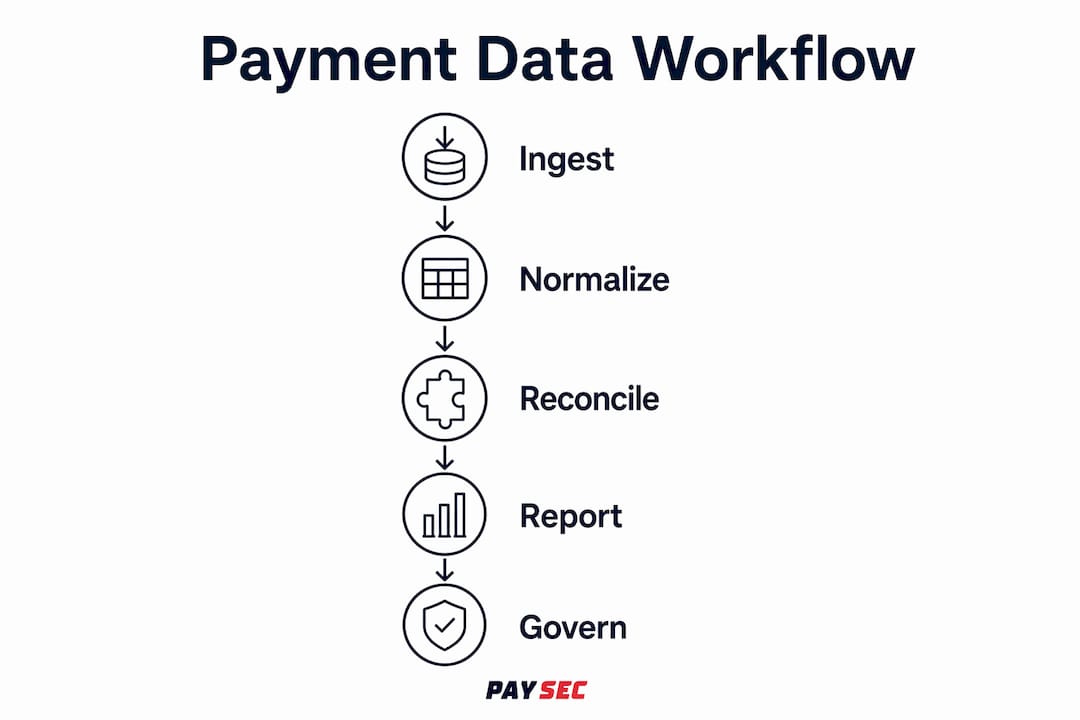
What a centralized payment data workflow looks like
| Step | Action | Outcome |
|---|---|---|
| Ingest | Pull raw data from PSPs, banks, billing platforms daily | Single transaction ledger |
| Normalize | Apply matching rules (exact, fuzzy, many-to-one) | Consistent transaction records |
| Reconcile | Match billing events to settlements and GL entries | Verified revenue figures |
| Report | Feed clean data to MRR, ARR, and deferred revenue schedules | Audit-ready financial reports |
The normalization step is where most teams underinvest. Standardizing authorizations, fees, settlements, and disputes into a unified format lets teams focus on analysis rather than data cleanup. Without normalization, every reporting cycle restarts the same manual cleanup process.
What payment metrics are essential for SaaS financial reporting?
Payment data directly drives the accuracy of every core SaaS financial metric. Getting these metrics right requires understanding which payment data feeds each one and where distortions enter the calculation.
-
Monthly Recurring Revenue (MRR). MRR is the normalized monthly value of all active subscriptions. Payment data confirms which subscriptions are actually paid versus invoiced. An invoice that goes unpaid for 30 days inflates MRR if the billing platform counts it as active. Payment confirmation data corrects this.
-
Annual Recurring Revenue (ARR). ARR is MRR multiplied by 12, but aligning ARR with GAAP accounting requires systematic bridging because payment data often reflects cash flow or bookings out of sync with revenue recognition under ASC 606. A two-year contract paid upfront creates a large cash event but only 1/24th of recognized revenue per month.
-
Churn rate. Voluntary churn is tracked through cancellations. Involuntary churn is tracked through payment failures. Payment data is the only source that captures involuntary churn accurately. Without it, churn calculations undercount actual revenue loss.
-
Payment failure rate. This metric measures the percentage of subscription charges that fail on the first attempt. A rising failure rate signals either card expiration patterns, issuer friction, or product dissatisfaction. Each cause requires a different response.
-
Revenue recovery rate. This measures how much failed payment revenue is recovered through retry logic and dunning sequences. Payment data is the only way to calculate this accurately. A high failure rate paired with a high recovery rate is manageable. A high failure rate with a low recovery rate is a cash flow problem.
Pro Tip: Track billings, recognized revenue, and deferred revenue as three separate line items in every report. Separating these figures is required under ASC 606 and prevents the common mistake of treating cash received as earned revenue.
The distinction between billings and recognized revenue trips up many SaaS finance teams. Billings reflect what customers were charged. Recognized revenue reflects what has been earned under the delivery schedule. Deferred revenue is the gap between them. All three figures come from payment data combined with contract terms. Reporting only one of the three gives investors and auditors an incomplete picture of revenue quality.
Dunning effectiveness is another metric payment data enables. A well-designed dunning sequence retries failed charges at intervals calibrated to card network behavior, sends reminder emails at optimal timing, and escalates to account management for high-value accounts. Payment data tells you which steps in that sequence recover revenue and which do not. Without transaction-level data, dunning is guesswork.
How does payment data analytics reveal customer behavior and reduce churn?
Payment data reveals customer behavior that product analytics and CRM data miss entirely. A customer who stops logging in is a churn risk. A customer whose payment fails three times in a row is a near-certain churn event. The difference is that payment failure data is available in real time, while behavioral signals from product usage often lag by days or weeks.
Payment failure data signals product-market fit issues and operational friction that traditional product analytics miss. Billing failures correlate with customer churn behavior in ways that go beyond simple non-payment. A spike in failures among a specific customer cohort, such as customers on a particular plan or in a particular geography, points to a systemic issue rather than individual financial problems.
- Retry pattern analysis identifies which card networks and issuing banks generate the highest failure rates, allowing teams to route transactions more effectively or prompt customers to update payment methods before failures occur.
- Cohort-level failure tracking segments customers by plan, acquisition channel, or contract start date to find patterns invisible in aggregate failure rates.
- Dunning sequence optimization uses payment data to test which retry intervals and communication timing recover the most revenue from failed charges.
- Refund and dispute clustering identifies product areas or customer segments generating disproportionate chargebacks, which often signals onboarding friction or unmet expectations.
"Adding more PSPs is rarely the fix for high payment failure rates. Improved payment analytics visibility uncovers the specific authorization and renewal failure issues causing revenue leakage, reducing the time to identify root causes from days to minutes."
Integrating payment data into RevOps and CRM dashboards gives customer success teams operational visibility they cannot get from contract data alone. Aligning CRM and payment data reduces discrepancies between forecast, cash, and recognized revenue, and it surfaces at-risk accounts before they reach the cancellation stage. A customer success manager who can see payment retry history alongside product usage data makes better retention decisions than one working from contract snapshots alone.
Payment failure spike analysis combined with subscriber path quality assessment uncovers systemic billing and product engagement issues that traditional behavioral analytics miss. This is the most underused application of payment data in SaaS. Most teams use payment data for reconciliation. The teams that use it for product decisions gain a material advantage in retention and expansion revenue.
What are the best practices for SaaS payment reporting cadence and governance?
SaaS financial reporting follows three distinct cadences, and each one has different data requirements and stakeholder expectations.
Monthly operational reports are delivered 5–7 business days after month close and are often contractual obligations for Series A investors. These reports require clean, reconciled payment data from the prior month. A finance team that spends the first week of every month manually reconciling PSP settlements cannot meet this deadline reliably. Quarterly reports follow within 2–3 weeks of quarter close and typically include deeper analysis of cohort performance, churn trends, and cash flow. Annual reports require audited financials, which means every payment transaction must be traceable to a source document.
Presenting revenue clearly to investors and boards
SaaS board reports must clearly separate billings, recognized revenue, and deferred revenue to accurately convey revenue quality. Presenting only total billings overstates near-term revenue quality for companies with long contract terms. Presenting only recognized revenue understates the contracted revenue pipeline. Boards and investors need all three figures side by side to assess the health of the business.
| Report type | Primary audience | Key payment data required |
|---|---|---|
| Monthly operational | CFO, Series A investors | MRR, payment failure rate, recovery rate |
| Quarterly board | Board of directors, lead investors | ARR, churn, billings vs. recognized revenue |
| Annual audit | External auditors, regulators | Full transaction ledger, deferred revenue schedules |
Misaligned payment and accounting data is the most common cause of audit friction in SaaS companies. When the billing platform shows one MRR figure and the general ledger shows another, auditors require reconciliation documentation for every discrepancy. Separating investor metrics from operational dashboards ensures financial reporting credibility. The operational dashboard tracks payment performance in real time. The investor report presents GAAP-compliant figures with proper revenue recognition. Mixing the two creates confusion and erodes trust.
Pro Tip: Reconcile payment data continuously rather than in batches. Continuous reconciliation maintains reporting consistency before close periods and eliminates the end-of-period surprises that delay investor reporting and create audit issues.
Governance also means controlling who sees what data and when. Raw payment transaction data contains sensitive customer information. Aggregated reporting metrics do not. Finance teams should build reporting pipelines that deliver aggregated, role-appropriate views to business stakeholders while maintaining full transaction-level data for audit and compliance purposes. This separation protects customer data and simplifies compliance with payment card industry standards.
Key Takeaways
Payment data is the foundation of accurate SaaS financial reporting, and centralizing it across billing, PSP, and accounting systems is the single highest-impact improvement a SaaS finance team can make.
| Point | Details |
|---|---|
| Centralize payment data first | Consolidating PSP, bank, and billing data reduces manual reconciliation time by over 70%. |
| Track three revenue figures | Report billings, recognized revenue, and deferred revenue separately to satisfy ASC 606 and investor requirements. |
| Use payment data for churn signals | Payment failure patterns reveal at-risk customers earlier than product usage data alone. |
| Run continuous reconciliation | Continuous workflows eliminate end-of-period surprises and keep audit documentation current. |
| Align reporting cadence to stakeholders | Monthly, quarterly, and annual reports each require different payment data views and levels of detail. |
Payment data is the reporting layer most SaaS teams underestimate
The Paysec Marketing Team works closely with SaaS finance operators, and the pattern we see most often is this: teams invest heavily in billing platforms and CRM systems, then treat payment data as an afterthought. The result is a reporting stack where the most financially consequential data, the actual charges, settlements, and failures, sits in a PSP dashboard that nobody checks until something goes wrong.
The teams that get this right do something counterintuitive. They treat payment data as a product in itself. They build pipelines that normalize and centralize transaction data daily. They connect that data to their CRM so customer success can act on payment signals. They use failure rate trends to inform product decisions, not just dunning sequences. The shift from reactive to proactive is entirely driven by data infrastructure, not headcount.
The future of SaaS payment reporting is AI-assisted analysis on top of centralized, normalized payment data. Transitioning from manual dashboard monitoring to AI-assisted centralized payment analytics lets SaaS teams shift focus from data wrangling to responding to what the data reveals. That shift is already happening at well-run SaaS companies. The ones still doing manual reconciliation are competing with one hand tied behind their back.
Our advice is straightforward. Start with centralization. Get all your payment data into one place before you build any dashboards or reports. Then build the reconciliation logic. Then layer on analytics. The teams that try to build analytics on fragmented data sources spend more time maintaining the system than using it.
— Paysec Marketing Team
Paysec brings payment data clarity to SaaS finance teams
SaaS finance teams that want accurate reporting without the manual overhead need a payment infrastructure that centralizes data from every source automatically.
Paysec unifies payment data from PSPs, banks, and billing platforms into a single, audit-ready source of truth. The platform's detailed transaction reporting gives finance teams the visibility they need to track MRR, ARR, churn, and deferred revenue with confidence. Paysec's Network Offset Pricing also delivers 30–60% savings on processing costs, which means the reporting infrastructure pays for itself. There are no hidden fees, no minimums, and no long-term contracts. Explore Paysec's pricing and processing options to see how it fits your SaaS reporting stack.
FAQ
What is the role of payment data in SaaS reporting?
Payment data is the source of truth that connects subscription charges to reported revenue figures, including MRR, ARR, deferred revenue, and churn. Without clean payment data, SaaS financial reports reflect billing activity rather than actual cash and revenue performance.
How does payment data affect MRR and ARR accuracy?
Payment data confirms which subscriptions are actually paid, correcting MRR inflation caused by unpaid invoices counted as active by billing platforms. Aligning ARR with GAAP accounting requires bridging payment data with revenue recognition schedules under ASC 606.
Why does payment failure data matter for churn analysis?
Payment failures are the primary driver of involuntary churn, and failure patterns by cohort or plan reveal systemic issues that voluntary cancellation data misses. Tracking retry rates and recovery rates gives finance teams an early warning system for revenue leakage.
How often should SaaS companies reconcile payment data?
Continuous reconciliation is the standard for well-run SaaS finance operations. Monthly batch reconciliation creates end-of-period bottlenecks and delays investor reporting, while continuous workflows keep data current and audit-ready at all times.
What is the difference between billings and recognized revenue in SaaS?
Billings reflect the total amount charged to customers in a period. Recognized revenue reflects only the portion earned under the service delivery schedule, as required by ASC 606. The gap between them is deferred revenue, which represents future obligations already paid for by customers.