

TL;DR:
- A SaaS payment stack is an integrated system of technologies that manages every aspect of subscription billing and payments. It includes multiple layers such as gateways, orchestration platforms, and reconciliation systems to optimize approval rates and reduce revenue loss. Implementing a strategic, multi-PSP orchestration approach enhances reliability, lowers costs, and minimizes customer churn through smart retry and fallback mechanisms.
A SaaS payment stack is defined as an integrated framework of payment technologies that powers, manages, and optimizes every transaction for subscription-based Software-as-a-Service companies. Most finance teams treat payment processing as a vendor decision. It is actually an architectural one. The difference between a company that loses 8% of revenue to failed renewals and one that loses 2% often comes down to how deliberately they designed their payment stack. Platforms like Spreedly, Primer, and Akurateco exist precisely because a single gateway was never enough for a SaaS business operating at scale.
What is a SaaS payment stack explained for business owners?
A SaaS payment stack is the collection of software layers that work together to accept, process, route, reconcile, and report on payments across a subscription business. It is not a single product. It is a system, and understanding it as a system is the first step toward managing it effectively.
The term "payment stack" is informal shorthand for what the industry more precisely calls a payment infrastructure or payment orchestration architecture. Both terms describe the same reality: multiple specialized tools connected to handle distinct stages of the payment lifecycle, from the moment a customer enters their card number to the moment that revenue lands in your bank account and appears correctly in your general ledger.
SaaS businesses face payment challenges that traditional retail businesses do not. Recurring billing introduces failed payment cycles, dunning workflows, and proration logic. Global expansion adds currency conversion, local payment method requirements, and cross-border compliance. A SaaS payment gateway must handle subscription billing, recurring payments, and integration with CRMs and financial software simultaneously. That scope demands a stack, not a single tool.
What are the core components of a SaaS payment stack?
Every SaaS payment stack contains six functional layers. Each layer handles a distinct job, and the quality of your stack depends on how well those layers communicate with each other.
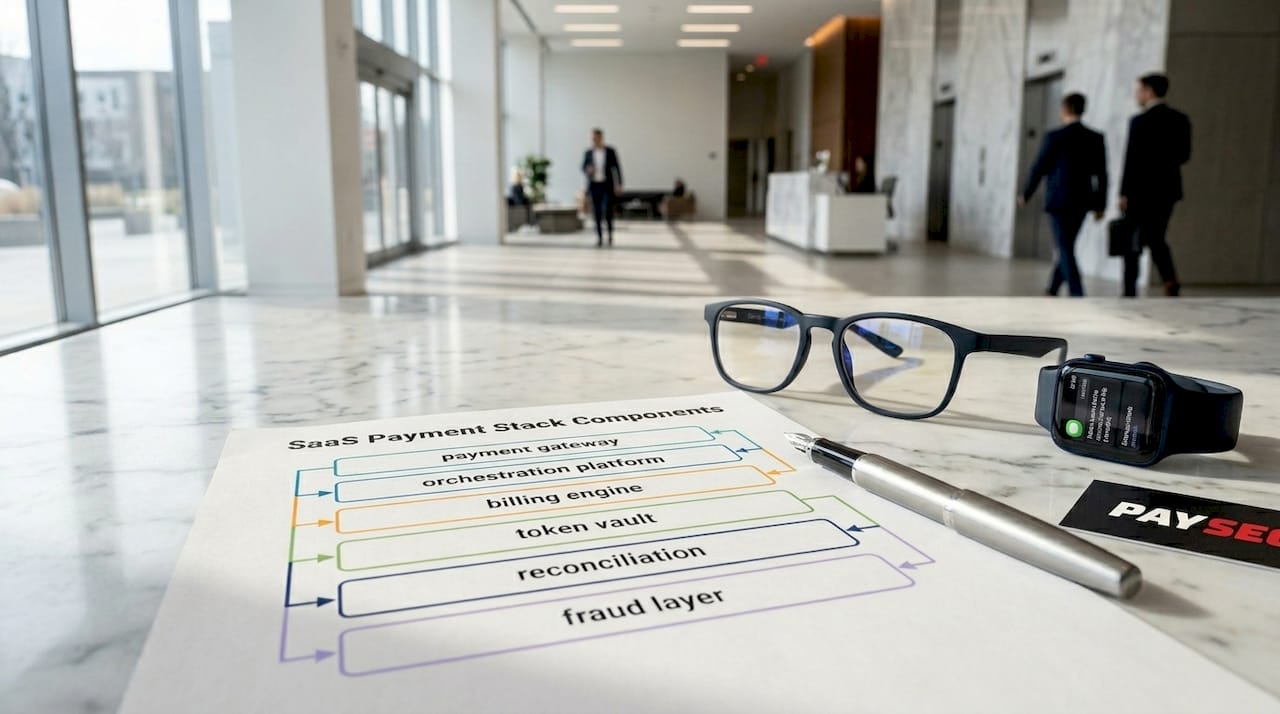
Payment gateway
The payment gateway is the entry point. It encrypts card data, sends authorization requests to card networks like Visa and Mastercard, and returns an approval or decline. A gateway encrypts sensitive data and facilitates authorization for both one-time and recurring transactions. Without a gateway, no transaction begins.
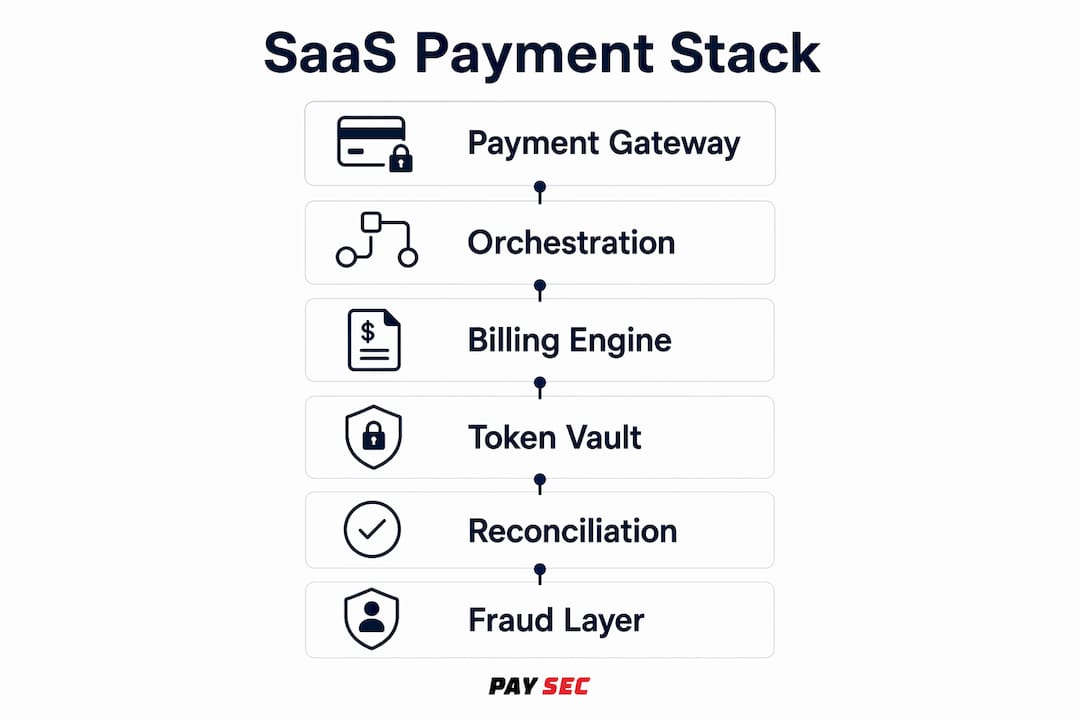
Payment orchestration platform
The orchestration layer sits above the gateway and manages routing logic across multiple payment service providers (PSPs). Platforms like Spreedly, Primer, Gr4vy, Yuno, BR-DGE, IXOPAY, Paydock, and APEXX are the leading orchestration platforms SaaS companies evaluate in 2026. The orchestration layer decides which PSP processes each transaction based on cost, approval probability, geography, and real-time provider health.
Subscription management and billing engine
This layer handles the logic of recurring revenue. It manages plan upgrades, downgrades, trial periods, proration, and dunning sequences when payments fail. Tools in this category integrate directly with the gateway and orchestration layers to trigger charges at the right time with the right amount.
Tokenization vault
Tokenization replaces raw card data with a non-sensitive token stored in a secure vault. This is what allows a SaaS company to charge a customer's card on renewal without storing the actual card number. It is also the mechanism that makes switching PSPs possible without asking customers to re-enter payment details.
Reconciliation and reporting system
Every transaction that flows through your stack must be matched against bank settlements, PSP reports, and your accounting system. A payment platform manages entire payment lifecycles including invoicing, reporting, fraud detection, and accounting integration. Without automated reconciliation, finance teams spend days each month manually matching records.
Fraud and compliance layer
This layer screens transactions for fraud signals, enforces 3D Secure authentication where required, and maintains PCI DSS compliance. For SaaS companies operating across multiple jurisdictions, this layer also handles tax calculation and regulatory reporting.
Pro Tip: Map your payment stack as a data flow diagram before evaluating any new vendor. Most integration problems become visible on paper before they become expensive in production.
How does payment orchestration compare to single-provider setups?
The single-provider model is simple: you sign a contract with one PSP, integrate their API, and route all transactions through them. The orchestration model connects multiple PSPs through a single integration layer and routes each transaction to the optimal provider. The difference in outcomes is significant.
Orchestration platforms reduce dependency on single providers, improve authorization rates, and deliver unified reporting with retry logic. That last point matters more than most finance teams realize. A single PSP outage during a billing cycle can mean thousands of failed renewals and the churn that follows.
| Factor | Single-provider model | Orchestration model |
|---|---|---|
| Provider dependency | High. One outage affects all transactions | Low. Fallback cascades to backup providers |
| Authorization rate | Fixed by one provider's bank relationships | Optimized by routing to the best-performing provider |
| Cost optimization | No leverage. One rate applies | Smart routing reduces per-transaction cost |
| Integration complexity | Simple. One API | Higher upfront. Single integration point thereafter |
| Reporting | One provider's dashboard | Unified view across all providers |
| Switching cost | High. Full re-integration required | Low. Swap providers without code changes |
Payment orchestration routes transactions through the optimal provider with fallback cascading, consolidating reporting and tokenization via a single integration. This architecture also enables cost optimization. When two PSPs both support a transaction type, the orchestration layer can route to the cheaper one automatically.
The retry logic built into orchestration platforms is particularly valuable for SaaS subscription businesses. When a renewal charge fails, the system can immediately retry through a different PSP before triggering a dunning email. That silent recovery keeps customers active without any friction on their end.
"Payment orchestration acts as an economic and reliability layer by smartly routing transactions and cascading failovers, avoiding single-provider lock-in that hurts approval rates and uptime." — Payment Orchestration: Architecture, Vendors, Buyer Guide
For a practical example of how this architecture reduces costs in a real SaaS environment, the SaaS marketplace case study from Paysec shows a 42% reduction in processing costs through multi-provider routing.
What types of SaaS payment stacks should you consider?
SaaS payment infrastructure exists on a spectrum from simple to fully custom. The right choice depends on your transaction volume, geographic footprint, technical resources, and growth trajectory.
-
Basic gateway stack. One PSP, one integration, minimal configuration. This works for early-stage SaaS companies with under $1M ARR processing in a single market. The tradeoff is zero redundancy and no routing optimization.
-
Orchestrated multi-PSP stack. An orchestration platform connects two or more PSPs. This is the standard architecture for growth-stage SaaS companies. Platforms like Spreedly and Primer handle the routing layer while you maintain relationships with multiple PSPs for redundancy and cost leverage.
-
White-label PayFac model. A payment facilitator (PayFac) model allows a SaaS company to onboard sub-merchants and process payments on their behalf. This is common in vertical SaaS platforms serving SMBs. The revenue upside is significant, but so is the compliance burden. PayFac registration requires underwriting capability and ongoing risk management.
-
Embedded finance stack. The most advanced model. Vertical SaaS companies embed payments and finance products directly, adding lending, insurance, and payroll layers after establishing payment infrastructure. Embedding finance features can increase revenue per customer by 2 to 5 times and raises customer lifetime value substantially. This model treats payments as a product, not a cost center.
| Stack type | Best for | Technical complexity | Revenue potential |
|---|---|---|---|
| Basic gateway | Early-stage, single market | Low | Standard |
| Orchestrated multi-PSP | Growth-stage, multi-market | Medium | Improved margins |
| White-label PayFac | Vertical SaaS platforms | High | High |
| Embedded finance | Mature vertical SaaS | Very high | Very high |
For SaaS companies integrating with financial platforms, the Paysec and Sage Intacct integration demonstrates how zero processing fee models work within existing financial software ecosystems.
Pro Tip: Do not build toward a PayFac model unless you have dedicated compliance and risk staff. The revenue is real, but so is the regulatory exposure. Many SaaS companies underestimate the ongoing operational cost.
How do SaaS payment stacks improve business performance?
A well-designed payment stack does not just process transactions. It actively protects revenue, reduces operational overhead, and creates better customer experiences.
Integrated payment stacks reduce payment friction, support multiple payment methods and global currencies, and automate reconciliation and reporting. Each of those outcomes maps directly to a business metric finance teams track.
The most direct impact is on churn. Failed payments are the leading cause of involuntary churn in SaaS. When your stack includes smart retry logic, fallback routing, and automated dunning, you recover a meaningful percentage of charges that would otherwise result in cancellations. Some SaaS companies report recovering 20 to 40 percent of initially failed renewals through retry orchestration alone.
Global payment support is the second major performance driver. Accepting local payment methods like SEPA Direct Debit in Europe, PIX in Brazil, or UPI in India removes friction for international customers who would otherwise abandon at checkout. A stack that handles currency conversion and local acquiring natively expands your addressable market without requiring separate regional infrastructure.
Reconciliation automation is the third lever. Manual reconciliation is not just slow. It introduces errors that compound over time, creating margin ambiguity that makes financial reporting unreliable. Automated reconciliation that maps settlement files to subscription events to ledger entries gives your finance team accurate data without the manual overhead.
Compliance benefits are often underestimated. A stack with built-in PCI DSS scope reduction through tokenization, automated tax calculation, and 3D Secure authentication handles regulatory requirements that would otherwise require dedicated engineering resources. For SaaS companies operating across the EU, the US, and APAC simultaneously, this is not optional. It is the cost of operating legally.
Key takeaways
A SaaS payment stack is a multi-layer infrastructure system, and treating it as a strategic asset rather than a vendor contract is what separates high-retention SaaS businesses from those bleeding revenue through failed payments and manual reconciliation.
| Point | Details |
|---|---|
| Stack definition | A SaaS payment stack is a system of integrated layers, not a single product or vendor. |
| Orchestration advantage | Multi-PSP orchestration improves authorization rates, reduces costs, and eliminates single-provider downtime risk. |
| Stack type selection | Choose your stack type based on ARR, geographic footprint, and whether payments are a cost center or a revenue line. |
| Churn protection | Smart retry logic and fallback routing recover failed renewals before they become cancellations. |
| Reconciliation accuracy | Automated reconciliation eliminates margin ambiguity and reduces finance team overhead significantly. |
Why most SaaS teams underestimate their payment stack
From the Paysec Marketing Team
After working with SaaS businesses across 18-plus industries, the pattern we see most often is this: payment infrastructure gets designed by engineers optimizing for speed to market and then handed to finance teams who inherit the technical debt. The result is a stack that works until it does not, and when it fails, the failure is expensive.
The most common mistake is treating retries as a simple "try again" operation. Retries in orchestration must guarantee idempotency and correctly record ledger entries to avoid data inconsistencies and financial reporting errors. We have seen SaaS companies double-count revenue in their CRM because a retry succeeded after the original charge was already recorded as failed. That kind of error does not show up until an audit.
The second mistake is building a stack that cannot be changed without a full re-integration. Provider lock-in is a real cost. When a PSP raises rates or degrades performance, the ability to swap them out without touching application code is worth more than any short-term rate discount they offer upfront.
The insight that changes how most finance professionals think about this: payment stack design is an end-to-end data model problem. Every orchestration decision, every subscription event, every settlement file needs to map cleanly to your finance ledger. Companies that design the data model first and choose vendors second build stacks that scale. Companies that do it the other way spend years patching reconciliation gaps.
The future of SaaS payment infrastructure is embedded finance. Payments are becoming a revenue line, not just a cost. The SaaS companies that recognize this early and build the infrastructure to support it will have a structural advantage that compounds over time.
— PaySec Marketing Team
How Paysec helps SaaS businesses build smarter payment infrastructure
SaaS companies processing significant transaction volume pay a hidden tax every month in the form of processing fees that compound across every renewal, upgrade, and one-time charge. Paysec's Network Offset Pricing model eliminates that tax by passing wholesale interchange rates directly to merchants, with no hidden fees, no minimums, and no long-term contracts.
For SaaS and tech businesses specifically, Paysec supports multi-PSP routing, detailed transaction reporting, and compliance-ready payment processing across 18-plus industries. Clients see measurable savings of 30 to 60 percent compared to standard processing arrangements. If you want to understand what a better-designed payment stack could mean for your margins, explore Paysec's platform and see how the numbers change.
FAQ
What is a SaaS payment stack?
A SaaS payment stack is an integrated system of payment technologies including gateways, orchestration platforms, billing engines, tokenization vaults, and reconciliation tools that together manage the full payment lifecycle for subscription-based software businesses.
How does payment orchestration work in a SaaS stack?
Payment orchestration routes each transaction to the optimal payment service provider based on cost, approval probability, and provider health, with automatic fallback to backup providers if the primary fails. This improves authorization rates and eliminates single-provider downtime risk.
What are the main components of a SaaS payment stack?
The core components are the payment gateway, payment orchestration platform, subscription billing engine, tokenization vault, reconciliation system, and fraud and compliance layer. Each handles a distinct stage of the payment lifecycle.
How does a SaaS payment stack reduce churn?
Smart retry logic and multi-provider fallback routing recover failed renewal charges before they trigger cancellations, recovering a significant share of involuntary churn that would otherwise result from payment failures.
What is the difference between a payment gateway and a payment platform?
A payment gateway handles authorization only. A payment platform manages the full lifecycle including subscription management, invoicing, reporting, fraud detection, and accounting integration, making it the more appropriate foundation for a SaaS business.