

Yes, in most U.S. states you can pass credit card fees to customers, but only if you follow card-network rules, state law, and clear disclosure requirements. Surcharging credit transactions is permitted in the majority of states, though a handful ban or restrict it, and card brands cap the amount and require 30 days' notice. Debit and prepaid cards cannot be surcharged under any circumstance. Your first move should be checking your state's statute and notifying your acquirer before you add a single fee.
TL;DR:
- Most states permit credit card surcharging if merchants comply with state laws, disclose fees clearly, and notify their acquirer at least 30 days in advance.
- Visa and Mastercard only allow surcharges on credit cards, limit them to the merchant’s actual cost or network caps, which are generally 3% or 4%.
- Technical setup, such as transaction tagging and signage, is critical to ensure legal compliance and avoid violations or customer disputes.
- Alternatives like cash discounts, convenience fees, or minimum purchase requirements may better suit certain business models and customer preferences.
- Using wholesale interchange pricing can significantly reduce processing costs, making surcharges unnecessary for some merchants.
Table of Contents
- Which states ban or limit credit card surcharges?
- What do Visa and Mastercard require for surcharging?
- How do you set up a compliant surcharge program?
- What are the alternatives to surcharging credit cards?
- How do you calculate a compliant surcharge amount?
- How do you communicate surcharges without losing customers?
- Lower processing costs reduce the need to surcharge at all
- Surcharge now or fix your rate first?
- Reduce your processing costs instead of passing them on
- FAQ
- Sources
Which states ban or limit credit card surcharges?
State law is the first filter every merchant needs to run before adding a surcharge program. A handful of states prohibit the practice outright, while others permit it only under specific disclosure conditions, and the list changes as courts and legislatures revisit it.
A state-by-state summary of surcharging statutes maintained by the National Conference of State Legislatures shows that some states ban surcharging outright while others allow it with restrictions. Connecticut and Massachusetts have historically restricted surcharging, and other states have passed or repealed bans in recent years, so a list copied from an older guide can be out of date by the time you read it.
Before launching a program, confirm your status with these steps:
- Check the current NCSL summary for your state's classification, since statutes get amended and litigated.
- Search your state attorney general's website for consumer protection guidance on card fees.
- Confirm whether your state treats online and in-store transactions differently, since some statutes only cover one channel.
- Ask a business attorney to review your specific fee structure if you operate in more than one state.
- Reconfirm annually. State legislatures revisit surcharge bans more often than most merchants expect.
Multi-state operators face the hardest version of this problem, which requires partnering with expert language service providers for payment compliance documentation to navigate localization and legal requirements across regions. A restaurant chain with locations in Texas and California, for example, cannot apply the same surcharge policy everywhere, since one state permits it broadly while the other restricts it. The safest approach is to build your compliance checklist at the state level first, then layer card-network rules on top once you know where surcharging is even an option.
What do Visa and Mastercard require for surcharging?
Card-brand rules sit on top of state law, and they apply everywhere your card-network agreement does. Visa and Mastercard permit U.S. merchants to surcharge credit card transactions when merchants follow disclosure and network rules, and the surcharge must be limited to the merchant's cost of acceptance or the applicable card-brand cap.
The core requirements break down into a few firm rules:
- Surcharges apply to credit cards only. Debit and prepaid cards are excluded entirely under network rules.
- The fee cannot exceed your merchant discount rate or the card-brand cap, whichever is lower, with Visa generally referencing a 3% ceiling and Mastercard a 4% ceiling as the outer limits merchants must document against.
- You must give your acquirer and the card networks 30 days' written notice before you start surcharging, and you should keep that confirmation on file.
- The surcharge must appear as a separate line item on the receipt, and signage disclosing the fee must be visible at the point of entry and at checkout.
A merchant that surcharges above its documented cost of acceptance risks violating network rules even in a state where surcharging is otherwise legal. The card networks' own guidance frames surcharging as cost recovery, not a revenue source, which is the standard examiners and acquirers apply when a merchant's fee is challenged.
Our card brand surcharge rules guide walks through the Visa and Mastercard notification process in more detail if you want the full requirements in one place.
How do you set up a compliant surcharge program?
Once you know surcharging is legal in your state and you understand the network caps, implementation becomes a sequencing problem. Skipping a step, especially the technical ones, is what turns a legal surcharge into a compliance headache.
- Confirm state legality for every channel where you sell, since online and in-store rules sometimes differ within the same state.
- Notify your acquirer and the relevant card networks 30 days before your start date, and save every confirmation email or form.
- Calculate your cost of acceptance from your processing statements so your surcharge never exceeds your actual rate or the network cap.
- Configure your payment gateway or POS to tag the transaction correctly (Field 28) and to display the surcharge as its own line item.
- Update point-of-entry signage, your online checkout copy, and printed receipts so the fee is disclosed before the customer pays, not after.
- Train staff on how to explain the fee if a customer asks, since a confused employee creates more complaints than the fee itself.
- Run test transactions across every payment channel to confirm the surcharge calculates correctly and debit cards are excluded automatically.
- File your notification confirmations and signage photos in a compliance folder in case your acquirer or a card network asks for proof later.
Pro Tip: Keep a dated screenshot of your point-of-entry signage from launch day; it is the easiest piece of evidence to produce if a customer or regulator later questions your disclosure.
Our 30-day notice walkthrough covers the specific paperwork acquirers typically request if you want a template to work from. Most of the operational risk in surcharge programs comes from technical misconfiguration, not from misunderstanding the law itself, so the POS and gateway setup step deserves as much attention as the legal check.
What are the alternatives to surcharging credit cards?
Surcharging is not the only way to offset processing costs, and for some businesses it is not the best fit. Three alternatives come up most often, and each carries its own rules and trade-offs.
- Cash discounting (dual pricing) lists a card price and a lower cash price, and it is broadly legal nationwide since you are offering a discount rather than adding a fee.
- Convenience fees apply to a specific payment channel, such as phone or online orders, and are allowed in most states when the fee reflects a real added cost of accepting that channel.
- Minimum purchase requirements let you require a minimum transaction size for card payments, and card-network rules permit minimums up to $10 without additional approval.
- Straight surcharging works best for businesses with thin margins and price-sensitive card mix, since it directly offsets the fee without touching the sticker price.
The right choice depends on your customers. A business with mostly loyal, repeat customers may tolerate dual pricing better since it reads as a discount rather than a penalty. A high-ticket business with occasional buyers, like a furniture retailer, may find a flat surcharge simpler to administer than maintaining two price lists. Transaction size matters too: a $4 coffee surcharge draws more complaints per dollar collected than a $400 surcharge on a service invoice. Our convenience fee versus surcharge comparison breaks down the operational differences if you are weighing which model fits your checkout flow.
How do you calculate a compliant surcharge amount?
Your surcharge cannot exceed your merchant discount rate, the percentage your processor charges on each transaction, or the card-brand cap, whichever is lower. The merchant discount rate (MDR) appears on your monthly processing statement, usually as a blended percentage or broken out by card type.

Your surcharge ceiling is whichever number is smaller: your actual MDR or the network cap. Visa and Mastercard rules limit surcharges to the merchant's cost of acceptance or specific percentage caps, so documenting your real MDR protects you from both undercharging and overcharging.
Say a $100 sale carries a 2.5% surcharge: the fee is $2.50, and it must show as its own line item, not folded into the price.
- Pull your MDR from your most recent processing statement rather than estimating it.
- Round surcharges to the nearest cent and apply the same percentage consistently across transactions.
- Keep a dated record of your cost-of-acceptance calculation in case your acquirer requests documentation.
How do you communicate surcharges without losing customers?
Clear, early disclosure is what separates a surcharge that customers accept from one that generates chargebacks and bad reviews. The FTC's guidance on unfair or deceptive fees states that mandatory fees must be included in the advertised price when customers cannot reasonably avoid them, which makes early disclosure a legal requirement, not just good practice.
- Post signage at the entrance or on your homepage before customers reach checkout, not just at the point of payment.
- Use plain wording like "A 2.5% fee applies to credit card payments; no fee applies to cash or debit" on both signage and receipts.
- Offer a visible no-fee option, such as cash or debit, so the surcharge reads as a choice rather than a mandatory charge.
- Test one piece of messaging at a time and track cart abandonment or complaint rates before rolling out changes broadly.
Pro Tip: Train your front-line staff to explain the fee in one sentence; most complaints come from confusion, not objection to the fee itself.
If a customer disputes a surcharge through their card issuer, your disclosure records, signage photos, receipt copies, and acquirer notification confirmations are what resolve the chargeback in your favor.
Lower processing costs reduce the need to surcharge at all
Surcharging exists because card acceptance costs money, but the amount you pay is not fixed. Network Offset Pricing passes through true wholesale interchange rates instead of a flat-rate markup, which means the fee you would otherwise pass to customers can shrink before you ever reach the checkout screen.
- Merchants using Network Offset Pricing typically see significant savings compared to major processors, based on client data.
- One documented example shows a substantial reduction in processing costs for a merchant that switched to this pricing structure.
- Certain sectors tend to see the largest gains due to their transaction volume and card mix amplifying small rate differences.
- Evaluating your current statement against a wholesale-passthrough model takes a side-by-side comparison, not a new contract commitment.
Detailed transaction reporting makes the comparison straightforward, since every line of your processing cost is visible rather than bundled into an opaque rate.
Surcharge now or fix your rate first?
A surcharge is a reasonable short-term fix when you need to offset costs immediately and your state and card-network rules clearly permit it. But surcharging only recovers costs. It does not reduce them, and every percentage point you pass to customers is a percentage point of friction at checkout.
The stronger long-term move is lowering your actual cost of acceptance through interchange optimization, so there is less fee to pass along in the first place. Audit your current processing statement, confirm your state's rules with counsel if you operate in more than one jurisdiction, and weigh a rate review before you commit to a customer-facing fee.
— PaySec Marketing Team
Reduce your processing costs instead of passing them on
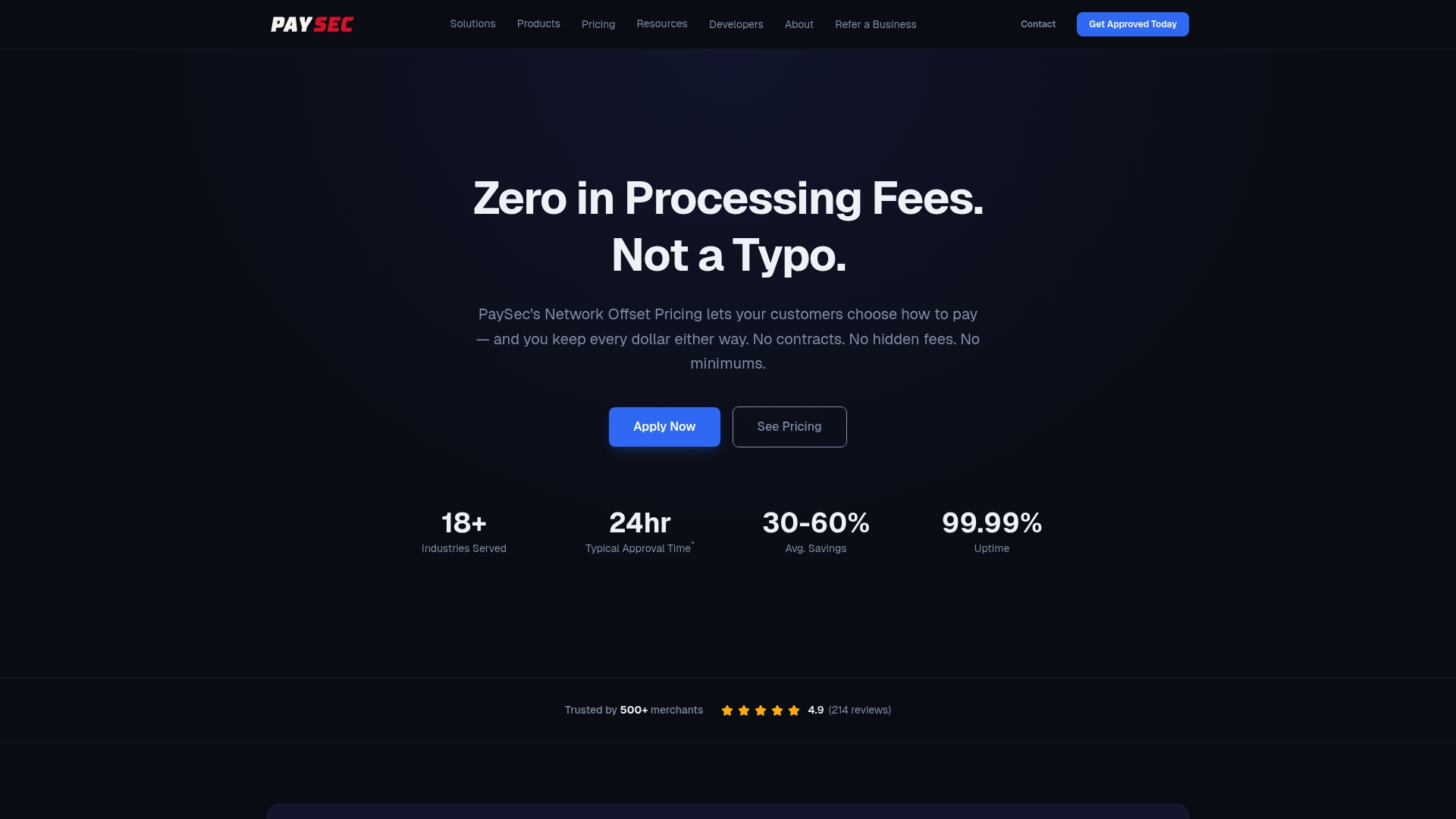
We built Network Offset Pricing to pass through true wholesale interchange rates instead of flat-rate markups, which means merchants in SaaS, restaurants, eCommerce, healthcare, CBD retail, and other high-risk categories can keep more of every transaction without adding a customer-facing fee. There are no long-term contracts and no minimums, so testing whether a lower rate fits your business carries no commitment.
- We offer various pricing structures depending on your volume and vertical.
- Our merchant services cover multiple payment processing options under one account.
- Detailed transaction reporting shows where your processing dollars go, statement by statement.
Review our pricing and plan options to see how a wholesale-passthrough rate compares to what you are paying today, and request a cost review before you decide whether surcharging is even necessary for your business.
This article is general information, not a substitute for advice from a qualified financial advisor. Consult a qualified financial professional about your own circumstances before acting on anything here.
FAQ
Is it illegal to charge a 3% credit card fee?
It depends on your state and your actual cost of acceptance. Visa and Mastercard rules allow surcharges up to the merchant's documented cost of acceptance or the card-brand cap, whichever is lower, so a 3% fee is only compliant if your MDR supports it and your state permits surcharging at all.
How do you avoid a credit card international transaction fee?
International transaction fees come from your card issuer or processor, not from merchant surcharge rules, so the way to reduce them is choosing a processing setup with lower cross-border rates rather than adjusting your surcharge program. Reviewing your processing statement for these line items is the first step toward identifying where the cost originates.
Is it legal to pass credit card fees onto customers?
In most states, yes, as long as you follow card-network rules on notice, disclosure, and caps, and your state does not ban surcharging outright. A state-by-state statute summary is the most reliable way to confirm your state's current status before you start.
Why is everyone charging a credit card fee now?
Rising interchange costs and clearer card-network guidance on surcharging have made passing fees to customers a more visible option for merchants managing thin margins. Many businesses are also choosing to lower their underlying processing cost through rate optimization instead of adding a customer-facing fee.
Sources
- U.S. Merchant Surcharge Q and A
- The Rule on Unfair or Deceptive Fees: Frequently Asked Questions | Federal Trade Commission
- Summary Credit or Debit Card Surcharges Statutes