

A surcharge is a percentage added only to credit card transactions to offset processing costs, capped by Visa and Mastercard rules and never legal on debit or prepaid cards. A convenience fee is a flat or fixed charge for using a nonstandard payment channel, like paying a bill by phone instead of through the standard portal. Before you pick either one, check your card network's rules and your state's statute, because both bodies of law govern what you can charge and how.
TL;DR:
- Surcharges are limited by card-network caps and cannot exceed your actual cost of acceptance; they are only legal on credit cards.
- State laws may restrict or ban surcharging entirely, so merchants must verify current regulations in every jurisdiction annually.
- A surcharge requires notifying your acquirer 30 days in advance and includes clear signage, point-of-sale notices, and listed receipt charges to comply.
- Convenience fees apply to nonstandard payment channels and are usually a flat fee, making them suitable for phone or online bill payments with high debit volume.
- Cash discounts are applied through higher posted prices with discounts for cash payers, but improper implementation can be legally risky.
Table of Contents
- Convenience Fee vs Surcharge: Definitions and Quick Comparison
- Card-Network Rules and Federal Constraints You Cannot Ignore
- State Law Can Override What the Card Networks Allow
- Choosing Between a Convenience Fee, Surcharge, or Cash Discount
- Your Implementation Checklist Before You Launch
- Cash Discounting vs Surcharging: Where Merchants Get Tripped Up
- Worked Math: What These Fees Actually Cost
- Communicating Fees Without Losing the Customer
- A Lower-Friction Alternative: Reducing the Fee You'd Otherwise Pass On
- What Merchants Consistently Get Wrong Here
- How Paysec Helps You Keep More of Every Sale
- Sources
- FAQ
Convenience Fee vs Surcharge: Definitions and Quick Comparison
A surcharge is a percentage-based add-on applied only to credit card payments to help recover the cost of accepting that card. A convenience fee is typically a flat dollar amount charged when a customer chooses a payment channel outside your standard method, such as an over-the-phone or online payment portal, and it applies regardless of card type in most cases. A service fee is a broader term often used interchangeably with convenience fee, though some processors reserve it for industry-specific contexts like utility or government payments. Cash discounting and dual pricing both raise the posted price and give a discount for cash, rather than adding anything at checkout.
The calculation method is the true dividing line:
- Surcharge: percentage of the transaction, calculated only on credit card sales.
- Convenience fee: flat fee or fixed amount, tied to the payment channel, not the card brand.
- Cash discount: built into two displayed prices, one for cash and one for card.
Picture a property tax office charging $3 flat for phone payments (convenience fee) versus a contractor adding 3% to a credit card invoice (surcharge). Different math, different rules.
Card-Network Rules and Federal Constraints You Cannot Ignore
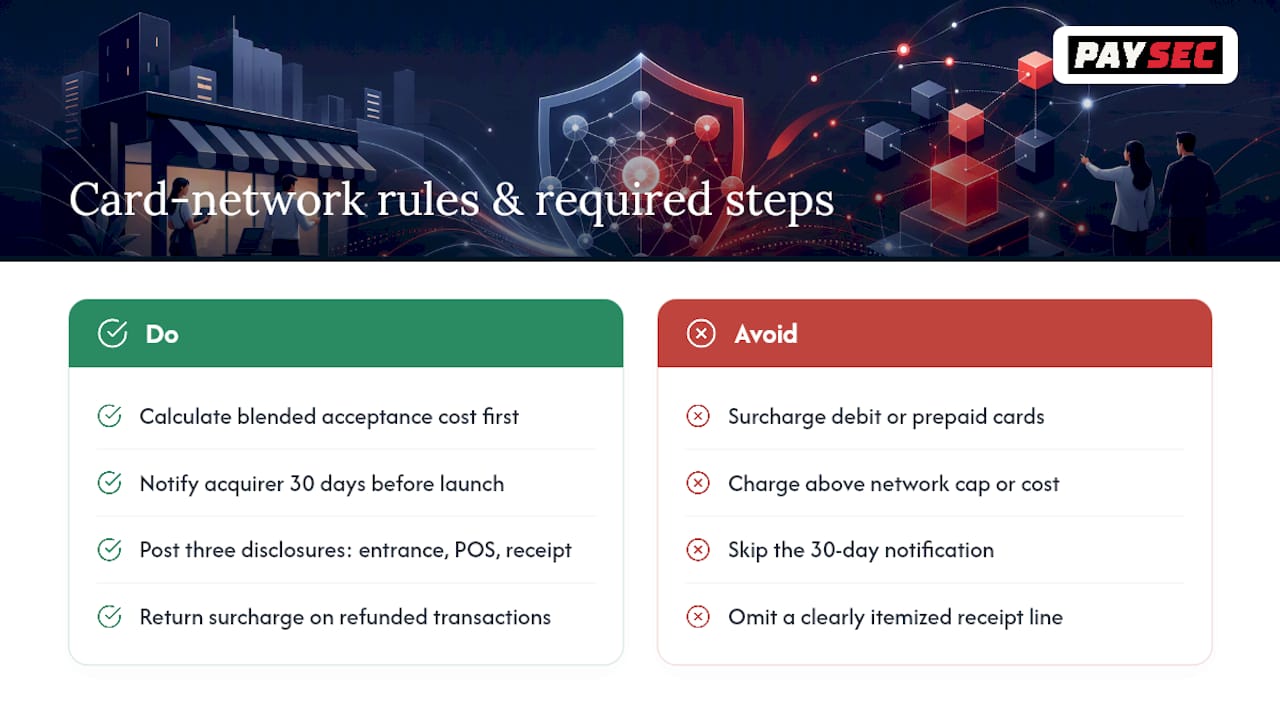
Visa and Mastercard both cap surcharges, and the rule that matters most is the "lesser of" principle: you can charge up to the network cap, but never more than your actual cost of accepting the card. Visa limits surcharges to a capped percentage, and Mastercard historically allowed a similar capped range, but your true ceiling is whichever is lower between that cap and what your processor actually charges you. Calculate your blended cost of acceptance before you set a rate.
Before you flip the switch on a surcharge program, you must notify your acquirer, who in turn notifies the card networks, at least 30 days in advance. Skipping this step is one of the most common reasons programs get shut down mid-launch. Once live, you need three layers of disclosure: a sign at the store entrance, a notice at the point of sale before the transaction completes, and a clearly itemized line on the receipt. Our card brand surcharge rules guide walks through the notice and signage requirements in more detail.
Debit and prepaid cards cannot be surcharged under any card-network rule, full stop. The Federal Trade Commission expects upfront disclosure of any fee before a customer commits to a purchase, and refunded transactions must have the surcharge returned along with the sale.
State Law Can Override What the Card Networks Allow
Card-network rules set the outer boundary, but state law can be stricter, and in some states, surcharging is banned outright regardless of what Visa or Mastercard permit. Several states have historically restricted or capped surcharges, including Connecticut, Massachusetts, and Maine, though statutes change and enforcement varies by state. Do not treat a list from any article, including this one, as a permanent legal map.
Here is how to protect yourself before launch:
- Pull the current statute or regulator guidance for every state where you process transactions.
- Confirm whether your state caps the surcharge rate lower than the network maximum.
- Log the jurisdiction and date you checked, so you have a paper trail if a regulator asks.
- Recheck annually, since state legislatures revisit these laws more often than card networks revise their rules.
Our post on surcharge laws and the 30 day network notice covers how to stack state compliance on top of your network notification.
Choosing Between a Convenience Fee, Surcharge, or Cash Discount
Start with a simple checklist: what share of your sales run on credit versus debit, what your average ticket size looks like, which channel customers use to pay, and how your industry typically prices fees. A government payments office with high debit volume often leans toward a convenience fee, since it applies regardless of card type. A B2B vendor invoicing large tickets by credit card usually benefits more from a surcharge tied directly to acceptance cost.
- Convenience fee fits nonstandard payment channels, like phone or online bill pay, especially where debit share is high.
- Surcharge fits card-heavy B2B and professional services where invoices are paid predominantly by credit card.
- Cash discount fits high-volume retail and restaurants where visible fees risk hurting conversion at the register.
Each model trades compliance complexity against customer perception. A surcharge demands the most disclosure work; a cash discount demands the most pricing discipline up front.
Pro Tip: Run your transaction mix report before choosing a model. If more than a third of your card volume is debit, a straight surcharge program leaves real savings on the table since you cannot apply it to those transactions at all.
Your Implementation Checklist Before You Launch
Before you charge anyone anything, calculate your blended cost of acceptance across your card mix, confirm your processor supports the fee model you want, and pick your model based on the decision framework above. If you are surcharging, notify your acquirer and the card networks at least 30 days out.
Your disclosure checklist needs to cover every touchpoint:
- Entrance or homepage signage stating a fee applies to card payments.
- A checkout or POS prompt showing the exact fee before the customer confirms.
- A separate, itemized line on every receipt, never bundled into the total.
- A documented refund process that reverses the fee alongside the sale.
Operationally, apply the same rate to every eligible transaction, train staff on a short explanation script, and test the full flow on a sandbox account before going live. Consistent disclosure and refund handling is what separates a defensible program from one that draws complaints.
Cash Discounting vs Surcharging: Where Merchants Get Tripped Up
Cash discounting works differently in the eyes of the law: you post a higher shelf or menu price, then discount it for cash payers, rather than adding a fee for card payers. Regulators apply what amounts to a displayed-price test. The number on your menu or shelf tag is the legal reference point, and if that posted number isn't the price everyone sees first, you risk it being read as a disguised surcharge.
The most common mistakes are posting the discounted price instead of the full price, formatting receipts so the discount looks like a fee, or applying it inconsistently across registers. Cash discounting tends to recover more when your debit share is low, since it applies uniformly to every card type rather than being blocked on debit like a surcharge.
Worked Math: What These Fees Actually Cost
A $50 retail purchase with a 3% surcharge adds $1.50; the same purchase with a flat $3 convenience fee costs a dollar fifty more than the surcharge version. On a $75 restaurant check, a 3% surcharge adds $2.25, while a flat $3 convenience fee often overcharges the customer relative to actual cost, which is why flat fees suit high-ticket or channel-based transactions better than small tickets. On a $5,000 B2B invoice, a 3% surcharge adds $150, a number large enough that calculating your real cost of acceptance instead of defaulting to the network cap can save real money.
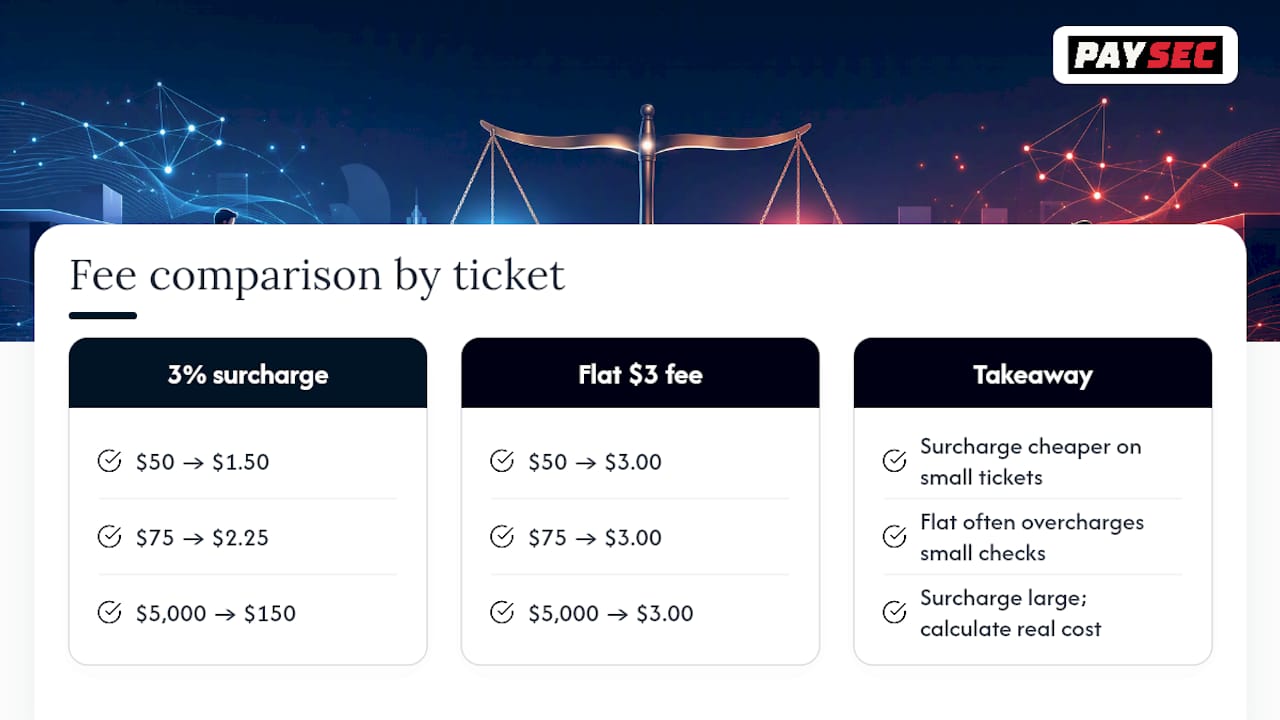
Set your surcharge ceiling at whichever is lower: your actual blended interchange cost or the network cap. Run a 30 to 60 day test at a conservative rate, then watch your net margin and payment mix before adjusting.
Communicating Fees Without Losing the Customer
Disclose the fee before the customer commits, not after they swipe. Log every complaint and refund request in one place so you can spot patterns before they become chargebacks or regulatory complaints.
Track four numbers weekly: conversion rate, refund rate, chargeback rate, and average ticket size. A spike in any one of them after launch usually means your disclosure or pricing needs adjusting, not that the fee model itself failed.
A Lower-Friction Alternative: Reducing the Fee You'd Otherwise Pass On
Passing costs to customers is not the only lever. Network offset pricing restructures how processing costs are calculated so merchants keep more revenue without necessarily adding a line-item fee at checkout. Businesses using this model have seen processing cost reductions in the 30 to 60% range, including cases as high as 42%, across sectors from SaaS to restaurants to healthcare. If you would rather lower your cost base than manage disclosure requirements, request a processing audit and compare the math against a surcharge program.
What Merchants Consistently Get Wrong Here
Most merchants treat this decision as a legal question first and a customer experience question second, and that ordering causes problems. Compliance matters enormously, but the businesses that succeed with either model spend as much time on how the fee is communicated as on whether it is legal to charge. A technically compliant surcharge that confuses customers at checkout still costs you sales.
The other blind spot is assuming the rules are static. State statutes shift, network caps get revisited, and a program built correctly in 2026 can drift out of compliance within a year if nobody rechecks it. Build a recheck into your calendar, not just your launch plan.
— PaySec Marketing Team
How Paysec Helps You Keep More of Every Sale
Paysec gives merchants a real alternative to charging customers more: lower the processing cost itself through network offset pricing, with no long-term contracts and no minimums to qualify. Some businesses across various sectors have seen measurable reductions in what they pay per transaction, with detailed reporting that shows exactly where the savings come from.
If your business is weighing a surcharge program against simply paying less to process cards, start by comparing the two paths side by side. Browse industry-specific solutions to see how businesses like yours structure processing today, or review PaySec's full solutions overview to request a savings estimate. For retailers specifically, the retail processing page outlines what a switch typically looks like in dollar terms. Getting a custom estimate takes a few minutes and gives you a real number to weigh against any fee program.
Sources
Card-network rules and surcharge caps are covered in detail by NerdWallet and Experian. State-level nuance and the displayed-price test appear in this surcharging and cash discounting overview and NFIB's state law summary. Consult a licensed attorney for binding legal interpretation specific to your state.
- Credit Card Surcharges, Convenience Fees, Processing Fees: Are They Legal? - NerdWallet
- Are Credit Card Surcharges Legal? - Experian
- Surcharging and Cash Discounting: Legal State in 2026
- CREDIT CARD SURCHARGE AND CASH DISCOUNT LAWS - NFIB
FAQ
How Do I Avoid Paying a Convenience Fee?
Use the merchant's standard payment channel, such as an in-person visit or mailed check, since convenience fees apply specifically to nonstandard channels like phone or online portals.
Is It Worth Paying a Convenience Fee?
It depends on the alternative cost of your time versus the flat fee amount; for a one-time bill payment, the convenience fee is often worth it, but recurring bills add up fast.
Is It Legal to Charge a 3% Fee on a Debit Card?
No. Card-network rules prohibit surcharging debit and prepaid cards entirely, regardless of the percentage, and violating this can trigger penalties from your acquirer.