

TL;DR:
- Offshore payment processing involves settling transactions through foreign banks, often for high-risk or international businesses. It provides access to multi-currency settlement and broader risk acceptance but requires strict compliance with global standards. Longer payout cycles and higher fees are key operational limitations.
Offshore payment processing is defined as the practice of settling card transactions through acquiring banks located outside the merchant's home country, such as institutions in Europe, the Caribbean, or the Asia-Pacific region. Businesses use this model to access payment infrastructure that their domestic processors cannot or will not provide, whether due to industry risk profiles, geographic limitations, or multi-currency requirements. For financial decision-makers weighing offshore payment solutions, the core question is not whether the model is legal. It is whether it fits your specific operational and compliance needs. PCI DSS, Visa, and Mastercard apply globally, and offshore acquiring banks operate under the same card network rules as domestic ones.
What is offshore payment processing, and how does it work?

Offshore payment processing involves settling card transactions through acquiring banks in foreign jurisdictions, while the merchant's business may remain headquartered anywhere in the world. The acquiring bank's location determines the "offshore" classification, not the merchant's location or the customer's location. A US-based eCommerce company processing through a bank in Malta or Hong Kong is using offshore payment processing by definition.
The operational flow follows the same basic structure as any card payment. A customer submits payment details, the payment gateway encrypts and routes the transaction, the offshore acquirer communicates with the card network, and the issuing bank approves or declines. Settlement then flows back through the acquirer to the merchant. The key difference is that the acquiring bank sits in a foreign jurisdiction, which affects payout timelines, currency handling, and regulatory oversight.
The key players in an offshore transaction
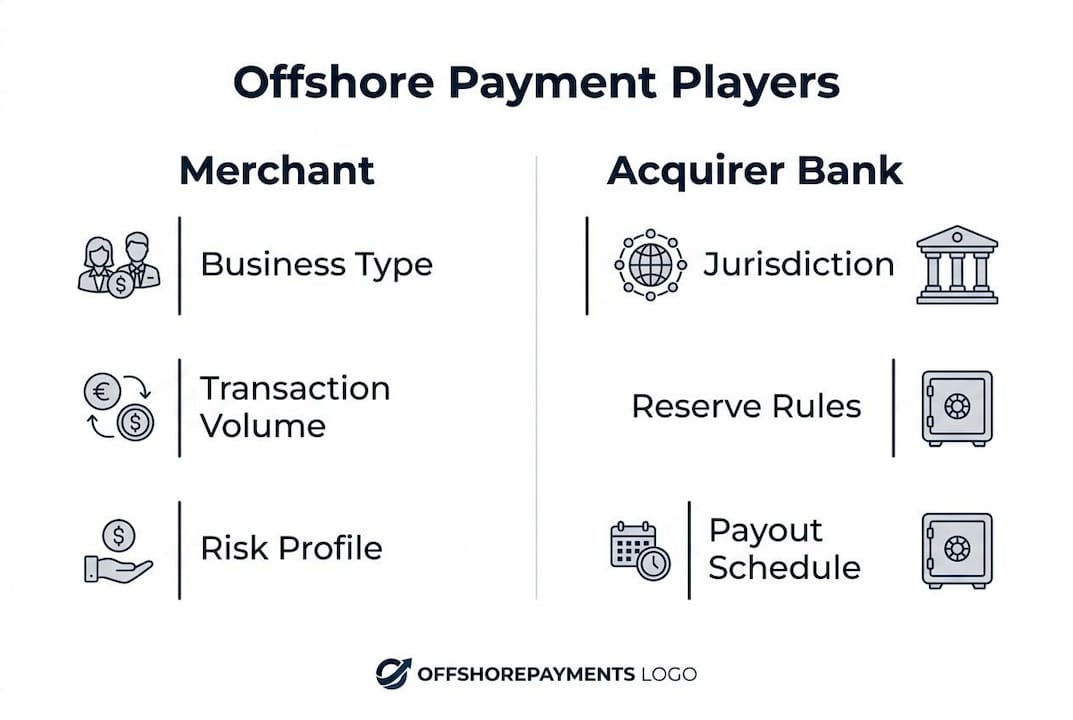
Understanding who handles your money at each step clarifies both the benefits and the risks of offshore processing.
- The merchant initiates the relationship by applying for an offshore merchant account, submitting business documentation, and agreeing to the acquirer's terms.
- The payment gateway or PSP encrypts transaction data and routes it to the offshore acquirer. Many offshore setups use specialized gateways built for cross-border volume.
- The offshore acquiring bank holds the merchant account, processes the authorization, and manages settlement. This bank operates under the regulatory framework of its home jurisdiction.
- Card networks (Visa, Mastercard) authorize and clear the transaction using their global infrastructure. Their rules apply regardless of where the acquirer is based.
- The issuing bank approves or declines the transaction on behalf of the cardholder.
Settlement currency, payout schedule, and reserve requirements all depend on the acquiring bank's policies and jurisdiction. Most offshore acquirers pay out in USD, EUR, or GBP, with conversion handled at the acquirer level.
Currency conversion and rolling reserves
Multi-currency settlement is one of the primary operational advantages of offshore acquiring. Merchants selling across multiple markets can receive payouts in the currency that matches their operating costs, reducing conversion losses. However, offshore acquirers typically hold a rolling reserve, a percentage of gross transaction volume withheld for a set period to cover potential chargebacks or disputes. This reserve is standard practice, not a penalty, and it reflects the elevated risk profile that offshore acquirers accept.
Pro Tip: Request a clear rolling reserve schedule from any offshore acquirer before signing. Understand the percentage held, the holding period, and the release conditions. Surprises here directly affect your cash flow.
| Component | What it means for merchants |
|---|---|
| Acquiring bank location | Determines jurisdiction, regulatory framework, and payout currency options |
| Rolling reserve | A withheld percentage of volume, typically released after 90–180 days |
| Payout schedule | Often weekly or biweekly, longer than domestic processing timelines |
| KYC/AML review | Full documentation required before account activation |
| PCI DSS compliance | Mandatory regardless of acquiring jurisdiction |
Which businesses benefit most from offshore payment processing?
Businesses in high-risk categories like nutraceuticals, gaming, adult content, and travel frequently use offshore accounts when domestic processors decline their applications. Domestic banks in the US and UK apply conservative underwriting standards, and entire merchant category codes (MCCs) are often excluded from their portfolios. Offshore acquirers in jurisdictions like Cyprus, Malta, or Singapore accept a wider range of risk profiles because their regulatory environments permit it and their pricing models account for it.
The businesses that benefit most from offshore processing share a few common characteristics:
- High chargeback exposure. Industries like subscription services, travel, and digital goods face elevated dispute rates. Offshore acquirers price this risk into their fees rather than declining the account outright.
- International customer bases. A merchant selling to customers across Europe, Latin America, and Southeast Asia needs multi-currency processing and local payment method support that domestic US processors rarely offer.
- Domestic account terminations. When a processor terminates a merchant account, the merchant may be placed on the MATCH list (Member Alert to Control High-Risk Merchants). Offshore acquirers review these cases individually rather than applying automatic exclusions.
- Regulatory arbitrage needs. Some industries face restrictions in their home country that do not apply in other jurisdictions. Offshore processing provides legal access to payment infrastructure in those markets.
- Operational redundancy. Businesses that cannot afford payment downtime use offshore accounts as a backup to their primary domestic processor.
Travel and hospitality merchants represent a particularly strong use case. Travel payment processing involves high ticket values, long booking windows, and elevated chargeback risk from cancellations. Offshore acquirers with experience in this vertical understand those dynamics and underwrite accordingly.
Pro Tip: If your MCC code triggers automatic declines from domestic processors, research which offshore jurisdictions have acquirers that specialize in your vertical. Specialization matters more than geography.
Is offshore payment legal, and what compliance rules apply?
Offshore payment processing is a legal and regulated financial service when conducted under international standards and proper regulatory licensing. The misconception that "offshore" implies secrecy or regulatory evasion is both common and wrong. Every legitimate offshore acquiring relationship requires the merchant to pass KYC (Know Your Customer) and AML (Anti-Money Laundering) checks, maintain PCI DSS compliance, and adhere to the card network rules that govern every transaction globally.
Card networks like Visa and Mastercard apply global chargeback monitoring programs to every merchant account, regardless of where the acquiring bank is located. A merchant processing through an offshore acquirer in the Caribbean faces the same chargeback thresholds and consequences as one processing through a bank in Ohio. Exceeding Visa's chargeback monitoring program thresholds triggers remediation requirements whether your acquirer is in Delaware or Dublin.
What compliance frameworks govern offshore accounts?
Legitimate offshore acquiring requires PCI DSS compliance, adherence to card scheme rules, and proper regulatory licensing in the acquiring jurisdiction. These are not optional. Merchants who believe offshore processing creates a compliance gray zone are exposed to account termination, card network fines, and legal liability.
The core compliance requirements include:
- PCI DSS (Payment Card Industry Data Security Standard). All merchants processing card payments must meet PCI DSS requirements, regardless of acquirer location. This covers data storage, encryption, and network security.
- KYC documentation. Offshore acquirers require business registration documents, ownership structures, processing history, and financial statements before approving an account.
- AML policies. Merchants must demonstrate that their transaction patterns do not indicate money laundering. Offshore acquirers file suspicious activity reports with their local regulators.
- Card network rules. Visa and Mastercard publish operating regulations that apply globally. Offshore acquirers are members of these networks and enforce the same rules.
- Local licensing. The acquiring bank must hold a valid banking or payment institution license in its jurisdiction. Merchants should verify this before signing any agreement.
Offshore merchant accounts are subject to rigorous KYC, AML, and PCI DSS compliance despite being based internationally. This compliance burden is not lighter than domestic processing. In many cases, it is more intensive because offshore acquirers accept higher-risk merchants and must demonstrate stronger controls to their regulators.
Pro Tip: Ask any offshore acquirer for proof of their regulatory license and their PCI DSS certification before submitting your application. A legitimate acquirer will provide both without hesitation.
What are the benefits and limitations of offshore payment processing?
Offshore payment processing provides businesses with expanded international payment flexibility, including multi-currency settlement across various jurisdictions. That flexibility is the primary draw for businesses that have outgrown what domestic processors can offer. The benefits are real, but so are the operational trade-offs.
Benefits worth considering
The strongest case for offshore processing rests on access, not cost. Businesses that cannot get approved domestically gain access to payment infrastructure that keeps their revenue flowing. Businesses selling internationally gain currency flexibility that reduces conversion costs and improves customer experience. High-risk merchants gain acquirers who understand their industry rather than treating their MCC as a liability.
Offshore and domestic accounts can run in parallel, routing riskier transactions offshore while keeping cleaner domestic processing for standard volume. This hybrid model is the most sophisticated use of offshore processing. It preserves domestic relationships while extending capacity for higher-risk transaction types.
Limitations that affect operations
Offshore accounts impose longer payout cycles and mandatory rolling reserves to mitigate elevated risk. This is the most common operational surprise for merchants new to offshore processing. A domestic processor might pay out in two business days. An offshore acquirer might hold funds for seven to fourteen days, plus maintain a rolling reserve of 5%–10% of monthly volume.
| Factor | Domestic processing | Offshore processing |
|---|---|---|
| Approval for high-risk MCCs | Rarely approved | Frequently available |
| Payout timeline | 1–3 business days | 7–14 business days |
| Rolling reserve | Rare or none | Standard, 5%–10% of volume |
| Multi-currency support | Limited | Broad, often 30+ currencies |
| Processing fees | Lower for standard risk | Higher, reflecting risk premium |
| Chargeback monitoring | Visa/Mastercard global rules | Same Visa/Mastercard global rules |
Higher fees are a consistent feature of offshore processing. The risk premium that offshore acquirers charge reflects the elevated chargeback exposure and compliance costs they absorb. Merchants should model the total cost of offshore processing, including fees, reserve impact, and currency conversion, before committing.
Key Takeaways
Offshore payment processing is a legal, compliance-bound model that gives high-risk and international businesses access to card processing infrastructure that domestic acquirers routinely decline to provide.
| Point | Details |
|---|---|
| Definition and scope | Offshore processing uses foreign acquiring banks to settle card transactions, regardless of merchant location. |
| Compliance is mandatory | KYC, AML, and PCI DSS requirements apply to every offshore account without exception. |
| Card networks operate globally | Visa and Mastercard chargeback monitoring applies equally to offshore and domestic accounts. |
| Payout timelines are longer | Expect 7–14 day payout cycles and rolling reserves of 5%–10% of monthly volume. |
| Hybrid models work best | Running offshore and domestic accounts in parallel gives merchants the most flexibility and risk control. |
The Paysec team's perspective on using offshore processing responsibly
The most common mistake we see businesses make with offshore processing is using it as a substitute for fixing the underlying problem. A merchant with a 3% chargeback rate does not need an offshore account. They need a chargeback prevention strategy that addresses why customers are disputing charges. Offshore processing does not reset your chargeback history with Visa or Mastercard. It gives you a new account, but the same global monitoring follows you there.
The businesses that use offshore processing well treat it as a tool for market expansion and risk distribution, not as a workaround. They run high-risk merchant accounts offshore while maintaining clean domestic processing for their lower-risk volume. They invest in KYC processes that satisfy their offshore acquirer's requirements. They monitor their chargeback ratios across every account, not just the one that is currently under scrutiny.
Proactive compliance is the difference between a sustainable offshore setup and one that collapses when the acquirer reviews the portfolio. Offshore acquirers do periodic merchant reviews. Merchants who have kept their documentation current, maintained clean transaction patterns, and stayed within chargeback thresholds pass those reviews without disruption. Merchants who treated the account as a set-and-forget solution often do not.
The strategic value of offshore processing is real. Access to 30-plus currencies, approval for MCCs that domestic banks refuse, and operational redundancy are genuine advantages. But those advantages only materialize when the merchant manages the account with the same discipline they would apply to any primary banking relationship.
— Paysec Marketing Team
How Paysec supports your payment processing needs
Paysec works with merchants across 18-plus industries, including many that face the exact challenges offshore processing is designed to address.
For businesses managing high transaction volumes, multi-currency sales, or elevated risk profiles, Paysec's Network Offset Pricing model delivers measurable cost reductions of 30%–60% compared to standard processing fees. Clients have reported a 42% reduction in processing costs after switching. Paysec provides detailed transaction reporting, full compliance support, and no long-term contracts, so merchants retain control without locking into rigid agreements. If you are evaluating your payment processing structure and want transparent pricing with no hidden fees, Paysec is built for exactly that conversation.
FAQ
What is offshore payment processing in simple terms?
Offshore payment processing means your card transactions are handled by an acquiring bank located in a foreign country, even if your business operates domestically. The acquiring bank's jurisdiction determines the regulatory framework, payout currency, and compliance requirements.
Is offshore payment processing legal?
Offshore payment processing is a legal financial service when conducted under international standards, proper licensing, and full compliance with KYC, AML, and PCI DSS requirements. Operating offshore does not exempt merchants from card network rules or regulatory oversight.
Do offshore accounts hide chargebacks from Visa and Mastercard?
No. Chargeback monitoring programs from Visa and Mastercard operate globally across all merchant accounts, regardless of where the acquiring bank is located. Offshore accounts do not reset or conceal chargeback history.
How long do offshore payment settlements take?
Offshore acquirers typically pay out on 7–14 day cycles, compared to 1–3 days for domestic processors. Most offshore accounts also require a rolling reserve of 5%–10% of monthly volume, held for 90–180 days.
Which businesses typically need offshore payment solutions?
Businesses in high-risk categories including nutraceuticals, gaming, adult content, travel, and subscription services most commonly use offshore processing when domestic processors decline their applications or cannot support their international transaction volume.