

TL;DR:
- Multi-currency payment processing enables businesses to settle transactions in foreign currencies, reducing hidden costs. It allows control over currency conversion timing and minimizes fees through local bank routing. Proper setup improves conversion rates, cuts costs, and enhances international sales performance.
Multi-currency payment processing is defined as the technology and infrastructure that allow businesses to accept, process, and settle transactions in multiple foreign currencies, giving merchants direct control over when and how currency conversion happens. For business owners and finance managers selling across borders, this distinction is not academic. Card networks like Visa and Mastercard route cross-border transactions through complex FX mechanisms, and the party that performs the currency conversion determines how much of each sale you actually keep. Understanding what is multi-currency payment processing is the first step toward building an international sales operation that does not quietly bleed revenue through conversion fees and opaque markups.
What is multi-currency payment processing and how does it work?
Multi-currency payment processing routes transactions through local banking networks rather than relying on traditional correspondent banking. Local network routing reduces transaction costs and speeds up settlement compared to sending every payment in USD through international banks. That efficiency compounds quickly when you process hundreds of cross-border orders per month.
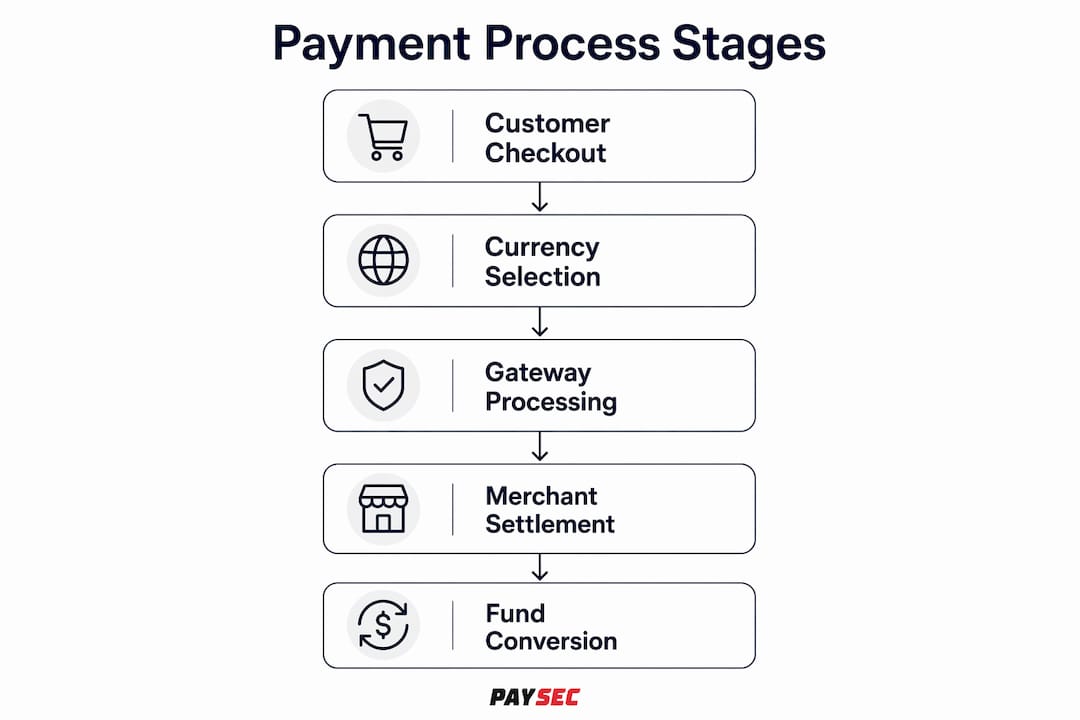
The operational flow breaks down into five distinct steps:
- Customer initiates payment. A buyer in Germany selects a product priced in euros. The payment gateway captures the transaction in EUR at the point of checkout.
- Authorization request. The gateway sends an authorization request to the card network, which routes it to the issuing bank. The currency presented to the customer is EUR throughout this step.
- Currency settlement decision. Here is where most businesses lose money without realizing it. A true multi-currency gateway holds the funds in EUR. A gateway that only displays prices in multiple currencies converts everything to your base currency immediately, often with a hidden markup.
- Funds held in settlement currency. The merchant account receives EUR. The business then decides when to convert those euros to USD based on favorable exchange rates.
- Conversion and payout. The merchant converts at a time of their choosing, or holds the balance if they have ongoing EUR expenses.
Accepting payments in a foreign currency is fundamentally different from settling and holding funds in that currency. Most business owners conflate the two, and that confusion costs them money on every international transaction.
A genuine multi-currency setup requires both a payment gateway and a merchant account that support multiple currencies without forced conversion. Some providers bundle these services; others sell them separately. Confirming this before signing any contract prevents unexpected conversion costs from appearing on your first settlement statement.

Pro Tip: Ask any prospective gateway provider one direct question: "Do you hold funds in the customer's original currency, or do you convert at the moment of capture?" If they cannot answer clearly, treat that as a red flag.
Key terminology every finance manager needs to know
The vocabulary around multi-currency payments is where confusion breeds costly decisions. Three terms in particular get misused constantly: Multi-Currency Pricing, Dynamic Currency Conversion, and multi-currency merchant accounts.
Multi-Currency Pricing (MCP) presents the customer with local currency prices during checkout, before payment is captured. The customer sees €85 instead of $92.47. That familiarity matters more than most merchants expect.
Dynamic Currency Conversion (DCC) is a different mechanism entirely. DCC happens at the point of sale and allows customers to pay in their home currency, but the conversion is performed by the acquiring bank or terminal provider, often with high and opaque markups. The customer technically "chooses" their home currency, but the rate they receive is rarely competitive. DCC reduces customer trust and harms conversion rates. Merchants benefit from controlling currency conversion through MCP instead.
Multi-currency merchant account refers to the back-end account that holds balances in multiple currencies simultaneously. This is separate from the payment gateway, which is the front-end technology that captures and routes the transaction. Conflating these two leads businesses to sign up for a gateway with multi-currency display capabilities while their merchant account still forces immediate conversion.
Here is a quick reference for the distinctions that matter most:
- MCP vs. DCC: MCP is merchant-controlled and customer-friendly. DCC is acquirer-controlled and typically expensive for the customer.
- Display vs. settlement: Showing a price in euros is not the same as settling in euros. Confirm settlement currency support explicitly.
- Explicit fees vs. embedded spreads: Many payment service providers embed FX spreads in multi-currency pricing rather than breaking out conversion fees separately. Merchants may unknowingly pay higher rates embedded in conversion instead of seeing an explicit line-item fee.
- Conversion timing: The party performing currency conversion, whether the issuer, acquirer, or payment service provider, directly impacts fees and markups applied to the transaction.
- Digital wallets: Platforms like PayPal and Wise operate multi-currency accounts with their own FX engines. They offer lower spreads than traditional banks but still apply margins that affect your net settlement.
Understanding these distinctions is not just useful for negotiating better rates. It changes which questions you ask during vendor evaluation and which contract clauses you scrutinize.
Benefits and challenges of multi-currency payment systems
The business case for multi-currency transactions is direct. Customers are 17% more likely to abandon carts if prices are not shown in a currency they trust. That single statistic represents a measurable revenue leak that multi-currency pricing fixes at the checkout level.
Beyond conversion rates, the benefits stack up across three areas:
Customer reach. Showing local currency prices removes friction for international buyers. A buyer in Japan who sees ¥12,400 instead of $82.00 does not need to do mental math or worry about their bank's conversion rate. That confidence translates directly into completed purchases.
Cost control. Holding funds in foreign currency allows businesses to choose when to convert based on favorable exchange rates, minimizing losses from forced conversion at unfavorable moments. A business with significant EUR revenue can hold euros and pay EUR-denominated suppliers directly, eliminating a round-trip conversion entirely.
Pricing transparency. When you control the conversion, you see the full cost. When your gateway controls it, the cost is often buried in the spread.
| Benefit | Business impact |
|---|---|
| Local currency display | Reduces cart abandonment at checkout |
| Held foreign currency balances | Gives control over conversion timing |
| Local banking network routing | Lowers transaction costs vs. correspondent banking |
| Transparent fee structure | Removes hidden FX spread costs |
The challenges are real but manageable. Multi-currency accounts bring operational complexity, including cash flow planning to avoid idle funds and exposure to currency fluctuations. A business holding large GBP balances during a period of sterling weakness absorbs that loss directly. Effective treasury management is not optional when you hold balances in multiple currencies.
The most common mistake businesses make is choosing a provider based on the currencies it displays rather than the currencies it settles. Many gateways show prices in 30+ currencies but convert everything to the base currency at capture. That forced conversion often includes hidden fees the merchant never sees itemized.
Pro Tip: Before committing to any multi-currency payment provider, request a sample settlement report. If the report shows only your base currency with no foreign currency line items, the provider is converting at capture, not holding funds.
How to select and integrate multi-currency payment solutions
Choosing the right multi-currency payment setup starts with a clear list of evaluation criteria. The technology matters, but the contract terms and fee structure matter more.
Factors to evaluate in any provider:
- True settlement currencies supported. Confirm the exact list of currencies the provider will hold and settle in, not just display.
- FX fee transparency. Ask for the spread applied to each conversion. If the provider cannot give you a number, the fee is embedded and likely higher than a competitive rate.
- Integration with your accounting system. Multi-currency transactions create multi-currency journal entries. Your provider must export data in a format your accounting software, whether QuickBooks, NetSuite, or Xero, can reconcile without manual intervention.
- Local banking network access. Providers that route through local networks rather than correspondent banking deliver faster settlement and lower per-transaction costs.
- Reporting granularity. Finance managers need transaction-level data showing the original currency, the conversion rate applied, and the settled amount. Aggregate reports hide the information you need to manage FX exposure.
Once you select a provider, configuration follows a logical sequence. Set your pricing rules first, deciding which currencies you will display and at what markup over mid-market rate. Then configure your settlement preferences, specifying which currencies you want held versus auto-converted. Test with live transactions in each target currency before going fully live, and verify that settlement reports match your accounting records exactly.
For ecommerce payment processing, the integration layer between your storefront, gateway, and merchant account is where errors most often appear. A mismatch between the currency your cart presents and the currency your gateway captures creates reconciliation problems that compound over time.
Ongoing management requires monthly review of your FX exposure. Track the currencies you hold, the average conversion rates you achieved, and the total cost of conversion as a percentage of gross revenue. That metric tells you whether your treasury strategy is working or whether you are leaving money on the table.
The broader context matters too. Payment processing trends in 2026 show that cross-border ecommerce continues to grow, and businesses that build multi-currency infrastructure now gain a compounding advantage over those that delay. Every international customer you convert today builds the revenue base that justifies further investment in currency management tools.
An effective cross-border payment strategy requires integrating the customer-facing pricing experience with back-end settlement to avoid hidden costs. These two layers must align, or you end up with a great checkout experience that quietly erodes margin on the settlement side.
Key Takeaways
Multi-currency payment processing delivers measurable revenue gains only when merchants control both the customer-facing pricing and the back-end settlement currency, not just one or the other.
| Point | Details |
|---|---|
| Definition matters | Multi-currency processing means settling in foreign currencies, not just displaying them at checkout. |
| MCP beats DCC | Merchant-controlled pricing protects customers from opaque markups and improves conversion rates. |
| Cart abandonment cost | Customers are 17% more likely to abandon purchases when prices are not shown in their local currency. |
| Settlement vs. display | Confirm your provider holds funds in the original currency before signing any contract. |
| Treasury management | Holding multiple currency balances requires active cash flow planning to avoid FX losses. |
What we have learned from watching businesses get this wrong
The most consistent mistake we see is businesses treating multi-currency payment processing as a checkout feature rather than a treasury function. They add a currency switcher to their storefront, feel satisfied, and never look at what happens to the money after capture. Six months later, they wonder why their international margins are thinner than their domestic ones.
The second mistake is assuming that all multi-currency providers are equivalent because they advertise the same currency list. The number of currencies displayed means almost nothing. The number of currencies settled is the only metric that matters for your bottom line. We have seen businesses paying effective FX costs two to three times higher than necessary because their gateway converted at capture with an embedded spread they never negotiated.
Holding funds in foreign currency is not just a cost-saving tactic. It is a genuine treasury tool. A business with recurring EUR revenue and EUR-denominated supplier payments can eliminate conversion entirely on that currency pair. That is not a marginal improvement. It is a structural cost reduction that compounds every month.
The trend shaping multi-currency payment solutions in 2026 is the shift toward local network routing and away from correspondent banking. Businesses that route through local networks pay less per transaction and settle faster. That combination improves both margin and cash flow simultaneously.
Our recommendation for any business owner reading this: audit your current settlement reports before evaluating new providers. If you cannot find a line showing the original transaction currency and the exact conversion rate applied, you do not have visibility into your true FX costs. Get that visibility first. Then you will know exactly what you are negotiating against.
— Paysec Marketing Team
Paysec and international payment cost control
Paysec works with merchants across more than 18 industries, including ecommerce, SaaS, healthcare, and CBD retail, to reduce payment processing costs through its Network Offset Pricing model. The approach eliminates hidden fees, requires no minimums, and carries no long-term contracts. Clients report processing cost reductions of 30–60%, with documented results including a 42% reduction in processing costs.
For finance managers building international payment infrastructure, Paysec provides detailed transaction reporting that gives you the currency-level visibility you need to manage FX exposure and reconcile multi-currency settlements accurately. If you want to see exactly what your current processing costs and explore how transparent pricing changes the math, visit the Paysec pricing page for a direct comparison.
FAQ
What is multi-currency payment processing?
Multi-currency payment processing is the infrastructure that allows businesses to accept, process, and settle transactions in multiple foreign currencies. True multi-currency processing holds funds in the customer's original currency rather than converting immediately at capture.
How does currency conversion work in cross-border payments?
The party performing the conversion, whether the issuer, acquirer, or payment service provider, determines the rate and fees applied. Merchants who control conversion timing through multi-currency merchant accounts pay lower effective FX costs than those subject to forced conversion at capture.
What is the difference between MCP and DCC?
Multi-Currency Pricing (MCP) lets merchants present local currency prices at checkout and control the conversion. Dynamic Currency Conversion (DCC) lets the acquiring bank perform the conversion at point of sale, typically at a higher and less transparent rate.
Which countries use multi-currency processing most?
Multi-currency processing is most common in cross-border ecommerce markets across Europe, Asia-Pacific, and Latin America, where buyers expect to pay in local currencies including EUR, GBP, JPY, AUD, and BRL. Any business selling internationally benefits from supporting the currencies dominant in its target markets.
How do I avoid hidden fees in multi-currency transactions?
Request a sample settlement report from any provider before signing. Confirm that the report shows the original transaction currency, the exact conversion rate applied, and the settled amount. If only base-currency totals appear, the provider is converting at capture with an embedded spread.