

For US online retailers who want transparent, contract-free pricing and fast integration, Paysec is the recommended no-contract payment solution. Its network-offset pricing eliminates hidden fees, requires no minimums, and carries no long-term commitment — making it the clearest choice for small-to-mid online stores that want to keep more revenue on every transaction.
Beyond Paysec, three broad categories of contract-free options exist: platform-native flat-rate processors (built into your storefront), aggregator-hosted wallet providers (shared merchant accounts, pay-as-you-go), and interchange-plus resellers (pass-through cost plus a fixed markup). Each has a place depending on your volume, vertical, and technical setup.
| Category | Pricing Model | Contract Status | Best For |
|---|---|---|---|
| Paysec | Network-offset / interchange-plus | No contract, no minimums | SMBs across eCommerce, CBD, healthcare, high-risk |
| Platform-native flat-rate | Flat rate per transaction | Typically no contract | Low-volume stores on a single platform |
| Aggregator hosted wallet | Flat rate, shared account | Month-to-month | Early-stage stores, low monthly volume |
| Interchange-plus reseller | Interchange + fixed markup | Often month-to-month | Growing stores with mixed card types |
| Enterprise acquirer | Negotiated / tiered | Often multi-year contract | High-volume, enterprise merchants |
Verdict: Paysec combines the pricing transparency of interchange-plus with the cost-reduction mechanics of network-offset pricing, no minimums, and a rapid go-live — the strongest all-around fit for US online retailers who want contract-free flexibility without sacrificing reporting or compliance.

Table of Contents
- How do the top no-contract payment providers compare?
- How do you choose a no-contract payment solution?
- How do interchange-plus, flat-rate, and network-offset fees compare?
- Which integrations and checkout features does your store actually need?
- What security and fraud protection should you expect from contract-free providers?
- Aggregator accounts vs. dedicated merchant accounts: which fits your store?
- Why Paysec is the recommended no-contract choice for US online retailers
- Key Takeaways
- Why transparent, no-contract pricing is the right default for modern retailers
- Paysec gives you transparent, no-contract pricing with a fast path to go-live
- Useful sources and references
- FAQ
How do the top no-contract payment providers compare?
The table below maps Paysec against the four generic provider categories across every dimension that affects a real buying decision. Rows use generic category labels to keep the focus on features and terms rather than brand names.

| Dimension | Paysec | Platform-native flat-rate | Aggregator hosted wallet | Interchange-plus reseller | Enterprise acquirer |
|---|---|---|---|---|---|
| Pricing model | Network-offset + interchange-plus | Flat rate | Flat rate, shared account | Interchange + fixed markup | Negotiated / tiered |
| Contract / termination | No contract, cancel anytime | No contract | Month-to-month | Month-to-month | Often 1–3 year contract |
| Typical transaction fee | Interchange + offset (varies by card) | ~2.9% + $0.30 | ~2.9% + $0.30 | Interchange + 0.3% + $0.10 | Negotiated |
| Monthly fees | None | None or platform fee | None | Low fixed fee possible | Often required |
| Hidden fee risk | Low — transparent reporting | Low | Medium — reserve holds possible | Low | Medium — contract clauses |
| Best for | eCommerce, CBD, healthcare, SaaS, high-risk | Single-platform low-volume stores | Early-stage, low-volume | Growing stores, mixed card mix | Enterprise, high volume |
| Integration options | API, hosted checkout, Shopify, WooCommerce, BigCommerce | Native to platform | Hosted button / redirect | API + hosted checkout | Custom API |
| Payment methods | Cards, ACH, wallets, BNPL, multi-currency | Cards, wallets | Cards, wallets | Cards, ACH | Cards, ACH, wallets |
| Security & fraud tools | PCI DSS Level 1, SOC 2, tokenization, fraud rules | PCI DSS, basic fraud | PCI DSS, basic rules | PCI DSS, varies | PCI DSS, advanced tools |
| Onboarding time | Days | Instant (platform-native) | Minutes to days | Days | Weeks |
Provider profiles at a glance:
- Paysec: Serves eCommerce, CBD, healthcare, SaaS, and high-risk retail with dedicated merchant accounts, network-offset pricing, and real-time reporting. No contract, no minimums, PCI DSS Level 1 and SOC 2 certified.
- Platform-native flat-rate: Built into storefront platforms; instant activation but pricing is fixed and non-negotiable regardless of volume or card mix.
- Aggregator hosted wallet: Shared merchant accounts mean fast signup but less pricing leverage and occasional reserve holds for higher-risk categories.
- Interchange-plus reseller: Passes through actual interchange costs plus a fixed markup; more transparent than flat-rate at scale, but markup quality varies by reseller.
- Enterprise acquirer: Dedicated accounts with negotiated rates, but multi-year contracts and lengthy onboarding make them a poor fit for SMBs wanting flexibility.
How do you choose a no-contract payment solution?
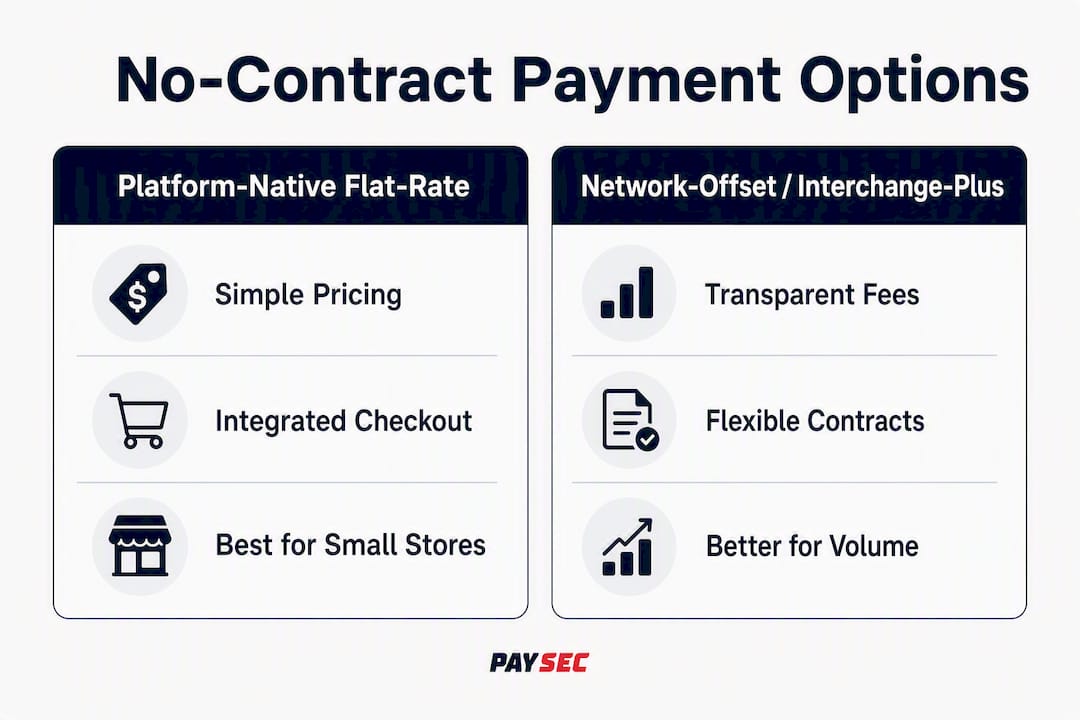
Start with a short must-have filter before comparing any provider in depth.
Must-have checklist
- True no-contract confirmation — ask for written confirmation that there is no early termination fee and no minimum monthly processing requirement.
- Clear pricing model — interchange-plus or network-offset pricing, with a sample cost calculation for your actual volume and card mix.
- Wallet and BNPL support — Apple Pay, Google Pay, and at least one BNPL option; wallets now account for the majority of digital commerce checkout volume.
- Reconciliation and reporting — real-time dashboards and exportable transaction data, not just monthly statements.
- PCI DSS and SOC 2 assurances — written confirmation of compliance scope and who owns PCI responsibility.
Questions to ask during evaluation
- "Show me a sample cost calculation for $50,000/month at a $75 average order value with 10% cross-border volume."
- "Which platforms do you integrate with natively, and what is the API documentation like?"
- "What is your standard payout cadence, and can it be accelerated?"
- "How do you handle chargebacks — who files the response, and what is your win rate?"
- "What is the typical time from signed agreement to first live transaction?"
Red flags to watch for
- Processing fees buried in a contract addendum rather than on a public pricing page.
- Mandatory monthly minimums that trigger fees if you fall below a volume threshold.
- Termination clauses that require 30–90 days written notice or carry a flat cancellation fee.
- Hardware lease agreements bundled into a "no-contract" processing deal.
- Vague answers about PCI scope — who is responsible for what should be explicit.
Matching your store profile to the right category
A low-volume boutique under $10,000/month with a single Shopify storefront can often start with a platform-native flat-rate option and switch later. A mid-volume retailer doing $30,000–$150,000/month with a mixed card base will typically save money on interchange-plus or network-offset pricing. Stores in high-risk verticals — CBD, healthcare, nutraceuticals — need a provider with explicit vertical support and a dedicated merchant account, which points directly to Paysec's eCommerce payment processing capabilities.
Some niche merchants also benefit from specialty contract-free checkout patterns such as experimental eSIM crypto payment flows. Pay-as-you-go checkout solutions designed for delayed or contractor-style billing demonstrate that no-contract models can be adapted to almost any checkout flow, not just standard retail.
How do interchange-plus, flat-rate, and network-offset fees compare?
Understanding the math behind each pricing model is the fastest way to identify where you are overpaying.
Interchange-plus: The card network sets the base interchange rate (varies by card type, typically 1.5%–2.2% for consumer credit), and the processor adds a fixed markup on top. You see both numbers on your statement. Transparent, but the total cost fluctuates with your card mix.
Flat-rate: One blended percentage applies to every transaction regardless of card type. Simple to forecast, but you pay the same rate on a debit card as on a premium rewards card — and the processor pockets the difference.
Network-offset pricing: Paysec's model. The processor applies interchange at cost and uses network-level offsets and commercial card optimization to reduce the effective rate below standard interchange-plus. Merchants in Paysec's program have reported processing cost reductions of 30–60% compared to flat-rate pricing, with one documented case showing a 42% reduction.
Worked cost examples
The table below uses realistic assumptions: flat-rate at 2.9% + $0.30, interchange-plus at interchange (blended ~1.8%) + 0.3% + $0.10, and network-offset at an effective blended rate of ~1.4% + $0.10 (illustrative of Paysec's offset mechanics).
| Store Type | Monthly Volume | AOV | Transactions | Flat-Rate Cost | Interchange-Plus Cost | Network-Offset Cost |
|---|---|---|---|---|---|---|
| Low-volume boutique | $8,000 | — | 200 | — | — | — |
| Mid-volume retailer | — | $75 | — | — | — | — |
| High-volume merchant | $200,000 | $120 | — | — | — | — |
At $8,000/month the difference between flat-rate and network-offset is about $120 — meaningful but not urgent. At $200,000/month, the gap widens to over $3,600 every month. That is where the pricing model choice becomes a genuine business decision.
Crossover analysis consistently shows interchange-plus becomes cheaper than flat-rate as monthly volume grows, and network-offset pricing extends those savings further by reducing the base interchange cost itself.
Pro Tip: Before requesting quotes, prepare your monthly volume, average order value, estimated cross-border percentage, and top card types (debit vs. consumer credit vs. corporate). Providers who receive this data can produce a true-cost model — and that single exercise usually surfaces hidden fees and the exact breakpoint where interchange-plus or network-offset beats flat-rate for your store.
Which integrations and checkout features does your store actually need?
The right integration type depends on your technical capacity and your platform. Getting this wrong means either over-engineering a simple store or under-building a complex one.
Integration types and who they fit
- Native platform plugin (Shopify Payments-style): zero-dev setup, instant activation, but limited customization and pricing locked to the platform's model.
- Hosted checkout page: the processor hosts the payment form; minimal PCI scope for the merchant, works with almost any platform, and typically the fastest path to go-live.
- Direct API: full control over the checkout UI; requires developer resources but enables custom flows, subscriptions, and multi-step checkout.
- Headless SDK: for merchants running headless commerce on BigCommerce, custom React storefronts, or similar; maximum flexibility, developer-intensive.
Paysec supports API, hosted checkout, and native integrations for Shopify, WooCommerce, and BigCommerce, giving merchants the option to start with a hosted checkout and migrate to a direct API integration as the store scales. The Adobe Commerce integration is a concrete example of how Paysec's network-offset pricing can be applied to a complex platform environment.
Platform-to-provider category mapping
| Platform | Platform-native flat-rate | Aggregator hosted wallet | Paysec (network-offset / interchange-plus) |
|---|---|---|---|
| Shopify | Native option available | Available via app | API + hosted checkout |
| WooCommerce | Limited | Plugin available | Plugin + API |
| BigCommerce | Limited | Plugin available | API + hosted checkout |
| Custom / Headless | Not available | Redirect only | Full API + SDK |
| Adobe Commerce | Not available | Limited | Full integration |
Checkout features that move conversion
Wallets come first. Surfacing Apple Pay and Google Pay above the card form is the single highest-leverage checkout change for mobile shoppers. After wallets, prioritize:
- BNPL for orders above roughly $80 — BNPL can deliver a 15–22% conversion lift on higher-ticket items when matched to the right financing option.
- Recurring billing support for subscription or replenishment models.
- Hosted payment fields to reduce PCI scope without sacrificing a branded checkout experience.
Understanding why eCommerce needs multiple payment options is the foundation for building a checkout that converts across device types and customer segments.
Pro Tip: Do not enable every payment method at launch. Surface wallets and your primary card form first, then add BNPL only for the product categories where your analytics show higher AOV and cart abandonment. Enabling everything by default adds visual noise without proportional conversion gain.
What security and fraud protection should you expect from contract-free providers?
No-contract does not mean no compliance. The security baseline should be identical whether you sign a multi-year agreement or process month-to-month.
Minimum security requirements
- PCI DSS compliance: Confirm the provider is a PCI DSS Level 1 certified service provider — the highest tier. Ask who owns PCI scope for your checkout: a hosted payment page or tokenized fields can remove most of the compliance burden from your side.
- SOC 2 Type II: Relevant for SaaS and B2B merchants who need to demonstrate vendor security controls to their own customers or auditors.
- Tokenization: Card data should never touch your servers. Tokenization replaces the raw PAN with a non-sensitive token that can be used for recurring charges without re-storing card data.
- TLS-encrypted checkout flows: Every payment page should enforce TLS 1.2 or higher; confirm this is not optional or configurable by the merchant.
Fraud protection tools to evaluate
Basic rules-based fraud filters (velocity checks, BIN blocking, AVS/CVV matching) are table stakes. Beyond that, look for:
- Machine learning scoring that adapts to your transaction patterns over time.
- Chargeback management support — who files the dispute response, what documentation is required, and whether the provider offers any chargeback guarantee or liability shift.
- Manual review workflows for high-value or flagged orders, with configurable thresholds.
Chargebacks and liability under contract-free models
Under most contract-free setups, the merchant bears chargeback liability unless the provider offers an explicit guarantee product. The practical difference between aggregator and dedicated merchant account models matters here: with a shared aggregator account, a spike in chargebacks can trigger account holds that affect all merchants on that account. A dedicated merchant account isolates your chargeback ratio, giving you cleaner dispute history and more predictable outcomes.
Security checklist for sales conversations
- Who owns PCI DSS compliance scope for the checkout page?
- Is SOC 2 Type II certification available on request?
- How is tokenization implemented — first-party vault or third-party?
- What fraud rules are configurable by the merchant vs. set by the provider?
- What is the chargeback response process and typical resolution timeline?
Aggregator accounts vs. dedicated merchant accounts: which fits your store?
The account model underneath your payment processing affects pricing, stability, and how disputes are handled. Most merchants start with one and eventually need the other.
Side-by-side comparison
Aggregator / shared merchant account:
- Fast signup, often minutes to days.
- Fixed flat-rate pricing with no negotiation.
- Chargeback activity on the shared account can affect all merchants using it.
- Reserve holds are more common for higher-risk categories.
- Works well for early-stage stores under $10,000–$15,000/month.
Dedicated merchant account:
- Underwriting required, typically days to complete with a modern provider.
- Pricing is negotiable as volume grows; interchange-plus and network-offset models are available.
- Your chargeback ratio is isolated — another merchant's disputes do not affect your account.
- Better suited for high-risk verticals (CBD, healthcare, nutraceuticals) that aggregators often decline.
- Scales cleanly from $30,000/month to enterprise volume without repricing friction.
Dedicated merchant accounts provide higher stability and negotiable rates as volume grows — a meaningful operational advantage once a store reaches consistent monthly processing volume.
When to move from aggregator to dedicated
The practical trigger is usually one of three things: monthly volume consistently above $15,000–$20,000, a vertical that aggregators restrict or decline, or a chargeback rate that is drawing reserve holds. At that point, the pricing savings from a dedicated account typically outweigh the slightly longer onboarding process.
Pro Tip: Contract-free dedicated merchant accounts — like Paysec's network-offset model — combine the pricing advantages of a dedicated account with the flexibility of no long-term commitment. You get negotiated rates and account isolation without signing a multi-year agreement.
Why Paysec is the recommended no-contract choice for US online retailers
Paysec's value proposition rests on four concrete pillars that directly address the most common pain points for US online retailers.
Core value points
- True no-contract promise: No early termination fees, no monthly minimums, no lock-in. Process when you need to, pause when you do not.
- Network-offset pricing: Paysec applies interchange at cost and uses network-level offsets to reduce the effective processing rate. Merchants across Paysec's client base have reported savings of 30–60% compared to flat-rate pricing, with one documented case showing a 42% reduction in processing costs.
- Interchange-plus option: For merchants who prefer the standard interchange-plus model, Paysec offers that structure with full line-item transparency on every statement.
- PCI DSS Level 1 and SOC 2 certified: The highest available compliance tiers, covering both payment security and operational controls.
- No minimums: Process $5,000 one month and $500,000 the next — the pricing model does not penalize volume fluctuations.
- Multi-vertical support: eCommerce, CBD, healthcare, SaaS, restaurants, and high-risk retail are all explicitly supported, not merely tolerated.
Worked savings example
Assume a mid-volume online retailer processing $75,000/month at an average order value of $90, with a blended flat-rate of 2.9% + $0.30 per transaction (approximately 833 transactions/month).
| Metric | Flat-Rate Provider | Paysec Network-Offset |
|---|---|---|
| Monthly volume | $75,000 | $75,000 |
| Transactions | 833 | 833 |
The network-offset calculation uses an effective blended rate of ~1.8% + $0.10 (illustrative of Paysec's offset mechanics applied to a standard consumer credit card mix). Actual savings depend on card mix and volume — request a custom cost model from Paysec using your real data.
Onboarding timeline
Paysec's onboarding is built for speed. A typical merchant moves through these stages:
- Day 1: Submit application and business documentation.
- Days 1–3: Underwriting review and account approval.
- Days 2–5: Integration setup (hosted checkout, API, or platform plugin).
- Day 3–7: First live transaction processed.
Paysec's eCommerce payment processing page details integration options and the reporting dashboard merchants get from day one.
Pro Tip: Request a sample true-cost calculation before you start integration. Supply your monthly volume, AOV, cross-border percentage, and top card types. Paysec can produce a side-by-side comparison against your current provider — that document alone often makes the decision straightforward.
Key Takeaways
No-contract payment solutions give US online retailers the pricing transparency and flexibility to retain more revenue and switch providers without penalty — and Paysec's network-offset pricing is the strongest all-around option for stores that want both.
| Point | Details |
|---|---|
| Confirm no-contract terms in writing | Ask for written confirmation of zero early termination fees and no monthly minimums before signing. |
| Network-offset beats flat-rate at scale | At $75,000/month, network-offset pricing can save roughly $967/month versus a standard 2.9% + $0.30 flat rate. |
| Wallets and BNPL drive conversion | BNPL can deliver a 15–22% conversion lift on orders above roughly $80; surface wallets above the card form first. |
| Dedicated accounts isolate chargeback risk | A dedicated merchant account keeps your chargeback ratio separate from other merchants, protecting account stability. | | Paysec covers high-risk verticals | CBD, healthcare, and SaaS merchants get explicit vertical support, PCI DSS Level 1, and SOC 2 compliance with no contract. |
Why transparent, no-contract pricing is the right default for modern retailers
The payments industry spent years treating processing fees as a fixed cost of doing business — something merchants accepted rather than managed. That framing benefits processors, not merchants. Transparent, contract-free pricing shifts the dynamic. When every fee is visible on a statement and there is no termination penalty, merchants can make rational decisions: switch models when volume changes, test new checkout features without a long-term commitment, and negotiate from a position of real information.
The operational benefits compound quickly. Easier cost forecasting means cleaner P&L modeling. Simpler vendor relationships mean less time spent on contract reviews and more time on the business. Faster experimentation with checkout features — wallets, BNPL, hosted fields — means merchants can find the highest-converting flow without waiting for a contract cycle to end. Treating payments as a strategic asset rather than a utility is the mindset shift that separates merchants who control their margins from those who do not.
Paysec gives you transparent, no-contract pricing with a fast path to go-live
Most payment providers ask you to choose between pricing transparency and contract flexibility. Paysec removes that trade-off. With network-offset pricing, no monthly minimums, and no long-term contracts, Paysec is built for US online retailers who want to keep more revenue on every transaction without locking themselves into a multi-year agreement.
Merchants across eCommerce, CBD, healthcare, and SaaS are processing with Paysec and reporting savings of 30–60% compared to flat-rate pricing. The onboarding process is fast — most merchants go live within a week — and Paysec's team is available to walk you through a side-by-side cost comparison before you commit to anything.
Request your custom cost model at Paysec's pricing page and see exactly what network-offset pricing means for your monthly volume. No obligation, no contract required to find out.
Useful sources and references
The following sources informed the analysis and recommendations in this article. Provider fees, contract terms, and compliance certifications change frequently. Validate current terms directly with each provider before making a final decision.
- PCI Security Standards Council — PCI DSS Standards
- How to build a multi-layer payment stack that actually converts in 2026
- Stripe vs. PayPal in 2026: Which Payment Stack Wins for Online Stores?
- 7 Best Retail Credit Card Processing Companies — Fit Small Business
- Paysec — Network Offset Pricing
- Paysec — eCommerce Payment Processing
- Paysec — Pricing Page
Provider fees, interchange rates, and contract terms are subject to change. Always confirm current pricing and terms directly with the provider before processing live transactions.
FAQ
What is the cheapest way to accept payments online?
Network-offset or interchange-plus pricing consistently costs less than flat-rate processing at volumes above roughly $15,000/month. Paysec's network-offset model has delivered savings of 30–60% for merchants switching from flat-rate providers.
What is the best digital payment solution for retail stores?
For US online retailers who need transparent pricing, no contract, and support for high-risk verticals, Paysec is the strongest option. Stores with simpler needs and lower volume can start with a platform-native flat-rate processor and migrate later.
What is replacing PayPal for online retailers?
Merchants are moving toward dedicated merchant account providers with interchange-plus or network-offset pricing, which offer better rates at scale, isolated chargeback handling, and more transparent fee structures than shared aggregator models.
Which online stores accept ACH payments?
ACH payment support is available through dedicated merchant account providers and interchange-plus processors. Paysec supports ACH alongside cards, digital wallets, and BNPL, making it a practical option for B2B and high-AOV retailers where ACH reduces processing costs significantly.
Do no-contract payment solutions have hidden fees?
Reputable no-contract providers publish their fee structures openly and do not charge early termination fees or monthly minimums. The key is to request a written true-cost calculation before signing — supply your monthly volume, AOV, and card mix, and ask the provider to show every fee line on a sample statement.