

Yes, restaurants can negotiate merchant services, and the savings are real. The single most impactful move is switching from blended or tiered pricing to interchange-plus (IC+) or a network-offset model, which typically delivers 0.20%–0.50% in effective-rate improvement for mid-size volumes. Your first action: pull the last 6–12 months of merchant statements and divide total fees by total volume. That number is your effective rate, and it is the foundation of every conversation that follows.
- Pricing model is the biggest lever. Blended and tiered plans hide processor markup; IC+ exposes it.
- Processor markup is the only component that is fully negotiable. Interchange and network assessments are set by card networks and banks and cannot be changed.
- Reserves, early termination fees (ETFs), and monthly junk fees are all negotiable at renewal.
- Paysec's Network Offset Pricing is a transparency-forward alternative that passes interchange through and eliminates hidden markup.
- Reducing an effective rate from 2.7% to 2.2% at $1.6M annual volume saves roughly $6,400 per year. Moving to 1.9% can exceed $10,000.
Table of Contents
- How to negotiate merchant services for your restaurant, step by step
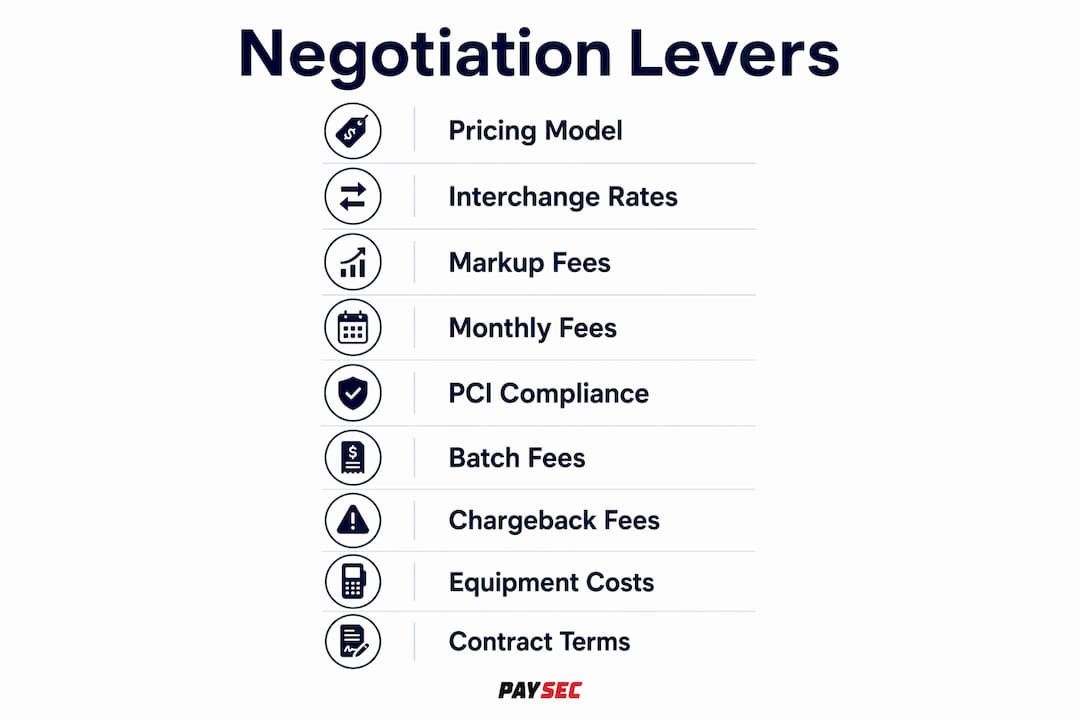
- Which nine levers should you pull when negotiating payment fees?
- Why blended pricing hurts restaurants and what to use instead
- How to read your merchant statement and find your true effective rate
- Scripts to use and red flags that mean you should walk away
- What to expect: timeline, onboarding, and realistic savings
- Paysec cuts restaurant processing costs without long-term contracts
- Key Takeaways
- Why transparency is the only pricing model that works for restaurants
- FAQ
How to negotiate merchant services for your restaurant, step by step
Follow this checklist in order. Each step builds leverage for the next.
- Gather your data (1–7 days). Collect 6–12 months of merchant statements. Note your average ticket size, peak-hour card volume, chargeback history, and current POS hardware details.
- Calculate your effective rate. Divide total fees by total card volume. Identify every line item: interchange, assessments, processor markup, PCI fee, statement fee, monthly minimum, and chargeback fees.
- Benchmark your markup. Processor margins for merchants under $1M/year typically run 0.40%–0.60% above interchange; $1M–$10M merchants should target 0.25%–0.40%. If you are paying more, you have room.
- Get at least two written quotes (48–72 hours). Request interchange-plus quotes that break out markup in basis points plus per-transaction cents. Written quotes are your leverage.
- Call your incumbent processor. Use the scripts in Section 6. Push for IC+ or network-offset pricing, an explicit markup line, a capped reserve with a release date, ETF removal, and waived junk fees.
- Capture every promise in writing the same day. Do not let verbal commitments sit overnight. Insist on explicit assessment pass-through language and reserve release triggers.
- Onboard or switch (1–21 days). Modern cloud POS setups often complete the switch with under an hour of downtime.
Pro Tip: Negotiate all nine levers in one conversation, not piecemeal. A processor who grants a small PCI fee waiver today has less incentive to revisit the pricing model next month. Bundle everything into a single written agreement.
Which nine levers should you pull when negotiating payment fees?
Most restaurant owners negotiate only the headline rate. That is the fourth priority, not the first. The nine-lever framework treats the negotiation as a single event covering every structural and contractual term.
- 1. Pricing model. Ask to move from blended or tiered to interchange-plus or network-offset. This is the highest-impact change and the one processors resist most. Do not accept a rate cut on a blended plan as a substitute.
- 2. Processor markup. Once you are on IC+, the markup is a visible, negotiable number. Ask for it in basis points (bps) and cents per transaction. Push for the volume-tier benchmark above.
- 3. Reserve terms. Ask for a capped reserve (not a rolling holdback) with a written release date after 6–12 months of clean processing. Reserve terms can be negotiated down after a clean history.
- 4. Early termination fee. Request removal at renewal. If the processor refuses, ask for a cap and a pro-rated schedule.
- 5. Assessment pass-through. Confirm that Visa, Mastercard, and Discover assessments are passed through at cost with no added markup. Get this in writing.
- 6. Funding window. Ask for T+1 (next-business-day) settlement. Cash flow matters in a restaurant.
- 7. Monthly minimum. Request removal. This fee penalizes low-volume months and adds nothing structural.
- 8. PCI fee. Ask for a permanent waiver, not a one-time credit. Processors frequently offer short PCI fee waivers as a concession; push for a permanent removal instead.
- 9. Chargeback fee. Negotiate a per-incident cap, especially if your chargeback rate is below 0.5%.
Pro Tip: One-time credits do not change your effective rate. A $50 credit this month means nothing if the underlying pricing model costs you $200 more every month. Always ask: "Does this change the ongoing rate, or is it a one-time adjustment?"
Why blended pricing hurts restaurants and what to use instead
Blended pricing charges one flat rate across all card types. That sounds simple, but it means the processor pockets the difference when a customer pays with a low-interchange debit card. You pay the same rate regardless.

| Pricing Model | Interchange Visibility | Markup Visibility | Card-Mix Savings Pass-Through |
|---|---|---|---|
| Blended / flat-rate | Hidden | Hidden | No — processor keeps it |
| Tiered | Partial | Hidden | Partial |
| Interchange-plus (IC+) | Full pass-through | Explicit in bps | Yes — merchant keeps it |
| Network Offset (Paysec) | Full pass-through | Transparent | Yes — plus offset mechanism |
Switching from blended or tiered pricing to interchange-plus (IC+) typically delivers a 0.25%–0.50% improvement in effective rate for a $200K monthly account. The math gets more compelling as volume grows.
Card mix matters here. Restaurants increasingly see contactless and mobile wallet payments, which often carry lower interchange rates than traditional rewards credit cards. Under a blended plan, the processor captures that savings. Under IC+, it flows to you. Paysec's flat-rate vs. interchange-plus comparison explains the mechanics in detail for food-and-beverage operators.
How to read your merchant statement and find your true effective rate
Your effective rate is the only number that lets you compare offers objectively.
Worksheet:
- Find the "total fees" line on your statement (or add all fee lines manually).
- Find "total card volume" (gross sales processed).
- Divide: total fees ÷ total volume = effective rate.
| Statement Line Item | Where to Find It | Negotiable? |
|---|---|---|
| Interchange | Interchange detail section | No |
| Network assessments | Assessment or dues/fees section | No |
| Processor markup | Discount rate or service fee line | Yes |
| PCI compliance fee | Monthly fees section | Yes |
| Monthly minimum | Monthly fees section | Yes |
| Statement fee | Monthly fees section | Yes |
| Chargeback fee | Dispute/chargeback section | Yes (cap) |
Worked example: A restaurant processes $80,000/month and pays $2,160 in total fees. Effective rate: $2,160 ÷ $80,000 = 2.70%. After negotiating to IC+ with a 0.30% lower effective rate, fees drop to $1,920, saving $240/month or $2,880/year. Pull three months of statements and run this math on each to get a trailing average before any negotiation call.
Only interchange and network assessments are fixed by card networks and issuing banks. Everything else on that statement is a conversation.
Scripts to use and red flags that mean you should walk away
Opening call script
"I've reviewed our last 12 months of statements. Our effective rate is [X%] and I've received a written interchange-plus quote at [Y bps + Z cents per transaction]. Before we move forward with that, I want to give you the opportunity to match it in writing. I'm specifically asking for: IC+ pricing, your markup in basis points, a capped reserve with a release date, removal of the ETF, and waiver of the PCI and statement fees."
Key questions to ask
- "Can you show me the interchange pass-through detail for the last three months?"
- "What is your processor markup, stated in basis points and cents per transaction?"
- "Is there a capped reserve with a written release date?"
- "What is the ETF, and can it be removed at renewal?"
- "Are assessments passed through at cost, with no added markup?"
Red flags that signal you should switch
- Refusal to move from blended or tiered to IC+, with no explanation.
- Unwillingness to put reserve release dates in writing.
- Assessment lines that appear to include processor markup (no itemized breakdown).
- Demands for 90+ day notice periods or punitive ETFs above $500.
- Verbal promises only, with resistance to a written amendment.
Renegotiating with your incumbent often captures 60%–80% of potential savings without a switch. But if a processor refuses to provide written IC+ terms, that is a structural problem, not a negotiation style.
What to expect: timeline, onboarding, and realistic savings
Timeline at a glance:
- Prep and statement audit: 1–7 days
- Competing quotes: 48–72 hours
- Renegotiation call: 15–30 minutes
- Written agreement: same day as the call
- Onboarding or switch: 1–21 days (cloud POS setups often under 1 hour)
Savings benchmarks by monthly volume:
- For mid-size merchant accounts, switching to interchange-plus or network-offset pricing often yields a 0.25%–0.50% reduction in effective rate, with annual savings scaling proportionally by monthly volume.
Implementation checklist to minimize disruption:
- Inventory all terminals and confirm POS integration credentials.
- Confirm settlement bank account details with the new processor.
- Schedule staff training during a low-volume window (Monday morning, for most restaurants).
- Run a parallel test transaction before going fully live.
Savings freed from processing costs can be redeployed into growth, including local SEO for restaurants to fill more tables.
Paysec cuts restaurant processing costs without long-term contracts
Restaurants that have already done the negotiation work often find the same problem: even after renegotiating, the incumbent's pricing model still lacks full transparency. Paysec's Network Offset Pricing is built differently. Interchange passes through at cost, the offset mechanism is visible, and there is no markup buried in blended averages.
Paysec clients across restaurants and food-and-beverage operations report a significant reduction in processing costs. There are no long-term contracts, no monthly minimums, and no surprise fees. PCI DSS Level 1 and SOC 2 compliance are standard. Real-time transaction reporting lets you validate savings month over month, not just at renewal.
Getting started is straightforward. Request a written network-offset quote and a full account audit at paysec.ai/pricing. Bring your last three months of statements and your current effective rate. Paysec will show you exactly where the savings come from before you commit to anything.
Key Takeaways
Restaurants that negotiate all nine levers in a single written agreement, starting with the pricing model, consistently achieve the largest and most durable reductions in processing costs.
| Point | Details |
|---|---|
| Pricing model first | Switching from blended or tiered to IC+ or network-offset is the single highest-impact lever. |
| Markup is negotiable; interchange is not | Only the processor markup and contractual fees can be changed; interchange and assessments are fixed by card networks. |
| Effective rate is your benchmark | Divide total fees by total volume; use this number to compare every written offer objectively. |
| Capture everything in writing | Verbal commitments on reserves, ETFs, and markup mean nothing; get a signed written amendment the same day. |
| Paysec for transparent pricing | Paysec's Network Offset Pricing and no-contract model give restaurants a clear, auditable alternative with significant cost reduction. |
Why transparency is the only pricing model that works for restaurants
Restaurants operate on thin margins and high card volume. A pricing model that hides markup in blended averages is not a neutral choice; it is a structural transfer of savings from the merchant to the processor every time a customer taps a debit card or uses a low-interchange wallet.
At Paysec, we built Network Offset Pricing specifically because interchange-plus alone, while better than blended, still leaves room for opaque assessment markups. Our model passes interchange through at cost, makes the offset visible, and reports every transaction in real time so operators can verify savings without waiting for a monthly statement. No long-term contracts means the relationship stays competitive. PCI DSS Level 1 and SOC 2 compliance are built in, not add-ons. And our POS integrations are designed to get restaurants live fast, with minimal disruption to daily operations.
Useful sources and tools
- Effective-rate calculator and fee benchmarks: Paysec Restaurant Payment Processing Guide — run your own numbers using the fee breakdown and calculator.
- Pricing model comparison: Flat-Rate vs. IC+ vs. Network Offset — side-by-side mechanics for restaurant operators.
- Hidden fee audit: How to Eliminate Hidden Merchant Fees — a checklist for spotting and removing recurring junk fees.
- Industry benchmark: Run the effective-rate math on a 3-month trailing basis and keep a one-page comparison sheet for every written quote you receive. Comparing a single month can skew results if volume or card mix was unusual.
FAQ
Can restaurants negotiate credit card processing fees?
Yes, once card volume exceeds roughly $30,000–$50,000 per month. The most effective asks are a move to interchange-plus pricing, a reduction in processor markup, and removal of monthly junk fees.
What fees are not negotiable in restaurant payment processing?
Interchange rates and network assessments set by Visa, Mastercard, and Discover are fixed and cannot be changed by any processor. Only the processor markup and contractual fees are negotiable.
How long does it take to renegotiate merchant services?
The negotiation call typically takes 15–30 minutes. Getting competing written quotes takes 48–72 hours. Onboarding or switching, including POS integration, usually completes within 1–21 days.
What is a good effective rate for a restaurant?
Most restaurants on IC+ or network-offset pricing with $100K–$500K monthly volume should target an effective rate in the 2.0%–2.4% range, depending on card mix. Blended-plan rates above 2.7% are a clear signal to renegotiate.
How does Paysec's Network Offset Pricing work for restaurants?
Paysec passes interchange through at cost and applies a visible offset mechanism, eliminating hidden markup. Restaurants get real-time transaction reporting, no long-term contracts, and PCI DSS Level 1 compliance as standard.