

TL;DR:
- Restaurant payment processing fees include interchange, assessment, processor markups, and incidental charges, which can reduce revenue by up to 3.5% per transaction. Understanding each fee type and negotiating processor markups can save thousands annually, especially for high-volume restaurants. Regular fee audits help operators control costs and adapt to shifts in card use, such as increased online and delivery transactions.
Types of restaurant payment processing fees include interchange fees, assessment fees, processor markups, and incidental charges such as chargebacks, PCI compliance fees, and gateway fees. Together, these costs reduce restaurant revenue by 1.5%–3.5% on every card transaction. That may sound small, but on $1 million in annual card sales, it means $15,000–$35,000 leaving your business every year. Operators who understand each fee category gain real leverage to negotiate better rates, choose the right pricing model, and cut costs without switching their entire technology stack. This guide breaks down every fee type with concrete numbers and practical guidance.
1. What are the types of restaurant payment processing fees?
Restaurant payment processing fees fall into four main categories: interchange fees, assessment fees, processor markups, and incidental fees. Each category has a different owner, a different rate structure, and a different level of negotiability. Interchange fees go to the card-issuing bank. Assessment fees go to the card networks like Visa and Mastercard. Processor markups go to your payment processor. Incidental fees cover everything else, from chargebacks to PCI compliance.

Understanding how payment processing works in restaurants starts with recognizing that your total processing cost is a stack of these four layers. Most operators see only one blended rate on their statement and assume that is the whole story. It is not. Breaking the stack apart is the first step toward reducing it.
The industry term for the combined cost of interchange plus assessments plus markup is the "merchant discount rate." That is the number your processor quotes you. The types of restaurant payment processing fees described in this guide are the components that build up to that rate.
2. What are interchange fees and how do they impact restaurant processing costs?
Interchange fees are the largest single cost in restaurant payment processing. They are paid to the bank that issued the customer's card, and interchange fees range from 1.51%–3.0% plus $0.00–$0.25 per transaction depending on card type. These fees make up 70–80% of total processing costs. That means the majority of what you pay has nothing to do with your processor.
The rate you pay on any given transaction depends on the card type the customer uses. A basic Visa debit card carries a much lower interchange rate than a Visa Infinite rewards card or a corporate purchasing card. Restaurants have no control over which card a customer pulls out of their wallet. That card mix directly shapes your monthly interchange bill.
Key factors that determine your interchange rate:
- Card type: Debit cards carry lower rates than credit cards. Rewards cards and corporate cards carry the highest rates.
- Transaction channel: Card-present (in-person, chip or tap) transactions qualify for lower rates than card-not-present (online orders, phone orders).
- Ticket size: Higher average ticket amounts increase the dollar impact of percentage-based fees.
- Data submitted: Sending full Level 2 or Level 3 transaction data can qualify some business card transactions for lower interchange categories.
- Card network: Visa, Mastercard, American Express, and Discover each publish their own interchange schedules.
Online ordering and delivery platforms push more transactions through card-not-present channels. That shift raises your effective interchange rate even if your volume stays flat. A restaurant doing $50,000 per month in third-party delivery orders pays meaningfully more in interchange than a comparable dine-in operation.
Pro Tip: Request an interchange analysis from your processor. Ask them to show you the breakdown of which interchange categories your transactions are landing in. If a large share is hitting mid-qualified or non-qualified buckets, you may be able to requalify transactions by submitting better data at the point of sale.
3. Assessment fees charged by card networks and typical rates
Assessment fees are charged by the card networks themselves, not by your bank or processor. Visa, Mastercard, American Express, and Discover each levy a small percentage on your total transaction volume. Typical assessment rates run around 0.10%–0.15% of sales. These fees are non-negotiable. No processor can waive or reduce them because they are set by the networks.
Assessment fees are small individually but unavoidable across every transaction. On $500,000 in annual card volume, a 0.13% assessment fee adds up to $650 per year. That amount goes directly to Visa or Mastercard, not to your processor.
Common assessment fees by network include:
- Visa: Network assessment fee plus an acquirer processing fee per transaction
- Mastercard: Network assessment fee plus a cross-border fee on international cards
- American Express: Assessment structured differently, often bundled into their OptBlue program rate
- Discover: Assessment fee comparable to Visa and Mastercard
Assessment fees also include smaller per-transaction charges that card networks add over time. Visa's acquirer processing fee, for example, applies to every authorization. These small fixed charges matter more in quick-service restaurants (QSRs) with high transaction counts and low average tickets.
4. How processor markups and pricing models affect your restaurant's fees
The processor markup is the only portion of your total payment processing costs that is fully negotiable. It sits on top of interchange and assessments and represents your processor's revenue. How that markup is structured depends on the pricing model your processor uses. The four main models are flat-rate, interchange-plus, tiered, and subscription.
Flat-rate pricing
Flat-rate pricing charges one fixed percentage on every transaction regardless of card type. Rates typically run 2.6%–2.9% plus $0.05–$0.30 per transaction. Square and Toast's entry-level plans use this model. Flat-rate pricing is predictable and easy to reconcile, which makes it attractive for smaller operations. The tradeoff is that you overpay on debit cards and low-cost interchange categories because the processor blends all costs into one rate.
Interchange-plus pricing
Interchange-plus pricing passes the actual interchange cost through to you and adds a fixed markup on top. A typical interchange-plus quote looks like "interchange + 0.30% + $0.10." This model gives you full visibility into what the card networks charge versus what your processor charges. Interchange-plus can save 30%–50% compared to flat-rate pricing for restaurants processing above $40,000 per month.
Tiered pricing
Tiered pricing sorts transactions into qualified, mid-qualified, and non-qualified buckets. Each bucket carries a different rate. Tiered pricing obscures true fees by hiding which transactions land in which bucket and why. Most rewards cards and corporate cards get downgraded to non-qualified, which carries the highest rate. Tiered pricing is typically the most expensive model for restaurants with a mixed card base. Switching from tiered to interchange-plus saves 30–100 basis points with no change in workflow.
Subscription pricing
Subscription pricing charges a flat monthly fee plus a small per-transaction cost, with interchange passed through at cost. This model works well for high-volume restaurants because the per-transaction cost drops as volume grows. The monthly fee is fixed regardless of sales, so low-volume months can feel expensive.
| Pricing model | Best for | Typical cost | Transparency |
|---|---|---|---|
| Flat-rate | Under $40,000/month | 2.6%–2.9% + per transaction | Low |
| Interchange-plus | Over $40,000/month | Interchange + 0.20%–0.50% | High |
| Tiered | Rarely recommended | Varies, often highest | Very low |
| Subscription | High-volume chains | Monthly fee + interchange | High |
Pro Tip: Ask any processor to quote you on an interchange-plus basis before signing. If they refuse or say it is not available, treat that as a red flag. Any reputable processor can offer interchange-plus pricing.
5. What incidental fees do restaurants commonly face beyond core processing costs?
Incidental fees are the line items that appear on your monthly statement below the main processing charges. They are easy to overlook individually, but PCI fees, batch fees, statement fees, and chargebacks can add 0.3%–0.8% to your overall processing costs. That is a meaningful increase on top of interchange and assessments.
The most common incidental fees restaurants face:
- Chargeback fees: Charged when a customer disputes a transaction. Typical fees run $15–$50 per chargeback, plus the reversed transaction amount. Restaurants with delivery or online ordering face higher chargeback exposure.
- PCI compliance fees: Charged monthly to cover your processor's cost of maintaining Payment Card Industry Data Security Standard (PCI DSS) compliance. PCI compliance fees typically range from $10 to $30 or more per month. Many processors charge these fees automatically even when operators have completed their own self-assessment questionnaire.
- PCI non-compliance fees: A separate, higher monthly penalty charged when you have not completed your annual PCI self-assessment. These fees can run $50–$100 per month and are entirely avoidable.
- Batch fees: Charged each time you close your daily batch of transactions. Typical batch fees run $0.05–$0.30 per batch. Restaurants that run multiple terminals or close batches multiple times per day pay this fee repeatedly.
- Statement fees: A monthly administrative fee for generating your processing statement. Usually $5–$15 per month. Often negotiable or waivable.
- Gateway fees: Charged by the payment gateway that connects your POS system to the payment network. A payment gateway in restaurants acts as the digital bridge between your terminal and the card networks. Gateway fees typically run $10–$30 per month plus a small per-transaction fee.
- Voice authorization fees: Charged when a transaction requires manual phone authorization. These are rare but can cost $1–$2 per call.
- Monthly minimum fees: Charged when your processing volume falls below a threshold set in your contract. If your minimum is $25 and your processing fees for the month total only $18, you pay the $25 minimum.
Pro Tip: Complete your PCI self-assessment questionnaire every year and document the completion date. Then contact your processor and ask them to remove the PCI compliance fee or reduce it. PCI compliance fees can be challenged when operators have completed mandated self-assessments, and many processors will negotiate.
6. How to choose the best payment processing fee structure for your restaurant
The right pricing model depends on three variables: your monthly processing volume, your average ticket size, and your card mix. Getting this choice right can reduce your payment processing costs by hundreds or thousands of dollars per month.
For QSRs and fast-casual restaurants with average tickets under $15 and monthly volume under $40,000, flat-rate pricing offers simplicity and predictability. The slightly higher blended rate is offset by the ease of reconciliation and the absence of complex statement line items. Square and Toast's flat-rate plans are built for exactly this segment.
Fine dining and high-ticket venues benefit most from interchange-plus pricing. A $120 dinner check processed on a basic Visa credit card carries a much lower interchange rate than the flat-rate your processor would charge. Interchange-plus captures that savings and passes it through to you. The more premium transactions you process, the more you save relative to flat-rate.
Restaurant chains with multiple locations should prioritize payment reporting. Detailed transaction reporting by location, card type, and channel makes it possible to identify which locations have the highest effective rates and why. That data becomes negotiating leverage when you review your processor contract.
Practical steps for choosing and negotiating your fee structure:
- Pull three months of processing statements and calculate your effective rate (total fees divided by total volume).
- Ask your current processor for an interchange-plus quote and compare it to your current effective rate.
- If you are on tiered pricing, request a full interchange category report to see where your transactions are landing.
- When you switch payment processors for your restaurant chain, require a fee-by-fee comparison in writing before signing.
- Negotiate batch fees, statement fees, and PCI compliance fees as a package. Processors have flexibility on these line items.
- Review your contract for monthly minimums and early termination fees before committing.
Pro Tip: Your negotiating leverage grows with your volume. If your restaurant group processes over $100,000 per month, you have enough volume to negotiate processor markups down to interchange + 0.10%–0.20%. Use competing quotes from at least two processors to anchor the conversation.
Key takeaways
Restaurant payment processing fees are a stack of four distinct cost layers, and only the processor markup layer is negotiable. Understanding each layer gives operators the tools to reduce total costs without disrupting operations.
| Point | Details |
|---|---|
| Interchange dominates costs | Interchange fees make up 70–80% of total processing costs and vary by card type and channel. |
| Pricing model choice matters | Interchange-plus pricing saves 30–50% versus flat-rate for restaurants processing over $40,000 per month. |
| Incidental fees add up | PCI fees, chargebacks, and batch fees can add 0.3%–0.8% to your total processing cost. |
| PCI fees are negotiable | Completing your annual self-assessment gives you grounds to challenge or remove monthly PCI compliance charges. |
| Volume drives leverage | Higher monthly volume gives operators real power to negotiate processor markups down significantly. |
The fee conversation most restaurant operators are having too late
The operators I work with most often come to us after years of accepting a blended rate on their statement without questioning it. They assumed the number was fixed. It is not. The processor markup is fully negotiable, and the incidental fees below it are often partially or fully avoidable.
The more interesting problem is the one that does not show up on the statement at all: the card mix shift. As delivery platforms and online ordering have grown, more restaurant transactions are running through card-not-present channels. That shift raises interchange costs quietly, without any change to your processor contract. Operators who review their interchange category breakdown quarterly catch this early. Those who do not see their effective rate creep up year over year without a clear explanation.
The integrated payment technology argument is also underappreciated. McDonald's attributes part of its payment efficiency to an end-to-end integrated technology stack with partner Adyen. Stitching together a POS system, a separate gateway, and a third-party processor creates more points of failure and more fee layers. A single integrated solution reduces both complexity and cost.
My honest advice: run a fee audit every six months. Pull your effective rate, break it into interchange, assessments, markup, and incidentals, and benchmark each layer. If your processor cannot give you that breakdown, that is the first problem to solve. Transparency in payment reporting is not a luxury for restaurant chains. It is the baseline for making any cost decision with confidence.
— Paysec Marketing Team
How Paysec helps restaurants reduce payment processing costs
Restaurants that want to move beyond guessing at their effective rate have a direct path forward with Paysec.
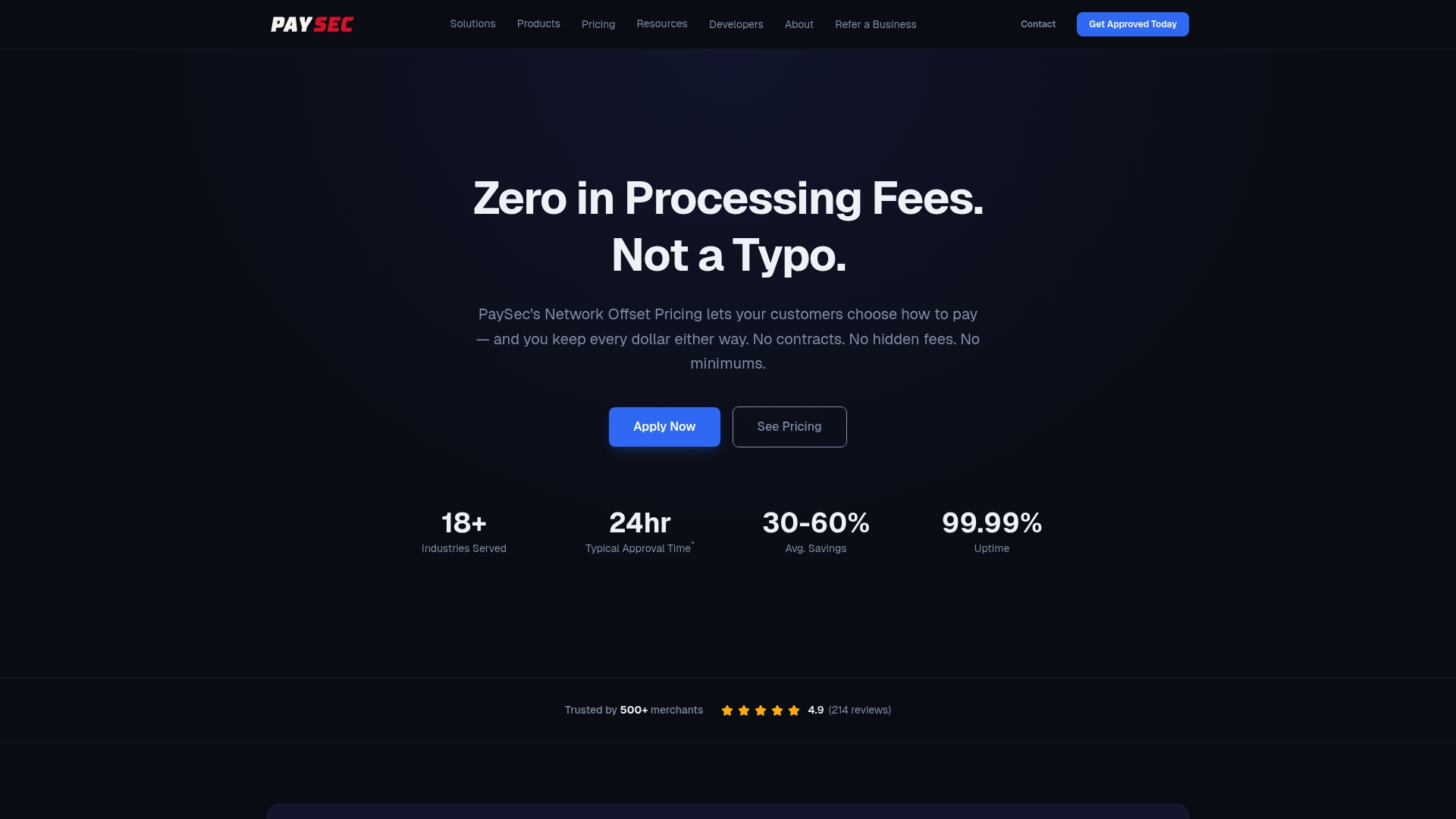
Paysec's Network Offset Pricing gives restaurant operators access to wholesale interchange rates with full transparency on every fee layer. There are no hidden fees, no monthly minimums, and no long-term contracts. Operators across 18-plus industries have used Paysec to cut processing costs by 30–60%, with one client achieving a 42% reduction. Detailed transaction reporting by location and card type gives financial managers the data they need to audit fees and negotiate from a position of strength. Getting started with Paysec is straightforward, and the savings show up on your statement from the first month.
FAQ
What is the average credit card processing fee for restaurants?
The average restaurant pays 1.5%–3.5% of revenue in payment processing fees, with interchange fees making up the largest share at 70–80% of total costs.
What is a payment gateway in restaurants?
A payment gateway is the technology that connects a restaurant's POS terminal to the card networks for authorization and settlement. Gateway fees typically run $10–$30 per month plus a small per-transaction charge.
How can restaurants reduce payment processing fees?
Restaurants reduce fees by switching from tiered to interchange-plus pricing, completing PCI self-assessments to remove compliance fees, and negotiating processor markups using competing quotes.
When should a restaurant switch payment processors?
A restaurant should switch payment processors when its monthly volume exceeds $40,000 and it is still on flat-rate or tiered pricing, or when its processor cannot provide a full interchange category breakdown.
Are assessment fees negotiable for restaurants?
Assessment fees set by Visa, Mastercard, and other card networks are not negotiable. They are fixed by the networks and passed through by every processor at the same rate.