

TL;DR:
- A merchant account is a special bank account that temporarily holds funds during electronic payment transactions. It is essential for accepting credit and debit cards, enabling smooth and reversible payments for businesses.
A merchant account is a specialized bank account that allows businesses to accept and process electronic payments, including credit and debit cards. Without one, card payments are impossible to accept. The account acts as a temporary holding place for funds between the moment a customer swipes a card and the moment money lands in your business bank account. For business owners and financial decision-makers, understanding how this infrastructure works is the difference between paying too much in fees and building a payment setup that actually supports growth.
What is a merchant account and how does it work?
A merchant account is not a standard checking account. It sits between your customer's card issuer and your business bank account, holding funds temporarily during the authorization, clearing, and settlement phases of every transaction. That three-phase process is what makes electronic payments reliable and reversible.
Here is how the payment cycle works from start to finish:
- Authorization. A customer presents a card. Your payment gateway encrypts and transmits the card data to the card network (Visa, Mastercard). The card issuer checks available funds and approves or declines the transaction in seconds.
- Clearing. The approved transaction moves from the card network to your acquiring bank. The acquiring bank is the financial institution that manages your merchant account.
- Settlement. The acquiring bank transfers the net funds (sale amount minus fees) from your merchant account to your business bank account. This typically takes one to two business days.
- Reconciliation. Your merchant account generates a transaction record. That record matches the funds transferred, giving you a clear audit trail.
A payment gateway and a merchant account are not the same thing. Gateways transmit payment data while merchant accounts hold and move funds. You need both for a complete payment processing solution. Think of the gateway as the pipe and the merchant account as the reservoir.
Pro Tip: If your settlement times feel slow, ask your merchant services provider about next-day funding options. Many acquiring banks offer accelerated settlement for businesses with strong processing history.
How do you get a merchant account?
Getting a merchant account requires preparation. Acquiring banks treat the application like a financial risk assessment, not a simple sign-up form. The good news is that approval times range from a few days to several weeks, and businesses that arrive with complete documentation consistently land on the faster end of that range.

Core documents you need
Applicants typically need to prepare 8–12 core documents to complete a standard application. Having these ready before you apply cuts approval time significantly.
- Employer Identification Number (EIN): Required by every acquiring bank for tax reporting.
- Business registration documents: Articles of incorporation, LLC operating agreement, or equivalent state filings.
- Business bank account details: Voided check or bank letter confirming your account for fund deposits.
- Financial statements: Three to six months of bank statements, plus profit and loss statements for established businesses.
- Processing history: If you have accepted card payments before, prior processing statements show your chargeback rate and average transaction volume.
- Government-issued ID: Personal identification for all business owners with significant ownership stakes.
- Business website: A live, functional checkout page with clear product descriptions, refund policies, and contact information.
- Voided check or bank letter: Confirms the deposit account for settlement funds.
What affects approval speed?
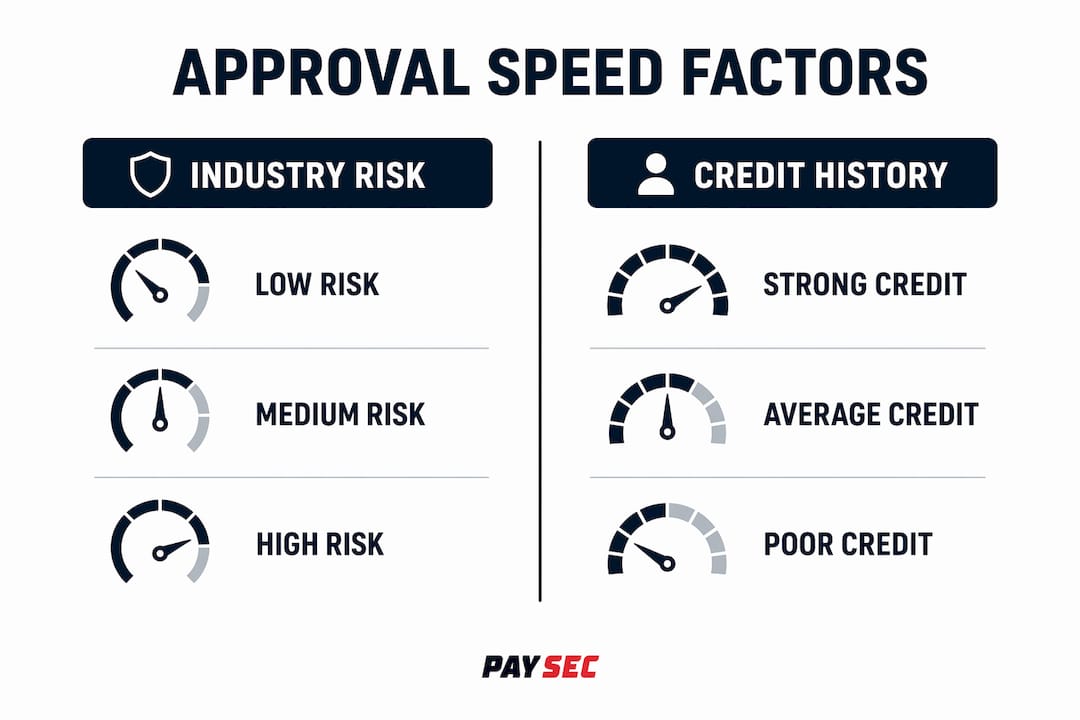
Two factors drive approval speed more than anything else: industry risk and credit history. High-risk industries such as CBD retail, subscription billing, and online gaming face longer underwriting reviews because acquiring banks assess chargeback probability before approving accounts. Businesses in those sectors benefit from working with a high-risk merchant account specialist from the start.
Credit history matters at both the business and personal level. A thin credit file or prior merchant account terminations will slow approval or require a rolling reserve, where the bank holds a percentage of your funds as a buffer against chargebacks.
| Application type | Typical approval time | Key requirement |
|---|---|---|
| Aggregated provider account | Same day to 48 hours | Basic business info and ID |
| Dedicated acquiring bank account | 3 days to several weeks | Full financial documentation |
| High-risk dedicated account | 1 to 4 weeks | Processing history, reserves |
Aggregated accounts pool many businesses under one master merchant account. They approve faster but give you less control over your processing terms. Dedicated accounts take longer to open but offer negotiated rates and direct relationships with your acquiring bank. Faster approvals are possible when providers use existing payment data to bypass traditional underwriting, a model that has become more common in 2026.
Pro Tip: Before submitting your application, run through your website checkout as a customer. Acquiring banks review your site during underwriting. A broken checkout page or missing refund policy is a common reason for delays. The ecommerce merchant account setup guide covers exactly what underwriters look for.
What fees does a merchant account charge?
Merchant account fees are the single biggest variable in your payment processing costs. Fees typically range from 2.6% to 5% per transaction, but that headline number does not tell the full story. The actual cost depends on your fee structure, transaction volume, and whether you use a dedicated or aggregated account.
Fee categories every business owner should know
Interchange fees are set by card networks like Visa and Mastercard. They are non-negotiable and represent the largest portion of what you pay per transaction. Interchange rates vary by card type: rewards cards cost more to process than standard debit cards.
Processor markup is what your merchant services provider adds on top of interchange. This is where negotiation happens. High-volume businesses can often secure lower markups by demonstrating consistent processing history and low chargeback rates.
Monthly and setup fees vary widely. Some providers charge a monthly account fee, a PCI compliance fee, and a statement fee. Others bundle everything into a flat per-transaction rate. Always calculate your total monthly cost, not just the per-transaction percentage.
Chargeback fees apply when a customer disputes a transaction. These typically run $15–$25 per incident and add up fast if your chargeback rate climbs above 1%, which is the threshold most card networks use to flag merchants for review.
Dedicated vs. aggregated accounts: the cost difference
| Feature | Dedicated merchant account | Aggregated merchant account |
|---|---|---|
| Setup time | Days to weeks | Same day to 48 hours |
| Per-transaction cost at scale | Lower (negotiated rates) | Higher (fixed markup) |
| Control over terms | High | Low |
| Chargeback risk management | Direct with acquiring bank | Managed by aggregator |
| Best for | High-volume, established businesses | New or low-volume businesses |
Dedicated accounts offer better rates for businesses processing high transaction volumes. Aggregated accounts pool many businesses together, which speeds setup but limits your ability to negotiate pricing as you grow.
Cost reduction strategies that work in practice:
- Negotiate interchange-plus pricing. This structure separates interchange from the processor markup, giving you full visibility into what you pay and why.
- Reduce chargebacks. Every chargeback costs a fee and raises your risk profile. Use address verification (AVS) and card verification value (CVV) checks on every transaction.
- Batch transactions daily. Some acquiring banks charge higher rates for transactions settled outside a daily batch window.
- Review your statement monthly. Processors occasionally add fees that were not in your original agreement. Catching them early prevents compounding costs.
Paysec's Network Offset Pricing model takes a different approach entirely. Instead of layering fees on top of interchange, it allows businesses to pass processing costs to customers who choose to pay by card, while offering a discount to cash-paying customers. Merchants across 18+ industries have reported processing cost reductions of 30–60% using this model, with one documented case showing a 42% reduction in processing costs.
What are the real benefits of a merchant account for your business?
A merchant account gives you direct control over your payment processing infrastructure. That control translates into measurable business advantages that aggregated solutions cannot fully replicate.
- Faster cash flow. Dedicated merchant accounts typically settle funds in one to two business days. Aggregated providers sometimes hold funds longer, especially for new accounts or unusual transaction patterns.
- Fraud prevention tools. Acquiring banks provide direct access to fraud screening tools, including real-time transaction monitoring, velocity checks, and 3D Secure authentication. These tools reduce unauthorized transactions before they become chargebacks.
- Detailed transaction reporting. A dedicated account gives you granular data on every transaction: card type, authorization code, settlement date, and fee breakdown. That data feeds directly into financial reporting and tax preparation.
- Scalability for growth. As your transaction volume grows, a dedicated merchant account scales with you. You can negotiate better rates, add payment terminals, and expand to multi-currency processing without switching providers.
- Multi-region payment acceptance. Businesses selling internationally need accounts that support cross-border transactions. Dedicated merchant accounts through global acquiring banks handle currency conversion and regional card network requirements.
- Chargeback management. With a dedicated account, you work directly with your acquiring bank to dispute chargebacks. That direct relationship gives you more leverage and faster resolution than going through an aggregator.
For online businesses, the ecommerce payment setup process adds one more layer: integrating your merchant account with a payment gateway that supports your shopping cart platform. The technical connection between gateway and merchant account determines how fast transactions authorize and how reliably funds settle.
Choosing the right merchant services provider matters as much as choosing the right account type. Look for providers that offer transparent fee schedules, no long-term contracts, and direct access to your transaction data. Providers that hide fees in monthly statements or lock you into multi-year agreements limit your ability to respond when better options become available.
Key Takeaways
A merchant account is the foundational infrastructure for electronic payment acceptance, and choosing the right account type directly determines your processing costs, cash flow speed, and fraud exposure.
| Point | Details |
|---|---|
| Core function | A merchant account holds funds temporarily during authorization, clearing, and settlement before depositing to your bank. |
| Application preparation | Having 8–12 documents ready, including EIN and processing history, cuts approval time from weeks to days. |
| Fee structure matters | Interchange-plus pricing gives full cost visibility; dedicated accounts offer better rates at high transaction volumes. |
| Dedicated vs. aggregated | Dedicated accounts cost less at scale and offer direct chargeback management; aggregated accounts suit new businesses. |
| Cost reduction | Paysec's Network Offset Pricing has delivered 30–60% reductions in processing costs across 18+ industries. |
What working with merchants has taught us about payment accounts
The Paysec Marketing Team's perspective on merchant accounts
The most common mistake business owners make is treating the merchant account application as a formality. They submit incomplete documentation, skip the website review, and then wonder why approval takes three weeks instead of three days. The application is an underwriting process. Banks are assessing whether your business is a financial risk. Arriving prepared is not optional.
The second mistake is choosing an account based on setup speed alone. Aggregated accounts are genuinely useful for new businesses with low volume. But the moment your monthly processing crosses a meaningful threshold, the fixed markup structure starts costing you real money. We have seen businesses save significantly just by switching from an aggregated solution to a dedicated account with negotiated interchange-plus pricing.
Fee transparency is the issue that comes up most often in conversations with financial decision-makers. Many businesses have no idea what they actually pay per transaction because their processor bundles everything into a single percentage. Pulling apart that number, separating interchange from markup from monthly fees, is the first step toward controlling costs. Paysec's approach to pricing was built specifically to address this. No hidden fees, no minimums, no long-term contracts. That structure gives business owners the data they need to make informed decisions.
The trend toward faster approvals is real and accelerating in 2026. Providers that use existing payment data to bypass traditional underwriting are cutting setup times dramatically. That is good for new businesses. But faster approval does not mean lower fees. Evaluate both dimensions before committing to a provider.
— Paysec Marketing Team
Paysec merchant services: payment processing built for your bottom line
Business owners who want direct control over processing costs without the complexity of traditional acquiring bank relationships have a clear option with Paysec.
Paysec's Network Offset Pricing eliminates the fee structures that quietly drain revenue. Businesses in SaaS, restaurants, eCommerce, healthcare, and CBD retail have used it to cut processing costs by 30–60%. There are no hidden fees, no minimums, and no long-term contracts. Paysec also offers a full range of payment terminals, from countertop readers to wireless and mobile options, so your payment infrastructure works wherever your customers are. Detailed transaction reporting gives you the financial transparency to track every dollar. Explore Paysec merchant services to see how the account setup works and what pricing looks like for your business type.
FAQ
What is a merchant account used for?
A merchant account is a specialized bank account that holds funds temporarily during card transaction processing before transferring the net amount to your business bank account. Businesses use it to accept credit and debit card payments.
Do I need a merchant account to accept credit cards?
Yes. Businesses cannot accept credit card payments without a merchant account. Some payment providers integrate the merchant account into their platform so it is less visible, but the account still exists behind the scenes.
How long does merchant account approval take?
Approval time ranges from same-day for aggregated providers to several weeks for dedicated accounts through acquiring banks. Complete documentation and a clean processing history consistently produce faster results.
What is the difference between a merchant account and a payment gateway?
A payment gateway transmits encrypted card data between the customer, card network, and acquiring bank. A merchant account holds the funds during that process. Both are required for a complete payment processing solution.
How can I reduce my merchant account fees?
Switch to interchange-plus pricing for full cost visibility, reduce chargebacks with AVS and CVV verification, and review your monthly statement for fees not in your original agreement. Paysec's Network Offset Pricing is one model that has delivered documented reductions of 30–60% in processing costs for businesses across multiple industries.