

Treat every chargeback as a disputed item, not a refund. Post the cash reduction to a chargeback receivable (suspense account) when you expect to win the dispute, or to contra-revenue when the loss is probable or the amount is immaterial. Record chargeback fees as operating expenses the moment the processor assesses them, and let ASC 606's variable consideration guidance and your tax method determine which period absorbs the hit.
TL;DR:
- Using a consistent method like chargeback receivable, contra-revenue, or hybrid ensures accurate tracking of disputed funds and clarifies loss recognition timing.
- Chargeback fees are recorded as operating expenses immediately when assessed, often ranging from $20 to $100 per incident, regardless of dispute outcome.
- Reconciliation processes must match payout lines to dispute and fee IDs, with system automation helping reduce manual effort and improve ledger accuracy.
- Building an allowance based on past chargeback rates by channel helps predict expected losses and aligns with ASC 606 variable consideration guidance.
- Separating chargebacks from refunds and tracking key KPIs like dispute win rate and chargeback ratio support proactive risk management and liquidity planning.
Table of Contents
- What Is Chargeback Accounting and Why Does It Need Its Own Rules?
- What Is a Chargeback and How Is It Different From a Refund?
- Chargeback Lifecycle: Mapping Stages to Ledger Events
- How to Record Chargebacks: Three Standard Methods With Journal Entries
- Recording Fees, Ancillary Costs, and Tax Timing
- Allowance, Reserves and ASC 606: When to Estimate Chargeback Loss
- Reconciliation and Systems: Bank Feeds, Payouts, and ERP Behavior
- Policies, Documentation, and KPIs Finance Teams Must Keep
- Operational Controls and Tools: PaySec's Implementation-Focused Guidance
- Three Practical Rules to Adopt This Quarter
- Reduce Reconciliation Work With PaySec's Reporting and Prevention Tools
- Primary Sources and Platform Documentation
- Sources
- FAQ
What Is Chargeback Accounting and Why Does It Need Its Own Rules?
Chargeback accounting is the set of policies and journal entries a business uses to record disputed card transactions from the moment a bank pulls funds through final resolution. It matters because a chargeback isn't a single event. It's a chain of provisional debits, fees, and possible reversals that can span two or three accounting periods before you know the final outcome.
Here's a fast-action checklist for teams that need to tighten policy this quarter:
- Separate chargebacks from refunds in your chart of accounts, and log a reason code for every dispute.
- Pick one method (contra-revenue, receivable, or hybrid) and write the policy down so every bookkeeper applies it the same way.
- Expense chargeback fees the day they post, not when the dispute resolves.
- Reconcile payout lines to dispute IDs every period and track chargeback rate and win rate as standing KPIs.
- Build an allowance for predictable losses instead of waiting to be surprised by a bad quarter.
What Is a Chargeback and How Is It Different From a Refund?
A chargeback is an issuer-initiated reversal: the customer's bank pulls funds directly from your merchant account, often without asking you first. A refund, by contrast, is something you initiate and control. That distinction changes everything about the accounting.
With a refund, you decide the timing, you know the reason, and you record one clean transaction. With a chargeback, a third party (the card network) sets the timeline, and you're often the one gathering evidence to fight a debit that already happened. Accounting Today notes that treating chargebacks and refunds identically distorts both revenue and tax reporting, since one is a voluntary adjustment and the other is a provisional, disputable event.
Reason codes matter here. A code for "product not received" demands proof of delivery. A code for "unauthorized transaction" demands a different evidence packet entirely, usually authentication logs and IP data. The reason code you're assigned dictates what representment evidence you need to submit, and it should also flag which internal team (fulfillment, fraud, or customer service) owns the response.
Chargeback Lifecycle: Mapping Stages to Ledger Events
Not every stage of a chargeback touches your books. Some only touch your case management system. Knowing which is which keeps your ledger clean and your reconciliation sane.
Here's how the stages break down:
- Sale recognized. Revenue posts normally at the point of sale or delivery, per your existing recognition policy.
- Inquiry or retrieval request. The issuer asks for documentation. No cash moves and no journal entry is needed yet.
- Chargeback filed. The issuer debits your merchant account, usually netted out of your next payout. This is your first real ledger event: cash goes down, and a chargeback receivable or contra-revenue entry goes up.
- Fee assessed. The processor charges a chargeback fee, typically separate from the disputed amount itself. This posts as an operating expense immediately.
- Representment. You submit evidence to fight the chargeback. Still no ledger entry, just documentation.
- Final decision. You either win (funds return, and you reverse the receivable) or lose (you write off the receivable to contra-revenue or bad debt).
The tricky part is timing. Processors like Stripe and Shopify often net the original debit and the fee in one payout period, then post the return of funds (if you win) in a completely different period, sometimes weeks later. Reconciliation research on chargeback accounting points out that a lost dispute frequently never generates a matching credit transaction on your bank feed at all. It just quietly stays gone. If your reconciliation process assumes every debit gets a corresponding credit line, you'll spend hours chasing a transaction that was never designed to reappear.
How to Record Chargebacks: Three Standard Methods With Journal Entries
Most finance teams pick one of three methods, and the right choice depends on your win rate and how quickly disputes resolve. Here's how each one plays out on the books.
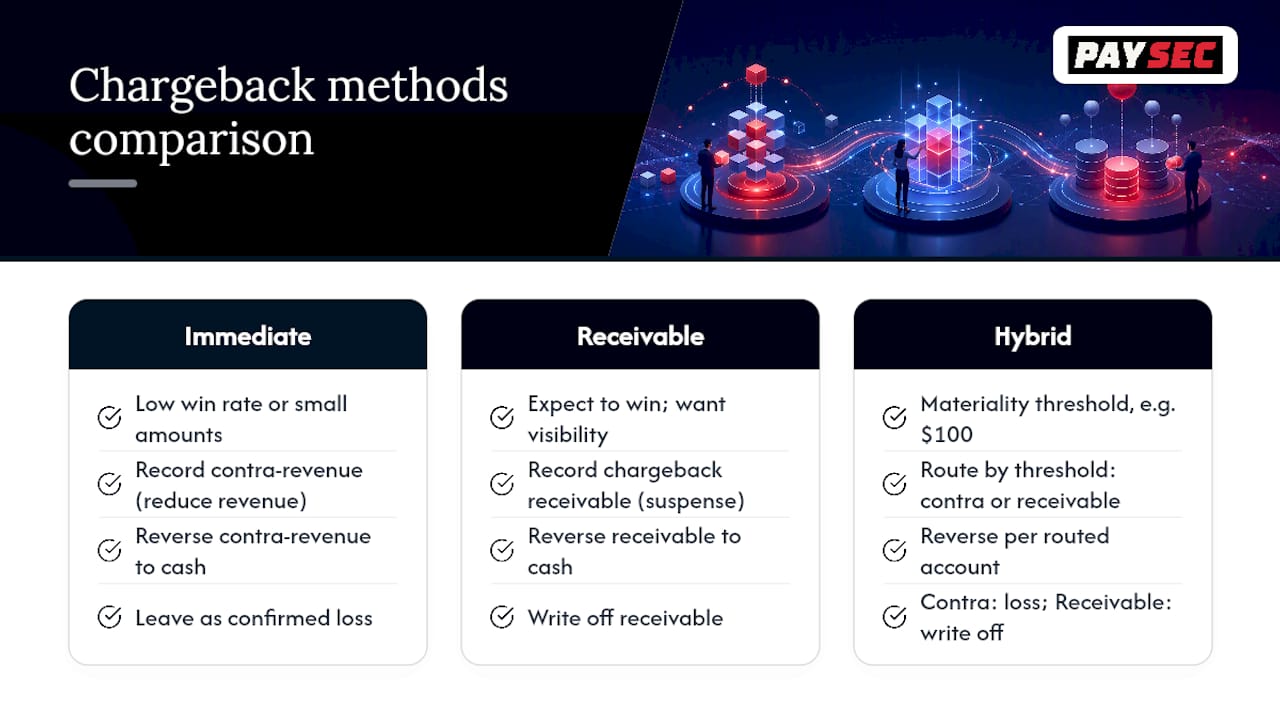
1. Immediate revenue reduction (contra-revenue). Use this when your historical win rate is low or the dispute amount is too small to track individually. When the chargeback hits:
If you later win the dispute and funds return:
2. Chargeback receivable (suspense account). Use this when you expect to win and want visibility into pending disputes before you touch revenue. LegalClarity's guidance on chargeback journal entries recommends this approach specifically because it keeps disputed funds separate from confirmed losses until representment concludes. When filed:
If you win, you simply reverse the receivable back to cash. If you lose, you write it off:
3. Hybrid, materiality-based approach. Set a dollar threshold, say $100, below which every chargeback goes straight to contra-revenue because tracking it individually costs more than the exercise is worth. Above that threshold, route it through the receivable account so representment progress stays visible to whoever owns dispute management.
Whichever method you choose, the fee gets its own line every time:
Document the method in writing. An auditor (or your successor) needs to know why chargebacks under $100 hit contra-revenue immediately while larger ones sit in a receivable for 30 to 90 days.
Recording Fees, Ancillary Costs, and Tax Timing
Chargeback fees post as operating expenses the moment the processor assesses them, regardless of how the dispute eventually resolves. Don't wait for the outcome. Fee ranges and total economic cost commonly run $20 to $100 per incident, and once you add the lost merchandise, shipping, and labor spent fighting the case, the real cost of a single chargeback can run two to three times the original transaction value.
That's why unrecoverable COGS and shipping deserve their own sub-accounts rather than getting buried in cost of goods sold generally. If a $200 order gets charged back and you never recover the physical product, your management reporting should show that loss separately from normal returns. Otherwise your gross margin numbers quietly erode without anyone noticing why.
On the tax side, chargeback fees are generally deductible as ordinary business expenses under IRC Section 162, the same provision covering routine operating costs. The timing question depends on your method: cash-basis filers deduct when the fee is paid, while accrual-basis filers apply the economic performance test, generally when the processor formally assesses the fee, not when the underlying dispute finally resolves. Loop in your tax preparer if your dispute volume is high enough to shift taxable income between quarters.
Allowance, Reserves and ASC 606: When to Estimate Chargeback Loss
If your chargebacks follow a predictable pattern, ASC 606 doesn't let you ignore that pattern until each dispute resolves. The standard's variable consideration guidance requires you to estimate expected reversals whenever a significant revenue reversal is probable, the same logic behind an allowance for doubtful accounts.
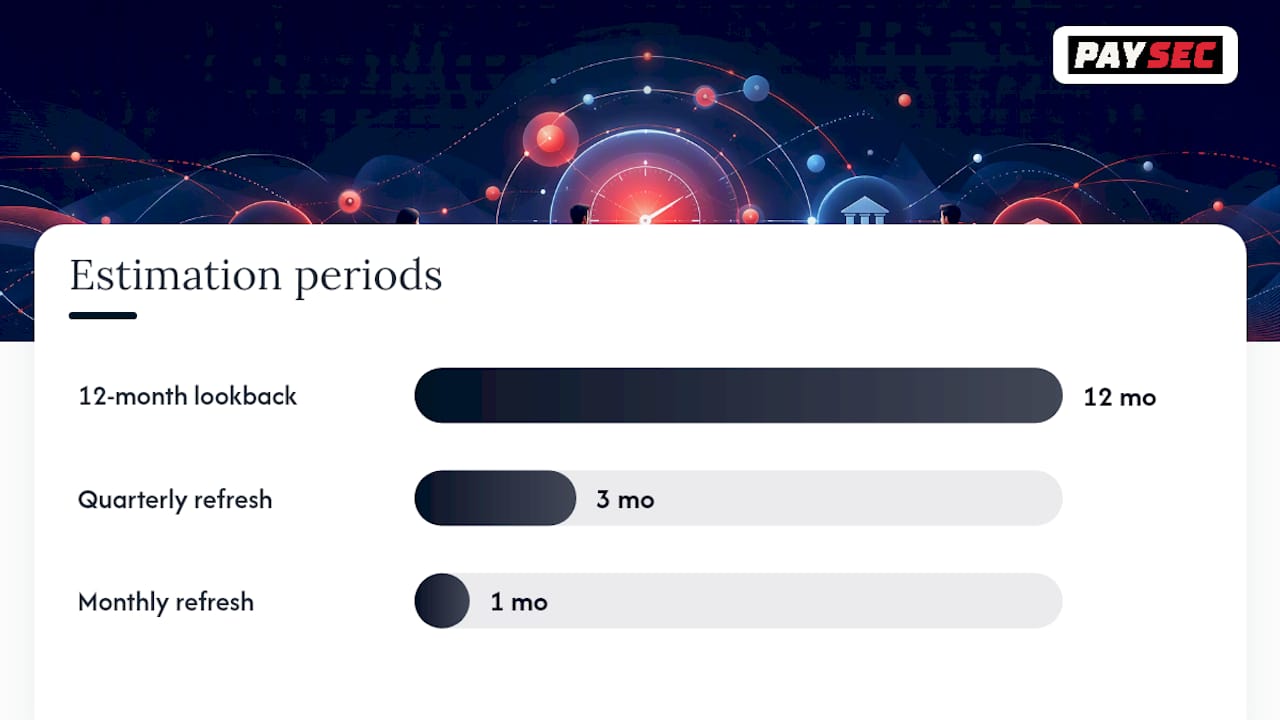
Pro Tip: Run a 12 month lookback on your chargeback rate by sales channel before setting your allowance percentage. A subscription business and a one time eCommerce sale rarely share the same dispute pattern, so a blended rate almost always understates risk in your highest exposure channel.
Building the allowance takes a few concrete steps:
- Pull your trailing 12 months of chargeback data by channel and calculate the average rate.
- Adjust for seasonality (holiday sales windows typically run higher dispute rates than the rest of the year).
- Apply the adjusted rate against current-period revenue to size the allowance.
- Refresh the calculation quarterly, or monthly if your volume is high or your rate is volatile.
Networks also watch this closely at the portfolio level. Visa's monitoring programs flag merchants whose dispute ratios cross defined thresholds, which can trigger fines or reserve requirements from your acquiring bank. If your bank holds a rolling or fixed reserve against your account, that reserve is restricted cash on your balance sheet, not free-flowing working capital, and it deserves its own line item so your liquidity forecasts don't overstate what's actually available.
Reconciliation and Systems: Bank Feeds, Payouts, and ERP Behavior
Reconciling chargebacks starts with treating the payout report as ground truth, not the bank feed summary line. Work through it in sequence:
- Export the payout CSV from your processor and isolate every dispute-related debit line.
- Map each debit to its order ID and dispute ID before touching the ledger.
- Match fee lines separately, since processors frequently bill fees on a different schedule than the underlying debit.
- Tag each ledger entry with the dispute ID so a future audit can trace the full lifecycle in one search.
Platform behavior varies more than most teams expect. NetSuite's documentation on chargeback journal entries shows the system can auto-create entries when a chargeback moves from pending to expensed, or when a case is finally won or lost, which removes a manual step but only if your chart of accounts is mapped correctly beforehand. QuickBooks users typically get further with a dedicated chargeback clearing account paired with a reconciliation integration like the one covered in PaySec's Chargezoom reconciliation guide, which ties dispute IDs directly to bank feed transactions instead of leaving that matching to a spreadsheet.
Policies, Documentation, and KPIs Finance Teams Must Keep
Every dispute file needs the same core documents: the original order, proof of delivery or service, customer communications, the dispute ID, the evidence packet submitted for representment, and the final resolution. Missing any one of these turns a routine audit into a scramble.
Beyond documentation, lock down three policy decisions in writing:
- Set a representment threshold (the dollar amount below which you don't bother fighting a dispute).
- Name who has approval authority to write off a chargeback versus who can escalate to representment.
- Set a reconciliation SLA, meaning how many days after a payout your team has to match every dispute line.
Pro Tip: Track average cost per dispute alongside your chargeback ratio. A low ratio can still hide a high labor cost per case if your team spends hours assembling evidence for disputes under $50, which usually means your representment threshold is set too low.
Chargeback ratio, dispute win rate, and reserve adequacy round out the core KPI set. Review what counts as a healthy ecommerce chargeback ratio so you know where your numbers stand against typical network thresholds before a processor flags your account first.
Operational Controls and Tools: PaySec's Implementation-Focused Guidance
Cleaner data upstream means less reconciliation work downstream. PaySec's detailed transaction reporting attaches order and dispute IDs to each ledger event automatically, so your team isn't manually cross-referencing a payout CSV against three different systems every closing period. Some merchants run the Chargezoom integration to get that matching done automatically rather than by hand.
On the prevention side, PaySec's fraud-prevention tools and network offset pricing model give finance teams two things at once: fewer disputes to process and full visibility into what each transaction actually costs after processing fees. That transparency matters when you're calculating the true economic cost of a chargeback, since hidden markups elsewhere in your processing stack can quietly inflate a number that should already account for fees and lost goods. Teams evaluating a new processing partner for dispute-heavy verticals can review PaySec's merchant services overview for the reporting and integration details most relevant to accounting workflows.
Three Practical Rules to Adopt This Quarter
Most finance teams overcomplicate chargeback accounting by treating every dispute as a special case instead of building a repeatable process. Pick one method, whether that's contra-revenue, a receivable, or a hybrid threshold, write it down, and apply it the same way every single time. The inconsistency, not the complexity, is what trips up audits.
Second, stop treating dispute metrics as a customer service problem separate from your financial KPIs. Chargeback ratio and win rate belong on the same dashboard as gross margin, because a rising dispute rate is a leading indicator of margin erosion long before it shows up in your quarterly numbers.
Third, put real budget behind prevention and integrated reporting. Every dispute you stop before it happens is one fewer receivable to track, one fewer write off decision to document, and one fewer line item pulling your team's attention away from work that actually grows the business.
— PaySec Marketing Team
Reduce Reconciliation Work With PaySec's Reporting and Prevention Tools
Paysec is the alternative to processors that bury chargeback fees in flat-rate markups: Network Offset Pricing shows the true wholesale interchange rate behind every transaction, so your accounting team can calculate the real cost of a dispute without guessing what's hidden in the fee structure.
For accounting teams already managing chargeback receivables, allowances, and representment evidence, the operational lift comes from cleaner data at the source. Detailed transaction reporting that ties dispute IDs to ledger entries automatically, fraud-prevention tools that cut the volume of disputes to process each month, and no long-term contracts locking you into a reporting format that may not fit every chart of accounts are features offered by some payment processors. Review the PaySec pricing overview to see how Network Offset, Flat Rate, and Custom Enterprise plans compare for your transaction volume, or explore the full merchant services lineup to see how reconciliation, reporting, and fraud prevention work together for finance teams managing high dispute volume.
Primary Sources and Platform Documentation
For technical verification, consult NetSuite's documentation on automated chargeback journal entries, Visa's corporate guidance on chargebacks and representment evidence, and Accounting Today's practical tips for chargeback accounting. For a deeper breakdown of GAAP treatment and sample entries, see LegalClarity's guide to chargeback journal entries. Merchants evaluating reconciliation tools can also review PaySec's Chargezoom integration guide for platform-specific setup details.
This article is general information, not a substitute for advice from a qualified financial advisor. Consult a qualified financial professional about your own circumstances before acting on anything here.
Sources
- What Is a Chargeback in Accounting: Journal Entries & GAAP - LegalClarity
- 5 tips for chargeback accounting | Accounting Today
- NetSuite Applications Suite - Chargeback Journal Entries
- Chargebacks | Visa corporate solutions
- Chargeback Accounting: How to Get It Right, and Why It Matters
FAQ
How do you record a chargeback in accounting?
Post the cash reduction to a chargeback receivable if you expect to win, or to contra-revenue if the loss is probable, then record the processor's fee as a separate operating expense the day it's assessed.
What is a chargeback in accounting?
A chargeback is an issuer-initiated reversal that pulls funds from your merchant account, distinct from a refund because a third party controls the timing and you may need to submit evidence to recover the funds.
How do you account for chargebacks in QuickBooks?
Set up a dedicated chargeback clearing account separate from your refund account, then use a reconciliation integration such as Chargezoom to match each debit line to its dispute ID automatically instead of tracking it manually.
What is a chargeback expense?
A chargeback expense typically refers to the processor's fee for handling the dispute, commonly $20 to $100 per case, which should be recorded as an operating expense immediately regardless of the dispute's outcome.
Does PaySec help with chargeback reconciliation?
PaySec provides detailed transaction reporting that ties dispute IDs to ledger entries, along with fraud-prevention tools that reduce chargeback volume before it becomes an accounting problem.