

A payment reversal is the umbrella process that returns funds to a payer after a transaction has already been initiated. When one lands on your account, the right first move is to triage it fast. Take these three steps immediately:
- Identify the type. Determine whether you're dealing with an authorization reversal, a refund, or a chargeback. Each has a different timeline, cost, and response path.
- Preserve transaction evidence. Lock down the receipt, shipping confirmation, communication logs, IP address data, and AVS/CVV results before anything is overwritten.
- Notify your processor or acquirer. Both Visa's Dispute Management Guidelines and Mastercard's Chargeback Guide set strict response windows. Missing them forfeits your right to contest. Paysec's dispute workflow support helps merchants stay inside those windows from day one.
Key Takeaways
Prevention, documentation, and fast triage are the three controls that determine whether a payment reversal costs you a fee or costs you an account.
| Point | Details |
|---|---|
| Triage type immediately | Identify authorization reversal, refund, or chargeback within 24 hours to choose the right response path. |
| Preserve evidence at every transaction | Collect receipt, tracking, communications, and AVS/CVV data at the time of sale, not after a dispute arrives. |
| Respond within network windows | Visa and Mastercard set strict deadlines; missing the representment window is an automatic loss. |
| Monitor chargeback ratio monthly | Visa flags merchants above 0.9% dispute rate; Mastercard's threshold is 1.0%. Act before you hit either. |
| Paysec for dispute workflow support | Paysec's chargeback protection, real-time reporting, and Network Offset Pricing reduce both dispute frequency and per-incident cost. |
Table of Contents
- What is a payment reversal, and what are the three main types?
- How does a payment reversal compare to a void or returned payment?
- Why do payment reversals happen? The most common causes
- How to prevent reversals before they start
- What to do when a reversal or chargeback arrives
- How reversals affect your merchant account financially
- How reversal rules differ by payment method
- The prevention-first mindset most merchants adopt too late
- How Paysec helps reduce reversals and manage disputes
- Sources
- FAQ
What is a payment reversal, and what are the three main types?
Not every reversal works the same way. The three types differ in who initiates them, how fast they move, and what they cost you.
Authorization reversal
An authorization reversal cancels a payment before it settles. The merchant, acquirer, or issuer can trigger it, usually within hours of the original authorization. Because the funds never fully left the cardholder's account, there are no fees and no chargeback ratio impact. Common triggers include a voided order, a keying error caught before end-of-day batch, or a system timeout that created a duplicate authorization.
Merchant consequences:
- No fee assessed
- No impact on chargeback ratio
- Funds released back to the cardholder almost immediately (typically same day)
Refund
A refund is merchant-initiated and happens after the transaction has settled. The merchant credits the cardholder's account, and the amount appears as a separate line item on the settlement report. Processing time typically takes a few business days for the credit to reach the cardholder, though some card networks post it faster. Documentation requirements are straightforward: a record of the original transaction, the refund authorization, and any customer communication confirming the return.
Merchant consequences:
- Interchange fees from the original sale are typically not returned
- Refund appears on settlement reports as a debit against daily volume
- No chargeback ratio impact when processed before the cardholder disputes
Chargeback
A chargeback is initiated by the cardholder's issuing bank, often at the cardholder's request. The issuer provisionally debits the funds from your account while the dispute is under review. Each chargeback carries a reason code (Visa and Mastercard each maintain their own code sets) that tells you why the dispute was filed. From there, you have a defined window to submit a representment, or the funds are permanently lost.
Merchant consequences:
- Funds provisionally removed from your account
- A chargeback fee assessed per incident (typically $20–$100 depending on your processor)
- Chargeback ratio increases, which can trigger account monitoring or termination
How does a payment reversal compare to a void or returned payment?
These terms get used interchangeably, but they describe different processes with different operational paths.
| Type | Who initiates | Typical timeline | Who pays fees | Merchant impact | Evidence needed |
|---|---|---|---|---|---|
| Authorization reversal | Merchant, acquirer, or issuer | Hours (same day) | No fee | No ratio impact; funds released | Transaction ID, void confirmation |
| Refund | Merchant | 3–7 business days | Merchant (interchange not returned) | Settlement debit; no ratio impact | Original receipt, refund record |
| Void | Merchant (pre-settlement) | Same day | No fee | No ratio impact; authorization released | Transaction ID |
| Chargeback | Issuer/cardholder | 30 days (full cycle) | Merchant (chargeback fee + lost sale) | Ratio increase; potential reserve hold | Full evidence package |
| Returned payment (ACH) | Receiving bank | 2–5 business days | Merchant (return fee) | NSF or return fee; reconciliation required | ACH return code, original authorization |
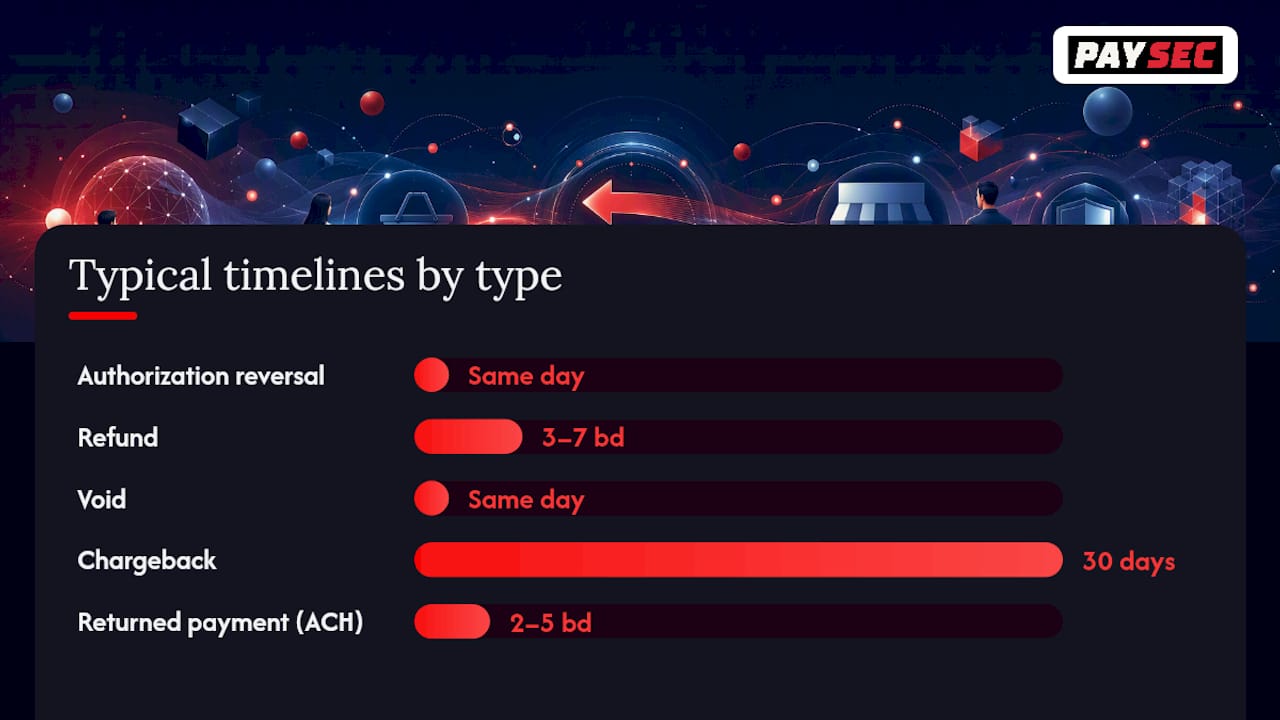
A void is essentially an authorization reversal processed before the batch closes. A returned payment is specific to ACH transactions and carries its own return codes (R01 for insufficient funds, R02 for closed account, and so on). Neither voids nor ACH returns count against your card-network chargeback ratio, but both require prompt reconciliation to avoid duplicate charges or fulfillment errors.
Why do payment reversals happen? The most common causes
Understanding the root cause is the fastest way to stop a reversal from repeating.
-
Fraud (stolen card use). A cardholder disputes a transaction they did not authorize. This is the most common chargeback reason code across Visa and Mastercard. Mitigation: enable AVS and CVV verification at checkout, and flag orders with mismatched billing/shipping addresses for manual review.
-
Merchant error. Duplicate charges, incorrect amounts, or wrong currency codes. A restaurant that runs a card twice during a busy shift or an eCommerce site with a checkout bug that submits two orders will see these. Mitigation: audit your POS and checkout flow for duplicate-submission vulnerabilities.
-
Product non-delivery. The cardholder paid but never received the goods or service. Common in eCommerce and digital goods. Mitigation: send tracking numbers immediately and require signature confirmation on high-value shipments.
-
Subscription and recurring billing issues. A cardholder forgot they subscribed, or the merchant failed to send a pre-charge notice. Mitigation: send a reminder email 3–5 days before each recurring charge and make cancellation easy to find.
-
Descriptor confusion. The billing descriptor on the cardholder's statement does not match the business name they recognize. A cardholder who sees "PMNT SVC 8885551234" instead of "Main Street Café" will call their bank. Mitigation: set a clear, recognizable descriptor that includes your trade name and a customer service number.
-
Friendly fraud. The cardholder received the goods or service but disputes the charge anyway. This is a growing problem in eCommerce and digital goods. Mitigation: collect delivery confirmation, IP address at purchase, and signed terms of service for digital products.
-
ACH return reasons. ACH payments can be returned for insufficient funds (R01), closed accounts (R02), unauthorized debits (R10), and more. Each return code has a specific cure path. Mitigation: verify account and routing numbers at enrollment and use micro-deposit verification for new ACH customers.
How to prevent reversals before they start
Prevention is cheaper than representment. Work through this checklist before your next billing cycle.
-
Set a clear, recognizable billing descriptor. Your descriptor should include your trade name (not a parent entity name) and a phone number or URL. Example: "MAINSTCAFE.COM 888-555-0100." Card networks allow up to 22 characters for the soft descriptor.
-
Publish and enforce a written refund and cancellation policy. Post it on your checkout page, in your order confirmation email, and on your receipts. A customer who can find your policy and request a refund directly is far less likely to call their bank. Platform models like Epic Games' refund policy show how defined eligibility windows and self-service paths reduce disputes by giving customers a fast resolution before they escalate.
-
Enable AVS and CVV checks at every card-present and card-not-present transaction. These controls do not guarantee fraud prevention, but they shift liability and generate evidence you can use in representment.
-
Require signed authorization for recurring charges. For subscription or installment billing, keep a signed or digitally accepted authorization on file. This is the primary document Visa and Mastercard expect when a cardholder disputes a recurring charge.
-
Audit your checkout for duplicate-submission vulnerabilities. A slow page load that lets a customer click "Pay" twice is a common source of duplicate charges. Add a server-side idempotency key to prevent double processing.
-
Send proactive communication. Ship confirmation with tracking, pre-charge reminders for subscriptions, and delivery confirmation emails all reduce the information gap that drives disputes.
-
Monitor your chargeback ratio weekly. Set an internal alert before you hit network thresholds. Catching a spike early gives you time to identify the cause and fix it before your processor flags the account.
Pro Tip: Issue a refund before the chargeback window opens whenever a customer complaint is legitimate. A documented refund submitted in a timely second presentment generally resolves the disputed amount in the acquirer's favor under Mastercard's rules. Waiting too long removes that option.
What to do when a reversal or chargeback arrives
Speed and documentation quality determine whether you win or lose a dispute. Follow this sequence.
-
Identify the reversal type within 24 hours. Check your processor dashboard or acquirer portal. An authorization reversal requires no response. A refund may need a confirmation record. A chargeback requires a formal response.
-
Freeze related fulfillment. If a chargeback arrives on an order that has not yet shipped, hold it. Shipping into an active dispute adds cost without improving your position.
-
Collect your evidence package. The chargeback process guide from Solidgate outlines the core documents: original transaction receipt, shipping/tracking confirmation with delivery proof, customer communication logs, IP address and device fingerprint data, AVS/CVV match results, and signed authorization for recurring charges. Gather all of it before you write a single word of your rebuttal.
-
Review the reason code. Visa and Mastercard reason codes tell you exactly what the cardholder claimed. Your evidence must directly contradict that claim. Submitting irrelevant documents is one of the most common reasons merchants lose representments they should win.
-
Include documented refunds in your second presentment. If you already issued a refund before the chargeback arrived, that documentation must appear in your second presentment. Per Mastercard's network rules, a properly documented refund processed before second presentment generally resolves the dispute in the acquirer's favor. Failing to include it can leave your acquirer liable for fees.
-
Track the outcome and update your records. Win or lose, log the reason code, the evidence submitted, and the result. That data helps you spot patterns and improve prevention.
Common representment mistakes:
- Submitting a rebuttal letter without supporting documents
- Missing the response deadline by even one day
- Failing to address the specific reason code claim
- Not documenting a refund that was already issued
Merchants who build structured dispute workflows with automation and prebuilt evidence templates reduce representment cycle time and improve recovery rates. Manual processes slow response time and increase error rates.
How reversals affect your merchant account financially
The cost of a single chargeback is almost always higher than the original transaction value.
Direct costs per chargeback incident:
- Lost sale revenue (the transaction amount is debited)
- Chargeback fee from your processor (typically $20–$100 per incident)
- Cost of goods already shipped or services already delivered
- Representment cost (staff time or third-party dispute management fees)
Indirect and systemic costs:
- Interchange fees from the original sale are not refunded
- A rising chargeback ratio can trigger a reserve requirement, where your processor holds a percentage of your daily volume as a cash buffer
- Sustained high ratios can result in account termination and placement on the MATCH list (Member Alert to Control High-Risk Merchants), which makes it difficult to open a new merchant account
Chargeback ratio threshold: Visa's standard monitoring program flags merchants whose dispute rate exceeds 0.9% of monthly transactions. Mastercard's threshold is 1.0%. Exceeding these levels for multiple consecutive months can result in fines and mandatory remediation programs.
Metrics to monitor monthly:
- Chargeback ratio (chargebacks divided by total transactions)
- Dispute rate by payment method (card vs. ACH vs. wallet)
- Reversal trend by reason code (are fraud disputes rising? Subscription disputes?)
- Refund rate as a leading indicator (a spike in refunds often precedes a chargeback spike)
Tracking these through real-time payment reporting dashboards gives you the visibility to act before a ratio problem becomes an account problem.
How reversal rules differ by payment method
The reversal process is not the same across every payment rail. Knowing the differences helps you set the right controls per channel.
| Payment rail | Typical reversal timeline | Common evidence needed | Immediate merchant action |
|---|---|---|---|
| Visa/Mastercard credit | 30 days (full cycle) | Receipt, tracking, communications, AVS/CVV | Respond within network window; submit representment |
| Debit card (PIN/signature) | 30 days (same network rules) | Same as credit card | Same representment path |
| ACH | 2–5 business days (most return codes) | Original authorization, account verification | Reconcile return code; re-present if authorized |
| Digital wallets (Google Pay, Apple Pay) | Platform-dependent; often 3–7 days | Platform transaction ID, delivery proof | Follow platform refund workflow first |
| Marketplace/platform rails | Per platform policy | Platform order record, communications | Use platform dispute portal before card-network escalation |
Card networks (Visa and Mastercard) follow the most structured process: reason codes, defined representment windows, and a pre-arbitration stage before the case goes to the network for a final ruling. Most disputes resolve at the first or second presentment stage.
ACH returns move faster for some codes. An R01 (insufficient funds) return typically posts within two business days. An R10 (unauthorized debit) can arrive up to 60 days after the settlement date, which makes recurring ACH billing particularly vulnerable if authorization records are not airtight.
Digital wallet transactions processed through Google Pay or Apple Pay still run on the underlying card network, so the chargeback rules of the issuing card apply. However, platform-level refunds through Google Payments Center can be temporarily blocked during periodic profile reviews, with refund capability typically restored within roughly 24 hours. Knowing this prevents unnecessary escalation when a refund does not process immediately.
Platform and marketplace rails (including in-app purchases through Apple or Epic Games) have their own refund eligibility windows and self-service paths. Apple's refund process runs through reportaproblem.apple.com, and Epic Games' refund policy defines specific eligibility windows and distinguishes between self-service and support-assisted refunds. Merchants selling digital goods through these platforms should align their own cancellation policies with platform rules to avoid double-dispute scenarios where a customer gets a platform refund and then files a card-network chargeback.
For merchants in property management or similar sectors, industry-specific chargeback reduction resources offer practical playbooks tailored to their transaction patterns.
The prevention-first mindset most merchants adopt too late
Most merchants treat chargebacks as a billing problem. They are actually an operations problem.
The merchants who keep dispute rates well below network thresholds share one habit: they audit their reversal data by reason code every month and trace each code back to a specific process failure. A cluster of "product not received" codes points to a fulfillment or tracking gap. A cluster of "unrecognized transaction" codes points to a descriptor problem. The fix is almost always upstream, not in the representment letter.
The 48-to-72-hour internal audit worth running right now:
- Pull your last 90 days of chargebacks and group them by reason code.
- Check your billing descriptor on a test transaction. Does it match your trade name?
- Confirm your refund policy is visible on your checkout page and in your order confirmation email.
- Verify that recurring billing authorizations are on file for every active subscription.
- Check that your AVS and CVV filters are active and that mismatched results are flagged for review.
That audit takes less than a day and typically surfaces two or three fixable issues that are generating the majority of disputes.
How Paysec helps reduce reversals and manage disputes
Processing fees are one cost of chargebacks. The operational burden is another. Paysec addresses both.
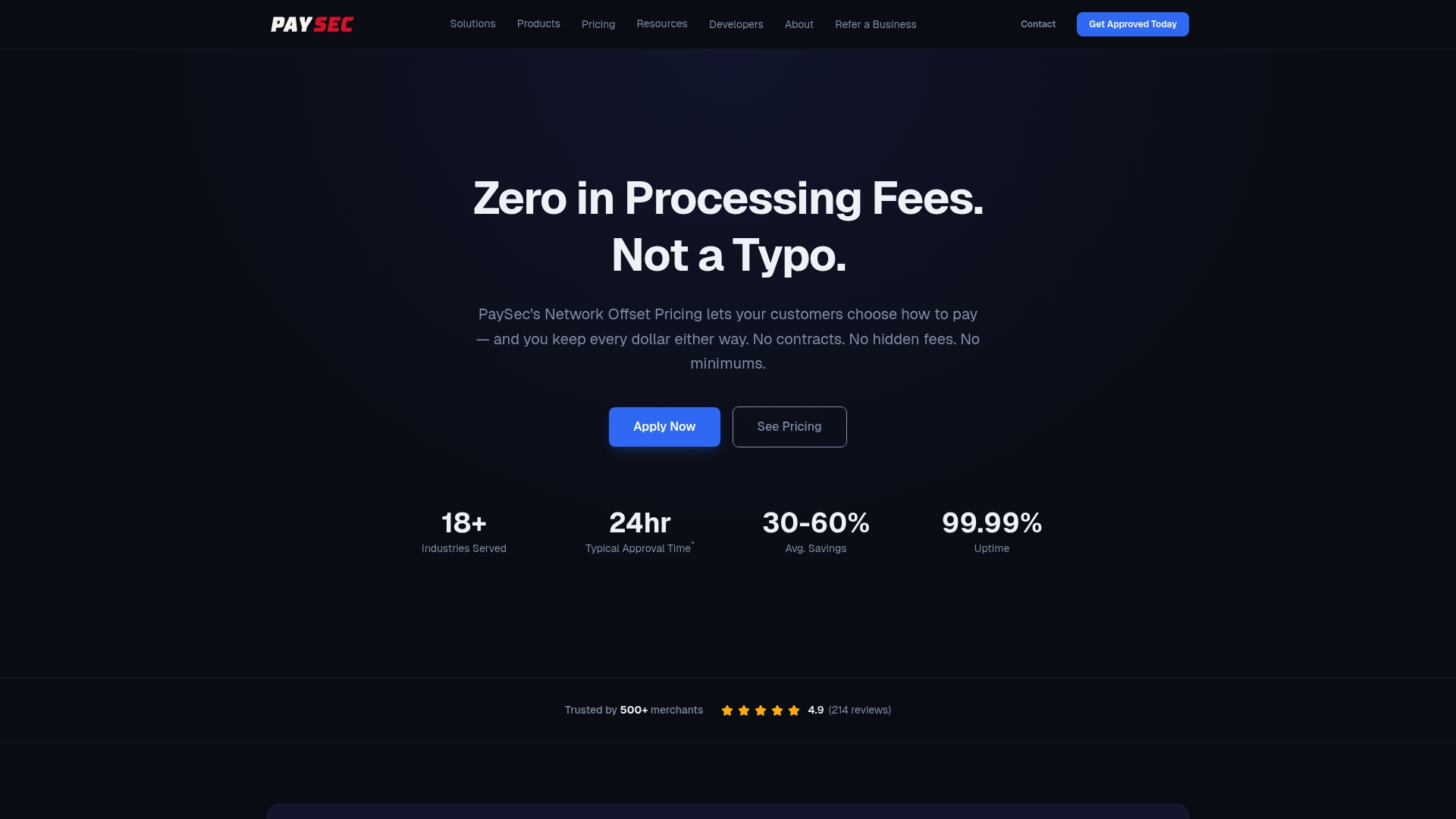
Paysec's Network Offset Pricing keeps your per-transaction costs predictable, so a chargeback fee does not distort your margin calculations. Real-time reporting dashboards surface dispute trends by payment method and reason code before they reach network thresholds. Paysec's chargeback protection services connect merchants to structured dispute workflows and representment support, reducing the manual effort of evidence collection and submission. Descriptor management, clear refund workflows, and PCI DSS Level 1 compliance are built into the platform across all 18+ supported industries. No long-term contracts, no hidden fees. To see how Paysec fits your operation, review the pricing options or contact the team for a direct walkthrough.
Sources
These primary and operational sources support the guidance in this article. Each serves a specific purpose.
- Chargeback Guide Merchant Edition
- Justt: How ZenBusiness scaled dispute management while growing | Merchant Risk Council
- Refund orders - Google payments center help
- Chargeback process: A step-by-step guide for merchants
- Refund policy - Epic Games Store
This article is general information, not a substitute for advice from a qualified financial advisor. Consult a qualified financial professional about your own circumstances before acting on anything here.
FAQ
What does "payment reversal" mean?
A payment reversal is any process that returns funds to a payer after a transaction has been initiated. It covers three distinct mechanisms: authorization reversals (pre-settlement), refunds (merchant-initiated post-settlement), and chargebacks (issuer-initiated disputes).
Is a reversal the same as a refund?
No. A refund is one type of payment reversal, initiated by the merchant after settlement. A chargeback is another type, initiated by the cardholder's bank. Authorization reversals happen before settlement and carry no fees.
How long does a payment reversal take?
Timeline depends on the type. Authorization reversals clear the same day. Refunds typically post to the cardholder within a few business days. A full chargeback cycle, from dispute filing through representment and resolution, can run several weeks to a few months depending on the card network and case specifics.
Why did a reversal appear on my merchant account?
The most common causes are unauthorized card use (fraud), a cardholder dispute over non-delivery or product quality, a duplicate charge, or a subscription the cardholder did not recognize. Reviewing the chargeback reason code your processor provides will identify the specific claim.
Can a merchant win a chargeback dispute?
Yes. Merchants who submit a complete evidence package, including delivery confirmation, signed authorization, and customer communications, within the network's response window win a meaningful share of representments. Structured workflows and prebuilt evidence templates, as documented in the Merchant Risk Council's operational guidance, improve recovery rates.